
 A SCHOLARLY BOOK REPOSITORY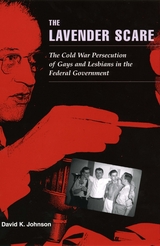
Historian David K. Johnson here relates the frightening, untold story of how, during the Cold War, homosexuals were considered as dangerous a threat to national security as Communists. Charges that the Roosevelt and Truman administrations were havens for homosexuals proved a potent political weapon, sparking a "Lavender Scare" more vehement and long-lasting than McCarthy's Red Scare. Relying on newly declassified documents, years of research in the records of the National Archives and the FBI, and interviews with former civil servants, Johnson recreates the vibrant gay subculture that flourished in New Deal-era Washington and takes us inside the security interrogation rooms where thousands of Americans were questioned about their sex lives. The homosexual purges ended promising careers, ruined lives, and pushed many to suicide. But, as Johnson also shows, the purges brought victims together to protest their treatment, helping launch a new civil rights struggle.
The Lavender Scare shatters the myth that homosexuality has only recently become a national political issue, changing the way we think about both the McCarthy era and the origins of the gay rights movement. And perhaps just as importantly, this book is a cautionary tale, reminding us of how acts taken by the government in the name of "national security" during the Cold War resulted in the infringement of the civil liberties of thousands of Americans.
Bron Taylor unites theoretical and applied social science to analyze a salient contemporary moral and political problem. Three decades after the passage of civil rights laws, criteria for hiring and promotion to redress past discrimination and the sensitive “quota” question are still unresolved issues.
Taylor reviews the works of prominent social scientists and philosophers on the moral and legal principles underlying affirmative action, and examines them in light of his own empirical study. Using participant observation, in-depth interviewing, and a detailed questionnaire, he examines the attitudes of four groups in the California Department of Parks and Recreation: male and female, white and nonwhite workers. Because the department has implemented a strong program for ten years, its employees have had firsthand experience with affirmative action. Their views about the rights of minorities in the economy are often surprising.
This work presents a comprehensive picture of the cross-pressures-the racial fears and antagonisms, the moral, ethical, and religious views about fairness and opportunity, the rigid ideas-that guide popular attitudes.

Weixing, or “surname guessing,” was a highly organized lottery practice in China wherein money was bet on the surnames of which candidates would pass the civil and military examinations. For centuries, up until 1905, the examination system was the primary means by which the Chinese state selected new officials from all over the empire and a way for commoners to climb the social ladder.
How was betting on the examinations possible and why did it matter? Opening with a weixing-related examination scandal in 1885, En Li reconstructs the inner mechanisms of weixing and other lottery games in the southern province of Guangdong. By placing the history of the lottery in a larger context, the author traces a series of institutional revenue innovations surrounding lottery regulation from the 1850s to the early 1900s, and depicts an expansive community created by the lottery with cultural and informational channels stretching among Guangdong, Southeast Asia, and North America. This book sheds light on a new reality that emerged during the final decades of China’s last imperial dynasty, with a nuanced understanding of competitions, strategic thinking by lottery players and public officials seeking to maximize revenues, and a global network of players.
Weixing, or “surname guessing,” was a highly organized lottery practice in China wherein money was bet on the surnames of which candidates would pass the civil and military examinations. For centuries, up until 1905, the examination system was the primary means by which the Chinese state selected new officials from all over the empire and a way for commoners to climb the social ladder.
How was betting on the examinations possible and why did it matter? Opening with a weixing-related examination scandal in 1885, En Li reconstructs the inner mechanisms of weixing and other lottery games in the southern province of Guangdong. By placing the history of the lottery in a larger context, the author traces a series of institutional revenue innovations surrounding lottery regulation from the 1850s to the early 1900s, and depicts an expansive community created by the lottery with cultural and informational channels stretching among Guangdong, Southeast Asia, and North America. This book sheds light on a new reality that emerged during the final decades of China’s last imperial dynasty, with a nuanced understanding of competitions, strategic thinking by lottery players and public officials seeking to maximize revenues, and a global network of players.
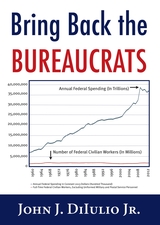
In Bring Back the Bureaucrats, John J. DiIulio Jr., one of America’s most respected political scientists and an adviser to presidents in both parties, summons the facts and statistics to show us how America’s big government works and why reforms that include adding a million more people to the federal workforce by 2035 might help to slow government’s growth while improving its performance.
Starting from the underreported reality that the size of the federal workforce hasn’t increased since the early 1960s, even though the federal budget has skyrocketed. The number of federal programs has ballooned; Bring Back the Bureaucrats tells us what our elected leaders won’t: there are not enough federal workers to work for our democracy effectively.
DiIulio reveals that the government in America is Leviathan by Proxy, a grotesque form of debt-financed big government that guarantees terrible government. Washington relies on state and local governments, for-profit firms, and nonprofit organizations to implement federal policies and programs. Big-city mayors, defense industry contractors, nonprofit executives, and other national proxies lobby incessantly for more federal spending. This proxy system chokes on chores such as cleaning up toxic waste sites, caring for hospitalized veterans, collecting taxes, handling plutonium, and policing more than $100 billion annually in “improper payments.” The lack of competent, well-trained federal civil servants resulted in the failed federal response to Hurricane Katrina and the troubled launch of Obamacare’s “health exchanges.”
Bring Back the Bureaucrats is further distinguished by the presence of E. J. Dionne Jr. and Charles Murray, two of the most astute voices from the political left and right, respectively, who offer their candid responses to DiIulio at the end of the book.
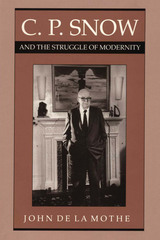
The condition of modernity springs from that tension between science and the humanities that had its roots in the Enlightenment but reached its full flowering with the rise of twentieth-century technology. It manifests itself most notably in the crisis of individuality that is generated by the nexus of science, literature, and politics, one that challenges each of us to find a way of balancing our personal identities between our public and private selves in an otherwise estranging world. This challenge, which can only be expressed as "the struggle of modernity," perhaps finds no better expression than in C. P. Snow. In his career as novelist, scientist, and civil servant, C. P. Snow (1905-1980) attempted to bridge the disparate worlds of modern science and the humanities.
While Snow is often regarded as a late-Victorian liberal who has little to say about the modernist period in which he lived and wrote, de la Mothe challenges this judgment, reassessing Snow's place in twentieth-century thought. He argues that Snow's life and writings—most notably his Strangers and Brothers sequence of novels and his provocative thesis in The Two Cultures and the Scientific Revolution—reflect a persistent struggle with the nature of modernity. They manifest Snow's belief that science and technology were at the center of modern life.

Replete with practical advice for anyone considering a career in federal, state, or local government, Caught between the Dog and the Fireplug, or How to Survive Public Service conveys what life is really like in a public service job. The book is written as a series of lively, entertaining letters of advice from a sympathetic uncle to a niece or nephew embarking on a government career.
Kenneth Ashworth draws on more than forty years of public sector experience to provide advice on the daily challenges that future public servants can expect to face: working with politicians, bureaucracy, and the press; dealing with unpleasant and difficult people; leading supervisors as well as subordinates; and maintaining high ethical standards. Ashworth relates anecdotes from his jobs in Texas, California, and Washington, D.C., that illustrate with humor and wit fundamental concepts of public administration.
Be prepared, says Ashworth, to encounter all sorts of unexpected situations, from the hostile to the bizarre, from the intimidating to the outrageous. He shows that in the confrontational world of public policymaking and program implementation, a successful career demands disciplined, informed thought, intellectual and personal growth, and broad reading. He demonstrates how, despite the inevitable inefficiencies of a democratic society, those working to shape policy in large organizations can nonetheless effect significant change-and even have fun along the way.
The book will interest students and teachers of public administration, public affairs, policy development, leadership, or higher education administration. Ashworth's advice will also appeal to anyone who has ever been caught in a tight spot while working in government service.
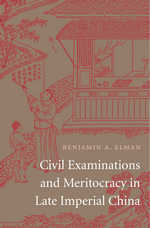
During China's late imperial period (roughly 1400-1900 CE), men would gather by the millions every two or three years outside official examination compounds sprinkled across China. Only one percent of candidates would complete the academic regimen that would earn them a post in the administrative bureaucracy. Civil Examinations assesses the role of education, examination, and China's civil service in fostering the world's first professional class based on demonstrated knowledge and skill.
While millions of men dreamed of the worldly advancement an imperial education promised, many more wondered what went on inside the prestigious walled-off examination compounds. As Benjamin A. Elman reveals, what occurred was the weaving of a complex social web. Civil examinations had been instituted in China as early as the seventh century CE, but in the Ming and Qing eras they were the nexus linking the intellectual, political, and economic life of imperial China. Local elites and members of the court sought to influence how the government regulated the classical curriculum and selected civil officials. As a guarantor of educational merit, civil examinations served to tie the dynasty to the privileged gentry and literati classes--both ideologically and institutionally.
China did away with its classical examination system in 1905. But this carefully balanced and constantly contested piece of social engineering, worked out over the course of centuries, was an early harbinger of the meritocratic regime of college boards and other entrance exams that undergirds higher education in much of the world today.
Between the sixth and twentieth centuries, the civil service examinations created and maintained political coherence across the Chinese polity. Preparation for the examinations transformed the lives of literate elites by defining educational standards and disseminating a language that determined elite status. However, as participation in the examinations became central to that status, an intense competition to determine the educational curriculum and the subject matter of the examinations erupted between intellectual and political rivals. The principal goal of this book is to explain the restructuring of the examination field during a critical point in its history, the Southern Song dynasty (1127-1279), which witnessed the increasing domination of the examinations by the Neo-Confucian Learning of the Way movement.
By analyzing textbooks, examination questions and essays, and official and private commentary, Hilde De Weerdt examines how occupational, political, and intellectual groups shaped curricular standards and examination criteria and how examination standards in turn shaped political and intellectual agendas. These questions reframe the debate about the civil service examinations and their place in the imperial order.
What is colonialism and what is a colonial state? Ranajit Guha points out that the colonial state in South Asia was fundamentally different from the metropolitan bourgeois state which sired it. The metropolitan state was hegemonic in character, and its claim to dominance was based on a power relation in which persuasion outweighed coercion. Conversely, the colonial state was non-hegemonic, and in its structure of dominance coercion was paramount. Indeed, the originality of the South Asian colonial state lay precisely in this difference: a historical paradox, it was an autocracy set up and sustained in the East by the foremost democracy of the Western world. It was not possible for that non-hegemonic state to assimilate the civil society of the colonized to itself. Thus the colonial state, as Guha defines it in this closely argued work, was a paradox--a dominance without hegemony.
Dominance without Hegemony had a nationalist aspect as well. This arose from a structural split between the elite and subaltern domains of politics, and the consequent failure of the Indian bourgeoisie to integrate vast areas of the life and consciousness of the people into an alternative hegemony. That predicament is discussed in terms of the nationalist project of anticipating power by mobilizing the masses and producing an alternative historiography. In both endeavors the elite claimed to speak for the people constituted as a nation and sought to challenge the pretensions of an alien regime to represent the colonized. A rivalry between an aspirant to power and its incumbent, this was in essence a contest for hegemony.
Stories of government management failures often make the headlines, but quietly much gets done as well. What makes the difference? Ira Goldstein offers wisdom about how to lead and succeed in the federal realm, even during periods when the political climate is intensely negative, based on his decades of experience as a senior executive at two major government consulting firms and as a member of the US federal government's Senior Executive Service.
The Federal Management Playbook coaches the importance of always keeping four key concepts in mind when planning for success: goals, stakeholders, resources, and time frames. Its chapters address how to effectively motivate government employees, pick the right technologies, communicate and negotiate with powerful stakeholders, manage risks, get value from contractors, foster innovation, and more. Goldstein makes lessons easy to apply by breaking each chapter’s plans into three strategic phases: create an offensive strategy, execute your plan effectively, and play a smart defense. Additional tips describe how career civil servants and political appointees can get the most from one another, advise consultants on providing value to government, and help everyone better manage ever-present oversight.
The Federal Management Playbook is a must-read for anyone working in the government realm and for students who aspire to public service.
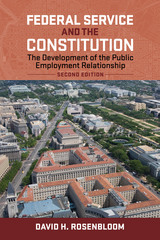
Conceived during the turbulent period of the late 1960s when ‘rights talk’ was ubiquitous, Federal Service and the Constitution, a landmark study first published in 1971, strove to understand how the rights of federal civil servants had become so differentiated from those of ordinary citizens. Now in a new, second edition, this legal–historical analysis reviews and enlarges its look at the constitutional rights of federal employees from the nation's founding to the present.
Thoroughly revised and updated, this highly readable history of the constitutional relationship between federal employees and the government describes how the changing political, administrative, and institutional concepts of what the federal service is or should be are related to the development of constitutional doctrines defining federal employees’ constitutional rights. Developments in society since 1971 have dramatically changed the federal bureaucracy, protecting and expanding employment rights, while at the same time Supreme Court decisions are eroding the special legal status of federal employees. Looking at the current status of these constitutional rights, Rosenbloom concludes by suggesting that recent Supreme Court decisions may reflect a shift to a model based on private sector practices.
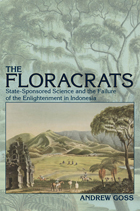
Situated along the line that divides the rich ecologies of Asia and Australia, the Indonesian archipelago is a hotbed for scientific exploration, and scientists from around the world have made key discoveries there. But why do the names of Indonesia’s own scientists rarely appear in the annals of scientific history? In The Floracrats Andrew Goss examines the professional lives of Indonesian naturalists and biologists, to show what happens to science when a powerful state becomes its greatest, and indeed only, patron.
With only one purse to pay for research, Indonesia’s scientists followed a state agenda focused mainly on exploiting the country’s most valuable natural resources—above all its major export crops: quinine, sugar, coffee, tea, rubber, and indigo. The result was a class of botanic bureaucrats that Goss dubs the “floracrats.” Drawing on archives and oral histories, he shows how these scientists strove for the Enlightenment ideal of objective, universal, and useful knowledge, even as they betrayed that ideal by failing to share scientific knowledge with the general public. With each chapter, Goss details the phases of power and the personalities in Indonesia that have struggled with this dilemma, from the early colonial era, through independence, to the modern Indonesian state. Goss shows just how limiting dependence on an all-powerful state can be for a scientific community, no matter how idealistic its individual scientists may be.
The creation and preservation of capable states is a lengthy, laborious, and multifaceted process, fraught with opportunities for failure and misspent resources. It requires time, commitment, innovative ideas, consensus building, new rules of the game, efficient design and resource allocation in technical assistance, and considerable good luck. By the mid-1990s, the imperative to improve government performance had been added to the development agenda precisely because of greater awareness that neither markets nor democracies could function well--or perhaps function at all--unless governments' efficiency, effectiveness, and responsiveness are improved.
This publication seeks to help understand how governments can be encouraged to perform better and how state capabilities can be developed in ways that allow markets and democracies to flourish. The contributors draw comparative lessons from specific efforts designed to enhance human resource development in the public sector, to strengthen organizations that contribute to the public purpose of government, and to reform the institutions that set the rules for economic and political interaction.
Getting Good Government will be of interest not only to public officials and public management and policy analysts, but also to political scientists and international development specialists.
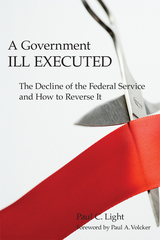
The federal government is having increasing difficulty faithfully executing the laws, which is what Alexander Hamilton called “the true test” of a good government. This book diagnoses the symptoms, explains their general causes, and proposes ways to improve the effectiveness of the federal government. Employing Hamilton’s seven measures of an energetic federal service, Paul Light shows how the government is wanting in each measure.
After assessing the federal report card, Light offers a comprehensive agenda for reform, including new laws limiting the number of political appointees, reducing the layers of government management, reducing the size of government as its Baby Boom employees retire, revitalizing the federal career, and reducing the heavy outsourcing of federal work. Although there are many ways to fix each of the seven problems with government, only a comprehensive agenda will bring the kind of reform needed to reverse the overall erosion of the capacity to faithfully execute all the laws.
Every time control of the U.S. presidency is passed from one party to another, the entire top layer of the executive branch changes. Thousands of men and women take down their pictures, pack up their desks, and move back into private life, just as others dust off their pictures and move in. The U.S. stands alone in this respect. Nearly every other advanced democracy is managed-save for elected officials and a few top aides-by an elite cadre of top civil servants selected by highly competitive examinations.
Hudleston and Boyer tell the story of U.S. efforts to develop higher civil service, beginning with the Eisenhower administration and culminating in the passage of the Civil Service Reform Act of 1978. Arguing that the highly-politicized U.S. system simply hasn't worked, they examine why and how reform efforts have failed and offer a series of recommendations for the future.
Patronage systems in the public service are universally reviled as undemocratic and corrupt. Yet patronage was the prevailing method of staffing government for centuries, and in some countries it still is. In Jobs for the Boys, Merilee Grindle considers why patronage has been so ubiquitous in history and explores the political processes through which it is replaced by merit-based civil service systems. Such reforms are consistently resisted, she finds, because patronage systems, though capricious, offer political executives flexibility to achieve a wide variety of objectives.
Grindle looks at the histories of public sector reform in six developed countries and compares them with contemporary struggles for reform in four Latin American countries. A historical, case-based approach allows her to take into account contextual differences between countries as well as to identify cycles that govern reform across the board. As a rule, she finds, transition to merit-based systems involves years and sometimes decades of conflict and compromise with supporters of patronage, as new systems of public service are politically constructed. Becoming aware of the limitations of public sector reform, Grindle hopes, will temper expectations for institutional change now being undertaken.
In The Lavender Scare, David K. Johnson tells the frightening story of how, during the Cold War, homosexuals were considered as dangerous a threat to national security as Communists. Charges that the Roosevelt and Truman administrations were havens for homosexuals proved a potent political weapon, sparking a “Lavender Scare” more vehement and long-lasting than Joseph McCarthy’s Red Scare. Drawing on declassified documents, years of research in the records of the National Archives and the FBI, and interviews with former civil servants, Johnson recreates the vibrant gay subculture that flourished in midcentury Washington and takes us inside the security interrogation rooms where anti-homosexual purges ruined the lives and careers of thousands of Americans. This enlarged edition of Johnson’s classic work of history—the winner of numerous awards and the basis for an acclaimed documentary broadcast on PBS—features a new epilogue, bringing the still-relevant story into the twenty-first century.
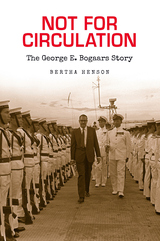
Do civil servants make a difference? Can they shape history? In 1985 when John Drysdale published one of the first books on the political history of independent Singapore, George E. Bogaars wrote to his daughter with typical understatement, “I feature in it a bit.” Bogaars headed the special branch at the time of Operation Cold Store. He reported directly to pioneer leaders such as Lee Kuan Yew and Goh Keng Swee before they became political icons. He started the Singapore Armed Forces from scratch when he was Permanent Secretary of the Interior and Defence. He was the head of the civil service, involved in a dozen or so government-linked companies attempting to shore up the country’s infrastructure, and expand its business portfolio. He held the country’s purse strings when he moved into the finance ministry before his retirement at the age of fifty-five. His impressive resume belies a colorful, flamboyant character with a wicked sense of humor. Veteran Singaporean journalist Bertha Henson tells his story.
In recent years, Western bureaucracies have continued to expand, but are citizens better served? In this volume, sixteen contributors analyze the problems of government organization, both in individual cases and in a broader comparative context.
Contributors: Joel D. Aberbach; Peter Aucoin; Richard A. Chapman; Michael G. Hansen; Peter Hennessy; Brian W. Hogwood; Mohammad Mohabbat Kahn; Ulrich Klöti; Charles H. Levine; Johan P. Olsen; Bert A. Rockman; Richard Rose; Norman C. Thomas; John Warhurst; and the editors.
Public-service executives, both elected and appointed within the public and nonprofit sectors, are retiring at record levels, and the number of Americans reaching age sixty-five annually will continue to rise over the next decade and is expected to surpass four million in 2020. Finding qualified, motivated leaders to fill vital public-service positions will challenge the public and nonprofit sectors.
Unfortunately, recent studies show that few proactive steps are being taken by public-service organizations to plan for the next generation. Passing the Torch: Planning for the Next Generation of Public-Service Leaders provides an outline for those who will be facing and managing these looming changes.
In this valuable guide, the factors that influence selection of a career in public service are explored through the authors’ years of experience as leaders in public-service organizations and through interviews with other public-service professionals. Passing the Torch will be essential for leaders of nonprofit organizations, university faculty, researchers in the field of nonprofit management, and students in nonprofit management courses.
The Qing dynasty office purchase system (juanna), which allowed individuals to pay for appointments in the government, was regarded in traditional Chinese historiography as an inherently corrupt and anti-meritocratic practice. It enabled participants to become civil and military officials while avoiding the competitive government-run examination systems.
Lawrence Zhang’s groundbreaking study of a broad selection of new archival and other printed evidence—including a list of over 10,900 purchasers of offices from 1798 and narratives of purchase—contradicts this widely held assessment and investigates how observers and critics of the system, past and present, have informed this questionable negative view. The author argues that, rather than seeing office purchase as a last resort for those who failed to obtain official appointments via other means, it was a preferred method for wealthy and well-connected individuals to leverage their social capital to the fullest extent. Office purchase was thus not only a useful device that raised funds for the state, but also a political tool that, through literal investments in their positions and their potential to secure status and power, tied the interests of official elites ever more closely to those of the state.
The Qing dynasty office purchase system (juanna), which allowed individuals to pay for appointments in the government, was regarded in traditional Chinese historiography as an inherently corrupt and anti-meritocratic practice. It enabled participants to become civil and military officials while avoiding the competitive government-run examination systems.
Lawrence Zhang’s groundbreaking study of a broad selection of new archival and other printed evidence—including a list of over 10,900 purchasers of offices from 1798 and narratives of purchase—contradicts this widely held assessment and investigates how observers and critics of the system, past and present, have informed this questionable negative view. The author argues that, rather than seeing office purchase as a last resort for those who failed to obtain official appointments via other means, it was a preferred method for wealthy and well-connected individuals to leverage their social capital to the fullest extent. Office purchase was thus not only a useful device that raised funds for the state, but also a political tool that, through literal investments in their positions and their potential to secure status and power, tied the interests of official elites ever more closely to those of the state.
Throughout Britain, Civil Servants are exposed to public scrutiny today in unprecedented ways. What does it mean that the political neutrality of the Civil Service has only been enshrined in law since 2010, nearly 150 years after it was first proposed? Why is it so important for politicians to trust Civil Servants (and what difficulties arise when they do not)?
Coauthored by former First Civil Service Commissioner David Normington and historian Peter Hennessy, The Power of Whitehall provides answers through rich observations about the nature of the British Civil Service, its values and effectiveness, and how it should continue to adapt to a changing world.
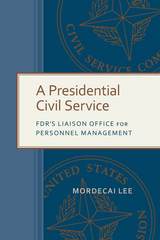
A Presidential Civil Service offers a comprehensive and definitive study of President Franklin Delano Roosevelt’s Liaison Office for Personnel Management (LOPM). Established in 1939 following the release of Roosevelt’s Brownlow Committee report, LOPM became a key milestone in the evolution of the contemporary executive-focused civil service.
The Progressive Movement of the nineteenth and early twentieth centuries comprised groups across the political spectrum with quite different. All, however, agreed on the need for a politically autonomous and independent federal Civil Service Commission (CSC) to eliminate patronage and political favoritism. In A Presidential Civil Service, public administration scholar Mordecai Lee explores two models open to later reformers: continuing a merit-based system isolated from politics or a management-based system subordinated to the executive and grounded in the growing field of managerial science.
Roosevelt’s 1937 Brownlow Committee, formally known as the President’s Committee on Administrative Management, has been widely studied including its recommendation to disband the CSC and replace it with a presidential personnel director. What has never been documented in detail was Roosevelt’s effort to implement that recommendation over the objections of Congress by establishing the LOPM as a nonstatutory agency.
The role and existence of LOPM from 1939 to 1945 has been largely dismissed in the history of public administration. Lee’s meticulously researched A Presidential Civil Service, however, persuasively shows that LOPM played a critical role in overseeing personnel policy. It was involved in every major HR initiative before and during World War II. Though small, the agency’s deft leadership almost always succeeded at impelling the CSC to follow its lead.
Roosevelt’s actions were in fact an artful and creative victory, a move finally vindicated when, in 1978, Congress abolished the CSC and replaced it with an Office of Personnel Management headed by a presidential appointee. A Presidential Civil Service offers a fascinating account and vital reassessment of the enduring legacy of Roosevelt’s LOPM.
Contains fourteen essays that examine, through a public policy focus, the 1978 civil service reform and its aftermath. The essays view policy design, implementation, and evaluation, as well as the overall politics of administration and institutional change. An indispensible tool for students of public administration, bureaucratic politics, and personnel policy.
Contributors: Carolyn Ban; John Halligan; Kirke Harper; Mark Huddleston; J. Edward Kellough; Larry M. Lane; Chester A. Newland; James L. Perry; Beryl A. Radin; Robert Vaughn; and the editors.
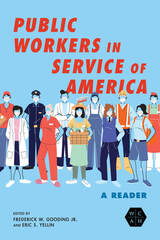
From white-collar executives to mail carriers, public workers meet the needs of the entire nation. Frederick W. Gooding Jr. and Eric S. Yellin edit a collection of new research on this understudied workforce. Part One begins in the late nineteenth- and early twentieth century to explore how questions of race, class, and gender shaped public workers, their workplaces, and their place in American democracy. In Part Two, essayists examine race and gender discrimination while revealing the subtle contemporary forms of marginalization that keep Black men and Black and white women underpaid and overlooked for promotion. The historic labor actions detailed in Part Three illuminate how city employees organized not only for better pay and working conditions but to seek recognition from city officials, the public, and the national labor movement. Part Four focuses on nurses and teachers to address the thorny question of whether certain groups deserve premium pay for their irreplaceable work and sacrifices or if serving the greater good is a reward unto itself.
Contributors: Eileen Boris, Cathleen D. Cahill, Frederick W. Gooding Jr., William P. Jones, Francis Ryan, Jon Shelton, Joseph E. Slater, Katherine Turk, Eric S. Yellin, and Amy Zanoni
"This is unlike any public-policy book I've ever read: part Catcher in the Rye, part The Road to Wigan Pier, part The Federalist Papers, it is mesmerizing, rueful, painfully honest, and never, ever dull."—Nicholas Lemann, author of The Big Test
"Extraordinary. It has the essential trait of a memorable book, in that after reading it you look at daily life in a lastingly different way." —James Fallows, author of Breaking the News
"[Geoghegan] has written a book that is not only compelling to read but that provokes us to seriously reflect on the choices we make and how we spend our time." —Jonathan Coleman, Washington Post Book World
"Geoghegan's language is playful. . . . Personal reminiscence mixing with historical anecdote, dipping into complex themes . . . shifting from wistful nostalgia to dark comedy." —Robert B. Reich, New York Times Book Review
"A truly strange and wonderful book." — William Finnegan
This book explores an important side of public employment that most Americans never get the opportunity to see—high-level career executives who make positive contributions to our quality of life. Norma M. Riccucci profiles six "unsung heroes," the people behind the scenes of some of the most successful programs in American government, and identifies the tools, skills, and strategies that make them effective leaders.
Through in-depth interviews and provocative story-telling, Riccucci demonstrates that while these executive-level bureaucrats—or "execucrats"—may have an overall negative public image, they create, develop, execute, and enforce a number of programs and public policies that change our country for the better. She highlights six of these modern execucrats who best exemplify the creativity, determination, and leadership found in such officials:
—William Black, Senior Deputy Chief Counsel, Office of Thrift Supervision, who attacked the rampant corruption and mismanagement that created the savings and loan crisis;
—Eileen Claussen, Director, Atmospheric and Indoor Air Programs, U.S. Environmental Protection Agency, who negotiated as intensely within her own government as with other countries to create an international plan to protect the earth's ozone layer;
—Ambassador Edward Perkins, U.S. State Department, the first African-American Ambassador to South Africa and the first American ambassador to meet with black South African leaders as part of his persistent efforts to end apartheid in that country;
—Stephen Marica, Assistant Inspector General, Small Business Administration, who investigated the Wedtech scandal, which bilked millions of dollars in fraudulent defense contracts from American taxpayers;
—Dr. Vince Hutchins, Director, Division of Maternal and Child Health, U.S. Department of Health and Human Services, who spearheaded the team that developed "Healthy Mothers, Healthy Babies Coalition," a public-private partnership that improved, and even saved, the lives of thousands of newborn babies; and
—Dr. Helene Gayle, Division Chief, HIV-AIDS Division, U.S. Centers for Disease Control, who is actively battling the AIDS virus through education and prevention programs around the world.
Riccucci not only relates the intriguing tales of these six dedicated officials who overcame the challenges before them, but she also analyzes the specific factors—from knowledge of the system to honesty, integrity, and humor—that are needed to become a dynamic government executive. Of interest to those both inside and outside government circles, Unsung Heroes gives captivating insights into effective executive leadership.
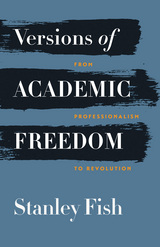
Depending on who’s talking, academic freedom is an essential bulwark of democracy, an absurd fig leaf disguising liberal agendas, or, most often, some in-between muddle that both exaggerates its own importance and misunderstands its actual value to scholarship. Fish enters the fray with his typical clear-eyed, no-nonsense analysis. The crucial question, he says, is located in the phrase “academic freedom” itself: Do you emphasize “academic” or “freedom”? The former, he shows, suggests a limited, professional freedom, while the conception of freedom implied by the latter could expand almost infinitely. Guided by that distinction, Fish analyzes various arguments for the value of academic freedom: Is academic freedom a contribution to society's common good? Does it authorize professors to critique the status quo, both inside and outside the university? Does it license and even require the overturning of all received ideas and policies? Is it an engine of revolution? Are academics inherently different from other professionals? Or is academia just a job, and academic freedom merely a tool for doing that job?
No reader of Fish will be surprised by the deftness with which he dismantles weak arguments, corrects misconceptions, and clarifies muddy arguments. And while his conclusion—that academic freedom is simply a tool, an essential one, for doing a job—may surprise, it is unquestionably bracing. Stripping away the mystifications that obscure academic freedom allows its beneficiaries to concentrate on what they should be doing: following their intellectual interests and furthering scholarship.
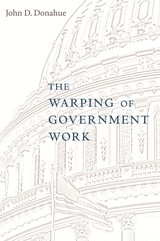
Government has become a refuge, and a relic, of America’s crumbling middle-class economy. As the public and private worlds of work have veered in different directions, the gaps between them are warping government work in unintended ways.
Three decades of economic turbulence have rendered American workplaces more demanding and less secure, more rewarding for high-end workers and punishing for workers without advanced skills. This workplace revolution, however, has largely bypassed government. Public employees—representing roughly one-sixth of the total workforce—still work under the conditions of dampened risk and constrained opportunity that marked most of the economy during the middle-class boom following World War II.
The divergent paths of public and private employment have intensified a long-standing pattern: elite workers spurn public jobs, while less skilled workers cling to government work as a refuge from a harsh private economy. The first trend creates a chronic talent deficit in the public sector. The second trend makes the government workplace rigid and resistant to change. And both contribute to shortfalls in public-sector performance.
The Warping of Government Work documents government’s isolation from the rest of the American economy and arrays the stark choices we confront for narrowing, or accommodating, the divide between public and private work.
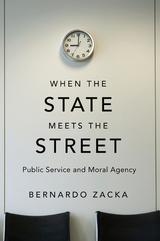
When the State Meets the Street probes the complex moral lives of street-level bureaucrats: the frontline social and welfare workers, police officers, and educators who represent government’s human face to ordinary citizens. Too often dismissed as soulless operators, these workers wield a significant margin of discretion and make decisions that profoundly affect people’s lives. Combining insights from political theory with his own ethnographic fieldwork as a receptionist in an urban antipoverty agency, Bernardo Zacka shows us firsthand the predicament in which these public servants are entangled.
Public policy consists of rules and regulations, but its implementation depends on how street-level bureaucrats interpret them and exercise discretionary judgment. These workers are expected to act as sensible moral agents in a working environment that is notoriously challenging and that conspires against them. Confronted by the pressures of everyday work, they often and unknowingly settle for one of several reductive conceptions of their responsibilities, each by itself pathological in the face of a complex, messy reality. Zacka examines the factors that contribute to this erosion of moral sensibility and what it takes to remain a balanced moral agent in such difficult conditions.
Zacka’s revisionary portrait reveals bureaucratic life as more fluid and ethically fraught than most citizens realize. It invites us to approach the political theory of the democratic state from the bottom-up, thinking not just about what policies the state should adopt but also about how it ought to interact with citizens when implementing these policies.
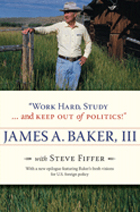
Beginning in 1975 with the Ford administration, in a job procured for him by friend and tennis partner George H. W. Bush, Baker was in the thick of American politics. He recounts the inside story of Ford’s rejection of Reagan as a running mate in 1976 with the same insight he has into Reagan’s rejection of Ford four years later. When the White House was plunged into turmoil after the Reagan assassination attempt, he was there, and his stories take readers deeper into those chaotic days. Baker was on hand for the George H. W. Bush campaign’s battle over running mate Dan Quayle and, more recently, he was again on the front row as George W. Bush fought it out in Florida. Spellbinding and frank, his stories are the ones between the lines of our history books.
In this new edition, Baker also responds for the first time in print to the George W. Bush administration’s reaction to the Iraq Study Group Report, written with his input. Baker is very qualified to comment on the political operation of the current administration, and his new writing for this paperback brings the full weight of his experience to bear.
READERS
Browse our collection.
PUBLISHERS
See BiblioVault's publisher services.
STUDENT SERVICES
Files for college accessibility offices.
RECENTLY PUBLISHED





UChicago Accessibility Resources
home | accessibility | search | about | contact us
BiblioVault ® 2001 - 2024
The University of Chicago Press