
 A SCHOLARLY BOOK REPOSITORY
5 start with F start with F
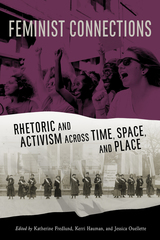
In 1917, Alice Paul and other suffragists famously picketed in front of the White House while holding banners with short, pithy sayings such as “Mr. President: How long must women wait for Liberty?” Their juxtaposition of this short phrase with the image of the White House (a symbol of liberty and justice) relies on the same rhetorical tactics as memes, a genre contemporary feminists use frequently to make arguments about reproductive rights, Black Lives Matter, sex-positivity, and more. Many such connections between feminists of different spaces, places, and eras have yet to be considered, let alone understood. Feminist Connections: Rhetoric and Activism across Time, Space, and Place reconsiders feminist rhetorical strategies as linked, intergenerational, and surprisingly consistent despite the emergence of new forms of media and intersectional considerations.
Contributors to this volume highlight continuities in feminist rhetorical practices that are often invisible to scholars, obscured by time, new media, and wildly different cultural, political, and social contexts. Thus, this collection takes a nonchronological approach to the study of feminist rhetoric, grouping chapters by rhetorical practice rather than time, content, or choice of media.
By connecting historical, contemporary, and future trajectories, this collection develops three feminist rhetorical frameworks: revisionary rhetorics, circulatory rhetorics, and response rhetorics. A theorization of these frameworks explains how feminist rhetorical practices (past and present) rely on similar but diverse methods to create change and fight oppression. Identifying these strategies not only helps us rethink feminist rhetoric from an academic perspective but also allows us to enact feminist activist rhetorics beyond the academy during a time in which feminist scholarship cannot afford to remain behind its hallowed yet insular walls.
Although it is well known in other fields, the concept of “resilience” has not been addressed explicitly by feminist rhetoricians. This collection develops it in readings of rhetorical situations across a range of social contexts and national cultures. Contributors demonstrate that resilience offers an important new conceptual frame for feminist rhetoric, with emphasis on agency, change, and hope in the daily lives of individuals or groups of individuals disempowered by social or material forces. Collectively, these chapters create a robust conception of resilience as a complex rhetorical process, redeeming it from its popular association with individual heroism through an important focus on relationality, community, and an ethics of connection. Resilience, in this volume, is a specifically rhetorical response to complicated forces in individual lives. Through it, Feminist Rhetorical Resilience widens the interpretive space within which rhetoricians can work.
In this book, first published in 1985, Ernest G. Bormann explores mass persuasion in America from 1620 to 1860, examining closely four rhetorical communities: the revivals of 1739–1740, the hot gospel of the postrevolutionary period, the evangelical revival and reform of the 1830s, and the Free Soil and Republican parties. Each community varies greatly, but Bormann asserts that each succeeding community shares a rhetorical vision of restoring the “American Dream” that is essentially a modification of the previous visions. Thus, they form a family of rhetorical visions that constitutes a rhetorical tradition of importance in nineteenth-century American popular culture.
Presented here are four major theories behind the functioning of the world's presses: (1) the Authoritarian theory, which developed in the late Renaissance and was based on the idea that truth is the product of a few wise men; (2) the Libertarian theory, which arose from the works of men like Milton, Locke, Mill, and Jefferson and avowed that the search for truth is one of man's natural rights; (3) the Social Responsibility theory of the modern day: equal radio and television time for political candidates, the obligations of the newspaper in a one-paper town, etc.; (4) the Soviet Communist theory, an expanded and more positive version of the old Authoritarian theory.
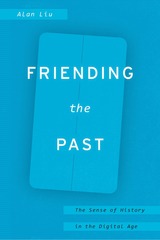
In Friending the Past, Alan Liu proposes fresh answers to these innovative questions of connection. He explores how we can learn from the relationship between past societies whose media forms fostered a communal and self-aware sense of history—such as prehistorical oral societies with robust storytelling cultures, or the great print works of nineteenth-century historicism—and our own instantaneous present. He concludes with a surprising look at how the sense of history exemplified in today’s JavaScript timelines compares to the temporality found in Romantic poetry.
Interlaced among these inquiries, Liu shows how extensive “network archaeologies” can be constructed as novel ways of thinking about our affiliations with time and with each other. These conceptual architectures of period and age are also always media structures, scaffolded with the outlines of what we mean by history. Thinking about our own time, Liu wonders if the digital, networked future can sustain a similar sense of history.
READERS
Browse our collection.
PUBLISHERS
See BiblioVault's publisher services.
STUDENT SERVICES
Files for college accessibility offices.
RECENTLY PUBLISHED



UChicago Accessibility Resources
home | accessibility | search | about | contact us
BiblioVault ® 2001 - 2024
The University of Chicago Press