front cover of We Can Do Better
We Can Do Better
Feminist Manifestos for Media and Communication
Linda Steiner
Rutgers University Press, 2025
Feminist Manifestos for Media and Communication brings together evidence-based manifestos for media and communication that take a feminist perspective and add up to a provocative vision of feminist media practices and of feminist communication. The book discusses critical problems and complaints in ways that identify and make the case for actionable, concrete solutions to media problems and deficiencies; it shows how feminist thinking can be usefully and effectively applied to a wide range of journalism, media, and communication practices. The manifestos are not “only” about women but rather offer specific, feasible blueprints for restructuring media in ways that make them fairer and more equitable along many vectors of identity, so that media can better serve democracy. These manifestos give concrete solutions to specific problems that can and should be implemented by journalists, media practitioners, students, faculty, and scholars. The manifestos are organized around three sets of demands: for better media practices, for more participatory online spaces, and for more precise and appropriate language.


[more]

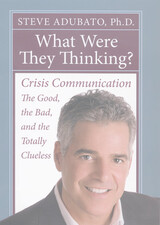
front cover of What Were They Thinking?
What Were They Thinking?
Crisis Communication: The Good, the Bad, and the Totally Clueless
Steve Adubato, Ph.D.
Rutgers University Press, 2008
Some corporations spend millions of dollars on so-called "crisis communication plans." Others offer lip service, avoiding the subject like the plague. They simply hope for the best, praying that they never face a crisis. Either way, as Steve Adubato says, "Wishful thinking is no substitute for a strategic plan."

Nationally recognized communication coach and four-time Emmy Awardûwinning broadcaster Steve Adubato has been teaching, writing, and thinking about comm¡unication, leadership, and crisis communication for nearly two decades. In What Were They Thinking? Adubato examines twenty-two controversial and complex public relations and media mishaps, many of which were played out in public. Among cases and people discussed are:

  • The Johnson & Johnson Tylenol scare: Perhaps the best crisis management ever
  • Don Imus: Sometimes saying "sorry" is too little too late
  • Former Attorney General Alberto Gonzales: Authority does not put you above questioning
  • Bill O'Reilly: Know when to stop defending yourself and save face
  • Former EPA Administrator Christie Whitman: Proof that your written words can come back to haunt you
  • Hurricane Katrina: A natural disaster that led to a larger governmental disaster
  • The Catholic Church's pedophilia scandal: Denial won't get rid of the skeletons in your closet

Arranged in short chapters detailing each case individually, the book provides a brief history of the topics and answers the questions: Who got it right? Who got it wrong? What can the rest of us learn from them?

[more]

logo for University of Illinois Press
Who Can Speak?
AUTHORITY AND CRITICAL IDENTITY
Edited by Judith Roof and Robyn Wiegman
University of Illinois Press, 1995
For women, for lesbians and gays, for African Americans, for Asians, Native Americans, or any other self-identified and -identifying group, who can speak? Who has the authority to speak for these groups? Is there genuinely such a thing as "objectivity," or can only members of these groups speak, finally, for themselves? And who has the authority to decide who has the authority?
This collection examines how theory and criticism are complicated by
multiple perspectives in an increasingly multicultural society and
faces head on the difficult question of what qualifies a critic to speak from or about a particular position. In different formats and from different perspectives from various disciplines, the contributors to this volume analytically and innovatively work together to define the problems and capture the contradictions and tensions inherent in the issues of authority, epistemology, and discourse.
 
[more]

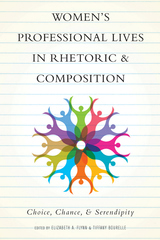
front cover of Women's Professional Lives in Rhetoric and Composition
Women's Professional Lives in Rhetoric and Composition
Choice, Chance, and Serendipity
Edited by Elizabeth A. Flynn and Tiffany Bourelle
The Ohio State University Press, 2018

This collection, edited by Elizabeth A. Flynn and Tiffany Bourelle, contributes to the valuable work of chronicling the professional and personal lives of women in academia. Through its line-up of contributors from diverse backgrounds, locations, and career paths, Women’s Professional Lives in Rhetoric and Composition showcases the voices of multiple scholars occupying a multitude of different roles in the profession: from prestigious professors emeritae and endowed chairs to assistant professors starting their careers to an independent scholar to part-time faculty.
 
 
The collection sets itself apart from other volumes not just in its diversity of perspectives but also by speaking against linear stories of success in the profession—sharing moments of shame and failure, showing how the personal and professional often intertwine and influence one another, and ultimately revealing how choice, chance, serendipity, and kairos have all played a role in the lives of its contributors. In focusing on this convergence, Women’s Professional Lives in Rhetoric and Composition offers a more nuanced picture of the professional and intellectual trajectories of women in rhetoric and composition.
[more]

front cover of Writing Science in Plain English, Second Edition
Writing Science in Plain English, Second Edition
Anne E. Greene
University of Chicago Press, 2025
An updated edition of the essential guide for all scientists—from undergraduates to senior scholars—who want to produce prose that anyone can understand.
 
Scientific writing is often dry, wordy, and difficult to understand. But, as biologist and experienced teacher of scientific writing Anne E. Greene shows in Writing Science in Plain English, writers from all scientific disciplines can learn to produce clear, concise prose by mastering just a few simple principles. This short, focused guide presents roughly a dozen such principles based on what readers need to understand complex information, including concrete subjects, strong verbs, consistent terms, organized paragraphs, and correct sentence structure. Greene illustrates each principle with real-life examples of both good and bad writing and shows how bad writing might be improved. She ends each chapter with revision exercises (and provides suggested answers in a separate key) so that readers can come away with new writing skills after just one sitting. To help readers understand the grammatical terms used in the book, an appendix offers a refresher course on basic grammar.
 
For this second edition, Greene has incorporated the latest research on what makes writing effective and engaging and has revised or replaced exercises and exercise keys where needed. She has also added new features that make it easier to navigate the book. A new resource for instructors who use Writing Science in Plain English in their classes is a free, online teacher’s guide. Drawn from Greene’s long experience teaching students how to write science clearly, the teacher’s guide provides additional lectures, assignments, and activities that will inform and enliven any class.
[more]

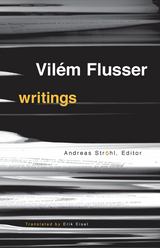
front cover of Writings
Writings
Vilem Flusser
University of Minnesota Press, 2004
Ten years after his death, Vilém Flusser’s reputation as one of Europe’s most original modern philosophers continues to grow. Increasingly influential in Europe and Latin America, the Prague-born intellectual’s thought has until now remained largely unknown in the English-speaking world. His innovative writings theorize—and ultimately embrace—the epochal shift that humanity is undergoing from what he termed "linear thinking" (based on writing) toward a new form of multidimensional, visual thinking embodied by digital culture. For Flusser, these new modes and technologies of communication make possible a society (the "telematic" society) in which dialogue between people becomes the supreme value.The first English-language anthology of Flusser’s work, this volume displays the extraordinary range and subtlety of his intellect. A number of the essays collected here introduce and elaborate his theory of communication, influenced by thinkers as diverse as Martin Buber, Edmund Husserl, and Thomas Kuhn. While taking dystopian, posthuman visions of communication technologies into account, Flusser celebrates their liberatory and humanizing aspects. For Flusser, existence was akin to being thrown into an abyss of absurd experience or "bottomlessness"; becoming human required creating meaning out of this painful event by consciously connecting with others, in part through such technologies. Other essays present Flusser’s thoughts on the future of writing, the revolutionary nature of photography, the relationship between exile and creativity, and his unconventional concept of posthistory. Taken together, these essays confirm Flusser’s importance and prescience within contemporary philosophy.Vilém Flusser (1920–1991) was born in Prague and taught philosophy in Brazil. Andreas Ströhl is director of the film department at the Goethe-Institut Inter Nationes in Munich. Erik Eisel works for a software technology company in Southern California.
[more]

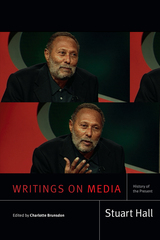
front cover of Writings on Media
Writings on Media
History of the Present
Stuart Hall
Duke University Press, 2021
Writings on Media gathers more than twenty of Stuart Hall's media analyses, from scholarly essays such as “Encoding and Decoding in the Television Discourse” (1973) to other writings addressed to wider publics. Hall explores the practices of news photography, the development of media and cultural studies, the changing role of television, and how the nation imagines itself through popular media. He attends to Britain's imperial history and the politics of race and cultural identity as well as the media's relationship to the political project of the state. Testifying to the range and agility of Hall's critical and pedagogic engagement with contemporary media culture—and also to his collaborative mode of working—this volume reaffirms his stature as an innovative media theorist while demonstrating the continuing relevance of his methods of analysis.
[more]


Send via email Share on Facebook Share on Twitter