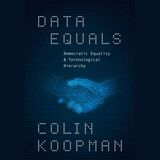
front cover of Data Equals
Data Equals
Democratic Equality and Technological Hierarchy
Colin Koopman
University of Chicago Press, 2025
An expansive vision for data equality that goes beyond algorithmic fairness.

When we gave algorithms power over our world, we hoped that the apparent neutrality of machine thinking would create a more egalitarian age. Yet we are more divided than ever, staring down threats to democracy itself. In Data Equals, Colin Koopman argues that data technologies fail us so often because we built them around a deficient notion of equality.

It is not enough, Koopman explains, that algorithms engage everyone’s data with the same measuring stick. The data themselves are all too often structured in ways that obscure and exacerbate stratifying distinctions. Koopman contends that we must also work to ensure that those people subject to computational assessment enter data systems on equal terms. Part philosophical argument, part practical guide (replete with case studies from education technology), Data Equals offers novel methods for realizing democratic equality in a digital age.
[more]

front cover of Data Equals
Data Equals
Democratic Equality and Technological Hierarchy
Colin Koopman
University of Chicago Press, 2025
This is an auto-narrated audiobook version of this book.

An expansive vision for data equality that goes beyond algorithmic fairness.


When we gave algorithms power over our world, we hoped that the apparent neutrality of machine thinking would create a more egalitarian age. Yet we are more divided than ever, staring down threats to democracy itself. In Data Equals, Colin Koopman argues that data technologies fail us so often because we built them around a deficient notion of equality.

It is not enough, Koopman explains, that algorithms engage everyone’s data with the same measuring stick. The data themselves are all too often structured in ways that obscure and exacerbate stratifying distinctions. Koopman contends that we must also work to ensure that those people subject to computational assessment enter data systems on equal terms. Part philosophical argument, part practical guide (replete with case studies from education technology), Data Equals offers novel methods for realizing democratic equality in a digital age.
[more]

front cover of Private Virtues, Public Vices
Private Virtues, Public Vices
Philanthropy and Democratic Equality
Emma Saunders-Hastings
University of Chicago Press, 2022
 A thought-provoking challenge to our ideas about philanthropy, marking it as a deeply political activity that allows the wealthy to dictate more than we think.
 

Philanthropy plays a huge role in supporting the provision of many public goods in contemporary societies. As a result, decisions that affect public outcomes and people’s diverse interests are often dependent on the preferences and judgments of the rich. Political theorist Emma Saunders-Hastings argues that philanthropy is a deeply political activity. She asks readers to look at how the power wielded by philanthropy impacts democracy and deepens political inequality by enabling the wealthy to exercise outsize influence in public life and by putting in place paternalistic relationships between donors and their intended beneficiaries. If philanthropy is to be made compatible with a democratic society of equals, it must be judged not simply on the benefits it brings but on its wider political consequences. Timely and thought-provoking, Private Virtues, Public Vices will challenge readers’ thoughts on what philanthropy is and how it truly affects us.
 
[more]


Send via email Share on Facebook Share on Twitter