
 A SCHOLARLY BOOK REPOSITORY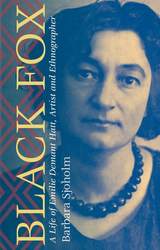
In recounting Demant Hatt's fascinating life, Barbara Sjoholm investigates the boundaries and influences between ethnographers and sources, the nature of authorship and visual representation, and the state of anthropology, racial biology, and politics in Scandinavia during the first half of the twentieth century.
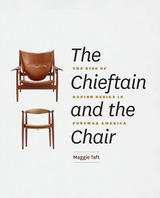
Today, Danish Modern design is synonymous with clean, midcentury cool. During the 1950s and ‘60s, it flourished as the furniture choice for Americans who hoped to signal they were current and chic. But how did this happen? How did Danish Modern become the design movement of the times? In The Chieftain and the Chair, Maggie Taft tells the tale of our love affair with Danish Modern design. Structured as a biography of two iconic chairs—Finn Juhl’s Chieftain Chair and Hans Wegner’s Round Chair, both designed and first fabricated in 1949—this book follows the chairs from conception and fabrication through marketing, distribution, and use.
Drawing on research in public and private archives, Taft considers how political, economic, and cultural forces in interwar Denmark laid the foundations for the postwar furniture industry, and she tracks the deliberate maneuvering on the part of Danish creatives and manufacturers to cater to an American market. Taft also reveals how American tastemakers and industrialists were eager to harness Danish design to serve American interests and how furniture manufacturers around the world were quick to capitalize on the fad by flooding the market with copies.
Sleek and minimalist, Danish Modern has experienced a resurgence of popularity in the last few decades and remains a sought-after design. This accessible and engaging history offers a unique look at its enduring rise among tastemakers.
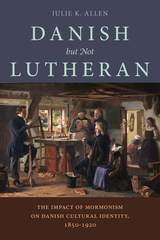
The Danish-Mormon migration to Utah in the nineteenth century was, relative to population size, one of the largest European religious out-migrations in history. Hundreds of thousands of Americans can trace their ancestry to Danish Mormons, but few know about the social and cultural ramifications of their ancestors’ conversion to Mormonism. This book tells that exciting and complex story for the first time.
In 1849, after nearly a thousand years of state- controlled religion, Denmark’s first democratic constitution granted religious freedom. One year later, the arrival of three Mormon missionaries in Denmark and their rapid success at winning converts to their faith caused a crisis in Danish society over the existential question: "How could someone be Danish but not Lutheran?" Over the next half-century nearly thirty thousand Danes joined the LDS Church, more than eighteen thousand of whom emigrated to join their fellow Mormons in Utah. This volume explores the range of Danish public reactions to Mormonism over a seventy-year period—from theological concerns articulated by Søren and Peter Christian Kierkegaard in the 1850s to fear-mongering about polygamy and white slavery in silent films of the 1910s and 1920s—and looks at the personal histories of converts.
Honorable Mention for Best International Book from the Mormon History Association.

Each interview is preceded by a photograph of the director, biographical information, and a filmography. Frame enlargements are used throughout to help clarify particular points of discussion and the book as a whole is contextualised by an informative general introduction. A valuable addition to the growing library of books on Scandinavian film, national cinema and minority cinema.
The authors of The Danish Voter investigate a series of interesting questions concerning voters’ reactions to these macrosocial challenges and how their reactions affect the foundations for the ideal. Indeed, due to an electoral system open to new influences, the Danish case is an important test case for theories about political development of contemporary Western societies.
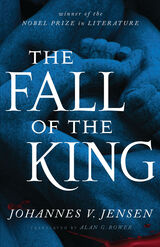
Taking place during the first half of the sixteenth century, The Fall of the King tells the story of dreamy, slacking student Mikkel Thøgersen and the entanglements that ultimately bring him into service as a mercenary under King Christian II of Denmark. Moving from the Danish countryside to Stockholm during the execution of Swedish nobility and finally to the imprisonment of Mikkel and Christian, the narrative is a lyrical encapsulation of “the fall”—the fall of country, history, individuals, and nature.
Twice voted as the most important Danish novel of the twentieth century, The Fall of the King is both an epic depiction of real events and a complex psychological novel. Half pure narration, half prose poem, its scenes of brute realism mixed with rhapsodical passages make it a work of artistic genius.
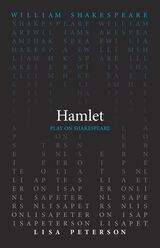
Lovers of Shakespeare’s language take heart: Lisa Peterson’s translation of Hamlet into contemporary American English was guided by the principle of “First, do no harm.” Leaving the most famous parts of Hamlet untouched, Peterson untied the language knots that can make the rest of the play difficult to understand in a single theatrical viewing. Peterson’s translation makes Hamlet accessible to new audiences, drawing out its timeless themes while helping to contextualize "To be, or not to be: that is the question," and “Something is rotten in the state of Denmark,” so that contemporary audiences can feel their full weight.
This translation of Hamlet was written as part of the Oregon Shakespeare Festival’s Play On! project, which commissioned new translations of thirty-nine Shakespeare plays. These translations present work from "The Bard" in language accessible to modern audiences while never losing the beauty of Shakespeare’s verse. Enlisting the talents of a diverse group of contemporary playwrights, screenwriters, and dramaturges from diverse backgrounds, this project reenvisions Shakespeare for the twenty-first century. These volumes make these works available for the first time in print—a new First Folio for a new era.
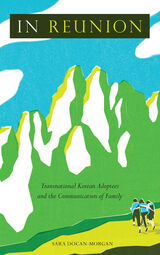
The paradoxes of adoption and reunion—shared history without blood relations, and blood relations without shared history—generate questions: What does it mean to be “family”? How do people use communication to constitute family relationships? How are family relationships created, maintained, and negotiated over time? In Reunion details adoptive and cultural identities, highlighting how adoptees often end up shouldering communicative responsibility in their family relationships. Interviews reveal how adoptees navigate birth family relationships across language and culture while also attempting to maintain relationships with their adoptive family members.
Docan-Morgan details the challenges, rewards, and contradictions of reunion. She also offers practical recommendations for transnational adoptees in reunion, adoptees considering reunion, adoptive families, and adoption practitioners.
In tracing the stories of the intercultural dynamics inherent in adoptees’ reunions, Docan-Morgan demonstrates the effort, flexibility, empathy, self-reflection, and time required to navigate long-term relationships with birth families.
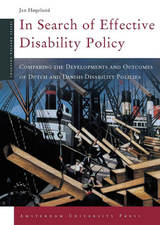
This book, built on years of unique access to the newsrooms of BBC News and ITV News in the United Kingdom and DR TV Avisen and TV2 Nyhedeme in Denmark, answers those questions and more. Exploring the shared professional ideals of journalists, the study analyzes how they conceive of stories as important, and how their ideals relating to their work are expressed and aspired to in everyday practice.
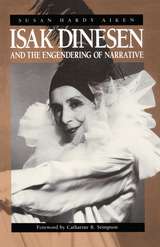
In a series of readings that range across Dinesen's career, Aiken demonstrates that Dinesen persistently asserted the inseparability of gender and the engendering of narrative. She argues that Dinesen's texts anticipate in remarkable ways some of the most radical insights of contemporary literary theories, particularly those of French feminist criticism. Aiken also offers a major rereading of Out of Africa that both addresses its distinctiveness as a colonialist text and places it within Dinesen's larger oeuvre.
In Aiken's account, Dinesen's work emerges as a compelling inquiry into sexual difference and the ways it informs culture, subjectivity, and the language that is their medium. This important book will at last give Isak Dinesen's work the prominence it deserves in literary studies.

This book presents a radical retelling of this story, placing (largely German-speaking) landed elites—rather than the Danish peasantry—at center stage. After acquiring estates in Denmark, these elites imported and adapted new practices from outside the kingdom, thus embarking on an ambitious program of agricultural reform and sparking a chain of events that eventually led to the emergence of Denmark’s famous peasant cooperatives in 1882. A Land of Milk and Butter presents a new interpretation of the origin of these cooperatives with striking implications for developing countries today.
Lard, Lice and Longevity reconstructs economic policies implemented in Denmark and the Netherlands during the German occupation. It clearly shows that the experiences of both these countries during World War I, and during the 1930s equipped them to introduce extensive and intrusive economic controls to ward off a subsistence crisis.
In spite of the strong similarities between the two countries in terms of policies and economic order, there remains a glaring difference between the two. Throughout the occupation years, the Netherlands suffered a markedly higher level of child mortality than before or after the war, caused by an upsurge of infectious diseases. Child health in Denmark, on the other hand, declined during the occupation years, and infectious diseases rose only marginally there. In spite of similar policies, hence, the outcome in terms of the biological standard of living was dissimilar.
By closely investigating the impact of various policies on everyday life, and the amounts of goods available to different groups of consumers, this study identifies the causes of this remarkable divergence.
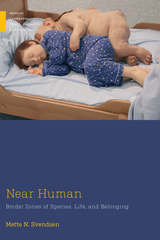
Loneliness and Its Opposite documents how two countries generally imagined to be progressive engage with these questions in very different ways. Denmark and Sweden are both liberal welfare states, but they diverge dramatically when it comes to sexuality and disability. In Denmark, the erotic lives of people with disabilities are acknowledged and facilitated. In Sweden, they are denied and blocked. Why do these differences exist, and how do both facilitation and hindrance play out in practice?
Loneliness and Its Opposite charts complex boundaries between private and public, love and sex, work and intimacy, and affection and abuse. It shows how providing disabled adults with access to sexual lives is not just crucial for a life with dignity. It is an issue of fundamental social justice with far reaching consequences for everyone.

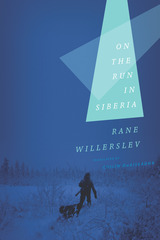
If I had let myself be ruled by reason alone, I would surely be lying dead somewhere or another in the Siberian frost.
The Siberian taiga: a massive forest region of roughly 4.5 million square miles, stretching from the Ural Mountains to the Bering Sea, breathtakingly beautiful and the coldest inhabited region in the world. Winter temperatures plummet to a bitter 97 degrees below zero, and beneath the permafrost lie the fossilized remains of mammoths, woolly rhinoceroses, and other ice age giants. For the Yukaghir, an indigenous people of the taiga, hunting sable is both an economic necessity and a spiritual experience—where trusting dreams and omens is as necessary as following animal tracks. Since the fall of Communism, a corrupt regional corporation has monopolized the fur trade, forcing the Yukaghir hunters into impoverished servitude.
Enter Rane Willerslev, a young Danish anthropologist who ventures into this frozen land on an idealistic mission to organize a fair-trade fur cooperative with the hunters. From the outset, things go terribly wrong. The regional fur company, with ties to corrupt public officials, proves it will stop at nothing to maintain its monopoly: one of Willerslev’s Yukaghir business partners is arrested on spurious charges of poaching and illegal trading; another drowns mysteriously. When police are sent to arrest him, Willerslev fears for his life, and he and a local hunter flee to a remote hunting lodge even deeper in the icy wilderness. Their situation turns even more desperate right away: they manage to kill a moose but lose the meat to predators and begin to starve, frostbitten and isolated in the frozen taiga.
Thus begins Willerslev’s extraordinary, chilling tale of one year living in exile among Yukaghir hunters in the stark Siberian taiga region. At turns shocking and quietly moving, On the Run in Siberia is a pulse-pounding tale of idealism, political corruption, starvation, and survival (with a timely assist from Vladimir Putin) as well as a striking portrait of the Yukaghirs’ shamanistic tradition and their threatened way of life, a drama unfolding daily in one of the world’s coldest, most enthralling landscapes.

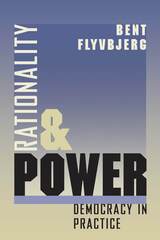
In the Enlightenment tradition, rationality is considered well-defined, independent of context; we know what rationality is, and its meaning is constant across time and space. Bent Flyvbjerg shows that rationality is context-dependent and that the crucial context is determined by decision-makers' power. Power blurs the dividing line between rationality and rationalization. The result is a rationality that is often as imaginary as the time in Little Town, yet with very real social and environmental consequences.
Flyvbjerg takes us behind the scenes to uncover the real politics—and real rationality—of policy-making, administration, and planning in an internationally acclaimed project for environmental improvement, auto traffic reduction, land use, and urban renewal. The action takes place in the Danish city of Aalborg, but it could be anywhere. Aalborg is to Flyvbjerg what Florence was to Machiavelli: a laboratory for understanding power and what it means for our more general concerns of social and political organization. Policy-making, administration, and planning are examined in ways that allow a rare, in-depth understanding. The reader is a firsthand witness to the classic, endless drama that defines what democracy and modernity are, and what they can be.
The result is a fascinating narrative that is both concrete and general, current and timeless. Drawing on the ideas of Machiavelli, Nietzsche, Foucault, and Habermas, Flyvbjerg reads the Aalborg case as a metaphor of modernity and of modern politics, administration, and planning. Flyvbjerg uncovers the interplay of power and rationality that distorts policy deliberation. He demonstrates that modern "rationality" is but an ideal when confronted with the real rationalities involved in decision making by central actors in government, economy, and civil society. Flyvbjerg then elaborates on how this problem can be dealt with so that more fruitful deliberation and action can occur.
If the new millennium marks a recurrence of the real, Flyvbjerg's Rationality and Power epitomizes this development, setting new standards for social and political inquiry. Richly informed, powerfully argued, and clearly written, this is a book that no one trying to understand policy-making, administration, and planning can afford to overlook.
"Flyvbjerg employs a wide-ranging intellect, an enthusiastic and persuasive voice, academic rigor, and great discipline to distill years of research into an outstanding and accessible 250-page civics lesson. It begs for a readership outside academic and professional circles . . . Rationality and Power's value is undeniable as a handbook and forensic tool for anyone seeking a better understanding of and access to the democratic process."—Arkansas Democrat-Gazette
"It makes an extremely strong, and to the reviewer's mind incontrovertible, argument for placing the analysis of planning within the context of power relations. As a result it will also make a significant mark on the development of planning theory."—Geographical Journal
"A book that is to be recommended doubly, first to all those engaged in planning and implementation in a democratic context, and also to all those interested in empirical power research. Rationality and Power is rewarding even enthralling reading, a seminal contribution to its field."—European Societies
"This book is a must for anyone interested in how planning works . . . a reality shock . . . excellent and illuminating."—International Planning Studies
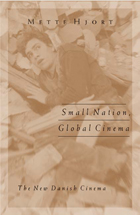
Hjort offers two key strategies underwriting the transformation and globalization of contemporary Danish cinema—the processes of cultural circulation and the psychological efficacy of heritage. Exploring the Dogma 95 movement initiated by Lars von Trier and Thomas Vinterberg as well as films by Erik Clausen, Gabriel Axel, Henning Carlsen, and Ole Bornedal, among others, Hjort examines means for cinematic globalization specific to Denmark, but then evolves her investigation into a truly comparative framework encompassing references to Hong Kong, Latin America, and Hollywood filmmaking. Providing a fresh way of looking at cultural influence in the era of globalization, Hjort’s concept of “small” nation points as much to the dynamics of recognition, indifference, and participation as it does to more common measures of population size, economic strength, or linguistic reach.
Mette Hjort is professor of intercultural studies at Aalborg University.
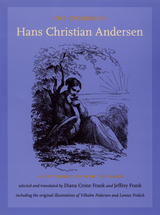
In this collection are twenty-two tales that best represent Andersen’s literary legacy, including such classics as “The Little Mermaid,” “The Ugly Duckling,” “Thumbelisa,” and “The Emperor’s New Clothes,” as well as largely unfamiliar stories like “By the Outermost Sea.” Illuminating notes clarify references in the tales. And in an introductory essay, the Franks explore the writer and his times, placing the enigmatic and often bizarre figure of Andersen among his literary contemporaries, such as Charles Dickens and Søren Kierkegaard, with whom he crossed paths; and they bring to life Andersen’s fascinating relationship with the United States. Illustrated with the delicate and beautiful drawings that accompanied the original Danish publication, The Stories of Hans Christian Andersen will delight readers of all ages.
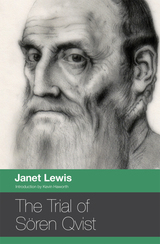
Originally published in 1947, The Trial of Sören Qvist has been praised by a number of critics for its intriguing plot and Janet Lewis’s powerful writing. And in the introduction to this new edition, Swallow Press executive editor and author Kevin Haworth calls attention to the contemporary feeling of the story—despite its having been written more than fifty years ago and set several hundred years in the past. As in Lewis’s best-known novel, The Wife of Martin Guerre, the plot derives from Samuel March Phillips’s nineteenth-century study, Famous Cases of Circumstantial Evidence, in which this British legal historian considered the trial of Pastor Sören Qvist to be the most striking case.
READERS
Browse our collection.
PUBLISHERS
See BiblioVault's publisher services.
STUDENT SERVICES
Files for college accessibility offices.
RECENTLY PUBLISHED






UChicago Accessibility Resources
home | accessibility | search | about | contact us
BiblioVault ® 2001 - 2024
The University of Chicago Press