
 A SCHOLARLY BOOK REPOSITORY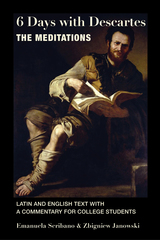
This new edition of Descartes’ Meditations by Zbigniew Janowski, wrote extensively on Descartes and 17th c. philosophy, was prepared with the first-year college student in mind. unlike all existing editions in english, which contain bare text of the Meditations, the novelty of this edition is that it includes a short commentary to each meditation, in which the editors help the reader follow Descartes’ steps and arguments.
In addition to their brief commentaries, the author also included short footnotes to the books and articles by contemporary Cartesian specialists who discuss in greater detail specific questions and problems which the text of the Meditations raises. In doing so, the author hopes to familiarize students with authors and titles of major works on Descartes, and with on-going scholarly controversies which this masterpiece of modern thought still inspires
Six Days with Descartes: The Meditations, Latin and English Text with a Commentary for College Students can also serve as a helpful tool for young and less experienced teachers of philosophy.
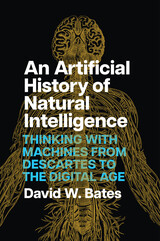
We imagine that we are both in control of and controlled by our bodies—autonomous and yet automatic. This entanglement, according to David W. Bates, emerged in the seventeenth century when humans first built and compared themselves with machines. Reading varied thinkers from Descartes to Kant to Turing, Bates reveals how time and time again technological developments offered new ways to imagine how the body’s automaticity worked alongside the mind’s autonomy. Tracing these evolving lines of thought, An Artificial History of Natural Intelligence offers a new theorization of the human as a being that is dependent on technology and produces itself as an artificial automaton without a natural, outside origin.
Over the course of human history, the sciences, and biology in particular, have often been manipulated to cause immense human suffering. For example, biology has been used to justify eugenic programs, forced sterilization, human experimentation, and death camps—all in an attempt to support notions of racial superiority. By investigating the past, the contributors to Biology and Ideology from Descartes to Dawkins hope to better prepare us to discern ideological abuse of science when it occurs in the future.
Denis R. Alexander and Ronald L. Numbers bring together fourteen experts to examine the varied ways science has been used and abused for nonscientific purposes from the fifteenth century to the present day. Featuring an essay on eugenics from Edward J. Larson and an examination of the progress of evolution by Michael J. Ruse, Biology and Ideology examines uses both benign and sinister, ultimately reminding us that ideological extrapolation continues today. An accessible survey, this collection will enlighten historians of science, their students, practicing scientists, and anyone interested in the relationship between science and culture.

Descartes and his Contemporaries recreates the tumultuous intellectual community of seventeenth-century Europe and provides a detailed, modern analysis of the Meditations in its historical context. The book's chapters examine the arguments and positions of each of the objectors—Hobbes, Gassendi, Arnauld, Morin, Caterus, Bourdin, and others whose views were compiled by Mersenne. They illuminate Descartes' relationships to the scholastics and particularly the Jesuits, to Mersenne's circle with its debates about the natural sciences, to the Epicurean movements of his day, and to the Augustinian tradition. Providing a glimpse of the interactions among leading 17th-century intellectuals as they grappled with major philosophical issues, this book sheds light on how Descartes' thought developed and was articulated in opposition to the ideas of his contemporaries.
A careful analysis of the rhetorical thought of René Descartes and of a distinguished group of post-Cartesians. Covering a unique range of authors, including Bernard Lamy and Nicolas Malebranche, Carr attacks the idea, which has become commonplace in contemporary criticism, that the Cartesian system is incompatible with rhetoric.
Carr analyzes the writings of Balzac, the Port-Royalists Arnauld and Nicole, Malebranche, and Lamy, exploring the evolution of Descartes’ thought into their different theories of rhetoric. He constructs his arguments, probing each author’s writings on rhetoric, persuasion, and attention, to demonstrate the basis for rhetorical thought present in Descartes’ theory of persuasion when it is combined with his psychophysiology of attention.
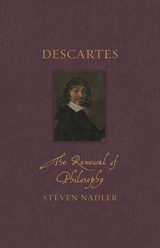
Often called the father of modern philosophy, René Descartes set the intellectual agenda for seventeenth-century philosophy, mathematics, natural science, and beyond. In this critical biography, based on compelling new research, Steven Nadler follows Descartes from his early education in France to the Dutch Republic, where he lived most of his adult life, to his final months as a tutor to Queen Christina of Sweden. Along the way, Nadler shows how Descartes renewed philosophy by transforming fundamental assumptions about the cosmos, natural world, and human nature as well as how his work continues to generate new insights into many of the metaphysical and epistemological problems that engage philosophers today.
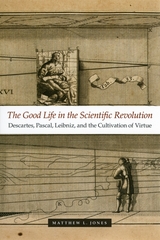
Amid the unrest, dislocation, and uncertainty of seventeenth-century Europe, readers seeking consolation and assurance turned to philosophical and scientific books that offered ways of conquering fears and training the mind—guidance for living a good life.
The Good Life in the Scientific Revolution presents a triptych showing how three key early modern scientists, René Descartes, Blaise Pascal, and Gottfried Leibniz, envisioned their new work as useful for cultivating virtue and for pursuing a good life. Their scientific and philosophical innovations stemmed in part from their understanding of mathematics and science as cognitive and spiritual exercises that could create a truer mental and spiritual nobility. In portraying the rich contexts surrounding Descartes’ geometry, Pascal’s arithmetical triangle, and Leibniz’s calculus, Matthew L. Jones argues that this drive for moral therapeutics guided important developments of early modern philosophy and the Scientific Revolution.

Perceptual Acquaintance was first published in 1984. Minnesota Archive Editions uses digital technology to make long-unavailable books once again accessible, and are published unaltered from the original University of Minnesota Press editions.
Philosophers, wrote Thomas Reid in 1785, "all suppose that we perceive not external objects immediately, and that the immediate objects of perception are only certain shadows of the external objects." To Reid, a founding father of the common-sense school of philosophy, John Locke's "way of ideas" threatened to supplant, in human knowledge, the world of physical objects and events—and to point down the dreaded path to scepticism.
John Yolton finds Reid at least partly responsible for this standard (and by now stereotypic) account of Locke and his eighteenth-century British successors on the subject of perception. By carefully examining the writings of Descartes and the Cartesians, and Locke and his successors, Yolton is able to suggest an alternative to this interpretation of their views. He goes back to a wide range of original texts—those of the period's major philosophers, to Descartes' scholastic precursors, to obscure pamphleteers, and to writers on religion, natural philosophy, medicine, and optics—all in an effort to help us understand the issues without the interference of modern labels and categories. The subtle changes over time reveal an important transformation in the understanding of perception, yet one that is prefigured in earlier work, contrary to Reid's view of the past. Included in Yolton's reevaluation is a full account of the role of Berkeley and Hume in the study of perceptual acquaintance, and of the connection between their work.
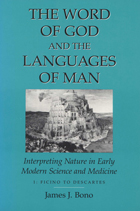
James J. Bono shows how the new interpretive principles and scientific practices of the sixteenth and seventeenth centuries evolved in response to new views of the relationship between the “Word of God” and the “Languages of Man” fostered by Renaissance Humanism, Neoplatonism, magic, and both the reformed and radical branches of Protestantism. He traces the cultural consequences of these ideas in the thought and work of major and minor actors in the scientific revolution—from Ficino and Paracelsus to Francis Bacon and Descartes. By considering these natural philosophers in light of their own intellectual, religious, philosophical, cultural, linguistic, and especially narrative frameworks, Bono suggests a new way of viewing the sociocultural dynamics of scientific change in the pre–modern period—and ultimately, a new way of understanding the nature and history of scientific thought. The narrative configuration he proposes provides a powerful alternative to the longstanding “revolutionary” metaphor of the history of the scientific revolution.
READERS
Browse our collection.
PUBLISHERS
See BiblioVault's publisher services.
STUDENT SERVICES
Files for college accessibility offices.
RECENTLY PUBLISHED


UChicago Accessibility Resources
home | accessibility | search | about | contact us
BiblioVault ® 2001 - 2024
The University of Chicago Press