logo for University of Chicago Press
Under Briggflatts
A History of Poetry in Great Britain, 1960-1988
Donald Davie
University of Chicago Press, 1989
Under Briggflatts is a history of the last thirty years of British poetry with necessary excursions into other areas: criticism, philosophy, translation, and non-British English poetries. It has grown naturally out of Donald Davie's immediate involvement with new writing as a poet, reviewer, teacher, and reader. He has reassessed the writers who have most engaged his attention, revised his reviews, and supplemented earlier material with much that is new. Under Briggflatts provides a narrative that is remarkable in scope and generous in tone. By combining close readings of specific poems and more general considerations of style, form, and context, Davie's account is characteristically elegant, precise, and uncompromising.

Under Briggflatts is organized in three large chapters, one devoted to each decade. In the 1960s, Davie pays particular attention to the work of Austin Clarke, Hugh MacDiarmid, Norman McCaig, Keith Douglas, Edwin Muir, Basil Bunting (the gurus whose prose writings helped catalyze the traumatic events of 1968), Elaine Feinstein, Sylvia Townsend Warner, Philip Larkin, Charles Tomlinson, Thomas Kinsella, and Ted Hughes. The second chapter follows these figures into the new decade and explores the work of (among others) Thom Gunn, C. H. Sisson, R. S. Thomas, John Betjeman, and such themes as women's poetry, translation, poetic theory, and the later impact of T. S. Eliot and of Edward Thomas. Perhaps the most controversial chapter is the third, in which David—without abandoning the poets already introduced—assesses Geoffrey Hill, Tony Harrison, and Seamus Heaney, and looks too at the recovery of Ivor Gurney's poems, at Ted Hughes as Laureate, the posthumous work of Sylvia Townsend Warner, the burgeoning Hardy industry, and the critical writings of Kenneth Cox.

[more]

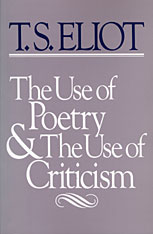
front cover of The Use of Poetry and the Use of Criticism
The Use of Poetry and the Use of Criticism
Studies in the Relation of Criticism to Poetry in England
T. S. Eliot
Harvard University Press, 1961

The elder statesman of literary modernism traces the reciprocal relationship between poet and critic.

No individual did more to shape the trajectory of twentieth-century criticism than T. S. Eliot. A self-described “classicist,” his repudiation of the Romantic era’s emphasis on subjectivity and self-expression in favor of a rigorous analytical focus on literary tradition influenced critics for generations to come.

Yet Eliot was not entirely comfortable with his place in the canon. “Tradition and the Individual Talent,” the universally anthologized 1919 essay that laid out his views in their most programmatic form, was, in his own estimation, “the most juvenile” of his critical writings. He believed that the 1932–1933 Norton Lectures collected here, in contrast, reflected his mature thought. In place of the sweeping pronouncements of his earlier work, these lectures offer a shrewd and sensitive account of criticism as a product of history. Beginning with the development of the field in the age of John Dryden, when critics turned poetry into the province of an intellectual aristocracy, Eliot explores how a long line of English poet-critics responded to the unique demands of their time. Johnson, Wordsworth, Coleridge, Shelley, Keats, Arnold, and Richards each mined the past to offer a fresh answer to the question, “what is poetry?” And Eliot brilliantly shows how the poetic strengths—and shortcomings—of each were intimately connected to their critical work.

Trenchant and authoritative, The Use of Poetry and the Use of Criticism reveals that Eliot himself is no exception to this rule. His deep erudition, his existential doubts, and his yearning for order animate these lectures as much as his best poems.

[more]


Send via email Share on Facebook Share on Twitter