
 A SCHOLARLY BOOK REPOSITORY
9 start with A start with A

In the opening of the book, Wilt discusses real case histories of several women. After studying the ambiguities of their decisions, she turns to their counterpoints depicted in contemporary fiction. Working from a feminist perspective, Wilt traces the theme of maternal choice in works by Margaret Atwood, Margaret Drabble, Joan Didion, Mary Gordon, Alice Walker, Toni Morrison, Gloria Naylor, Marge Piercy, Thomas Keneally, Graham Swift, Ernest Hemingway, William Faulkner, John Barth, John Irving, and others.
Behind the political, medical, and moral debates on abortion, Wilt argues, is a profound psychocultural shock at the recognition that maternity is passing from the domain of instinct to that of conscious choice. Although never wholly instinctual, maternity's potential capture by consciousness raises complex questions. The novels Wilt discusses portray worlds in which principles are endangered by sexual inequality, male power and hidden male fear of abandonment, impotence, female submission, and covert rage, and, in the case of black maternity, the hideous aftermath of slavery.
Wilt provides a resonant new context for debates—whether political or personal—on the issue of abortion and maternal choice. Ultimately she enables us to rethink how we shape our own identities and lives.
All scholars subscribe to theories, and these are embedded in their criticism and scholarship. Whatever the excesses of (and differences between) deconstruction, feminism, the new historicism, and the other theories that Jay and Miller review, they share a commitment to heightening the teacher/critic's self-consciousness about the labor that he or she performs.
*
The book traces this mode of thinking in linguistics, collaborative intellectual work in the arts and sciences, and interpretations of literary and sacred texts, concluding with a reading of the concept of Enlightenment in a comparison of Descartes and Foucault. The book examines the poststructuralism of Derrida; the collaborations of information theory and modern science as opposed to the individualism of Adam Smith and others, and analogical interpretations of Yeats, Dinesen, the Bible, Dreiser, and Mailer. Its overall aim is to present an interdisciplinary examination of a particular kind of understanding that responds to the experiences of our time.
Ronald Schleifer is Professor of English, University of Oklahoma. His books include Rhetoric and Death: The Language of Modernism and Postmodern Discourse Theory, Criticism and Culture; and Culture and Cognition: The Boundaries of Literary and Scientific Inquiry.

Although women and men have different relationships to language and to each other, traditional theories of rhetoric do not foreground such gender differences. Krista Ratcliffe argues that because feminists generally have not conceptualized their language theories from the perspective of rhetoric and composition studies, rhetoric and composition scholars must construct feminist theories of rhetoric by employing a variety of interwoven strategies: recovering lost or marginalized texts; rereading traditional rhetoric texts; extrapolating rhetorical theories from such nonrhetoric texts as letters, diaries, essays, cookbooks, and other sources; and constructing their own theories of rhetoric.
Focusing on the third option, Ratcliffe explores ways in which the rhetorical theories of Virginia Woolf, Mary Daly, and Adrienne Rich may be extrapolated from their Anglo-American feminist texts through examination of the interrelationship between what these authors write and how they write. In other words, she extrapolates feminist theories of rhetoric from interwoven claims and textual strategies. By inviting Woolf, Daly, and Rich into the rhetorical traditions and by modeling the extrapolation strategy/methodology on their writings, Ratcliffe shows how feminist texts about women, language, and culture may be reread from the vantage point of rhetoric to construct feminist theories of rhetoric. She also outlines the pedagogical implications of these three feminist theories of rhetoric, thus contributing to ongoing discussions of feminist pedagogies.
Traditional rhetorical theories are gender-blind, ignoring the reality that women and men occupy different cultural spaces and that these spaces are further complicated by race and class, Ratcliffe explains. Arguing that issues such as who can talk, where one can talk, and how one can talk emerge in daily life but are often disregarded in rhetorical theories, Ratcliffe rereads Roland Barthes’ "The Old Rhetoric" to show the limitations of classical rhetorical theories for women and feminists. Discovering spaces for feminist theories of rhetoric in the rhetorical traditions, Ratcliffe invites readers not only to question how women have been located as a part of— and apart from—these traditions but also to explore the implications for rhetorical history, theory, and pedagogy.


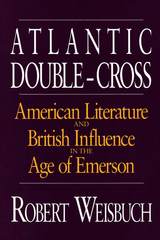
Describing the transatlantic "double-cross" of literary influence, Weisbuch documents both the American desire to create a literature distinctly different from English models and the English insistence that any such attempt could only fail. The American response, as he demonstrates, was to make strengths out of national disadvantages by rethinking history, time, and traditional concepts of the self, and by reinterpreting and ridiculing major British texts in mocking allusions and scornful parodies.
Weisbuch approaches a precise characterization of this "double-cross" by focusing on paired sets of English and American texts. Investigations of the causes, motives, and literary results of the struggle alternate with detailed analyses of several test cases. Weisbuch considers Melville's challenge to Dickens, Thoreau's response to Coleridge and Wordsworth, Hawthorne's adaptation of Keats and influence on Eliot, Whitman's competition with Arnold, and Poe's reshaping of Shelley. Adding a new dimension to the exploration of an emerging aesthetic consciousness, Atlantic Double-Cross provides important insights into the creation of the American literary canon.
READERS
Browse our collection.
PUBLISHERS
See BiblioVault's publisher services.
STUDENT SERVICES
Files for college accessibility offices.
RECENTLY PUBLISHED



UChicago Accessibility Resources
home | accessibility | search | about | contact us
BiblioVault ® 2001 - 2024
The University of Chicago Press