
 A SCHOLARLY BOOK REPOSITORY
29 start with A start with A
The political and cultural ties between England and the US act as a backdrop for the identity negotiations of these English people, many of whom do not even consider themselves to be immigrants. This unique exploration of the workings of white privilege offers an important new understanding of the paradoxes of how class, gender, and race are formed in the US and, by implication, in the UK.
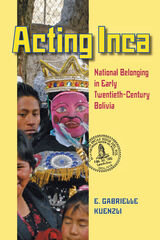
Kuenzli examines documents from the famous postwar Peñas Trial to recover Aymara testimony during what essentially became a witch hunt. She reveals that the Aymara served as both dutiful plaintiffs allied with liberals and unwitting defendants charged with wartime atrocities and instigating a race war.
To further combat their “Indian problem,” Creole liberals developed a public discourse that positioned the Inca as the only Indians worthy of national inclusion. This was justified by the Incas’ high civilization and reputation as noble conquerors, along with their current non-threatening nature. The “whitening” of Incans was a thinly veiled attempt to block the Aymara from politics, while also consolidating the power of the Liberal Party.
Kuenzli posits that despite their repression, the Aymara did not stagnate as an idle, apolitical body after the civil war. She demonstrates how the Aymara appropriated the liberal’s Indian discourse by creating theatrical productions that glorified Incan elements of the Aymara past. In this way, the Aymara were able to carve an acceptable space as “progressive Indians” in society. Kuenzli provides an extensive case study of an “Inca play” created in the Aymara town of Caracollo, which proved highly popular and helped to unify the Aymara.
As her study shows, the Amyara engaged liberal Creoles in a variety of ways at the start of the twentieth century, shaping national discourse and identity in a tradition of activism that continues to this day.
The Affinity of the Eye scrutinizes authors such as José Watanabe, Fernando Iwasaki, Augusto Higa, Doris Moromisato, and Carlos Yushimito, discussing their literature and their connections to the past, present, and future. Whether these authors push against or accept what it means to be Japanese Peruvians, they enrich the images and feelings of that experience. Through a close reading of literary and cultural productions, López-Calvo’s analysis challenges and reframes the parameters of being Nikkei in Peru.
Covering both Japanese issues in Peru and Peruvian issues in Japan, the book is more than a compendium of stories, characters, and titles. It proves the fluid, enriching, and ongoing relationship that exists between Peru and Japan.
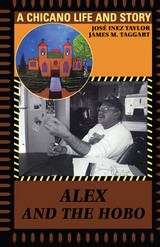
When a ten-year-old boy befriends a mysterious hobo in his southern Colorado hometown in the early 1940s, he learns about evil in his community and takes his first steps toward manhood by attempting to protect his new friend from corrupt officials. Though a fictional story, Alex and the Hobo is written out of the life experiences of its author, José Inez (Joe) Taylor, and it realistically portrays a boy's coming-of-age as a Spanish-speaking man who must carve out an honorable place for himself in a class-stratified and Anglo-dominated society.
In this innovative ethnography, anthropologist James Taggart collaborates with Joe Taylor to explore how Alex and the Hobo sprang from Taylor's life experiences and how it presents an insider's view of Mexicano culture and its constructions of manhood. They frame the story (included in its entirety) with chapters that discuss how it encapsulates notions that Taylor learned from the Chicano movement, the farmworkers' union, his community, his father, his mother, and his religion. Taggart gives the ethnography a solid theoretical underpinning by discussing how the story and Taylor's account of how he created it represent an act of resistance to the class system that Taylor perceives as destroying his native culture.
This interdisciplinary collection brings together contributors working in Asian American studies, English, anthropology, sociology, and art history. They consider issues of cultural authenticity raised by Asian American participation in hip hop and jazz, the emergence of an orientalist “Indo-chic” in U.S. youth culture, and the circulation of Vietnamese music variety shows. They examine the relationship between Chinese restaurants and American culture, issues of sexuality and race brought to the fore in the video performance art of a Bruce Lee–channeling drag king, and immigrant television viewers’ dismayed reactions to a Chinese American chef who is “not Chinese enough.” The essays in Alien Encounters demonstrate the importance of scholarly engagement with popular culture. Taking popular culture seriously reveals how people imagine and express their affective relationships to history, identity, and belonging.
Contributors. Wendy Hui Kyong Chun, Kevin Fellezs, Vernadette Vicuña Gonzalez, Joan Kee, Nhi T. Lieu, Sunaina Maira, Martin F. Manalansan IV, Mimi Thi Nguyen, Robyn Magalit Rodriguez, Sukhdev Sandhu, Christopher A. Shinn, Indigo Som, Thuy Linh Nguyen Tu, Oliver Wang
On television, the Arab Spring took place in Cairo, Tunis, and the city-states of the Persian Gulf. Yet the drama of 2010, and the decade of subsequent activism, extended beyond the cities—indeed, beyond Arabs. Bruce Maddy-Weitzman brings to light the sustained post–Arab Spring political movement of North Africa’s Amazigh people.
The Amazigh movement did not begin with the Arab Spring, but it has changed significantly since then. Amazigh Politics in the Wake of the Arab Spring details the increasingly material goals of Amazigh activism, as protest has shifted from the arena of ethnocultural recognition to that of legal and socioeconomic equality. Amazigh communities responded to the struggles for freedom around them by pressing territorial and constitutional claims while rejecting official discrimination and neglect. Arab activists, steeped in postcolonial nationalism and protective of their hegemonic position, largely refused their support, yet flailing regimes were forced to respond to sharpening Amazigh demands or else jeopardize their threadbare legitimacy. Today the Amazigh question looms larger than ever, as North African governments find they can no longer ignore the movement’s interests.
Lieu examines how live music variety shows and videos, beauty pageants, and Web sites created by and for Vietnamese Americans contributed to the shaping of their cultural identity. She shows how popular culture forms repositories for conflicting expectations of assimilation, cultural preservation, and invention, alongside gendered and classed dimensions of ethnic and diasporic identity.
The American Dream in Vietnamese demonstrates how the circulation of images manufactured by both Americans and Vietnamese immigrants serves to produce these immigrants’ paradoxical desires. Within these desires and their representations, Lieu finds the dramatization of the community’s struggle to define itself against the legacy of the refugee label, a classification that continues to pathologize their experiences in American society.
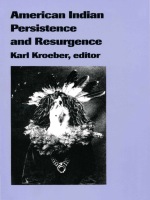
Diverse commentators, including literary critics, anthropologists, ethnohistorians, poets and a novelist address persistent issues facing Native Americans and Native American studies today. The future of White-Indian relation, the viability of Pan-Indianism, tensions between Native Americans and North American anthropologists, and new devlopments in ethnohistory are among the topics discussed. The survival of Native Americans as recorded in this collection, an expanded edition of a special issue of boundary 2, brings into focus the dynamically adaptive values of Native American culture. Native Americans’ persistence in U.S. culture—not disappearing under the pressure to assimilate or through genocidal warfare—reminds us of the extent to which any living culture is defined by the process of transformation.
Contributors. Linda Ainsworth, Jonathan Boyarin, Raymomd J. DeMallie, Elaine Jahner, Karl Kroeber, William Overstreet, Douglas R. Parks, Katharine Pearce, Jarold Ramsey, Wendy Rose, Edward H. Spicer, Gerald Vizenor, Priscilla Wald
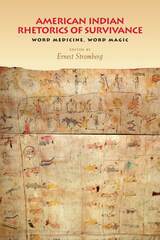
American Indian Rhetorics of Survivance presents an original critical and theoretical analysis of American Indian rhetorical practices in both canonical and previously overlooked texts: autobiographies, memoirs, prophecies, and oral storytelling traditions. Ernest Stromberg assembles essays from a range of academic disciplines that investigate the rhetorical strategies of Native American orators, writers, activists, leaders, and intellectuals.
The contributors consider rhetoric in broad terms, ranging from Aristotle's definition of rhetoric as “the faculty . . . of discovering in the particular case what are the available means of persuasion,” to the ways in which Native Americans assimilated and revised Western rhetorical concepts and language to form their own discourse with European and American colonists. They relate the power and use of rhetoric in treaty negotiations, written accounts of historic conflicts and events, and ongoing relations between American Indian governments and the United States.
This is a groundbreaking collection for readers interested in Native American issues and the study of language. In presenting an examination of past and present Native American rhetoric, it emphasizes the need for an improved understanding of multicultural perspectives.
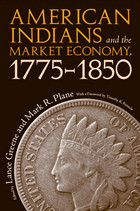
The last quarter of the 18th century was a period of extensive political, economic, and social change in North America, as the continent-wide struggle between European superpowers waned. Native groups found themselves enmeshed in the market economy and new state forms of control, among other new threats to their cultural survival. Native populations throughout North America actively engaged the expanding marketplace in a variety of economic and social forms. These actions, often driven by and expressed through changes in material culture, were supported by a desire to maintain distinctive ethnic identities.
Illustrating the diversity of Native adaptations in an increasingly hostile and marginalized world, this volume is continental in scope—ranging from Connecticut to the Carolinas, and westward through Texas and Colorado. Calling on various theoretical perspectives, the authors provide nuanced perspectives on material culture use as a manipulation of the market economy. A thorough examination of artifacts used by Native Americans, whether of Euro-American or Native origin, this volume provides a clear view of the realities of the economic and social interactions between Native groups and the expanding Euro-American population and the engagement of these Native groups in determining their own fate.
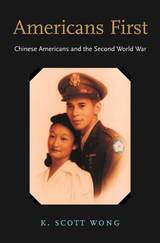
World War II was a watershed event for many of America's minorities, but its impact on Chinese Americans has been largely ignored. Utilizing extensive archival research as well as oral histories and letters from over one hundred informants, K. Scott Wong explores how Chinese Americans carved a newly respected and secure place for themselves in American society during the war years.
Long the victims of racial prejudice and discriminatory immigration practices, Chinese Americans struggled to transform their image in the nation's eyes. As Americans racialized the Japanese enemy abroad and interned Japanese Americans at home, Chinese citizens sought to distinguish themselves by venturing beyond the confines of Chinatown to join the military and various defense industries in record numbers. Wong offers the first in-depth account of Chinese Americans in the American military, tracing the history of the 14th Air Service Group, a segregated unit comprising over 1,200 men, and examining how their war service contributed to their social mobility and the shaping of their ethnic identity.
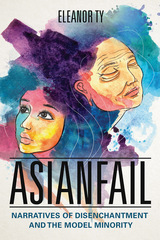
Americans First pays tribute to a generation of young men and women who, torn between loyalties to their parents' traditions and their growing identification with America and tormented by the pervasive racism of wartime America, served their country with patriotism and courage. Consciously developing their image as a "model minority," often at the expense of the Japanese and Japanese Americans, Chinese Americans created the pervasive image of Asian Americans that still resonates today.
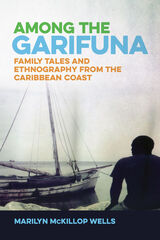
Among the Garifuna is the first ethnographic narrative of a Garifuna family. The Garifuna are descendants of the “Black Carib,” whom the British deposited on Roatan Island in 1797 and who settled along the Caribbean coast from Belize City to Nicaragua.
In 1980, medical anthropologist Marilyn McKillop Wells found herself embarking on an “improbable journey” when she was invited to the area to do fieldwork with the added challenge of revealing the “real” Garifuna. Upon her arrival on the island, Wells was warmly embraced by a local family, the Diegos, and set to work recording life events and indigenous perspectives on polygyny, Afro-indigenous identity, ancestor-worshiping religion, and more. The result, as represented in Among the Garifuna, is a lovingly intimate, earthy human drama.
The family narrative is organized chronologically. Part I, “The Old Ways,” consists of vignettes that introduce the family backstory with dialogue as imagined by Wells based on the family history she was told. We meet the family progenitors, Margaret and Cervantes Diego, during their courtship, experience Margaret’s pain as Cervantes takes a second wife, witness the death of Cervantes and ensuing mourning rituals, follow the return of Margaret and the children to their previous home in British Honduras, and observe the emergence of the children’s personalities.
In Part II, “Living There,” Wells continues the story when she arrives in Belize and meets the Diego children, including the major protagonist, Tas. In Tas’s household Wells learns about foods and manners and watches family squabbles and reconciliations. In these mini-stories, Wells interweaves cultural information on the Garifuna people with first-person narrative and transcription of their words, assembling these into an enthralling slice of life. Part III, “The Ancestor Party,” takes the reader through a fascinating postmortem ritual that is enacted to facilitate the journey of the spirits of the honored ancestors to the supreme supernatural.
Among the Garifuna contributes to the literary genres of narrative anthropology and feminist ethnography in the tradition of Zora Neal Hurston and other women writing culture in a personal way. Wells’s portrait of this Garifuna family will be of interest to anthropologists, Caribbeanists, Latin Americanists, students, and general readers alike.

The boys and men who left their Greek valley and mountain villages in the early 1900s for America came with amulets their mothers had made for them. Some were miniature sacks attached to a necklace; more often they were merely a square of fabric enclosing the values of their lives: a piece of a holy book or a sliver of the True Cross representing their belief in Greek Orthodoxy; a thyme leaf denoting their wild terrain; a blue bead to ward off the Evil Eye; and a pinch of Greek earth.
In her evocative and meticulously researched book An Amulet of Greek Earth, author Helen Papanikolas explains and examines the vibrant culture these immigrants brought with them to the new world. The Romiosini culture, as it was called, provided the foundation for their new lives and was oftentimes the cause of strife as they passed on their beliefs and traditions to successive generations of Greek Americans.
In the tradition of her fictional accounts of Greek immigrant life, Helen Papanikolas unearths the cultural beliefs and passions that compelled the Greek-American community to make its own way into the broader culture of America. Based on extensive study, personal interviews, and a lifetime of experience, An Amulet of Greek Earth is a revealing and informative chronicle of the immigrant’s experience in becoming an American.
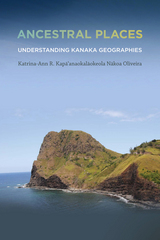
Katrina-Ann R. Kapa‘anaokalaokeola Nakoa Oliveira elucidates a Kanaka geography and provides contemporary scholars with insights regarding traditional culture—including the ways in which Kanaka utilize cartographic performances to map our ancestral places and retain our mo‘olelo, such as reciting creation accounts, utilizing nuances embedded in language, and dancing hula.
A Kanaka by birth, a kumu ‘olelo Hawai‘i (language teacher) by profession, and a geographer by training, Oliveira’s interests intersect at the boundary where words and place-making meet her ancestral land. Thus, Ancestral Places imbues the theoretical with sensual practice. The book’s language moves fluidly between Hawaiian and English, terms are nimbly defined, and the work of the field is embodied: geographic layers are enacted within the text, new understandings created—not just among lexica, but amidst illustrations, charts, terms, and poetry.
In Ancestral Places, Oliveira reasserts both the validity of ancestral knowledge systems and their impact in modernity. Her discussion of Kanaka geographies encompasses the entire archipelago, offering a new framework in Kanaka epistemology.

This book is a study of the variable perceptions of Greek collective identity, discussing ancient categories such as blood- and mythically-related primordiality, language, religion, and culture. With less emphasis on dichotomies between Greeks and others, the book considers complex middle grounds of intra-Hellenic perceptions, oppositional identities, and outsiders’ views. Although the authors do not seek to provide a litmus test of Greek identity, they do pay close attention to modern theories of ethnicity, its construction, function, and representation, and assess their applicability to views of Greekness in antiquity.
From the Archaic period through the Roman Empire, archaeological, anthropological, historical, historiographical, rhetorical, artistic, and literary aspects are studied. Regardless of the invented aspects of ethnicity, the book illustrates its force and validity in history.
Winner, Premio Flora Tristán Al Mejor Libro, Peru Section, Latin American Studies Association, 2019
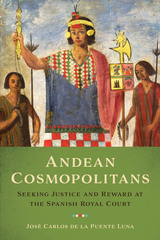
After the Spanish victories over the Inca claimed Tawantinsuyu for Charles V in the 1530s, native Andeans undertook a series of perilous trips from Peru to the royal court in Spain. Ranging from an indigenous commoner entrusted with delivering birds of prey for courtly entertainment to an Inca prince who spent his days amid titles, pensions, and other royal favors, these sojourners were both exceptional and paradigmatic. Together, they shared a conviction that the sovereign’s absolute authority would guarantee that justice would be done and service would receive its due reward. As they negotiated their claims with imperial officials, Amerindian peoples helped forge the connections that sustained the expanding Habsburg realm’s imaginary and gave the modern global age its defining character.
Andean Cosmopolitans recovers these travelers’ dramatic experiences, while simultaneously highlighting their profound influences on the making and remaking of the colonial world. While Spain’s American possessions became Spanish in many ways, the Andean travelers (in their cosmopolitan lives and journeys) also helped to shape Spain in the image and likeness of Peru. De la Puente brings remarkable insights to a narrative showing how previously unknown peoples and ideas created new power structures and institutions, as well as novel ways of being urban, Indian, elite, and subject. As indigenous people articulated and defended their own views regarding the legal and political character of the “Republic of the Indians,” they became state-builders of a special kind, cocreating the colonial order.
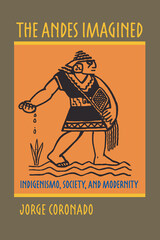
In The Andes Imagined, Jorge Coronado not only examines but also recasts the indigenismo movement of the early 1900s. Coronado departs from the common critical conception of indigenismo as rooted in novels and short stories, and instead analyzes an expansive range of work in poetry, essays, letters, newspaper writing, and photography. He uses this evidence to show how the movement's artists and intellectuals mobilize the figure of the Indian to address larger questions about becoming modern, and he focuses on the contradictions at the heart of indigenismo as a cultural, social, and political movement.
By breaking down these different perspectives, Coronado reveals an underlying current in which intellectuals and artists frequently deployed their indigenous subject in order to imagine new forms of political inclusion. He suggests that these deployments rendered particular variants of modernity and make indigenismo representational practices a privileged site for the examination of the region's cultural negotiation of modernization. His analysis reveals a paradox whereby the un-modern indio becomes the symbol for the modern itself.
The Andes Imagined offers an original and broadly based engagement with indigenismo and its intellectual contributions, both in relation to early twentieth-century Andean thought and to larger questions of theorizing modernity.
“A singular achievement. Mark Banker reveals an almost paradoxical Appalachia that trumps all the stereotypes. Interweaving his family history with the region’s latest scholarship, Banker uncovers deep psychological and economic interconnections between East Tennessee’s ‘three Appalachias’—its tourist-laden Smokies, its urbanized Valley, and its strip-mined Plateau.”
—Paul Salstrom, author of Appalachia’s Path to Dependency
"Banker weaves a story of Appalachia that is at once a national and regional history, a family saga, and a personal odyssey. This book reads like a conversation with a good friend who is well-read and well-informed, thoughtful, wise, and passionate about his subject. He brings new insights to those who know the region well, but, more importantly, he will introduce the region's complexities to a wider audience."
—Jean Haskell, coeditor, <i>Encyclopedia of Appalachia</i>
Appalachians All intertwines the histories of three communities—Knoxville with its urban life, Cades Cove with its farming, logging, and tourism legacies, and the Clearfork Valley with its coal production—to tell a larger story of East Tennessee and its inhabitants. Combining a perceptive account of how industrialization shaped developments in these communities since the Civil War with a heartfelt reflection on Appalachian identity, Mark Banker provides a significant new regional history with implications that extend well beyond East Tennessee’s boundaries.
Writing with the keen eye of a native son who left the area only to return years later, Banker uses elements of his own autobiography to underscore the ways in which East Tennesseans, particularly “successful” urban dwellers, often distance themselves from an Appalachian identity. This understandable albeit regrettable response, Banker suggests, diminishes and demeans both the individual and region, making stereotypically “Appalachian” conditions self-perpetuating. Whether exploring grassroots activism in the Clearfork Valley, the agrarian traditions and subsequent displacement of Cades Cove residents, or Knoxvillians’ efforts to promote trade, tourism, and industry, Banker’s detailed historical excursions reveal not only a profound richness and complexity in the East Tennessee experience but also a profound interconnectedness.
Synthesizing the extensive research and revisionist interpretations of Appalachia that have emerged over the last thirty years, Banker offers a new lens for constructively viewing East Tennessee and its past. He challenges readers to reconsider ideas that have long diminished the region and to re-imagine Appalachia. And ultimately, while Appalachians All speaks most directly to East Tennesseans and other Appalachian residents, it also carries important lessons for any reader seeking to understand the crucial connections between history, self, and place.
Mark T. Banker, a history teacher at Webb School of Knoxville, resides on the farm where he was raised in nearby Roane County. He earned his PhD at the University of New Mexico and is the author of Presbyterian Missions and Cultural Interaction in the Far Southwest, 1850–1950. His articles have appeared in the Journal of Presbyterian History, Journal of the West, OAH Magazine of History, and Appalachian Journal.

Yen Le Espiritu explores the construction of large-scale affiliations, in which previously unrelated groups submerge their differences and assume a common identity. Making use of extensive interviews and statistical data, she examines how Asian panethnicity protects the rights and interests of all Asian American groups, including those, like the Vietnamese and Cambodians, which are less powerful and prominent than the Chinese and Japanese. By citing specific examples—educational discrimination, legal redress, anti-Asian violence, the development of Asian American Studies programs, social services, and affirmative action—the author demonstrates how Asian Americans came to understand that only by cooperating with each other would they succeed in fighting the racism they all faced.

-Eric Liu, author of The Accidental Asian
"There's fury, dignity, and self-awareness in these essays. I found the voices to be energetic and the ideas exciting."
-Diana Son, playwright (Stop Kiss) and co-producer (Law & Order: Criminal Intent)
This refreshing and timely collection of coming-of-age essays, edited and written by young Asian Americans, powerfully captures the joys and struggles of their evolving identities as one of the fastest-growing groups in the nation and poignantly depicts the many oft-conflicting ties they feel to both American and Asian cultures. The essays also highlight the vast cultural diversity within the category of Asian American, yet ultimately reveal how these young people are truly American in their ideals and dreams.
Asian American X is more than a book on identity; it is required reading both for young Asian Americans who seek to understand themselves and their social group, and for all who are interested in keeping abreast of the changing American social terrain.
Combining rich ethnographic descriptions with clear theoretical analyses, At the Risk of Being Heard considers the paradoxical challenges and opportunities confronting indigenous peoples at the dawn of the twenty-first century. In the face of state-sanctioned violence, indigenous peoples encounter considerable risks when asserting their rights, especially to self-determination. Yet, if they remain silent or absent from new arenas of power, hiding in marginalized homelands or cultural practices, they risk being invisible to those allies that would aid them in their struggles for survival.
At the Risk of Being Heard offers needed insights for individuals working on issues of governance, sustainable development, resource management, globalization, and indigenous affairs. It will undoubtedly appeal to undergraduate and graduate students in anthropology, sociology, history, political science, peace studies, and to those students in courses that explore relationships among postcolonial states, indigenous peoples, and human rights.
Bartholomew Dean is Assistant Professor of Anthropology, University of Kansas. Jerome M. Levi is Associate Professor of Anthropology, Carleton College.
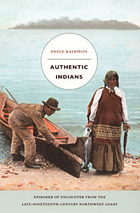
Drawing on research in newspapers, magazines, agency and missionary records, memoirs, and diaries, Raibmon combines cultural and labor history. She looks at three historical episodes: the participation of a group of Kwakwaka’wakw from Vancouver in the 1893 World’s Columbian Exposition in Chicago; the work of migrant Aboriginal laborers in the hop fields of Puget Sound; and the legal efforts of Tlingit artist Rudolph Walton to have his mixed-race step-children admitted to the white public school in Sitka, Alaska. Together these episodes reveal the consequences of outsiders’ attempts to define authentic Aboriginal culture. Raibmon argues that Aboriginal culture is much more than the reproduction of rituals; it also lies in the means by which Aboriginal people generate new and meaningful ways of identifying their place in a changing modern environment.
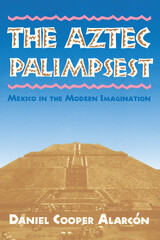
He shows how the Chicano myth of Aztlan was constructed upon earlier Mesoamerican myths, discusses representations of Mexico in texts by nineteenth- and twentieth-century writers, and analyzes the content of tourist literature, thereby revealing the economic, social, and political interests that drive the production of Mexicanness today. This original linking of seemingly incongruous discourses corrects the misconception that Mexicanness is produced only by hegemonic groups. Cooper shows how Mexico has been defined and represented, by both Mexicans and non-Mexicans, as more than a political or geographic entity, and he particularly reveals how Mexicanness has been exploited by Mexicans themselves through the promotion of tourism as a form of neocolonialism.
Cooper's work is valuable both for identifying attempts to revise and control Mexican myth, history, and culture and for defining the intricate relationship between history, historiography, and cultural nationalism. The Aztec Palimpsest extends existing analyses of Mexicanness into new theoretical realms and provides a fresh perspective on the relationship between the United States and Mexico at a time when these two nations are becoming more intimately linked.
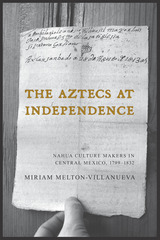
The Aztecs at Independence offers the first internal ethnographic view of these central Mexican indigenous communities in the critical transitional time of Independence. Miriam Melton-Villanueva uses previously unknown Nahuatl-language sources—primarily last wills and testaments—to provide a comprehensive understanding of indigenous societies during the transition from colonial to postcolonial times. The book describes the cultural life of people now called Nahuas or Mexicas in the nineteenth century—based on their own words, their own written records. The book uses previously unknown, unstudied, and untranslated indigenous texts to bring Nahua society into history, fleshing out glimpses of daily life in the early nineteenth century. Thus, The Aztecs at Independence describes life at the most local level: Nahua lineages of ritual and writing, guilds and societies, the people that take turns administering festivals and attending to the last wishes of the dying.
Interwoven with personal stories and memory, The Aztecs at Independence invites a general audience along on a scholarly journey, where readers are asked to imagine Nahua concepts and their contemporary meanings that give light to modern problems.
READERS
Browse our collection.
PUBLISHERS
See BiblioVault's publisher services.
STUDENT SERVICES
Files for college accessibility offices.
RECENTLY PUBLISHED



UChicago Accessibility Resources
home | accessibility | search | about | contact us
BiblioVault ® 2001 - 2024
The University of Chicago Press