
 A SCHOLARLY BOOK REPOSITORY
In a discussion of the Renaissance revival of classical culture, Piccolomini considers the period’s mythologizing of Brutus, Caesar’s assassin. He cites Dante as the initiator of an important literary, dramatic, political, and artistic theme and explains how the historical Brutus was changed by literature and theatre into a symbol of the just citizen rebelling against the unjust tyrant.
Piccolomini discusses several Renaissance political conspiracies modeled after Brutus’ act and explores how those conspiracies, in turn, formed the basis for the theme’s recurrence in Italian, French, and English theatre of the period.

Canonical States, Canonical Stages was first published in 1994. Minnesota Archive Editions uses digital technology to make long-unavailable books once again accessible, and are published unaltered from the original University of Minnesota Press editions.
In the crucible of seventeenth-century Europe, a new kind of subjectivity formed, private and interior. Perversely, the new private subject made its most spectacular appearance on the public stage-an appearance that, as Mitchell Greenberg amply demonstrates, also marked the emergence of absolutism in Europe. What these two phenomena had to do with one another, and how they were elaborated in the theater of the seventeenth century, is the subject of Greenberg's book, a masterful critical work that relates the dramatic construction of modern subjectivity and absolutist culture to the formation of the Western literary canon.
In particular, Canonical States, Canonical Stages shows how the Oedipus myth, reinterpreted on various stages at the end of the Renaissance, served the purposes of the emerging culture by replaying the founding moment of absolute rule. Working with models of genealogical criticism, psychoanalysis, and a certain Continental feminism, Greenberg reads plays by Shakespeare, Lope de Vega, Calderón, Corneille, and Racine to show how, as symptomatic texts staged within the confines of familial scenarios, they combine a dynamics of politics with a conflicting "private" desire shown to be inimical to the dominant ideology. This analysis reveals how scenarios of sacrifice and transcendence are brought into play to normalize and naturalize inchoate and threatening forces of social change by appealing to preexisting cultural models such as the myth of Oedipus. A fascinating integration of texts from political theory, psychoanalysis, history, and literature, Canonical States, Canonical Stages offers a powerful interpretation of the interrelated representation of subjectivity and absolutism on the seventeenth-century stage.Winner of the 1995 MLA Aldo and Jeanne Scaglione Prize for Comparative Literary Studies
Mitchell Greenberg is chair of the Department of French and Italian at Miami University in Ohio. He is the author of, among other books, Subjectivity and Subjugation in Seventeenth-Century Drama and Prose: The Family Romance of French Classicism (1992).
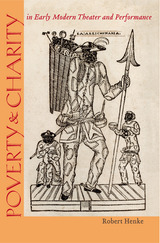
The actor-based theatre and performance traditions examined in this study, which persistently explore felt connections between the itinerant actor and the vagabond beggar, evoke the poor through complex and variegated forms of imagination, thought, and feeling. Early modern theatre does not simply reflect the social ills of hunger, poverty, and degradation, but works them through the forms of poverty, involving displacement, condensation, exaggeration, projection, fictionalization, and marginalization. As the critical mass of medieval charity was put into question, the beggar-almsgiver encounter became more like a performance. But it was not a performance whose script was prewritten as the inevitable exposure of the dissembling beggar. Just as people’s attitudes toward the poor could rapidly change from skepticism to sympathy during famines and times of acute need, fictions of performance such as Edgar’s dazzling impersonation of a mad beggar in Shakespeare’s King Lear could prompt responses of sympathy and even radical calls for economic redistribution.
In this fortieth volume of Renaissance Drama, we pause again, not with the idea that we could define, or even describe, what might be, ought to be, or is included in the study of Renaissance drama (or if it is even always or ever the Renaissance, or the drama, that we study). But this does not even seem to have been what moved the first conversations that became "Research Opportunities" and Renaissance Drama. Rather, as they seem to have felt, we want to look at where we are and where our studies might lead us, and we too think we might as well make a beginning. For this issue, the editors invited a number of scholars working on different kinds of Renaissance drama, in a variety of ways and in several languages, to contribute brief essays addressing the state of the field of Renaissance drama, "the field" being convenient shorthand for the practical but productive indefinition under which we carry out our research and publish Renaissance Drama. In particular we asked them to consider these questions:
- How and with what effects has the study of Renaissance drama (or early modern performance) changed over the past half-century?
- What now is Renaissance drama? What could Renaissance drama become?
- What do you see as the most exciting (or least productive) development in the field?
- How have other developments in literary studies, performance studies, or other historical periods affected work in the field?
- What is missing from work in the field that it would be desirable to include or revive?
- Are there strategies you would propose for working through the divisions in the field based on national boundaries, between languages and traditions, or between canonical figures like Shakespeare, Molière, and other kinds of work? What kinds of distinctions do you see in the field? How are they useful or misleading?
- What new avenues in the field should open up further? Where should we look now?
- What is the most important work being done, or remaining to be done?
Using case studies that explore the Eucharistic wafer on the medieval stage, the bloody handkerchief on the Elizabethan stage, the skull on the Jacobean stage, the fan on the Restoration and early eighteenth-century stage, and the gun on the modern stage, Andrew Sofer reveals how stage props repeatedly thwart dramatic convention and reinvigorate theatrical practice.
While the focus is on specific objects, Sofer also gives us a sweeping history of half a millennium of stage history as seen through the device of the prop, revealing that as material ghosts, stage props are a way for playwrights to animate stage action, question theatrical practice, and revitalize dramatic form.
Andrew Sofer is Assistant Professor of English, Boston College. He was previously a stage director.
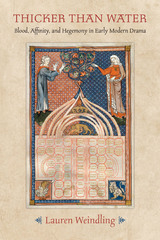
“Blood is thicker than water,” goes the old proverb. But do common bloodlines in fact demand special duties or prescribe affections? Thicker than Water examines the roots of this belief by studying the omnipresent discourse of bloodlines and kindred relations in the literature of early modern Europe.
Early modern discourses concerning kinship promoted the idea that similar bloodlines dictated greater love or affinity, stabilizing the boundaries of families and social classes, as well as the categories of ethnicity and race. Literary representations of romantic relationships were instrumental in such conceptions, and Lauren Weindling examines how drama from England, France, and Italy tests these assumptions about blood and love, exposing their underlying political function. Among the key texts that Weindling studies are Shakespeare’s Romeo and Juliet¸ Othello, and The Merchant of Venice, Pierre Corneille’s Le Cid, Giambattista della Porta’s La Sorella and its English analog, Thomas Middleton’s No Wit/Help Like a Woman’s, John Ford’s ’Tis Pity She’s a Whore, and Machiavelli’s La Mandragola.
Each of these plays offers an extreme limit case for early modern notions of belonging and exclusion, through plots of love, courtship, and marriage, including blood feuds and incest. Moreover, they feature the voices of marginalized groups, unprivileged by these metrics and ideologies, and thus offer significant counterpoints to this bloody worldview.
While most critical studies of blood onstage pertain to matters of guilt or violence, Thicker Than Water examines the work that blood does unseen in arbitrating social and emotional connections between persons, and thus underwriting our deepest forms of social organization.
READERS
Browse our collection.
PUBLISHERS
See BiblioVault's publisher services.
STUDENT SERVICES
Files for college accessibility offices.
RECENTLY PUBLISHED




UChicago Accessibility Resources
home | accessibility | search | about | contact us
BiblioVault ® 2001 - 2024
The University of Chicago Press