
 A SCHOLARLY BOOK REPOSITORY
8 start with L start with L

George Robb’s pioneering study explores the financial methods, accomplishments, and careers of three generations of women. Plumbing sources from stock brokers’ ledgers to media coverage, Robb reveals the many ways women invested their capital while exploring their differing sources of information, approaches to finance, interactions with markets, and levels of expertise. He also rediscovers the forgotten women bankers, brokers, and speculators who blazed new trails--and sparked public outcries over women’s unsuitability for the predatory rough-and-tumble of market capitalism.
Entertaining and vivid with details, Ladies of the Ticker sheds light on the trailblazers who transformed Wall Street into a place for women’s work.
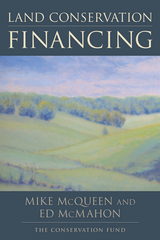
Written by two of the nation's leading experts on land conservation, Land Conservation Financing provides a comprehensive overview of successful land conservation programs -- how they were created, how they are funded, and what they've accomplished -- along with detailed case studies from across the United States.
The authors present important new information on state-of-the-art conservation financing, showcasing programs in states that have become the nation's leaders in open-space protection: California, Colorado, Florida, Illinois, Maryland, Massachusetts, Minnesota, and New Jersey. They look at key local land protection efforts by examining model programs in DeKalb County, Georgia; Douglas County, Colorado; Jacksonville, Florida; Lake County, Illinois; Lancaster County, Pennsylvania; Marin County, California; the St. Louis metro area in Missouri and Illinois, and on Cape Cod, Massachusetts.
The authors then examine how hundreds of communities have created hundreds of millions of dollars in funding by developing successful campaigns to win land conservation ballot measures. They offer case studies and pull together lessons learned as they lay out how to run a successful campaign. The authors also consider the role of private foundations, which have made immense contributions to land conservation over the past two decades.
The book concludes with an examination of the emerging concept of green infrastructure -- a strategic approach to conservation that involves planning and managing a network of parks, natural areas, greenways, and working lands that can help support native species, maintain ecological processes, and contribute to the health and quality of life for America's people and its communities.
Land Conservation Financing is an indispensable resource for land conservationists in the public and private sectors who are looking for a detailed, national portrait of the state of land conservation in America today.
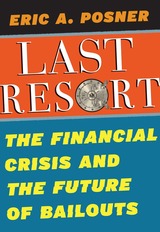
The answer, according to Eric A. Posner, is no. The federal government freely and frequently violated the law with the bailouts—but it did so in the public interest. An understandable lack of sympathy toward Wall Street has obscured the fact that bailouts have happened throughout economic history and are unavoidable in any modern, market-based economy. And they’re actually good. Contrary to popular belief, the financial system cannot operate properly unless the government stands ready to bail out banks and other firms. During the recent crisis, Posner agues, the law didn’t give federal agencies sufficient power to rescue the financial system. The legal constraints were damaging, but harm was limited because the agencies—with a few exceptions—violated or improvised elaborate evasions of the law. Yet the agencies also abused their power. If illegal actions were what it took to advance the public interest, Posner argues, we ought to change the law, but we need to do so in a way that also prevents agencies from misusing their authority. In the aftermath of the crisis, confusion about what agencies did do, should have done, and were allowed to do, has prevented a clear and realistic assessment and may hamper our response to future crises.
Taking up the common objections raised by both right and left, Posner argues that future bailouts will occur. Acknowledging that inevitability, we can and must look ahead and carefully assess our policy options before we need them.
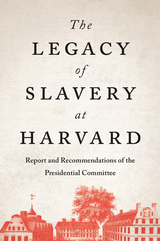
Harvard’s searing and sobering indictment of its own long-standing relationship with chattel slavery and anti-Black discrimination.
In recent years, scholars have documented extensive relationships between American higher education and slavery. The Legacy of Slavery at Harvard adds Harvard University to the long list of institutions, in the North and the South, entangled with slavery and its aftermath.
The report, written by leading researchers from across the university, reveals hard truths about Harvard’s deep ties to Black and Indigenous bondage, scientific racism, segregation, and other forms of oppression. Between the university’s founding in 1636 and 1783, when slavery officially ended in Massachusetts, Harvard leaders, faculty, and staff enslaved at least seventy people, some of whom worked on campus, where they cared for students, faculty, and university presidents. Harvard also benefited financially and reputationally from donations by slaveholders, slave traders, and others whose fortunes depended on human chattel. Later, Harvard professors and the graduates they trained were leaders in so-called race science and eugenics, which promoted disinvestment in Black lives through forced sterilization, residential segregation, and segregation and discrimination in education.
No institution of Harvard’s scale and longevity is a monolith. Harvard was also home to abolitionists and pioneering Black thinkers and activists such as W. E. B. Du Bois, Charles Hamilton Houston, and Eva Beatrice Dykes. In the late twentieth century, the university became a champion of racial diversity in education. Yet the past cannot help casting a long shadow on the present. Harvard’s motto, Veritas, inscribed on gates, doorways, and sculptures all over campus, is an exhortation to pursue truth. The Legacy of Slavery at Harvard advances that necessary quest.
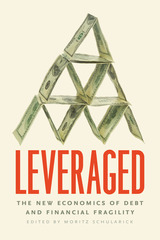
The 2008 financial crisis was a seismic event that laid bare how financial institutions’ instabilities can have devastating effects on societies and economies. COVID-19 brought similar financial devastation at the beginning of 2020 and once more massive interventions by central banks were needed to heed off the collapse of the financial system. All of which begs the question: why is our financial system so fragile and vulnerable that it needs government support so often?
For a generation of economists who have risen to prominence since 2008, these events have defined not only how they view financial instability, but financial markets more broadly. Leveraged brings together these voices to take stock of what we have learned about the costs and causes of financial fragility and to offer a new canonical framework for understanding it. Their message: the origins of financial instability in modern economies run deeper than the technical debates around banking regulation, countercyclical capital buffers, or living wills for financial institutions. Leveraged offers a fundamentally new picture of how financial institutions and societies coexist, for better or worse.
The essays here mark a new starting point for research in financial economics. As we muddle through the effects of a second financial crisis in this young century, Leveraged provides a road map and a research agenda for the future.
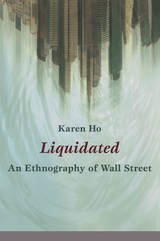
Ho, who worked at an investment bank herself, argues that bankers’ approaches to financial markets and corporate America are inseparable from the structures and strategies of their workplaces. Her ethnographic analysis of those workplaces is filled with the voices of stressed first-year associates, overworked and alienated analysts, undergraduates eager to be hired, and seasoned managing directors. Recruited from elite universities as “the best and the brightest,” investment bankers are socialized into a world of high risk and high reward. They are paid handsomely, with the understanding that they may be let go at any time. Their workplace culture and networks of privilege create the perception that job insecurity builds character, and employee liquidity results in smart, efficient business. Based on this culture of liquidity and compensation practices tied to profligate deal-making, Wall Street investment bankers reshape corporate America in their own image. Their mission is the creation of shareholder value, but Ho demonstrates that their practices and assumptions often produce crises instead. By connecting the values and actions of investment bankers to the construction of markets and the restructuring of U.S. corporations, Liquidated reveals the particular culture of Wall Street often obscured by triumphalist readings of capitalist globalization.
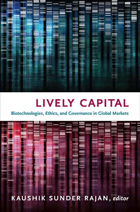
Contributors. Timothy Choy, Joseph Dumit, Michael M. J. Fischer, Kim Fortun, Mike Fortun, Donna Haraway, Sheila Jasanoff, Wen-Hua Kuo, Andrew Lakoff, Kristin Peterson, Chloe Silverman, Elta Smith, Kaushik Sunder Rajan, Travis J. Tanner

READERS
Browse our collection.
PUBLISHERS
See BiblioVault's publisher services.
STUDENT SERVICES
Files for college accessibility offices.
RECENTLY PUBLISHED





UChicago Accessibility Resources
home | accessibility | search | about | contact us
BiblioVault ® 2001 - 2024
The University of Chicago Press