
 A SCHOLARLY BOOK REPOSITORY
22 start with S start with S

America’s public universities educate 80% of our nation’s college students. But in the wake of rising demands on state treasuries, changing demographics, growing income inequality, and legislative indifference, many of these institutions have fallen into decline. Tuition costs have skyrocketed, class sizes have gone up, the number of courses offered has gone down, and the overall quality of education has decreased significantly.
Here James C. Garland draws on more than thirty years of experience as a professor, administrator, and university president to argue that a new compact between state government and public universities is needed to make these schools more affordable and financially secure. Saving Alma Mater challenges a change-resistant culture in academia that places too low a premium on efficiency and productivity. Seeing a crisis of campus leadership, Garland takes state legislators to task for perpetuating the decay of their public university systems and calls for reforms in the way university presidents and governing boards are selected. He concludes that the era is long past when state appropriations can enable public universities to keep their fees low and affordable. Saving Alma Mater thus calls for the partial deregulation of public universities and a phase-out of their state appropriations. Garland’s plan would tie university revenues to their performance and exploit the competitive pressures of the academic marketplace to control costs, rein in tuition, and make schools more responsive to student needs.
A much-needed blueprint for reform based on Garland’s real-life successes as the head of Miami University of Ohio, Saving Alma Mater will be essential for anyone concerned with the costs and quality of higher education in America today.
With Science for Sale, acclaimed journalist Daniel S. Greenberg reveals that campus capitalism is more complicated—and less profitable—than media reports would suggest. While universities seek out corporate funding, news stories rarely note that those industry dollars are dwarfed by government support and other funds. Also, while many universities have set up technology transfer offices to pursue profits through patents, many of those offices have been financial busts. Meanwhile, science is showing signs of providing its own solutions, as highly publicized misdeeds in pursuit of profits have provoked promising countermeasures within the field.
But just because the threat is overhyped, Greenberg argues, doesn’t mean that there’s no danger. From research that has shifted overseas so corporations can avoid regulations to conflicts of interest in scientific publishing, the temptations of money will always be a threat, and they can only be countered through the vigilance of scientists, the press, and the public.
Based on extensive, candid interviews with scientists and administrators, Science for Sale will be indispensable to anyone who cares about the future of scientific research.

What difference does it make who pays for science?
Some might say none. If scientists seek to discover fundamental truths about the world, and they do so in an objective manner using well-established methods, then how could it matter who’s footing the bill? History, however, suggests otherwise. In science, as elsewhere, money is power. Tracing the recent history of oceanography, Naomi Oreskes discloses dramatic changes in American ocean science since the Cold War, uncovering how and why it changed. Much of it has to do with who pays.
After World War II, the US military turned to a new, uncharted theater of warfare: the deep sea. The earth sciences—particularly physical oceanography and marine geophysics—became essential to the US Navy, which poured unprecedented money and logistical support into their study. Science on a Mission brings to light how this influx of military funding was both enabling and constricting: it resulted in the creation of important domains of knowledge but also significant, lasting, and consequential domains of ignorance.
As Oreskes delves into the role of patronage in the history of science, what emerges is a vivid portrait of how naval oversight transformed what we know about the sea. It is a detailed, sweeping history that illuminates the ways funding shapes the subject, scope, and tenor of scientific work, and it raises profound questions about the purpose and character of American science. What difference does it make who pays? The short answer is: a lot.

Miller was perhaps best known for a series of highly influential papers he cowrote in the 1950s and 1960s with fellow Nobel laureate Franco Modigliani that advanced a set of capital structure theorems later dubbed the "M and M propositions." In brief, the M and M propositions state that the actions of investors, firms, and capital markets will cause the market value of a firm to be independent of its capital structure. In other words, a corporation's value depends on its investments in people, ideas, and physical capital goods and not on the mix of bonds, stocks, and other securities used to finance the investments. Four of these papers are reprinted here, together with important later work by Miller in macroeconomics, corporate capital structure, management science, asset pricing, and the economic and regulatory problems of the financial services industry.
Diverse and innovative, the papers in Selected Works of Merton H. Miller will interest students and practitioners of economics, finance, and business, as well as policymakers responsible for market regulation.

Miller was perhaps best known for a series of highly influential papers he cowrote in the 1950s and 1960s with fellow Nobel laureate Franco Modigliani that advanced a set of capital structure theorems later dubbed the "M and M propositions." In brief, the M and M propositions state that the actions of investors, firms, and capital markets will cause the market value of a firm to be independent of its capital structure. In other words, a corporation's value depends on its investments in people, ideas, and physical capital goods and not on the mix of bonds, stocks, and other securities used to finance the investments. Four of these papers are reprinted here, together with important later work by Miller in macroeconomics, corporate capital structure, management science, asset pricing, and the economic and regulatory problems of the financial services industry.
Diverse and innovative, the papers in Selected Works of Merton H. Miller will interest students and practitioners of economics, finance, and business, as well as policymakers responsible for market regulation.
How can you turn an English department into a revenue center? How do you grade students if they are "customers" you must please? How do you keep industry from dictating a university's research agenda? What happens when the life of the mind meets the bottom line? Wry and insightful, Shakespeare, Einstein, and the Bottom Line takes us on a cross-country tour of the most powerful trend in academic life today--the rise of business values and the belief that efficiency, immediate practical usefulness, and marketplace triumph are the best measures of a university's success.
With a shrewd eye for the telling example, David Kirp relates stories of marketing incursions into places as diverse as New York University's philosophy department and the University of Virginia's business school, the high-minded University of Chicago and for-profit DeVry University. He describes how universities "brand" themselves for greater appeal in the competition for top students; how academic super-stars are wooed at outsized salaries to boost an institution's visibility and prestige; how taxpayer-supported academic research gets turned into profitable patents and ideas get sold to the highest bidder; and how the liberal arts shrink under the pressure to be self-supporting.
Far from doctrinaire, Kirp believes there's a place for the market--but the market must be kept in its place. While skewering Philistinism, he admires the entrepreneurial energy that has invigorated academe's dreary precincts. And finally, he issues a challenge to those who decry the ascent of market values: given the plight of higher education, what is the alternative?

As the complex plot to bring down a major financial institution unfolds at a rapid pace, American and Japanese officials scramble to prevent a crisis with international implications. Set against the backdrop of the political and financial practices of Japan, China, and the US, The Shanghai Intrigue brings with it murder, betrayal, romance, even a natural disaster, as the plot races to a most unpredictable outcome. The book’s breakneck speed and thrilling twists and turns will leave readers spellbound from the first page.

In Hollywood, we hear, it’s all about the money. It’s a ready explanation for why so few black films get made—no crossover appeal, no promise of a big payoff. But what if the money itself is color-coded? What if the economics that governs film production is so skewed that no film by, about, or for people of color will ever look like a worthy investment unless it follows specific racial or gender patterns? This, Monica Ndounou shows us, is precisely the case. In a work as revealing about the culture of filmmaking as it is about the distorted economics of African American film, Ndounou clearly traces the insidious connections between history, content, and cash in black films.
How does history come into it? Hollywood’s reliance on past performance as a measure of potential success virtually guarantees that historically underrepresented, underfunded, and undersold African American films devalue the future prospects of black films. So the cycle continues as it has for nearly a century. Behind the scenes, the numbers are far from neutral. Analyzing the onscreen narratives and off-screen circumstances behind nearly two thousand films featuring African Americans in leading and supporting roles, including such recent productions as Bamboozled, Beloved, and Tyler Perry’s Diary of a Mad Black Woman, Ndounou exposes the cultural and racial constraints that limit not just the production but also the expression and creative freedom of black films. Her wide-ranging analysis reaches into questions of literature, language, speech and dialect, film images and narrative, acting, theater and film business practices, production history and financing, and organizational history.
By uncovering the ideology behind profit-driven industry practices that reshape narratives by, about, and for people of color, this provocative work brings to light existing limitations—and possibilities for reworking stories and business practices in theater, literature, and film.



The essays here highlight the problems that the European pension reform process faces and how it differs from that of the United States. This timely volume will significantly enrich the debate on pension reform worldwide.
Drawing on the work of an international group of noted economists, the editors argue that social security programs provide strong incentives for workers to leave the labor force by retiring and taking the benefits to which they are entitled. By penalizing work, social security systems magnify the increased financial burden caused by aging populations, thus contributing to the insolvency of the system. This book is a model of comparative analysis that evaluates the effects of illustrative policies for countries facing the impending rapid growth of social security benefits. Its insights will help inform one of the most pressing debates.

According to the authors of this important new study, the answer to these questions is a resounding no. In Social Security: The Phony Crisis, economists Dean Baker and Mark Weisbrot argue that there is no economic, demographic, or actuarial basis for the widespread belief that the program needs to be fixed.
As the authors emphasize, there is virtually no disagreement about the facts of Social Security's finances, or even the projections for its future. Rather, the Social Security debate has been foundering on misconceptions, confusion, and lack of agreement on the meaning of crucial terms.
The authors also take on related issues: that privatization would help save Social Security, that America has a pressing need to increase its national savings, and that future generations will suffer from the costs—especially for health care—of supporting a growing elderly population.
As New York Times columnist Fred Brock recently wrote, "So-called reform of the Social Security system is looking more and more like a solution in search of a problem." In this accessible and insightful work, Baker and Weisbrot seek to cut through some of the myths and fallacies surrounding this crucial policy issue.
"Dean Baker and Mark Weisbrot have no trouble at all demonstrating that even on highly conservative assumptions about economic growth, the much-forecast insolvency of the Social Security system by about 2030 is most unlikely to happen then, if indeed ever."—The Economist
"The authors challenge basic assumptions with vigor and intelligence. . . . An absolutely relevant and important analysis, presented with force and clarity, that asks, basically, what kind of a nation we really are."—Kirkus Reviews
"Proponents—like George W. Bush—of Social Security privatization . . . typically ignore prospects for a stagnant or falling stock market. In Social Security: The Phony Crisis, [Baker and Weisbrot] show how a falling stock market could place pressure on both future Social Security payments and privatization schemes because earnings from the trust fund could actually fall."—Jeff Madrick, New York Review of Books
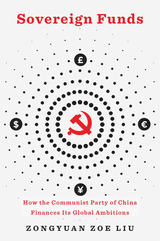
The first in-depth account of the sudden growth of China’s sovereign wealth funds and their transformative impact on global markets, domestic and multinational businesses, and international politics.
One of the keys to China’s global rise has been its strategy of deploying sovereign wealth on behalf of state power. Since President Xi Jinping took office in 2013, China has doubled down on financial statecraft, making shrewd investments with the sovereign funds it has built up by leveraging its foreign exchange reserves. Sovereign Funds tells the story of how the Communist Party of China (CPC) became a global financier of surpassing ambition.
Zongyuan Zoe Liu offers a comprehensive and up-to-date analysis of the evolution of China’s sovereign funds, including the China Investment Corporation, the State Administration of Foreign Exchange, and Central Huijin Investment. Liu shows how these institutions have become mechanisms not only for transforming low-reward foreign exchange reserves into investment capital but also for power projection. Sovereign funds are essential drivers of the national interest, shaping global markets, advancing the historic Belt and Road Initiative, and funneling state assets into strategic industries such as semiconductors, fintech, and artificial intelligence. In the era of President Xi, state-owned financial institutions have become gatekeepers of the Chinese economy. Political and personal relationships with prestigious sovereign funds have enabled Blackstone to flourish in China and have fueled the ascendance of private tech giants such as Alibaba, Ant Finance, and Didi.
As Liu makes clear, sovereign funds are not just for oil exporters. The CPC is a leader in both foreign exchange reserves investment and economic statecraft, using state capital to encourage domestic economic activity and create spheres of influence worldwide.
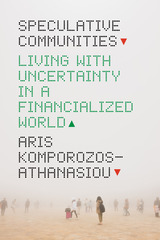
In Speculative Communities, Aris Komporozos-Athanasiou examines the ways that speculation has moved beyond financial markets to shape fundamental aspects of our social and political lives. As ordinary people make exceptional decisions, such as the American election of a populist demagogue or the British vote to leave the European Union, they are moving from time-honored and -tested practices of governance, toward the speculative promise of a new, more uncertain future. This book shows how even our methods of building community have shifted to the speculative realm as social media platforms enable and amplify our volatile wagers.
For Komporozos-Athanasiou, “to speculate” means increasingly “to connect,” to endorse the unknown pre-emptively, and often daringly, as a means of social survival. Grappling with the question of how more uncertainty can lead to its full-throated embrace rather than dissent, Speculative Communities shows how finance has become the model for society writ large. As Komporozos-Athanasiou argues, virtual marketplaces, new social media, and dating apps bring finance’s opaque infrastructures into the most intimate realms of our lives, leading to a new type of speculative imagination across economy, culture, and society.
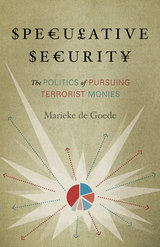
Since the terrorist acts of September 11, 2001, finance and security have become joined in new ways to produce particular targets of state surveillance. In Speculative Security, Marieke de Goede describes how previously unscrutinized practices such as donations and remittances, especially across national borders, have been affected by security measures that include datamining, asset freezing, and transnational regulation. These “precrime” measures focus on transactions that are perfectly legal but are thought to hold a specific potential to support terrorism. The pursuit of suspect monies is not simply an issue of financial regulation, she shows, but a broad political, social, and even cultural phenomenon with profound effects on everyday life.
Speculative Security offers a range of examples that illustrate the types of security interventions employed today, including the extralegal targeting and breaking up of the al-Barakaat financial network that was accompanied by raids in the United States, asset freezes in Sweden, and the incarceration of a money remitter at Guantánamo Bay. De Goede develops the paradigm of “speculative security” as a way to understand the new fusing of finance and security, denoting the speculative nature of both the means and the ends of the war on terrorist financing.
Ultimately, de Goede reveals how the idea of creating “security” appeals to multiple imaginable—and unimaginable—futures in order to enable action in the present.
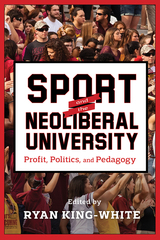
The contributors to Sport and the Neoliberal University examine how intercollegiate athletics became a contested terrain of public/private interests. They look at college sports from economic, social, legal, and cultural perspectives to cut through popular mythologies regarding intercollegiate athletics and to advocate for increased clarity about what is going on at a variety of campuses with regard to athletics. Focusing on current issues, including the NCAA, Title IX, recruitment of high school athletes, and the Penn State scandal, among others, Sport and the Neoliberal University shows the different ways institutions, individuals, and corporations are interacting with university athletics in ways that are profoundly shaped by neoliberal ideologies.
Building on recent developments in the social studies of finance, Stories of Capitalism provides the first ethnography of financial analysis. Drawing on two years of fieldwork in a Swiss bank, Stefan Leins argues that financial analysts construct stories of possible economic futures, presenting them as coherent and grounded in expert research and analysis. In so doing, they establish a role for themselves—not necessarily by laying bare empirically verifiable trends but rather by presenting the market as something that makes sense and is worth investing in. Stories of Capitalism is a nuanced look at how banks continue to boost investment—even in unstable markets—and a rare insider’s look into the often opaque financial practices that shape the global economy.
In higher education, supply refers to such issues as government support for public colleges and universities, the means by which graduate programs allocate financial support to students, and the criteria that universities use for investing endowments. Demand pertains to patterns of student enrollment and to the government, business, and individual market for the service and research activities of higher education.
Why are tuitions nearly the same among schools despite differences in prestige? How are institutions with small endowments able to compete successfully with institutions that have huge endowments? How are race and ethnicity reflected in enrollment trends? Where do the best students go? What choices among colleges do young people from low-income backgrounds face? This volume addresses these questions and suggests subjects for further study of the economics of higher education.
Listen to a short interview with Philip T. HoffmanHost: Chris Gondek | Producer: Heron & Crane
Financial disasters often have long-range institutional consequences. When financial institutions--banks, insurance companies, brokerage firms, stock exchanges--collapse, new ones take their place, and these changes shape markets for decades or even generations. Surviving Large Losses explains why such financial crises occur, why their effects last so long, and what political and economic conditions can help countries both rich and poor survive--and even prosper--in the aftermath.Looking at past and more recent financial disasters through the lens of political economy, the authors identify three factors critical to the development of financial institutions: the level of government debt, the size of the middle class, and the quality of information that is available to participants in financial transactions. They seek to find out when these factors promote financial development and mitigate the effects of financial crises and when they exacerbate them.Although there is no panacea for crises--no one set of institutions that will resolve them--it is possible, the authors argue, to strengthen existing financial institutions, to encourage economic growth, and to limit the harm that future catastrophes can do.
How “innovative” finance schemes skim public wealth while hijacking public governance
Charter school expansion. Vouchers. Scholarship tax credit programs. The Swindle of Innovative Educational Finance offers a new social theory to explain why these and other privatization policies and programs win support despite being unsupported by empirical evidence. Kenneth J. Saltman details how, under the guise of innovation, cost savings, and corporate social responsibility, new and massive neoliberal educational privatization schemes have been widely adopted in the United States. From a trillion-dollar charter school bubble to the Chan Zuckerberg Initiative to celebrities branding private schools, Saltman ultimately connects such schemes to the country’s current crisis of truth and offers advice for resistance.
Forerunners is a thought-in-process series of breakthrough digital works. Written between fresh ideas and finished books, Forerunners draws on scholarly work initiated in notable blogs, social media, conference plenaries, journal articles, and the synergy of academic exchange. This is gray literature publishing: where intense thinking, change, and speculation take place in scholarship.
READERS
Browse our collection.
PUBLISHERS
See BiblioVault's publisher services.
STUDENT SERVICES
Files for college accessibility offices.
RECENTLY PUBLISHED







UChicago Accessibility Resources
home | accessibility | search | about | contact us
BiblioVault ® 2001 - 2024
The University of Chicago Press