
 A SCHOLARLY BOOK REPOSITORY
In this fascinating piece of scholarly detective work, biblical scholar Savina J. Teubal peels away millenia of patriarchal distortion to reveal the lost tradition of biblical matriarchs. In Ancient Sisterhood: The Lost Traditions of Hagar and Sarah (originally published as Hagar the Egyptian), she shows that Hagar, the mother of Ishmael, was actually lady-in-waiting to the priestess Sarah and participated in an ancient Near Eastern custom of surrogate motherhood.
Ancient Sisterhood cites evidence that Hebrew women actually enjoyed the privileges and sanctity of their own religious practices. These practices, however, were gradually eroded and usurped by the establishment of patriarchal monarchies that were based on militaristic conquest and power. Teubal examines the figures of Hagar and Sarah from a feminist perspective that combines thorough scholarship with an informed and detailed understanding of the cultural and religious influences from which the mysterious biblical figure of Hagar emerged. She looks at Hagar’s important role in the genesis of Hebrew culture, her role as mother of the Islamic nations, and her power as a matriarch as opposed to her apparent status as a concubine.
Teubal posits two distinct sources for the Hagar episodes: Hagar as companion to Sarah and an unknown woman whom she refers to as the desert matriarch. She explores whether Hagar was a slave to Abraham or Sarah, the differences between Hagar and the desert matriarch, and the obscurantism of these important elements in biblical texts. Teubal sheds considerable light on two central figures of these world religions and “the disassociation of woman from her own female religious experience.”
Examining Genesis in a philosophical light, Kass presents it not as a story of what happened long ago, but as the enduring story of humanity itself. He asserts that the first half of Genesis contains insights about human nature that “rival anything produced by the great philosophers.” Kass here reads these first stories—from Adam and Eve to the tower of Babel—as a mirror for self-discovery that reveals truths about human reason, speech, freedom, sexual desire, pride, shame, anger, and death. Taking a step further in the second half of his book, Kass explores the struggles in Genesis to launch a new way of life that addresses mankind’s morally ambiguous nature by promoting righteousness and holiness.
Even readers who don’t agree with Kass’s interpretations will find The Beginning of Wisdom acompelling book—a masterful philosophical take on one of the world’s seminal religious texts.
“A learned and fluent, delightfully overstuffed stroll through the Gates of Eden. . . . Mix Harold Bloom with Stephen Jay Gould and you’ll get something like Kass. A wonderfully intelligent reading of Genesis.”—Kirkus Reviews, starred review
“Throughout his book, Kass uses fruitful, fascinating techniques for getting at the heart of Genesis. . . . Innumerable times [he] makes a reader sit back and rethink what has previously been tediously familiar or baffling.”—Washington Post
“It is important to state that this is a book not merely rich, but prodigiously rich with insight. Kass is a marvelous reader, sensitive and careful. His interpretations surprise again and again with their cogency and poignancy.”—Jerusalem Post
Thirteen respected researchers combine their experiences in Bonebeds, providing readers with workable definitions, theoretical frameworks, and a compendium of modern techniques in bonebed data collection and analysis. By addressing the historical, theoretical, and practical aspects of bonebed research, this edited volume—the first of its kind—provides the background and methods that students and professionals need to explore and understand these fantastic records of ancient life and death.

Chicano Studies is a comparatively new academic discipline. Unlike well-established fields of study that long ago codified their canons and curricula, the departments of Chicano Studies that exist today on U.S. college and university campuses are less than four decades old. In this edifying and frequently eye-opening book, a career member of the discipline examines its foundations and early years. Based on an extraordinary range of sources and cognizant of infighting and the importance of personalities, Chicano Studies is the first history of the discipline.
What are the assumptions, models, theories, and practices of the academic discipline now known as Chicano Studies? Like most scholars working in the field, Michael Soldatenko didn't know the answers to these questions even though he had been teaching for many years. Intensely curious, he set out to find the answers, and this book is the result of his labors. Here readers will discover how the discipline came into existence in the late 1960s and how it matured during the next fifteen years-from an often confrontational protest of dissatisfied Chicana/o college students into a univocal scholarly voice (or so it appears to outsiders).
Part intellectual history, part social criticism, and part personal meditation, Chicano Studies attempts to make sense of the collision (and occasional wreckage) of politics, culture, scholarship, ideology, and philosophy that created a new academic discipline. Along the way, it identifies a remarkable cast of scholars and administrators who added considerable zest to the drama.

“They join the greatest boldness in thought to the most obedient character.” So Madame de Stael described German intellectuals at the close of the 18th century, and her view of this schism between the intellectual and the political has stood virtually unchallenged for 200 years. This book lays to rest Madam de Stael's legacy, the myth of the apolitical German. In a narrative history of ideas that proceeds from his book The Fate of Reason, Frederick Beiser discusses how the French Revolution, with a rationalism and an irrationalism that altered the world, transformed and politicized German philosophy and its central concern: the authority and limits of reason. In Germany, three antithetical political traditions—liberalism, conservatism, and romanticism—developed in response to the cataclysmic events in France.
Enlightenment, Revolution, and Romanticism establishes the genesis and context of these traditions and illuminates their fundamental political ideas. Moving from such well-known figures as Kant, Fichte, Jacobi, Forster, and Moser, Beiser summarizes responses to the French Revolution by the major political thinkers of the period. He investigates the sources for their political theory before the 1790s and assesses the importance of politics for their thought in general. By concentrating on a single formative decade, Beiser aims to reveal the political values and purposes underlying German thought in the late 18th century and ultimately to clarify the place of practical reason in the German philosophical tradition.
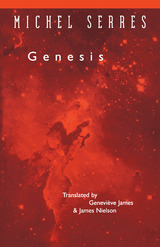
Serres draws on a vast knowledge of such diverse disciplines as anthropology, classical history, music, theology, art history, information theory, physics, biology, dance and athletics, and Western metaphysics, and a range of cultural material that includes the writings of Plato, Kant, August Comte, Balzac, and Shakespeare, to name a few. He argues that although philosophy has been instrumental in the past in establishing laws of logic and rationality that have been crucial to our understanding of ourselves and our universe, one of the most pressing tasks of thought today is to recognize that such pockets of unity are islands of order in a sea of multiplicity--a sea which cannot really be conceived, but which perhaps can still be sensed, felt, and heard raging in chaos beneath the momentary crests of order imposed by human civilization.
Philosophy of science or prose poetry, a classical meditation on metaphysics or a stream-of-consciousness polemic and veiled invective, Serres mounts a quirky, at times rhapsodical, but above all a "noisy" critique of traditional and current models in social theory, historiography, and aesthetics. The result is a work that is at once provocative, poetic, deeply personal, and ultimately religious--an apocalyptic call for the rebirth of philosophy as the art of thinking the unthinkable.
About the Book:
"An intensely beautiful and rigourous meditation on the birth of forms amid chaos and multiplicity from a major philosopher who is also an exquisite craftsman of the written word." --William Paulson, University of Michigan
"Serres exhibits a rare, raw tendentiousness refreshing in its vitriol . . . it's the sort of light-hearted, perverse, and basically liberal tirade one hears too infrequently of late." --Word
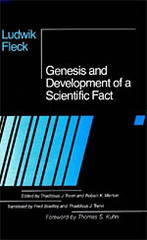
"To many scientists just as to many historians and philosophers of science facts are things that simply are the case: they are discovered through properly passive observation of natural reality. To such views Fleck replies that facts are invented, not discovered. Moreover, the appearance of scientific facts as discovered things is itself a social construction, a made thing. A work of transparent brilliance, one of the most significant contributions toward a thoroughly sociological account of scientific knowledge."—Steven Shapin, Science
First published in 1951, Genesis and Geology describes the background of social and theological ideas and the progress of scientific researches that, between them, produced the religious difficulties that afflicted the development of science in early industrial England. The book makes clear that the furor over On the Origin of Species was nothing new: earlier discoveries in science, particularly geology, had presented major challenges, not only to the literal interpretation of the Book of Genesis, but even more seriously to the traditional idea that Providence controls the order of nature with an eye to fulfilling divine purpose.
A new Foreword by Nicolaas Rupke places this book in the context of the last forty-five years of scholarship in the social history of evolutionary thought. Everyone interested in the history of modern science, in ideas, and in nineteenth-century England will want to read this book.
We seem to be abandoning the codes that told previous generations who they should love. But now that many of us are free to choose whoever we want, nothing is less certain. The proliferation of divorces and separations reveal a dynamic we would rather not see: others sometimes reject us as passionately as we are attracted to them.
Our desire makes us sick. The throes of rivalry are at the heart of our attraction to one another. This is the central thesis of Jean-Michel Oughourlian's The Genesis of Desire, where the war of the sexes is finally given a scientific explanation. The discovery of mirror neurons corroborates his ideas, clarifying the phenomena of empathy and the mechanisms of violent reciprocity.
How can a couple be saved when they have declared war on one another? By helping them realize that desire originates not in the self but in the other. There are strategies that can help, which Dr. Oughourlian has prescribed successfully to his patients. This work, alternating between case studies and more theoretical statements, convincingly defends the possibility that breakups need not be permanent.
The austerity and grandeur of Kant's philosophical writings sometimes make it hard to recognize them as the products of a historical individual situated in the particular constellation of his time and society. Here Kant emerges as a concrete historical figure struggling to preserve the achievements of cosmopolitan Aufkl-rung against challenges in natural science, religion, and politics in the late 1780s. More specifically Zammito suggests that Kant's Third Critique was animated throughout by a fierce personal rivalry with Herder and by a strong commitment to traditional Christian ideas of God and human moral freedom.
"A work of extraordinary erudition. Zammito's study is both comprehensive and novel, connecting Kant's work with the aesthetic and religious controversies of the late eighteenth century. He seems to have read everything. I know of no comparable historical study of Kant's Third Critique."-Arnulf Zweig, translator and editor of Kant's ;IPhilosophical Correspondence, 1759-1799;X
"An intricate, subtle, and exciting explanation of how Kant's thinking developed and adjusted to new challenges over the decade from the first edition of the Critique of Pure Reason to the appearance of the Critique of Judgment."—John W. Burbidge, Review of Metaphysics
"There has been for a long time a serious gap in English commentary on Kant's Critique of Judgment; Zammito's book finally fills it. All students and scholars of Kant will want to consult it."—Frederick Beiser, Times Literary Supplement
This important work, which brought Timpanaro international repute, now appears in its first English translation. The Genesis of Lachmann's Method examines the origin, development, and validity of Lachmann's model as well as its association with Lachmann himself. It remains a fundamental work on the history and methods of philology, and Glenn W. Most's translation makes this seminal study available to an English-speaking audience. Revealing Timpanaro's extraordinary talent as a textual critic and world-class scholar, this book will be indispensable to classicists, textual critics, biblical scholars, historians of science, and literary theorists.

The story of the blending of diverse cultures in a land rich in resources and beauty is an extraordinary one. In this account, the pioneer hunters, trappers, and traders who roamed the Ozark hills and the boatmen who traded on the Missouri and Mississippi Rivers take their place beside the small coterie of St. Louisans whose wealth and influence enabled them to dominate the region politically and economically. Especially appealing for many readers will be the attention Foley gives to common Missourians, to the status of women and blacks, and to Indian-white relations.
Frank Kermode has long held a distinctive place among modern critics. He brings to the study of literature a fine and fresh critical intelligence that is always richly suggestive, never modish. He offers here an inquiry—elegant in conception and style—into the art of interpretation. His subject quite simply is meanings; how they are revealed and how they are concealed.
Drawing on the venerable tradition of biblical interpretation, Mr. Kermode examines some enigmatic passages and episodes in the gospels. From his reading come ideas about what makes interpretation possible—and often impossible. He considers ways in which narratives acquire opacity, and he asks whether there are methods of distinguishing all possible meaning from a central meaning which gives the story its structure. He raises questions concerning the interpretation of single texts in relation to their context in a writer’s work and a tradition; considers the special interpretative problems of historical narration; and tries to relate the activities of the interpreter to interpretation more broadly conceived as a means of living in the world.
While discussing the gospels, Mr. Kermode touches upon such literary works as Kafka’s parables, Joyce’s Ulysses, Henry James’s novels, and Pynchon’s Crying of Lot 49. By showing the relationships between religious interpretation and literary criticism, he has enhanced both fields.
Research powers innovation and technoscientific advance, but it is due for a rethink, one consistent with its deeply holistic nature, requiring deeply human nurturing.
Research is a deeply human endeavor that must be nurtured to achieve its full potential. As with tending a garden, care must be taken to organize, plant, feed, and weed—and the manner in which this nurturing is done must be consistent with the nature of what is being nurtured.
In The Genesis of Technoscientific Revolutions, Venkatesh Narayanamurti and Jeffrey Tsao propose a new and holistic system, a rethinking of the nature and nurturing of research. They share lessons from their vast research experience in the physical sciences and engineering, as well as from perspectives drawn from the history and philosophy of science and technology, research policy and management, and the evolutionary biological, complexity, physical, and economic sciences.
Narayanamurti and Tsao argue that research is a recursive, reciprocal process at many levels: between science and technology; between questions and answer finding; and between the consolidation and challenging of conventional wisdom. These fundamental aspects of the nature of research should be reflected in how it is nurtured. To that end, Narayanamurti and Tsao propose aligning organization, funding, and governance with research; embracing a culture of holistic technoscientific exploration; and instructing people with care and accountability.


In his introduction, Terras outlines the genesis, main ideas, and structural peculiarities of the novel as well as Dostoevsky’s political, philosophical, and aesthetic stance. The detailed commentary takes the reader through the novel, clarifying aspects of Russian life, the novel’s sociopolitical background, and a number of polemic issues. Terras identifies and explains hundreds of literary and biblical quotations and allusions. He discusses symbols, recurrent images, and structural stylistic patterns, including those lost in English translation.
There is no doubt about Le Corbusier's dominating stature in twentieth century architecture. Here, for the first time, is a richly illustrated portrait of the way he worked out a design from inception to completion; it is an examination of the creative process that looks over the architect's shoulder, seeing his governing principles and typical strategies as well as his working habits and personality.
The book recounts the story of a building that for its creator had a special significance. The Carpenter Center for the Visual Arts at Harvard was one of his last buildings. Le Corbusier was aware that it would be his only one in the United States and thus his only chance to teach an object lesson in a country about which he had very strong feelings. William Curtis describes the Carpenter Center and traces, step by step, the development of its design. Eduard Sekler assesses the building's aesthetics, especially in relation to Le Corbusier's total oeuvre. Rudolph Arnheim and Barbara Norfleet contribute chapters that look at the Carpenter Center as an exercise in creativity and assess its psychological effect and its ability to meet the changing needs of its users.
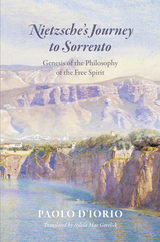
Nietzsche first voyaged to the south in the autumn of 1876, upon the invitation of his friend, Malwida von Meysenbug. The trip was an immediate success, reviving Nietzsche’s joyful and trusting sociability and fertilizing his creative spirit. Walking up and down the winding pathways of Sorrento and drawing on Nietzsche’s personal notebooks, D’Iorio tells the compelling story of Nietzsche’s metamorphosis beneath the Italian skies. It was here, D’Iorio shows, that Nietzsche broke intellectually with Wagner, where he decided to leave his post at Bâle, and where he drafted his first work of aphorisms, Human, All Too Human, which ushered in his mature era. A sun-soaked account of a philosopher with a notoriously overcast disposition, this book is a surprising travelogue through southern Italy and the history of philosophy alike.
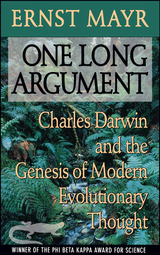
Evolutionary theory ranks as one of the most powerful concepts of modern civilization. Its effects on our view of life have been wide and deep. One of the most world-shaking books ever published, Charles Darwin’s On the Origin of Species, first appeared in print over 130 years ago, and it touched off a debate that rages to this day.
Every modern evolutionist turns to Darwin’s work again and again. Current controversies in the life sciences very often have as their starting point some vagueness in Darwin’s writings or some question Darwin was unable to answer owing to the insufficient biological knowledge available during his time. Despite the intense study of Darwin’s life and work, however, many of us cannot explain his theories (he had several separate ones) and the evidence and reasoning behind them, nor do we appreciate the modifications of the Darwinian paradigm that have kept it viable throughout the twentieth century.
Who could elucidate the subtleties of Darwin’s thought and that of his contemporaries and intellectual heirs—A. R. Wallace, T. H. Huxley, August Weismann, Asa Gray—better than Ernst Mayr, a man considered by many to be the greatest evolutionist of the century? In this gem of historical scholarship, Mayr has achieved a remarkable distillation of Charles Darwin’s scientific thought and his enormous legacy to twentieth-century biology. Here we have an accessible account of the revolutionary ideas that Darwin thrust upon the world. Describing his treatise as “one long argument,” Darwin definitively refuted the belief in the divine creation of each individual species, establishing in its place the concept that all of life descended from a common ancestor. He proposed the idea that humans were not the special products of creation but evolved according to principles that operate everywhere else in the living world; he upset current notions of a perfectly designed, benign natural world and substituted in their place the concept of a struggle for survival; and he introduced probability, chance, and uniqueness into scientific discourse.
This is an important book for students, biologists, and general readers interested in the history of ideas—especially ideas that have radically altered our worldview. Here is a book by a grand master that spells out in simple terms the historical issues and presents the controversies in a manner that makes them understandable from a modern perspective.

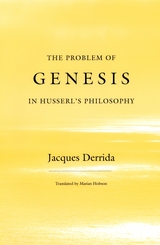
For Derrida, the problem of genesis in Husserl's philosophy is that both temporality and meaning must be generated by prior acts of the transcendental subject, but transcendental subjectivity must itself be constituted by an act of genesis. Hence, the notion of genesis in the phenomenological sense underlies both temporality and atemporality, history and philosophy, resulting in a tension that Derrida sees as ultimately unresolvable yet central to the practice of phenomenology.
Ten years later, Derrida moved away from phenomenology entirely, arguing in his introduction to Husserl's posthumously published Origin of Geometry and his own Speech and Phenomena that the phenomenological project has neither resolved this tension nor expressly worked with it. The Problem of Genesis complements these other works, showing the development of Derrida's approach to phenomenology as well as documenting the state of phenomenological thought in France during a particularly fertile period, when Levinas, Sartre, Merleau-Ponty, Ricoeur, and Tran-Duc-Thao, as well as Derrida, were all working through it. But the book is most important in allowing us to follow Derrida's own development as a philosopher by tracing the roots of his later work in deconstruction to these early critical reflections on Husserl's phenomenology.
"A dissertation is not merely a prerequisite for an academic job. It may set the stage for a scholar's life project. So, the doctoral dissertations of Max Weber and Jacques Derrida, never before available in English, may be of more than passing interest. In June, the University of Chicago Press will publish Mr. Derrida's dissertation, The Problem of Genesis in Husserl's Philosophy, which the French philosopher wrote in 1953-54 as a doctoral student, and which did not appear in French until 1990. From the start, Mr Derrida displayed his inventive linguistic style and flouting of convention."—Danny Postel, Chronicle of Higher Education
Syncretistic exegesis.
The philosopher Philo was born about 20 BC to a prominent Jewish family in Alexandria, the chief home of the Jewish Diaspora as well as the chief center of Hellenistic culture; he was trained in Greek as well as Jewish learning. In attempting to reconcile biblical teachings with Greek philosophy he developed ideas that had wide influence on Christian and Jewish religious thought.
The Loeb Classical Library edition of the works of Philo is in ten volumes and two supplements, distributed as follows. Volume I: Creation; Interpretation of Genesis II and III. II: On the Cherubim; The Sacrifices of Abel and Cain; The Worse Attacks the Better; The Posterity and Exile of Cain; On the Giants. III: The Unchangeableness of God; On Husbandry; Noah's Work as a Planter; On Drunkenness; On Sobriety. IV: The Confusion of Tongues; The Migration of Abraham; The Heir of Divine Things; On the Preliminary Studies. V: On Flight and Finding; Change of Names; On Dreams. VI: Abraham; Joseph; Moses. VII: The Decalogue; On Special Laws Books I–III. VIII: On Special Laws Book IV; On the Virtues; Rewards and Punishments. IX: Every Good Man Is Free; The Contemplative Life; The Eternity of the World; Against Flaccus; Apology for the Jews; On Providence. X: On the Embassy to Gaius; indexes. Supplement I: Questions on Genesis. II: Questions on Exodus; index to supplements.
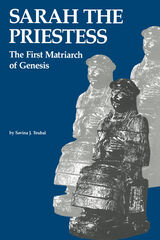
In a patriarchal environment such as the Canaan of Genesis, the situation is discordant and problematic. Dr. Teubal suggests that the difficulty is eliminated, however, if we understand that Sarah and the other matriarchs mentioned in the narratives acted within the established, traditional Mesopotamian role of priestess, of a class of women who retained a highly privileged position vis-a-vis their husbands.
Dr. Teubal shows that the “Sarah tradition” represents a nonpatriarchal system struggling for survival in isolation, in the patriarchal environment of what was for Sarah a foreign society. She further indicates that the insistence of Sarah and Rebekah that their sons and heirs marry wives from the old homeland had to do not so much with preference for endogamy and cousin marriage as with their intention of ensuring the continuation of their old kahina-tradition against the overwhelming odds represented by patriarchal Canaan.
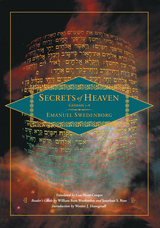
The first major theological work of the Swedish scientist-turned-seer Emanuel Swedenborg, Secrets of Heaven is in one sense a traveler's account. It reveals the unseen realms that await beyond death--the light, the warmth, and harmony of the angelic heavens and the varied darkness of the multitudinous hells. But in addition, the work offers a detailed examination of Genesis and Exodus, providing a model for a new way to understand the entire Bible. Prized for both the simplicity of its explanation and the breadth and depth of its vision, Swedenborg's reading of Scripture discloses layer upon layer of inner meaning, all without undermining the power and import of the literal word.
This first of the multivolume work contains an introduction by Wouter J. Hanegraaff, professor of History of Hermetic Philosophy and Related Currents at the University of Amsterdam, and a reader's guide by Swedenborgian scholar William Ross Woofenden and New Century Edition Series Editor Jonathan S. Rose.
The New Century Edition of the Works of Emanuel Swedenborg is a modern-language, scholarly translation of Swedenborg’s theological works. The series’ easy-to-read style retains the dignity, variety, clarity, and gender-inclusive language of Swedenborg’s original Latin, bringing his thought to life. Introductions and annotations by eminent, international scholars place Swedenborg’s writings in their historical context and illuminate obscure references within the text, enabling readers to understand and trace Swedenborg’s influence as never before.
The first major theological work of the Swedish scientist-turned-seer Emanuel Swedenborg, Secrets of Heaven is in one sense a traveler's account. It reveals the unseen realms that await beyond death--the light, the warmth, and harmony of the angelic heavens and the varied darkness of the multitudinous hells. But in addition, the work offers a detailed examination of Genesis and Exodus, providing a model for a new way to understand the entire Bible. Prized for both the simplicity of its explanation and the breadth and depth of its vision, Swedenborg's reading of Scripture discloses layer upon layer of inner meaning, all without undermining the power and import of the literal word.
The New Century Edition of the Works of Emanuel Swedenborg is a modern-language, scholarly translation of Swedenborg’s theological works. The series’ easy-to-read style retains the dignity, variety, clarity, and gender-inclusive language of Swedenborg’s original Latin, bringing his thought to life.
This portable edition of Secrets of Heaven vol. 1 includes the text of the New Century Edition without the introduction, annotations, and other supplementary of the deluxe hardcover and paperback editions.
Secrets of Heaven is Emanuel Swedenborg’s magnum opus, a fifteen-volume work that delves into the inner, spiritual meaning of the Bible. Starting from the first verse, Swedenborg goes through Genesis and Exodus verse by verse, sometimes word by word, uncovering the fascinating teachings behind the literal account. By doing careful comparison of passages and tracing individual images and motifs through the Bible, he demonstrates that it contains a profound, coherent, and unified inner meaning.
The second volume covers Genesis 9–15, beginning with God’s covenant with Noah following the Flood and then following the familiar story of the patriarch Abraham. In the process, Swedenborg discusses the concept of regeneration, or spiritual rebirth, and describes the way the people act before and after rebirth. He also talks about an epoch of human history that he calls the ancient church and the spiritual state of the people in that church. Interspersed with the biblical commentary are chapters on related topics such as the lives of angels in heaven, how distance and time work in the spiritual world, and the nature of hell.
Secrets of Heaven provides essential insight into Swedenborg’s theology and lays the groundwork for the rest of his writings. This new translation, part of the New Century Edition series, makes his insights into Scripture and his accounts of his spiritual experiences more accessible than ever before.

This third volume covers the inner meaning of Genesis 16–21, giving an account of the early stages of Jesus’ inward development, including the interactions of his human side and his divine side. It additionally addresses other topics, and in particular the true nature of the Last Judgment.
This new translation, part of the New Century Edition series, makes Swedenborg’s insights into Scripture and his accounts of his spiritual experiences more accessible than ever before.
This fourth volume covers the inner meaning of Genesis 22–26, which on the surface recount God’s testing of Abraham and the generational shift that occurs as Sarah and Abraham die, Isaac and Rebekah marry, and Jacob and Esau are born. The intricacies of this narrative are interpreted as the processes Jesus went through inwardly as he united his human and divine natures and established a new religious culture on earth. Much of this volume also explores the concepts of correspondence and representation as underlying realities present in the natural and spiritual worlds and in the Bible.
This new translation, part of the New Century Edition series, makes Swedenborg’s insights into Scripture and his accounts of his spiritual experiences more accessible than ever before.

Secrets of Heaven is Emanuel Swedenborg’s magnum opus, a fifteen-volume work that delves into the inner, spiritual meaning of the Bible. Starting from the first verse, Swedenborg goes through Genesis and Exodus verse by verse, sometimes word by word, uncovering the fascinating teachings behind the literal account. By engaging in a careful comparison of passages and tracing individual images and motifs through the Bible, he shows that it contains a profound, coherent, and unified inner meaning.
This sixth volume interprets the inner narrative of Genesis 31–35, in which Jacob leaves Laban’s house, wrestles with God, and reunites with Esau. These acts, Swedenborg argues, are each symbolic of the inner separations, struggles, and unifications that Jesus accomplished on his path to divinity. Swedenborg continues to explore two themes found in previous volumes: the Last Judgment as the ending of an old church and the beginning of a new church, and the correlation between human individuals and the “universal human.”
This new translation, part of the New Century Edition series, makes Swedenborg’s insights into Scripture and his accounts of his spiritual experiences more accessible than ever before.
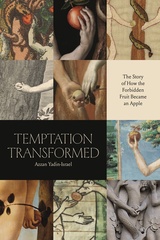
How did the apple, unmentioned by the Bible, become the dominant symbol of temptation, sin, and the Fall? Temptation Transformed pursues this mystery across art and religious history, uncovering where, when, and why the forbidden fruit became an apple.
Azzan Yadin-Israel reveals that Eden’s fruit, once thought to be a fig or a grape, first appears as an apple in twelfth-century French art. He then traces this image back to its source in medieval storytelling. Though scholars often blame theologians for the apple, accounts of the Fall written in commonly spoken languages—French, German, and English—influenced a broader audience than cloistered Latin commentators. Azzan Yadin-Israel shows that, over time, the words for “fruit” in these languages narrowed until an apple in the Garden became self-evident. A wide-ranging study of early Christian thought, Renaissance art, and medieval languages, Temptation Transformed offers an eye-opening revisionist history of a central religious icon.

With authority and sensitivity Plotkin traces the close relationship between Hopkins’s poetry and the theories of language suggested in his Journals and expounded by Victorian philologists such as Max Müller and George Marsh.
Plotkin seeks to determine what changed Hopkins’s perception of language between the writing of such early poems as "The Habit of Perfection" and "Nondum" (1866) and his creation of The Wreck of the Deutschland (1875–76). Did the language of the ode, and of Hopkins’s mature poetry generally, arise as spontaneously as it appears to have done, or does it have a traceable genesis in the ways in which language as a whole was conceived and studied in mid-century England? In answer, Plotkin fixes the development of Hopkins’s singular poetic language in the philological context of his time.
If one is to understand Hopkins’s writings and poetic language in the context in which they developed rather than in the terms of a present-day theory of history or textuality, then that movement in all of its complexity must be considered. Hopkins "translates" into the language of poetry patterns and categories common to Victorian language study.


READERS
Browse our collection.
PUBLISHERS
See BiblioVault's publisher services.
STUDENT SERVICES
Files for college accessibility offices.
RECENTLY PUBLISHED




UChicago Accessibility Resources
home | accessibility | search | about | contact us
BiblioVault ® 2001 - 2024
The University of Chicago Press