
 A SCHOLARLY BOOK REPOSITORY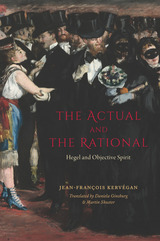
Kervégan begins with Hegel’s term “objective spirit,” the public manifestation of our deepest commitments, the binding norms that shape our existence as subjects and agents. He examines objective spirit in three realms: the notion of right, the theory of society, and the state. In conversation with Tocqueville and other theorists of democracy, whether in the Anglophone world or in Europe, Kervégan shows how Hegel—often associated with grand metaphysical ideas—actually had a specific conception of civil society and the state. In Hegel’s view, public institutions represent the fulfillment of deep subjective needs—and in that sense, demonstrate that the real is the rational, because what surrounds us is the product of our collective mindedness. This groundbreaking analysis will guide the study of Hegel and nineteenth-century political thought for years to come.
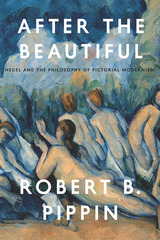
While Hegel could never engage modernist painting, he did have an understanding of modernity, and in it, art—he famously asserted—was “a thing of the past,” no longer an important vehicle of self-understanding and no longer an indispensable expression of human meaning. Pippin offers a sophisticated exploration of Hegel’s position and its implications. He also shows that had Hegel known how the social institutions of his day would ultimately fail to achieve his own version of genuine equality, a mutuality of recognition, he would have had to explore a different, new role for art in modernity. After laying this groundwork, Pippin goes on to illuminate the dimensions of Hegel’s aesthetic approach in the path-breaking works of Manet, the “grandfather of modernism,” drawing on art historians T. J. Clark and Michael Fried to do so. He concludes with a look at Cézanne, the “father of modernism,” this time as his works illuminate the relationship between Hegel and the philosopher who would challenge Hegel’s account of both modernity and art—Martin Heidegger.
Elegantly inter-weaving philosophy and art history, After the Beautiful is a stunning reassessment of the modernist project. It gets at the core of the significance of modernism itself and what it means in general for art to have a history. Ultimately, it is a testament, via Hegel, to the distinctive philosophical achievements of modernist art in the unsettled, tumultuous era we have inherited.
Hobbes's Leviathan, Hegel's Phenomenology of Spirit, and Heidegger's Being and Time dramatize conscience's relation to language and knowledge, morality and duty, and ontology. Feldman investigates how, within these works, conscience is described as binding upon us while at the same time asking how texts themselves may be read as binding.
By uncovering these theoretical filiations across time, The Birth of Theory will not only change the way we read Hegel, but also the way we think about the histories of theory. With chapters that powerfully reanimate the overly familiar topics of ideology, commodity fetishism, and political economy, along with a groundbreaking reinterpretation of Hegel’s famous master/slave dialectic, The Birth of Theory places the disciplines of philosophy, literature, and history in conversation with one another in an unprecedented way. Daring to reconcile the sworn enemies of Hegelianism and Deleuzianism, this timely book will revitalize dialectics for the twenty-first century.
Conceptual Harmonies develops an original account of G. W. F. Hegel’s perplexing Science of Logic from a simple insight: philosophical and mathematical thought have shaped each other since classical times. Situating Science of Logic within the rise of modern mathematics, Redding stresses Hegel’s attention to Pythagorean ratios, Platonic reason, and Aristotle’s geometrically inspired logic. He then explores how later traditions shaped Hegel’s world, through both Leibniz and new forms of algebraic geometry. This enlightening reading recovers an overlooked stream in Hegel’s philosophy that remains, Redding argues, important for contemporary conceptions of logic.
Kolb offers his own views, proposing the possibility of a meaningful life that is free but still rooted in shared contexts. He concludes with comments on "postmodernity" as discussed by Lyotard and others, arguing persuasively against the presupposition of a unified Modern or Postmodern Age.
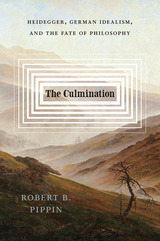
Heidegger claimed that Western philosophy ended—failed, even—in the German Idealist tradition. In The Culmination, Robert B. Pippin explores the ramifications of this charge through a masterful survey of Western philosophy, especially Heidegger’s critiques of Hegel and Kant. Pippin argues that Heidegger’s basic concern was to determine sources of meaning for human life, particularly those that had been obscured by Western philosophy’s attention to reason. The Culmination offers a new interpretation of Heidegger, German Idealism, and the fate of Western rationalism.
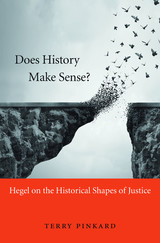
Hegel’s philosophy of history—which most critics view as a theory of inevitable progress toward modern European civilization—is widely regarded as a failure today. In Does History Make Sense? Terry Pinkard argues that Hegel’s understanding of historical progress is not the kind of teleological or progressivist account that its detractors claim, but is based on a subtle understanding of human subjectivity.
Pinkard shows that for Hegel a break occurred between modernity and all that came before, when human beings found a new way to make sense of themselves as rational, self-aware creatures. In Hegel’s view of history, different types of sense-making become viable as social conditions change and new forms of subjectivity emerge. At the core of these changes are evolving conceptions of justice—of who has authority to rule over others. In modern Europe, Hegel believes, an unprecedented understanding of justice as freedom arose, based on the notion that every man should rule himself. Freedom is a more robust form of justice than previous conceptions, so progress has indeed been made. But justice, like health, requires constant effort to sustain and cannot ever be fully achieved.
For Hegel, philosophy and history are inseparable. Pinkard’s spirited defense of the Hegelian view of history will play a central role in contemporary reevaluations of the philosopher’s work.
Beginning at the point where Heidegger encountered Hegel, this volume of provocative essays addresses the respective philosophies of the two men. Leading scholars provide a variety of models from which to view the unique relationship between the bodies of thought of Heidegger and Hegel: bodies of thought that cannot be taken as two objects to be compared, contrasted, and finally evaluated but that must be viewed in dynamic terms, as a relationship in which self-transformations lead to mutual transformations and vice versa.
A clarifying examination of Gilles Deleuze’s first book shows how he would later transform the problem of immanence into the problem of difference
Despite the wide reception Gilles Deleuze has received across the humanities, research on his early work has remained scant. Experience and Empiricism remedies that gap with a detailed study of Deleuze’s first book, Empiricism and Subjectivity, which is devoted to the philosophical project of David Hume. Russell Ford argues that this work is poorly understood when read simply as a stand-alone study on Hume. Its significance only becomes apparent within the context of a larger problematic that dominated, and continues to inform, modern European philosophy: the conceptual constitution of a purely immanent account of existence. While the importance of this debate is recognized in contemporary scholarship, its genealogy—including Deleuze’s place within it—has been underappreciated. This book shows how Deleuze directly engages in an ongoing debate between his teachers Jean Wahl and Jean Hyppolite over experience and empiricism, an intervention that restages the famous encounter between rationalism and empiricism that yielded Kant’s critical philosophy. What, Deleuze effectively asks, might have happened had Hume been the one roused from his empirical dogmatic slumber by the rationalist challenge of Kant?
The author's purpose is to understand the philosophical foundations of Hegel's social theory by articulating the normative standards at work in his claim that the three central social institutions of the modern era--the nuclear family, civil society, and the constitutional state--are rational or good. Its central question is: what, for Hegel, makes a rational social order rational? In addressing this question the book aspires to be faithful to Hegel's texts and to articulate a compelling theory of rational social institutions; its aim is not only to interpret Hegel correctly but also to demonstrate the richness and power that his vision of the rational social order possesses.
Frederick Neuhouser's task is to understand the conceptions of freedom on which Hegel's theory rests and to show how they ground his arguments in defense of the modern social world. In doing so, the author focuses on Hegel's most important and least understood contribution to social philosophy, the idea of "social freedom."
Neuhouser's strategy for making sense of social freedom is to show its affinities with Rousseau's conception of the general will. The main idea that Hegel appropriates from Rousseau is that rational social institutions must satisfy two conditions: first, they must furnish the basic social preconditions of their members' freedom; and, second, all social members must be able subjectively to affirm their freedom-conditioning institutions as good and thus to regard the principles that govern their social participation as coming from their own wills.

Georg Wilhelm Friedrich Hegel, perhaps the most influential of all German philosophers, made one of the last great attempts to develop philosophy as an all-embracing scientific system. This system places Hegel among the “classical” philosophers—Aristotle, Aquinas, Spinoza—who also attempted to build grand conceptual edifices.
In this study, available for the first time in paperback, Howard P. Kainz emphasizes the uniqueness of Hegel’s system by focusing on his methodology, terminology, metaphorical and paradoxical language, and his special contributions to metaphysics, the philosophy of nature, philosophical anthropology, and other areas.
Kainz focuses on Hegel’s system as a whole and its seminal ideas, making generous use of representative texts. He gives special attention to the interrelationship between dialectical methodology and paradoxical propositions; the prevalence of metaphor in the philosophy of nature; and the close interrelationship between Christian doctrine and Hegelian speculation. A rich array of diagrams and tables further elucidates Kainz’s analyses.
An ideal text for the student of philosophy coming to Hegel for the first time, G. W. F. Hegel provides the reader with useful insights into Hegel’s work and illuminates Hegel’s enduring significance in the late twentieth century.

A crucial moment came in the developing split between Anglo-American and continental European philosophers when G. E. Moore and Bertrand Russell rebelled against the “Hegelianism” of their teachers and inaugurated the tradition of “analytic” philosophy. In this new book, John McDowell builds on his much discussed Mind and World—one of the most highly regarded books in contemporary philosophy. McDowell, who has long commanded attention for his fresh approach to issues in contemporary epistemology, philosophy of language, and philosophy of mind, shocked some mainstream analytic philosophers in Mind and World by drawing inspiration not only from analytic philosophers but also from continental philosophers, most notably Hegel.
McDowell argues that the roots of some problems plaguing contemporary philosophy can be found in issues that were first discerned by Kant, and that the best way to get a handle on them is to follow those issues as they are reshaped in the writings of Hegel and Sellars. Having the World in View will be a decisive further step toward healing the divisions in contemporary philosophy, by showing how central methods of the two traditions remain deeply entangled and by revealing how philosophers in both camps might still learn from each other.
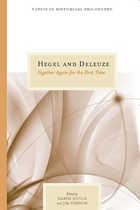
Hegel and Deleuze cannily examines the various resonances and dissonances between these two major philosophers. The collection represents the best in contemporary international scholarship on G. W. F. Hegel and Gilles Deleuze, and the contributing authors inhabit the as-yet uncharted space between the two thinkers, collectively addressing most of the major tensions and resonances between their ideas and laying a solid ground for future scholarship.
The essays are organized thematically into two groups: those that maintain a firm but nuanced disjunction or opposition between Hegel and Deleuze, and those that chart possible connections, syntheses, or both. As is clear from this range of texts, the challenges involved in grasping, appraising, appropriating, and developing the systems of Deleuze and Hegel are varied and immense. While neither Hegel nor Deleuze gets the last word, the contributors ably demonstrate that partisans of either can no longer ignore the voice of the other.

The rejection by Anglo-Saxon philosophers of much "continental philosophy" (from Hegel on down) is largely based on the perceived failure of continental thinkers to grapple with the tough questions of epistemology in general and skepticism in particular. Forster demonstrates that Hegel did not in fact ignore epistemology, but on the contrary he fought a tireless and subtle campaign to defeat the threat of skepticism. Forster's work should dispel once and for all the view that Hegel was naive or careless in epistemological matters.
Forster begins by discussing Hegel's critical interpretation of the skeptical tradition, in particular his convincingly argued case for the superiority of ancient over modern skepticism. He goes on to show that the difficulties characteristic of ancient skepticism play a crucial and fascinating role in Hegel's philosophy of history. Hegel sees in the emergence of these difficulties an explanation of why the harmonious unified Greek culture collapsed and was replaced by the division and alienation characteristic of subsequent western culture. Finally, Forster examines the elaborate and ingenious system of defenses erected by Hegel to protect his philosophical thought against skeptical difficulties, as the core of a somewhat broader epistemological project. Along the way, Forster makes much that has hither to remained obscure in Hegel's texts intelligible for the first time. This book should cause a re-evaluation of Hegel, and German Idealism generally, and contribute to a re-evaluation of the skeptical tradition in philosophy.
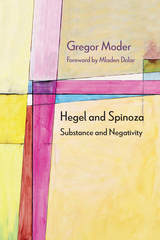
Hegel and Spinoza traces the historical roots of these alternatives and shows how contemporary discussions between Heideggerians and Althusserians, Lacanians and Deleuzians are a variation of the disagreement between Hegel and Spinoza. Throughout, Moder persuasively demonstrates that the best way to read Hegel and Spinoza is not in opposition or contrast but together: as Hegel and Spinoza.
Addressing a range of important topics, the essays examine the conceptual bases of Hegel's organization of his aesthetics, his treatment of various specific arts (architecture, sculpture, painting, music, and tragedy), and several of the most famous issues in the literature--including the "end of art" thesis, the relation between art and religion, and the vexed relationship between Hegel and the romantics. Together they shed light on the profound reflections on art contained in Hegel's philosophy and also suggest ways in which his aesthetics might resonate well beyond the field of philosophical aesthetics, perhaps beyond philosophy itself.
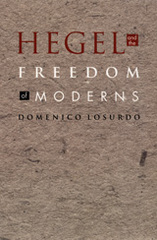
Hegel and the Freedom of Moderns persuasively argues that the tug of war between “conservative” and “liberal” interpretations of Hegel has obscured and distorted the most important aspects of his political thought. Losurdo unravels this misleading dualism and provides an illuminating discussion of the relation between Hegel’s political philosophy and the thinking of Karl Marx and Friedrich Engels. He also discusses Hegel’s ideas in relation to the pertinent writings of other major figures of modern political philosophy such as Jean-Jacques Rousseau, John Locke, Edmund Burke, John Stuart Mill, Jeremy Bentham, Karl Popper, Norberto Bobbio, and Friedrich Hayek.
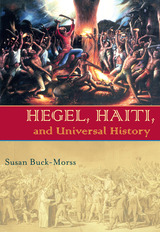
Historicizing the thought of Georg Wilhelm Friedrich Hegel and the actions taken in the Haitian Revolution, Buck-Morss examines the startling connections between the two and challenges us to widen the boundaries of our historical imagination. She finds that it is in the discontinuities of historical flow, the edges of human experience, and the unexpected linkages between cultures that the possibility to transcend limits is discovered. It is these flashes of clarity that open the potential for understanding in spite of cultural differences. What Buck-Morss proposes amounts to a “new humanism,” one that goes beyond the usual ideological implications of such a phrase to embrace a radical neutrality that insists on the permeability of the space between opposing sides and as it reaches for a common humanity.
In 1828, G. W. F. Hegel published a critical review of Johann George Hamann, a retrospective of the life and works of one of Germany's most enigmatic and challenging thinkers and writers. While Hegel's review had enjoyed a central place in Hamann studies since its appearance, Hegel on Hamann is the first English translation of the important work. Philosophers, theologians, and literary critics welcome Anderson's stunning translation since Hamann is gaining renewed attention, not only as a key figure of German intellectual history, but also as an early forerunner of postmodern thought. Relationships between Enlightenment, Counter Enlightenment, and Idealism come to the fore as Hegel reflects on Hamann's critiques of his contemporaries Immanuel Kant, Moses Mendelssohn, J. G. Herder, and F. H. Jacobi. Hegel on Hamann also includes an introduction to Hegel's review, as well as an essay on the role of friendship in Hamann's life, in Hegel's thought, and in German intellectual culture more broadly. Rounding out the volume are its extensive annotations and bibliography, which facilitate further study of eighteenth- and nineteenth-century philosophy in English and German. This book is essential both for readers of Hegel or Hamann and for those interested in the history of German thought, the philosophy of religion, language and hermeneutics, or friendship as a philosophical category.

Hegel or Spinoza is the first English-language translation of the modern classic Hegel ou Spinoza. Published in French in 1979, it has been widely influential, particularly in the work of the philosophers Alain Badiou, Antonio Negri, and Gilles Deleuze.
Hegel or Spinoza is a surgically precise interrogation of the points of misreading of Spinoza by Hegel. Pierre Macherey explains the necessity of Hegel’s misreading in the kernel of thought that is “indigestible” for Hegel, which makes the Spinozist system move in a way that Hegel cannot grasp. In doing so, Macherey exposes the limited and situated truth of Hegel’s perspective—which reveals more about Hegel himself than about his object of analysis. Against Hegel’s characterization of Spinoza’s work as immobile, Macherey offers a lively alternative that upsets the accepted historical progression of philosophical knowledge. He finds in Spinoza an immanent philosophy that is not subordinated to the guarantee of an a priori truth.
Not simply authorizing a particular reading—a “good” Spinoza against a “bad” Hegel—Hegel or Spinoza initiates an encounter that produces a new understanding, a common truth that emerges in the interval that separates the two.
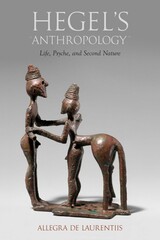
A groundbreaking contribution to scholarship on Hegel and nineteenth-century philosophy, this book shows that the Anthropology is essential to understanding Hegel’s concept of spirit, not only in its connection with nature but also in its more sophisticated realizations as objective and absolute spirit. Future scholarship on this subject will recount—and build upon—de Laurentiis’s innovative study.
The Phenomenology of Spirit emerges as an extraordinarily coherent work with a rich array of important and original ideas. These include a diagnosis of the ills of modernity in terms of its commitment to a series of dualisms, and a project for overcoming them; a sweeping naturalism; a deep rethinking of and response to problems of skepticism; subtle arguments for social theories of meaning and truth; and ideas based on the insight that human thought changes in fundamental ways over the course of history. Forster's unique and compelling reading unlocks the mysteries of Hegel's seminal work.
The primary focus of Marx's book is on the account. Hegel gives of the phenomenological journey from natural consciousness to philosophical wisdom (or absolute knowledge, as Hegel calls it). In showing that Hegel's many statements concerning consciousness 'finding itself' or 'knowing itself' in its world can be understood as discovering the rationality of the conditioning world, Marx offers a solution to several sets of interrelated problems that have troubled students of Hegel. His book contains valuable analyses of the relation between Hegel's thought and that of Descartes and Kant as well as that of Karl Marx, and it also sheds considerable light on the question of the internal unity or coherence of the Phenomenology.
Kainz provides an accessible entry into the complexities of Hegelian thought by asking a series of questions about such matters as the literary form of the Phenomenology, its "plot," its relation to the "system," its subject matter, the problem of objectivity, dialectical necessity, the concept of "experience," and the Hegelian concept of consciousness. Building of the work of previous commentators, and presenting the work of these commentators in a clear and unbiased manner, Kainz offers an analysis that will be helpful both to experienced Hegelian scholars and to those readers preparing to approach the large and bewildering territory of the Phenomenology for the first time.
The publication in 1807 of Georg Wilhelm Frederich Hegel’s Phanomenologie des Geistes (translated alternately as “Phenomenology of Mind” or “Phenomenology of Spirit”) marked the beginning of the modern era in philosophy. Hegel’s remarkable insights formed the basis for what eventually became the Existentialist movement. Yet the Phenomenology remains one of the most difficult and forbidding works in the canon of philosophical literature.
Robert B. Pippin offers here a bold, original interpretation of Hegel’s claim that only now, after Kant’s critical breakthrough in philosophy, can we understand how logic can be a metaphysics. Pippin addresses Hegel’s deep, constant reliance on Aristotle’s conception of metaphysics, the difference between Hegel’s project and modern rationalist metaphysics, and the links between the “logic as metaphysics” claim and modern developments in the philosophy of logic. Pippin goes on to explore many other facets of Hegel’s thought, including the significance for a philosophical logic of the self-conscious character of thought, the dynamism of reason in Kant and Hegel, life as a logical category, and what Hegel might mean by the unity of the idea of the true and the idea of the good in the “Absolute Idea.” The culmination of Pippin’s work on Hegel and German idealism, this is a book that no Hegel scholar or historian of philosophy will want to miss.
Zambrana clarifies crucial features of Hegel’s theory of normativity previously thought to be absent from the argument of the Science of Logic—what she calls normative precariousness and normative ambivalence. She shows that Hegel’s theory of determinacy views intelligibility as both precarious, the result of practices and institutions that gain and lose authority throughout history, and ambivalent, accommodating opposite meanings and valences even when enjoying normative authority. In this way, Zambrana shows that the Science of Logic provides the philosophical justification for the necessary historicity of intelligibility. Intervening in several recent developments in the study of Kant, Hegel, and German Idealism more broadly, this book provides a productive new understanding of the value of Hegel’s systematic ambitions.

Ferry's treatise begins in the mid-1600s with the simultaneous invention of the notions of taste (the essence of art as subjective pleasure) and modern democracy (the idea of the State as a consensus among individuals). He explores the differences between subjectivity and individuality by examining aesthetic theory as developed first by Kant's predecessors and then by Kant, Hegel, Nietzsche, and proponents of the avant-garde. Ferry discerns two "moments" of the avant-garde aesthetic: the hyperindividualistic iconoclasm of creating something entirely new, and the hyperrealistic striving to achieve an extraordinary truth. The tension between these two, Ferry argues, preserves an essential element of the Enlightenment concern for reconciling the subjective and the objective—a problem that is at once aesthetic, ethical, and political.
Rejecting postmodern proposals for either a radical break with or return to tradition, Ferry embraces a postmodernism that recasts Enlightenment notions of value as a new intersubjectivity. His original analysis of the growth and decline of the twentieth-century avant-garde movement sheds new light on the connections between aesthetics, ethics, and political theory.
Rosen’s overarching question is how, if at all, rationalism can overcome the split between monism and dualism. Monism—which claims a singular essence for all things—ultimately leads to nihilism, while dualism, which claims multiple, irreducible essences, leads to what Rosen calls “the endless chatter of the history of philosophy.” The Science of Logic, he argues, is the fundamental text to offer a new conception of rationalism that might overcome this philosophical split. Leading readers through Hegel’s book from beginning to end, Rosen’s argument culminates in a masterful chapter on the Idea in Hegel. By fully appreciating the Science of Logic and situating it properly within Hegel’s oeuvre, Rosen in turn provides new tools for wrangling with the conceptual puzzles that have brought so many other philosophers to disaster.
Infinite Phenomenology builds on John Russon’s earlier book, Reading Hegel’s Phenomenology, to offer a second reading of Hegel’s Phenomenology of Spirit. Here again, Russon writes in a lucid, engaging style and, through careful attention to the text and a subtle attunement to the existential questions that haunt human life, he demonstrates how powerfully Hegel’s philosophy can speak to the basic questions of philosophy. In addition to original studies of all the major sections of the Phenomenology, Russon discusses complementary texts by Hegel, namely, the Philosophy of Spirit, the Philosophy of Right, and the Science of Logic. He concludes with an appendix that discusses the reception and appropriation of Hegel’s Phenomenology in twentieth-century French philosophy. As with Russon’s earlier work, Infinite Phenomenology will remain essential reading for those looking to engage Hegel’s essential, yet difficult, text.
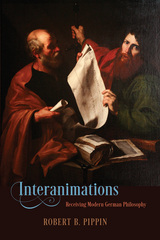
After opening up his territory with an initial discussion of contemporary revisionist readings of Kant’s moral theory, Pippin sets his sights on his main objects of interest: Hegel and Nietzsche. Through them, however, he offers what few others could: an astonishing synthesis of an immense and diverse set of thinkers and traditions. Deploying an almost dialogical, conversational approach, he pursues patterns of thought that both shape and, importantly, connect the major traditions: neo-Aristotelian, analytic, continental, and postmodern, bringing the likes of Heidegger, Honneth, MacIntyre, McDowell, Brandom, Strauss, Williams, and Žižek—not to mention Hegel and Nietzsche— into the same philosophical conversation.
By means of these case studies, Pippin mounts an impressive argument about a relatively under discussed issue in professional philosophy—the bearing of work in the history of philosophy on philosophy itself—and thereby he argues for the controversial thesis that no strict separation between the domains is defensible.
In a sense it would be inappropriate to speak of “Hegel’s system of philosophy,” because Hegel thought that in the strict sense there is only one system of philosophy evolving in the Western world. In Hegel’s view, although at times philosophy’s history seems to be a chaotic series of crisscrossing interpretations of meanings and values, with no consensus, there has been a teleological development and consistent progress in philosophy and philosophizing from the beginning; Hegel held that his own version of “German idealism” was simply bringing to final expression the latest refinements of an ongoing, perennial system.
If we take Hegel at his word, then one of the best entries into his system would be through the history of philosophy, showing how systems and schools of thought prior to Hegel led up to his system. The most important currents to focus on, however, would be in modern philosophy, in which especially intensive changes led ultimately to German idealism and Hegel’s immediate predecessors.
Fortunately, Hegel lectured extensively on the history of modern philosophy and structured his lectures in such a way as to throw light on the status of the “one system” of Western philosophy at the time — the status to which Hegel felt he had been contributing and was continuing to contribute. These lectures are of interest, first of all, as a systematic chronicle of philosophical positions in the heyday of modern philosophy, from Bacon to Hegel. Second, they are interesting because Hegel’s critical comments on his predecessors clarify his own positions: for example, the dialectic method and the importance of triplicity, the relationship of philosophy to the scientific method, the necessity for avoidance of the extremes of empiricism and of idealism, the subject/object problematic, the “identity” of rationality and reality, and the technical meaning in Hegel’s philosophy of “absolute,” “infinity,” and the “idea.”
"With impressive argumentation
and wide-ranging scholarship, Anderson presents us with a Lenin that no
one seriously interested in current debates over the relevance of Marxist
theory to socialist practice can afford to miss." -- Bertell Ollman,
author of Dialectical Investigations
"An important contribution
to grasping the conceptual roots of Marxist theory and practice."
-- Tom Rockmore, author of Hegel's Circular Epistomology
"Today Lenin looks like
he did little more than prepare the way for Stalin. You will find the
opposite view in this novel study. . . . I recommend the book to anyone
seriously interested in Russia and revolution." -- George Uri Fischer,
author of The Soviet System and Modern Society
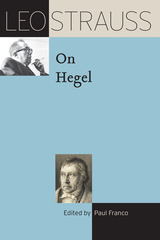
Leo Strauss on Hegel reconstructs Strauss’s seminar on Hegel, supplemented by passages from an earlier version of the seminar from which only fragments of a transcript remain. Strauss focused his seminar on the lectures collected in The Philosophy of History, which he considered more accessible than Hegel’s written works. In his own lectures on Hegel, Strauss continues his project of demonstrating how modern philosophers related to ancient thought and explores the development and weaknesses of modern political theory. Strauss is especially concerned with the relationship in Hegel between empirical history and his philosophy of history, and he argues for the primacy of religion in Hegel’s understanding of history and society. In addition to a relatively complete transcript, Leo Strauss on Hegel also includes annotations, which bring context and clarity to the text.

Exploring anxieties raised by Atlantic slavery in radical enlightenment literature concerned about political unfreedom in Europe, Metaracial argues that Hegel's philosophy assuages these anxieties for the left. Interpreting Hegel beside Rousseau, Kant, Mary Shelley, and Marx, Terada traces Hegel's transposition of racial hierarchy into a hierarchy of stances toward reality. By doing so, she argues, Hegel is simultaneously antiracist and antiblack. In dialogue with Black Studies, psychoanalysis, and critical theory, Metaracial offers a genealogy of the limits of antiracism.
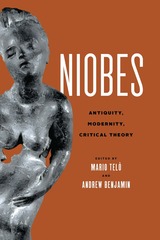
A marginalized but persistent figure of Greek tragedy, Niobe, whose many children were killed by Apollo and Artemis, embodies yet problematizes the philosophically charged dialectics between life and death, mourning and melancholy, animation and inanimation, silence and logos. The essays in Niobes present her as a set of complex figurations, an elusive mythical character but also an overdetermined figure who has long exerted a profound influence on various modes of modern thought, especially in the domains of aesthetics, ethics, psychoanalysis, and politics. As a symbol of both exclusion and resistance, Niobe calls for critical attention at a time of global crisis.
Reconstructing the dialogues of Phillis Wheatley, G. W. F. Hegel, Walter Benjamin, Aby Warburg, and others with Niobe as she appears in Aeschylus, Sophocles, Ovid, and the visual arts, a collective of major thinkers—classicists, art historians, and critical theorists—reflect on the space that she can occupy in the humanities today. Inspiring new ways of connecting the classical tradition and ancient tragic discourse with crises and political questions relating to gender, race, and social justice, Niobe insists on living on.
Contributors:
Barbara Baert, Andrew Benjamin, drea brown, Adriana Cavarero, Rebecca Comay, Mildred Galland-Szymkowiak, John T. Hamilton, Paul A. Kottman, Jacques Lezra, Andres Matlock, Ben Radcliffe, Victoria Rimell, Mario Telò, Mathura Umachandran, Daniel Villegas Vélez
Verene takes as his departure point that Cassirer never wishes to argue Kant over Hegel. Instead he takes from each what he needs, realizing that philosophical idealism itself did not stop with Kant but developed to Hegel, and that much of what remains problematic in Kantian philosophy finds particular solutions in Hegel’s philosophy. Cassirer never replaces transcendental reflection with dialectical speculation, but he does transfer dialectic from a logic of illusion, that is, the form of thinking beyond experience as Kant conceives it in the Critique of Pure Reason, to a logic of consciousness as Hegel employs it in the Phenomenology of Spirit. Cassirer rejects Kant’s thing-in-itself but he also rejects Hegel’s Absolute as well as Hegel’s conception of Aufhebung. Kant and Hegel remain the two main characters on his stage, but they are accompanied by a large secondary cast, with Goethe in the foreground. Cassirer not only contributes to Goethe scholarship, but in Goethe he finds crucial language to communicate his assertions. Verene introduces us to the originality of Cassirer’s philosophy so that we may find access to the riches it contains.
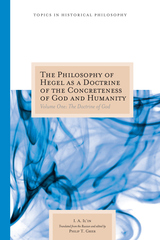
This landmark two-volume translation from Russian of The Philosophy of Hegel as a Doctrine of the Concreteness of God and Humanity marks the first appearance in English of any of the works of Russian philosopher Ivan Aleksandrovich Il’in (Ilyin). Originally published in 1918, on the eve of the Russian civil war, Il'in's commentary on Hegel marked both an apogee of Russian Silver Age philosophy and a significant manifestation of the resurgence of interest in Hegel that began in the early twentieth century.
A. F. Losev accurately observed in the same year it appeared: “Neither the study of Hegel nor the study of contemporary Russian philosophical thought is any longer thinkable without this book of I. A. Il’in’s.” Some Hegel scholars may know this work through the abridged translation into German that Il’in produced himself in 1946. However, that edition omitted most of the original volume two. Noted Hegel scholar Philip T. Grier’s edition—with an introduction setting Il’in’s work in its proper historical, cultural, and philosophical contexts and annotation throughout—represents the first opportunity for non-Russian-speaking readers to acquaint themselves with the full scope of Il’in’s still provocative interpretation of Hegel.
Volume 1 is "The Doctrine of God." Volume 2 is "The Doctrine of Humanity."
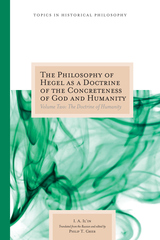
The publication of volume 2 of Philip T. Grier’s translation of The Philosophy of Hegel as a Doctrine of the Concreteness of God and Humanity completes the first appearance in English of any of the works of Russian philosopher I. A. Il’in (Ilyin).
Most of the contents of volume 2 will be unknown even to those who have read the 1946 German version prepared by Il’in, because in that version he omitted eight of the original ten chapters. These omitted chapters provide an extended reflection on the central categories of Hegel’s moral, legal, and political philosophies, as well as of the philosophy of history. The topics examined are, in order: freedom, humanity, will, right, morality, ethical life, personhood and its virtue, and the state. Contained within these chapters are some notably insightful expositions of core doctrines in Hegel’s philosophy.
Il’in’s colleague A. F. Losev accurately observed in the same year the text first appeared: “Neither the study of Hegel nor the study of contemporary Russian philosophical thought is any longer thinkable without this book of I. A. Il’in’s.”

Jean-Paul Sartre’s Critique of Dialectical Reason, released to great fanfare in 1960, has since then receded in philosophical visibility. As Sartre’s reputation is now making a comeback, it is time for a reappraisal of his later work. In Practice, Power, and Forms of Life, philosopher Terry Pinkard interprets Sartre’s late work as a fundamental reworking of his earlier ideas, especially in terms of his understanding of the possibility of communal action as genuinely free, which the French philosopher had previously argued was impossible.
Pinkard reveals how Sartre was drawn back to Hegel, a move that was itself incited by Sartre’s newfound interest in Marxism. Pinkard argues that Sartre constructed a novel position on freedom that has yet to be adequately taken up and analyzed within philosophy and political theory. Through Sartre, Pinkard advances an argument that contributes to the history of philosophy as well as key debates on action and freedom.
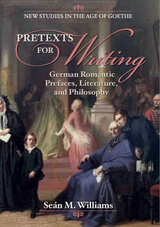
Published by Bucknell University Press. Distributed worldwide by Rutgers University Press.
In A Weak Nature Alone, Johnston develops his transcendental materialist account of nature through engaging with and weaving together five main sources of inspiration: Hegelian philosophy, Marxist materialism, Freudian-Lacanian metapsychology, Anglo-American analytic neo-Hegelianism, and evolutionary theory and neurobiology. Johnston argues that these seemingly (but not really) strange bedfellows should be brought together so as to construct a contemporary ontology of nature. Through this ontology, nonnatural human subjects can be seen to arise in an immanent, bottom-up fashion from nature itself.
Readings in Interpretation was first published in 1987. Minnesota Archive Editions uses digital technology to make long-unavailable books once again accessible, and are published unaltered from the original University of Minnesota Press editions.
Readings in Interpretation — a volume primarily on the texts of Holderlin, Hegel, and their interpreter Heidegger—locates itself strategically between literature and philosophy. In keeping with this juxtaposition, it treats the question of self-consciousness and reflection on the levels of "theme" and "text." For both Hegel and Holderlin, selfconsciousness and its relation to knowing are explicit themes, but Waminski's readings show that a more disruptive reflection is operative on the level of text.
In an argument that centers on the textual aspects of Hegel's Phenomenology of the Spirit,Warminski demonstrates that the negative moment—which is often interpreted as a prelude to a unified self-consciousness—cannot be accounted for by interpretive models drawn from outside the text—by concepts like the self, consciousness, or the subject. Instead, a completely different practice and theory is necessary. The author's "Prefatory Postscript" at the beginning of the book therefore serves as an introduction to sketch the theoretical basis of the readings that follow and as a "postscript" that explains the difference between "reading" and "interpretation" which those readings make necessary.

Sallis focuses on certain operations of "spacing" in metaphysics—textual lapses and leaps in which reason is displaced or suspended or abridged. In the project of establishing priority of reason, such operations can appear only in disguise, and Sallis reveals the play of imagination and metaphor that masks them. Concentrating on what has been called the closure of metaphysics, he examines texts in which the suppression of spacing would be carried out most rigorously, texts in which even metaphysics itself is seen as only an errant roaming, a spacing that must still be secured, to be replaced by a pure space of truth. And yet, in these very texts Sallis identifies outbreaks of spacing that would disrupt the tranquil space of reason. Rather than closure, he finds an opening of reason to imagination.
Sallis's reading of a metaphorical system in the Critique of Pure Reason reveals a fissuring and historicizing of what would otherwise be called pure reason. Next he traces in Fichte's major work as well as in several lesser-known texts a decentering from reason to imagination, which he characterizes as a power of hovering between opposites and beyond being. Sallis then returns to the Critique of Pure Reason to expose, in relation to the famous question of the common root of reason and sensibility, a certain eccentricity of reason. Proceeding to the Critique of Judgment, he traces a divergence of sublime nature away from that supersensible space of reason to which Kant would otherwise assimilate it—a withdrawal toward an abyss. Finally, Sallis turns to Hegel's Encyclopedia, supplementing his reading with previously unknown notes from Hegel's lectures on those sections dealing with imagination; his reading of those sections serves to expose, within the most rigorous reduction of spacing in the history of metaphysics, an irrepressible and disseminative play of imagination.
In a confrontation with today’s fatalistic milieu, principal emphasis is given to Hegel’s idea of infinity as the intrinsic dimension of negativity within all finitude. Against the modern era’s paradigmatic tendency to externalize social problems in the form of antagonism and Otherness, Daly argues for a renewal of utopian thought based on Hegelian reconciliation and the affirmation of excess as the essence of all being. On these grounds, he advances a new kind of political imagination that in speculative terms centers on uncompromising notions of truth and reason.
Forty years in the making, this long-awaited reinterpretation of Hegel’s The Phenomenology of Spirit is a landmark contribution to philosophy by one of the world’s best-known and most influential philosophers.
In this much-anticipated work, Robert Brandom presents a completely new retelling of the romantic rationalist adventure of ideas that is Hegel’s classic The Phenomenology of Spirit. Connecting analytic, continental, and historical traditions, Brandom shows how dominant modes of thought in contemporary philosophy are challenged by Hegel.
A Spirit of Trust is about the massive historical shift in the life of humankind that constitutes the advent of modernity. In his Critiques, Kant talks about the distinction between what things are in themselves and how they appear to us; Hegel sees Kant’s distinction as making explicit what separates the ancient and modern worlds. In the ancient world, normative statuses—judgments of what ought to be—were taken to state objective facts. In the modern world, these judgments are taken to be determined by attitudes—subjective stances. Hegel supports a view combining both of those approaches, which Brandom calls “objective idealism”: there is an objective reality, but we cannot make sense of it without first making sense of how we think about it.
According to Hegel’s approach, we become agents only when taken as such by other agents. This means that normative statuses such as commitment, responsibility, and authority are instituted by social practices of reciprocal recognition. Brandom argues that when our self-conscious recognitive attitudes take the radical form of magnanimity and trust that Hegel describes, we can overcome a troubled modernity and enter a new age of spirit.
Responding to the ongoing “objectal turn” in contemporary humanities and social sciences, the essays in Subject Lessons present a sustained case for the continued importance— indeed, the indispensability—of the category of the subject for the future of materialist thought.
Approaching matters through the frame of Hegel and Lacan, the contributors to this volume, including the editors, as well as Andrew Cole, Mladen Dolar, Nathan Gorelick, Adrian Johnston, Todd McGowan, Borna Radnik, Molly Anne Rothenberg, Kathryn Van Wert, and Alenka Zupančič—many of whom stand at the forefront of contemporary Hegel and Lacan scholarship—agree with neovitalist thinkers that material reality is ontologically incomplete, in a state of perpetual becoming, yet they maintain that this is the case not in spite of but, rather, because of the subject.
Incorporating elements of philosophy, psychoanalysis, and literary and cultural studies, Subject Lessons contests the movement to dismiss the subject, arguing that there can be no truly robust materialism without accounting for the little piece of the Real that is the subject.
In Tarrying with the Negative, Žižek challenges the contemporary critique of ideology, and in doing so opens the way for a new understanding of social conflict, particularly the recent outbursts of nationalism and ethnic struggle. Are we, Žižek asks, confined to a postmodern universe in which truth is reduced to the contingent effect of various discursive practices and where our subjectivity is dispersed through a multitude of ideological positions? No is his answer, and the way out is a return to philosophy. This revisit to German Idealism allows Žižek to recast the critique of ideology as a tool for disclosing the dynamic of our society, a crucial aspect of which is the debate over nationalism, particularly as it has developed in the Balkans—Žižek's home. He brings the debate over nationalism into the sphere of contemporary cultural politics, breaking the impasse centered on nationalisms simultaneously fascistic and anticolonial aspirations. Provocatively, Žižek argues that what drives nationalistic and ethnic antagonism is a collectively driven refusal of our own enjoyment.
Using examples from popular culture and high theory to illuminate each other—opera, film noir, capitalist universalism, religious and ethnic fundamentalism—this work testifies to the fact that, far more radically than the postmodern sophists, Kant and Hegel are our contemporaries.
In Teachers of the People, Dana Villa takes us back to the moment in history when “the people” first appeared on the stage of modern European politics. That moment—the era just before and after the French Revolution—led many major thinkers to celebrate the dawning of a new epoch. Yet these same thinkers also worried intensely about the people’s seemingly evident lack of political knowledge, experience, and judgment. Focusing on Rousseau, Hegel, Tocqueville, and Mill, Villa shows how reformist and progressive sentiments were often undercut by skepticism concerning the political capacity of ordinary people. They therefore felt that “the people” needed to be restrained, educated, and guided—by laws and institutions and a skilled political elite. The result, Villa argues, was less the taming of democracy’s wilder impulses than a pervasive paternalism culminating in new forms of the tutorial state.
Ironically, it is the reliance upon the distinction between “teachers” and “taught” in the work of these theorists which generates civic passivity and ignorance. And this, in turn, creates conditions favorable to the emergence of an undemocratic and illiberal populism.
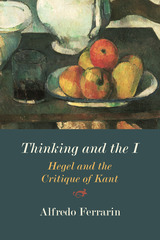
What is the relation between thinking and the I that thinks? And what is the relation between thought and reality? The ordinary view shared by modern philosophers from Descartes to Kant, as well as by common sense, is that there is only thought when someone thinks something, and thoughts and concepts are mental acts that refer to objects outside us.
In Thinking and the I: Hegel and the Critique of Kant, Alfredo Ferrarin shows that Hegel’s philosophy entails a radical criticism of this ordinary conception of thinking. Breaking with the habitual presuppositions of both modern philosophy and common sense, Ferrarin explains that thought, negation, truth, reflection, and dialectic for Hegel are not properties of an I and cannot be reduced to the subjective activity of a self-conscious subject. Rather, he elucidates, thought is objective for Hegel in different senses. Reality as a whole is animated by a movement of thought and an unconscious logic as a spontaneity that reifies itself in determinate forms. Ferrarin concludes the book with a comprehensive comparison of Hegel’s and Kant’s concepts of reason.
While it mainly focuses on Hegel’s Phenomenology, Science of Logic, and Encyclopaedia, this ambitious book covers all aspects of Hegel’s philosophy. Its originality and strength lie in its recovery of the original core of Hegel’s dialectic over and above its currently predominant transcendental, neopragmatist, or realist appropriations. It will be essential reading for all students of Hegel, Kant, and German idealism in general for years to come.
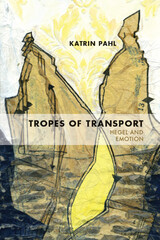
Intervening in the multidisciplinary debate on emotion, Tropes of Transport offers a fresh analysis of Hegel’s work that becomes an important resource for Pahl’s cutting-edge theory of emotionality. If it is usually assumed that the sincerity of emotions and the force of affects depend on their immediacy, Pahl explores to what extent mediation—and therefore a certain degree of manipulation but also of sympathy—is constitutive of emotionality. Hegel serves as a particularly helpful interlocutor not only because he offers a sophisticated analysis of mediation, but also because, rather than locating emotion in the heart, he introduces impersonal tropes of transport, such as trembling, release, and shattering.
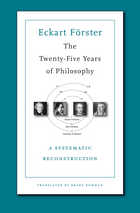
Kant declared that philosophy began in 1781 with his Critique of Pure Reason. In 1806 Hegel announced that philosophy had now been completed. Eckart Förster examines the reasons behind these claims and assesses the steps that led in such a short time from Kant’s “beginning” to Hegel’s “end.” He concludes that, in an unexpected yet significant sense, both Kant and Hegel were indeed right.
“Presents a novel interpretation of the development of German idealism that is rich in both historical depth and philosophical insight…Förster sets forth a historically nuanced and philosophically discerning interpretation of the central debates of the era.”
—Peter Yong, Philosophy in Review
“[Förster’s] book does not disappoint…The amount of material covered by Förster is impressive…Förster’s book is rich in specificity…Wherever the discussion goes, it is going to have to go on by taking Förster’s big picture and all his detailed accounts into account.”
—Terry Pinkard, Notre Dame Philosophical Reviews
“Förster’s command of the historical sources is most impressive. Moreover, this book is clearly written, and Bowman’s translation is commendable. Scholars and graduate students will welcome this masterpiece.”
—J. M. Fritzman, Choice
In The Unity of Hegel's "Phenomenology of Spirit", Jon Stewart interprets Hegel's work as a dialectical transformation of Kantian transcendental philosophy, providing from this unified standpoint a case for Hegel's own conception of philosophy as a system. In restoring them to their larger systematic contexts, Stewart clarifies Hegel's individual analyses, as well as indicating the meaning and significance of the transitions and illustrating the parallelisms between the respective analyses. Many of Hegel's main themes-
universal-particular, mediacy-immediacy-are traced through the text, demonstrating Hegel's formal continuity.
By examining at the microlevel the particulars of the dialectical movement, and by analyzing at the macrolevel the role of the argument in question in the context of the work as a whole, Stewart provides a detailed analysis of the Phenomenology and a significant scholarly demonstration of Hegel's own conception of the Phenomenology as a part of a systematic philosophy.
READERS
Browse our collection.
PUBLISHERS
See BiblioVault's publisher services.
STUDENT SERVICES
Files for college accessibility offices.
RECENTLY PUBLISHED





UChicago Accessibility Resources
home | accessibility | search | about | contact us
BiblioVault ® 2001 - 2024
The University of Chicago Press