front cover of Bad Books
Bad Books
Rétif de la Bretonne, Sexuality, and Pornography
Amy S. Wyngaard
University of Delaware Press, 2013
Bad Books reconstructs how the eighteenth-century French author Nicolas-Edme Rétif de la Bretonne and his writings were at the forefront of the development of modern conceptions of sexuality and pornography. Although certain details are well known (for example, that Rétif’s 1769 treatise on prostitution, Le Pornographe, is the work from which the term pornography is derived, or that he was an avid foot and shoe fetishist), much of this story has been obscured and even forgotten: how the author actively worked to define the category of obscenity and the modern pornographic genre; how he coined the psycho-sexual term “fetish” and played a central role in the formation of theories of sexual fetishism in the late nineteenth and early twentieth centuries. Thus this book is also about literary history and how it is written: it explores how Rétif, perceived as a bad author in both senses of the term, and his contributions were glossed over or condemned, such that the originality of his texts has still not been fully established.

Published by University of Delaware Press. Distributed worldwide by Rutgers University Press.
 
[more]

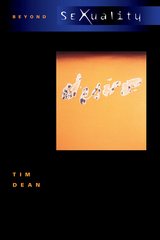
front cover of Beyond Sexuality
Beyond Sexuality
Tim Dean
University of Chicago Press, 2000
Beyond Sexuality points contemporary sexual politics in a radically new direction. Combining a psychoanalytic emphasis on the unconscious with a deep respect for the historical variability of sexual identities, this original work of queer theory makes the case for viewing erotic desire as fundamentally impersonal. Tim Dean develops a reading of Jacques Lacan that—rather than straightening out this notoriously difficult French psychoanalyst—brings out the queer tensions and productive incoherencies in his account of desire.

Dean shows how the Lacanian unconscious "deheterosexualizes" desire, and along the way he reveals how psychoanalytic thinkers as well as queer theorists have failed to exploit the full potential of this conception of desire. The book elaborates this by investigating social fantasies about homosexuality and AIDS, including gay men's own fantasies about sex and promiscuity, in an attempt to illuminate the challenges facing safe-sex education. Taking on many shibboleths in contemporary psychoanalysis and queer theory—and taking no prisoners—Beyond Sexuality offers an antidote to hagiographical strains in recent work on psychoanalysis, Foucault, and sexuality.
[more]

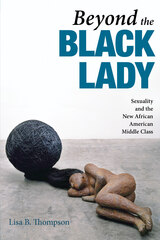
front cover of Beyond the Black Lady
Beyond the Black Lady
Sexuality and the New African American Middle Class
Lisa B. Thompson
University of Illinois Press, 2012
In this book, Lisa B. Thompson explores the representation of black middle-class female sexuality by African American women authors in narrative literature, drama, film, and popular culture, showing how these depictions reclaim black female agency and illustrate the difficulties black women confront in asserting sexual agency in the public sphere. Thompson broadens the discourse around black female sexuality by offering an alternate reading of the overly determined racial and sexual script that casts the middle class "black lady" as the bastion of African American propriety. Drawing on the work of black feminist theorists, she examines symptomatic autobiographies, novels, plays, and key episodes in contemporary American popular culture, including works by Anita Hill, Judith Alexa Jackson, P. J. Gibson, Julie Dash, Kasi Lemmons, Jill Nelson, Lorene Cary, and Andrea Lee.
[more]

front cover of Blind to Sameness
Blind to Sameness
Sexpectations and the Social Construction of Male and Female Bodies
Asia Friedman
University of Chicago Press, 2013
What is the role of the senses in how we understand the world? Cognitive sociology has long addressed the way we perceive or imagine boundaries in our ordinary lives, but Asia Friedman pushes this question further still. How, she asks, did we come to blind ourselves to sex sameness?

Drawing on more than sixty interviews with two decidedly different populations—the blind and the transgendered—Blind to Sameness answers provocative questions about the relationships between sex differences, biology, and visual perception. Both groups speak from unique perspectives that magnify the social construction of dominant visual conceptions of sex, allowing Friedman to examine the visual construction of the sexed body and highlighting the processes of social perception underlying our everyday experience of male and female bodies. The result is a notable contribution to the sociologies of gender, culture, and cognition that will revolutionize the way we think about sex.

[more]

front cover of Bodies, Pleasures, and Passions
Bodies, Pleasures, and Passions
Sexual Culture in Contemporary Brazil, Second Edition
Richard G. Parker
Vanderbilt University Press, 2009
Winner of the Ruth Benedict Prize from the Society of Lesbian and Gay Anthropologists

Originally published in the early 1990s, Bodies, Pleasures, and Passions quickly became a classic ethnographic study of the social, cultural and historical construction of sexuality and sexual diversity. Drawing on extensive field research and interviews, together with the analysis of historical and literary texts, anthropologist Richard Parker mapped out the multiple cultural systems that structure gender, sexuality, and erotic practices in Brazil, and helped to open up a new wave of social science research on sexuality.

Using ethnographic methods focusing on sexual meanings as an alternative to traditional surveys of sexual behavior, Parker argues that sexual life can only be fully understood through an analysis of the cultural logics that shape experience. Drawing on the tradition of interpretive anthropology, he focuses on the diverse sexual scripts that have been articulated in Brazilian culture and examines the often contradictory ways in which these scripts shape the sexual experience of different individuals. He highlights the sexual socialization of children and young people, and the changing sexual realities of adults living in a rapidly changing world. He underlines the ways in which complex cultural forms such as carnaval can be understood as stories that Brazilians tell themselves about themselves and about the meaning of sexuality in contemporary Brazilian life.
[more]

front cover of The Book of Minor Perverts
The Book of Minor Perverts
Sexology, Etiology, and the Emergences of Sexuality
Benjamin Kahan
University of Chicago Press, 2019
Shortlisted for the Modernist Studies Assocation Book Prize

­Statue-fondlers, wanderlusters, sex magicians, and nymphomaniacs: the story of these forgotten sexualities—what Michel Foucault deemed “minor perverts”—has never before been told. In The Book of Minor Perverts, Benjamin Kahan sets out to chart the proliferation of sexual classification that arose with the advent of nineteenth-century sexology. The book narrates the shift from Foucault’s “thousand aberrant sexualities” to one: homosexuality. The focus here is less on the effects of queer identity and more on the lines of causation behind a surprising array of minor perverts who refuse to fit neatly into our familiar sexual frameworks. The result stands at the intersection of history, queer studies, and the medical humanities to offer us a new way of feeling our way into the past.

[more]

front cover of Boston Marriages
Boston Marriages
Romantic but Asexual Relationships among Contemporary Lesbians
Edited by Esther D. Rothblum and Kathleen A. Brehony
University of Massachusetts Press, 1993

For decades the term “Boston marriage” was used to describe single women who lived together and shared their lives. The presumption then was that these partnerships were nonsexual. In recent years, however, the opposite assumption has prevailed, causing some women involved in such relationships to hide the asexual nature of their attachments in the lesbian community.

Convinced that Boston marriages are both legitimate and important, Esther D. Rothblum and Kathleen A. Brehony argue that in a society that defines intimacy by the occurrence of sexual activity, we have no word for—and thus no understanding of—the intensely romantic but asexual relationships that some lesbians form. By bringing these relationships “out of the closet” and discussing them openly, the editors and other contributors to this volume challenge our views about lesbianism and address larger questions concerning the construction of sexuality and sexual identity. How, for example, do we define a lesbian relationship? What constitutes a romantic involvement? If a couple does not engage in sex, are they still considered lovers?

This book includes ten personal accounts by women involved in Boston marriages as well as theoretical essays by Lillian Faderman, Marnie Hall, JoAnn Loulan, Suzanna Rose, Debra Zand, Marie Cini, and Laura Brown.

[more]

front cover of Brokered Subjects
Brokered Subjects
Sex, Trafficking, and the Politics of Freedom
Elizabeth Bernstein
University of Chicago Press, 2018
Brokered Subjects digs deep into the accepted narratives of sex trafficking to reveal the troubling assumptions that have shaped both right- and left-wing agendas around sexual violence. Drawing on years of in-depth fieldwork, Elizabeth Bernstein sheds light not only on trafficking but also on the broader structures that meld the ostensible pursuit of liberation with contemporary techniques of power. Rather than any meaningful commitment to the safety of sex workers, Bernstein argues, what lies behind our current vision of trafficking victims is a transnational mix of putatively humanitarian militaristic interventions, feel-good capitalism, and what she terms carceral feminism: a feminism compatible with police batons.
[more]


Send via email Share on Facebook Share on Twitter