
 A SCHOLARLY BOOK REPOSITORY
113 books about Human Sexuality and 6
start with T
113 books about Human Sexuality and 6
113 books about Human Sexuality
6 start with T start with T
6 start with T start with T
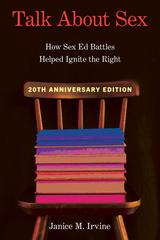
Talk about Sex
How Sex Ed Battles Helped Ignite the Right
Janice M. Irvine
Temple University Press, 2023
Praise for Talk about Sex
“Must reading for scholars, sexuality researchers, activists, and public policy and public health planners engaged in efforts to promote education on sex, sexually transmitted diseases, and HIV infection prevention for adolescents in schools.”—JAMA
Talk about Sex is a rich social history about the political transformations, cultural dynamics, and emotional rhetorical strategies that helped the right wing manufacture controversies on the local and national levels in the United States. Although the emergence of a politicized Christian Right is commonly dated at the mid-seventies, with the founding of groups like the Moral Majority, Talk about Sex tells the story of a powerful right-wing Christian presence in politics a full decade earlier. These activists used inflammatory sexual rhetoric—oftentimes deceptive and provocative—to capture the terms of public debate, galvanize voters, and reshape the culture according to their own vision.
This 20th Anniversary Edition includes a new preface and epilogue by the author that examines current controversies over public education on sexuality, gender, and race.
Demonstrating how the right wing draws on the cultural power of sexual shame and fear to build a political movement, Talk about Sex explores the complex entanglements of sexual knowledge, politics, and discourses.
“Must reading for scholars, sexuality researchers, activists, and public policy and public health planners engaged in efforts to promote education on sex, sexually transmitted diseases, and HIV infection prevention for adolescents in schools.”—JAMA
Talk about Sex is a rich social history about the political transformations, cultural dynamics, and emotional rhetorical strategies that helped the right wing manufacture controversies on the local and national levels in the United States. Although the emergence of a politicized Christian Right is commonly dated at the mid-seventies, with the founding of groups like the Moral Majority, Talk about Sex tells the story of a powerful right-wing Christian presence in politics a full decade earlier. These activists used inflammatory sexual rhetoric—oftentimes deceptive and provocative—to capture the terms of public debate, galvanize voters, and reshape the culture according to their own vision.
This 20th Anniversary Edition includes a new preface and epilogue by the author that examines current controversies over public education on sexuality, gender, and race.
Demonstrating how the right wing draws on the cultural power of sexual shame and fear to build a political movement, Talk about Sex explores the complex entanglements of sexual knowledge, politics, and discourses.
[more]

Teenage Dreams
Girlhood Sexualities in the U.S. Culture Wars
Charlie Jeffries
Rutgers University Press, 2022
Utilizing a breadth of archival sources from activists, artists, and policymakers, Teenage Dreams examines the race- and class-inflected battles over adolescent women’s sexual and reproductive lives in the late twentieth and early twenty-first century United States. Charlie Jeffries finds that most adults in this period hesitated to advocate for adolescent sexual and reproductive rights, revealing a new culture war altogether--one between adults of various political stripes in the cultural mainstream who prioritized the desire to delay girlhood sexual experience at all costs, and adults who remained culturally underground in their support for teenagers’ access to frank sexual information, and who would dare to advocate for this in public. The book tells the story of how the latter group of adults fought alongside teenagers themselves, who constituted a large and increasingly visible part of this activism. The history of the debates over teenage sexual behavior reveals unexpected alliances in American political battles, and sheds new light on the resurgence of the right in the US in recent years.
[more]
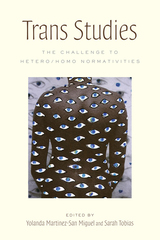
Trans Studies
The Challenge to Hetero/Homo Normativities
Martínez-San Miguel, Yolanda
Rutgers University Press, 2016
Winner of the 2017 Sylvia Rivera Award in Transgender Studies from the Center for LGBTQ Studies (CLAGS)
From Caitlyn Jenner to Laverne Cox, transgender people have rapidly gained public visibility, contesting many basic assumptions about what gender and embodiment mean. The vibrant discipline of Trans Studies explores such challenges in depth, building on the insights of queer and feminist theory to raise provocative questions about the relationships among gender, sexuality, and accepted social norms.
From Caitlyn Jenner to Laverne Cox, transgender people have rapidly gained public visibility, contesting many basic assumptions about what gender and embodiment mean. The vibrant discipline of Trans Studies explores such challenges in depth, building on the insights of queer and feminist theory to raise provocative questions about the relationships among gender, sexuality, and accepted social norms.
Trans Studies is an interdisciplinary essay collection, bringing together leading experts in this burgeoning field and offering insights about how transgender activism and scholarship might transform scholarship and public policy. Taking an intersectional approach, this theoretically sophisticated book deeply grounded in real-world concerns bridges the gaps between activism and academia by offering examples of cutting-edge activism, research, and pedagogy.
[more]
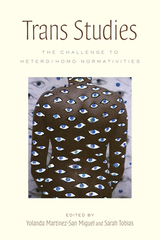
Trans Studies
The Challenge to Hetero/Homo Normativities
Martínez-San Miguel, Yolanda
Rutgers University Press, 2016
Winner of the 2017 Sylvia Rivera Award in Transgender Studies from the Center for LGBTQ Studies (CLAGS)
From Caitlyn Jenner to Laverne Cox, transgender people have rapidly gained public visibility, contesting many basic assumptions about what gender and embodiment mean. The vibrant discipline of Trans Studies explores such challenges in depth, building on the insights of queer and feminist theory to raise provocative questions about the relationships among gender, sexuality, and accepted social norms.
From Caitlyn Jenner to Laverne Cox, transgender people have rapidly gained public visibility, contesting many basic assumptions about what gender and embodiment mean. The vibrant discipline of Trans Studies explores such challenges in depth, building on the insights of queer and feminist theory to raise provocative questions about the relationships among gender, sexuality, and accepted social norms.
Trans Studies is an interdisciplinary essay collection, bringing together leading experts in this burgeoning field and offering insights about how transgender activism and scholarship might transform scholarship and public policy. Taking an intersectional approach, this theoretically sophisticated book deeply grounded in real-world concerns bridges the gaps between activism and academia by offering examples of cutting-edge activism, research, and pedagogy.
[more]
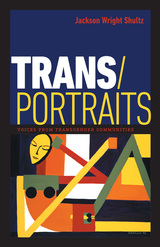
Trans/Portraits
Voices from Transgender Communities
Jackson Wright Shultz
Dartmouth College Press, 2015
Although transgender people are increasingly represented in academic studies and popular culture, they rarely have the opportunity to add their own voices to the conversation. In this remarkable book, Jackson Shultz records the stories of more than thirty Americans who identify as transgender. They range in age from fifteen to seventy-two; come from twenty-five different states and a wide array of racial, religious, and socioeconomic backgrounds; and identify across a vast spectrum of genders and sexualities. Giving voice to a diverse group of individuals, the book raises questions about gender, acceptance, and unconditional love. From historical descriptions of activism to personal stories of discrimination, love, and community, these touching accounts of gender transition shed light on the uncharted territories that lie beyond the gender binary. Despite encounters with familial rejection, drug addiction, and medical malpractice, each account is imbued with optimism and humor, providing a thoughtful look at the daily joys and struggles of transgender life. With an introduction and explanations from the author, this work will appeal to transgender individuals, their significant others, friends, family, and allies; health-care providers, educators, and legal professionals; and anyone questioning their own gender, considering transition, or setting out on their own transition journey.
[more]
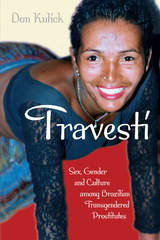
Travesti
Sex, Gender, and Culture among Brazilian Transgendered Prostitutes
Don Kulick
University of Chicago Press, 1998
In this dramatic and compelling narrative, anthropologist Don Kulick follows the lives of a group of transgendered prostitutes (called travestis in Portuguese) in the Brazilian city Salvador. Travestis are males who, often beginning at ages as young as ten, adopt female names, clothing styles, hairstyles, and linguistic pronouns. More dramatically, they ingest massive doses of female hormones and inject up to twenty liters of industrial silicone into their bodies to create breasts, wide hips, and large thighs and buttocks. Despite such irreversible physiological changes, virtually no travesti identifies herself as a woman. Moreover, travestis regard any male who does so as mentally disturbed.
Kulick analyzes the various ways travestis modify their bodies, explores the motivations that lead them to choose this particular gendered identity, and examines the complex relationships that they maintain with one another, their boyfriends, and their families. Kulick also looks at how travestis earn their living through prostitution and discusses the reasons prostitution, for most travestis, is a positive and affirmative experience.
Arguing that transgenderism never occurs in a "natural" or arbitrary form, Kulick shows how it is created in specific social contexts and assumes specific social forms. Furthermore, Kulick suggests that travestis—far from deviating from normative gendered expectations—may in fact distill and perfect the messages that give meaning to gender throughout Brazilian society and possibly throughout much of Latin America.
Through Kulick's engaging voice and sharp analysis, this elegantly rendered account is not only a landmark study in its discipline but also a fascinating read for anyone interested in sexuality and gender.
Kulick analyzes the various ways travestis modify their bodies, explores the motivations that lead them to choose this particular gendered identity, and examines the complex relationships that they maintain with one another, their boyfriends, and their families. Kulick also looks at how travestis earn their living through prostitution and discusses the reasons prostitution, for most travestis, is a positive and affirmative experience.
Arguing that transgenderism never occurs in a "natural" or arbitrary form, Kulick shows how it is created in specific social contexts and assumes specific social forms. Furthermore, Kulick suggests that travestis—far from deviating from normative gendered expectations—may in fact distill and perfect the messages that give meaning to gender throughout Brazilian society and possibly throughout much of Latin America.
Through Kulick's engaging voice and sharp analysis, this elegantly rendered account is not only a landmark study in its discipline but also a fascinating read for anyone interested in sexuality and gender.
[more]
READERS
Browse our collection.
PUBLISHERS
See BiblioVault's publisher services.
STUDENT SERVICES
Files for college accessibility offices.
RECENTLY PUBLISHED





UChicago Accessibility Resources
home | accessibility | search | about | contact us
BiblioVault ® 2001 - 2024
The University of Chicago Press