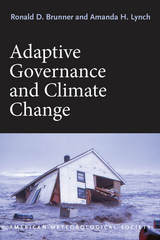
front cover of Adaptive Governance and Climate Change
Adaptive Governance and Climate Change
Ronald D. Brunner and Amanda H. Lynch
American Meteorological Society, 2010

While recent years have seen undeniable progress in international acknowledgement both of the dangers of climate change and the importance of working to mitigate it, little has actually been done. Emissions continue to rise, and even the ambitious targets set by international accords would fall far short of the drastic cuts that are needed to prevent catastrophe.

            
With Adaptive Governance and Climate Change, Ronald D. Brunner and Amanda H. Lynch argue that we need to take a new tack, moving away from reliance on centralized, top-down approaches—the treaties and accords that have proved disappointingly ineffective thus far—and towards a more flexible, multi-level approach. Based in the principles of adaptive governance—which are designed to produce programs that adapt quickly and easily to new information and experimental results—such an approach would encourage diversity and innovation in the search for solutions, while at the same time pointedly recasting the problem as one in which every culture and community around the world has an inherent interest.
[more]

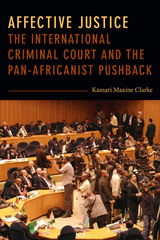
front cover of Affective Justice
Affective Justice
The International Criminal Court and the Pan-Africanist Pushback
Kamari Maxine Clarke
Duke University Press, 2019
Since its inception in 2001, the International Criminal Court (ICC) has been met with resistance by various African states and their leaders, who see the court as a new iteration of colonial violence and control. In Affective Justice Kamari Maxine Clarke explores the African Union's pushback against the ICC in order to theorize affect's role in shaping forms of justice in the contemporary period. Drawing on fieldwork in The Hague, the African Union in Addis Ababa, sites of postelection violence in Kenya, and Boko Haram's circuits in Northern Nigeria, Clarke formulates the concept of affective justice—an emotional response to competing interpretations of justice—to trace how affect becomes manifest in judicial practices. By detailing the effects of the ICC’s all-African indictments, she outlines how affective responses to these call into question the "objectivity" of the ICC’s mission to protect those victimized by violence and prosecute perpetrators of those crimes. In analyzing the effects of such cases, Clarke provides a fuller theorization of how people articulate what justice is and the mechanisms through which they do so.
[more]

logo for Georgetown University Press
Agenda Setting, the UN, and NGOs
Gender Violence and Reproductive Rights
Jutta M. Joachim
Georgetown University Press, 2007

In the mid-1990s, when the United Nations adopted positions affirming a woman's right to be free from bodily harm and to control her own reproductive health, it was both a coup for the international women's rights movement and an instructive moment for nongovernmental organizations (NGOs) seeking to influence UN decision making.

Prior to the UN General Assembly's 1993 Declaration on the Elimination of All Forms of Violence against Women and the 1994 decision by the UN's Conference on Population and Development to vault women's reproductive rights and health to the forefront of its global population growth management program, there was little consensus among governments as to what constituted violence against women and how much control a woman should have over reproduction. Jutta Joachim tells the story of how, in the years leading up to these decisions, women's organizations got savvy—framing the issues strategically, seizing political opportunities in the international environment, and taking advantage of mobilizing structures—and overcame the cultural opposition of many UN-member states to broadly define the two issues and ultimately cement women's rights as an international cause.

Joachim's deft examination of the documents, proceedings, and actions of the UN and women's advocacy NGOs—supplemented by interviews with key players from concerned parties, and her own participant-observation—reveals flaws in state-centered international relations theories as applied to UN policy, details the tactics and methods that NGOs can employ in order to push rights issues onto the UN agenda, and offers insights into the factors that affect NGO influence. In so doing, Agenda Setting, the UN, and NGOs departs from conventional international relations theory by drawing on social movement literature to illustrate how rights groups can motivate change at the international level.
[more]

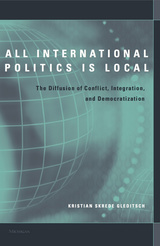
front cover of All International Politics Is Local
All International Politics Is Local
The Diffusion of Conflict, Integration, and Democratization
Kristian Skrede Gleditsch
University of Michigan Press, 2002

How does regional interdependence influence the prospects for conflict, integration, and democratization? Some researchers look at the international system at large and disregard the enormous regional variations. Others take the concept of sovereignty literally and treat each nation-state as fully independent. Kristian Skrede Gleditsch looks at disparate zones in the international system to see how conflict, integration, and democracy have clustered over time and space. He argues that the most interesting aspects of international politics are regional rather than fully global or exclusively national. Differences in the local context of interaction influence states' international behavior as well as their domestic attributes.

In All International Politics Is Local, Gleditsch clarifies that isolating the domestic processes within countries cannot account for the observed variation in distribution of political democracy over time and space, and that the likelihood of transitions is strongly related to changes in neighboring countries and the prior history of the regional context. Finally, he demonstrates how spatial and statistical techniques can be used to address regional interdependence among actors and its implications.

Kristian Skrede Gleditsch is Assistant Professor of Political Science at the University of California, San Diego.

[more]

front cover of An Alliance Of Women
An Alliance Of Women
Immigration And The Politics Of Race
Heather Merrill
University of Minnesota Press, 2006
In the 1980s, Italy transformed from a country of emigration to one of immigration. Italians are now faced daily with the presence of migrants from all over Africa, parts of South and Central America, the Middle East, Asia, and Eastern Europe. While much attention has been paid to the impact on Italians, few studies have focused on the agency of migrants themselves. In An Alliance of Women, Heather Merrill investigates how migrants and Italians struggle over meanings and negotiate social and cultural identities.

Taking as a starting point the Italian crisis over immigration in the early 1990s, Merrill examines grassroots interethnic spatial politics among female migrants and Turin feminists in Northern Italy. Using rich ethnographic material, she traces the emergence of Alma Mater—an anti-racist organization formed to address problems encountered by migrant women. Through this analysis, Merrill reveals the dynamics of an alliance consisting of women from many countries of origin and religious and class backgrounds.

Highlighting an interdisciplinary approach to migration and the instability of group identities in contemporary Italy, An Alliance of Women presents migrants grappling with spatialized boundaries amid growing nativist and anti-immigrant sentiment in Western Europe.

Heather Merrill is assistant professor of geography and anthropology at Dickinson College.
[more]

front cover of Anarchy, Order and Integration
Anarchy, Order and Integration
How to Manage Interdependence
Harvey Starr
University of Michigan Press, 2000
Most observers agree that the global arena is in the midst of multiple changes. The elements that create and intensify global interdependencies have been expanding rapidly, generating questions about the viability of the state and the viability of the state-centric system that has existed for over 500 years, as well as what sorts of structures and behaviors might replace them. And yet much of the analysis is not helpful in understanding the condition of the international system because it either fails to define the meaning of terms such as interdependence and order or treats these as new problems ignoring many important ideas that have developed over the years about international politics. One of our most accomplished scholars in international affairs, Harvey Starr offers a fresh and original analysis of the nature of the international system. Starr argues that the global system can best be understood as the consequence of states adapting to changing interdependencies. States do remain important in this system, but the reality they adapt to is changing. Thus the environment surrounding states is important not because it is "anarchic," as argued by structural realists such as Waltz, but because environmental conditions have changed, thereby changing the meaning and significance of such structural characteristics as "anarchy." Starr argues that we must recognize that the modes by which states adapt to change in the international system lead to changes in both the states themselves and in their environment. This book will appeal to scholars of international relations in political science and economics as well as to policy makers and analysts interested in understanding change in the international system.
[more]

front cover of Automobiles and the Future
Automobiles and the Future
Competition, Cooperation, and Change
Robert E. Cole, Editor
University of Michigan Press, 1983
At the time of the U.S.-Japan auto conferences in March 1983, the hoped-for economic recovery as manifested in auto sales had revealed itself quite modestly. Three months later, the indicators were more robust and certainly long overdue for those whose livelihood depends on the health of the industry--some of whom are university professors.
With Japanese import restrictions in place until March 1984 and drastically reduced break-even points for domestic manufactures, rising consumer demand holds great promise for the industry. The rapidly rising stock prices of the auto-makers captures well the sense of heightened optimism, as do the various forecasts for improved profits.
While the news is certainly welcome, it nevertheless should be greeted with caution. As Mr. Perkins noted at the conference, "we have a tendency to forget things very quickly. If we have a boom market this year, there is a good chance that a lot of things we learned will be forgotten."
To put the matter differently and more bluntly, with growing prosperity there is the risk that management will fall back into old habits, making impossible the achievement of sustained quality and productivity improvement. Similarly, the commitment to develop cooperative relations with workers and suppliers will weaken. The union will be under membership pressure to retrieve concessions rather than to take the longer-term view. This longer-term view recognizes that "up-front increases" and adherence to existing work rules increasingly come at the sacrifice of future job security. Government policymakers will turn their attention away from the industry. This may not mean a great deal given how weakly focused their attentions has been during the last three years and how mixed and contradictory government auto policies have been for over a decade.
[more]

front cover of The Banality of Good
The Banality of Good
The UN's Global Fight against Human Trafficking
Lieba Faier
Duke University Press, 2024
In The Banality of Good, Lieba Faier examines why contemporary efforts to curb human trafficking have fallen so spectacularly short of their stated goals despite well-funded campaigns by the United Nations and its member-state governments. Focusing on Japan’s efforts to enact the UN’s counter-trafficking protocol and assist Filipina migrants working in Japan’s sex industry, Faier draws from interviews with NGO caseworkers and government officials to demonstrate how these efforts disregard the needs and perspectives of those they are designed to help. She finds that these campaigns tend to privilege bureaucracies and institutional compliance, resulting in the compromised quality of life, repatriation, and even criminalization of human trafficking survivors. Faier expands on Hannah Arendt’s idea of the “banality of evil” by coining the titular “banality of good” to describe the reality of the UN’s fight against human trafficking. Detailing the protocols that have been put in place and evaluating their enactment, Faier reveals how the continued failure of humanitarian institutions to address structural inequities and colonial history ultimately reinforces the violent status quo they claim to be working to change.
[more]

front cover of Beyond the Boomerang
Beyond the Boomerang
From Transnational Advocacy Networks to Transcalar Advocacy in International Politics
Edited by Christopher L. Pallas and Elizabeth A. Bloodgood
University of Alabama Press, 2022
Essays that generate a new, empirically grounded theory of transnational advocacy
 
Margaret E. Keck and Kathryn Sikkink introduced the boomerang theory in their 1998 book, Activists beyond Borders: Advocacy Networks in International Politics. It remains one of the first broadly applicable theories for why groups of NGOs and interested individuals form transnational advocacy networks. Since its publication, however, the empirical conditions that prompted their theory have changed. The types of actors involved in transnational advocacy have diversified. Northern NGOs have lost power and influence and have been restricted in their access to southern states. Southern NGOs have developed the capacity to undertake advocacy on their own and often built closer relationships with their own governments. The architecture of global governance has likewise changed, providing new avenues of access and influence for southern voices.
 
In Beyond the Boomerang: From Transnational Advocacy Networks to Transcalar Advocacy in International Politics, editors Christopher L. Pallas and Elizabeth A. Bloodgood offer cutting-edge scholarship that synthesizes a new theoretical framework to develop a coherent, integrated picture of the current dynamics in global advocacy. This new theory of transcalar advocacy focuses on advocacy activities and policy impacts that transcend different levels or scales of political action. In transcalar advocacy, all NGOs–northern and southern–are treated as strategic actors, choosing the targets, scales of advocacy, and partnerships that best suit their capacities and goals. The case studies in the volume develop the empirical grounding of this theory using data from Latin America, Africa, Europe, and Asia, with several chapters featuring cross-national comparison. The chapters highlight the wide variety of actors involved in advocacy work, including NGOs, social movements, international institutions, governments, and businesses. Contributors use both qualitative and quantitative methodologies and bring to bear insights from political science, international relations, and sociology. The case studies also include diverse issue areas, from women’s rights to environmental protection, sustainable agriculture, health policy, and democracy promotion.
 
[more]

front cover of Binational Commons
Binational Commons
Institutional Development and Governance on the U.S.-Mexico Border
Edited by Tony Payan and Pamela L. Cruz
University of Arizona Press, 2020
Studying institutional development is not only about empowering communities to withstand political buccaneering; it is also about generating effective and democratic governance so that all members of a community can enjoy the benefits of social life. In the U.S.-Mexico borderlands, cross-border governance draws only sporadic—and even erratic—attention, primarily in times of crises, when governance mechanisms can no longer provide even moderately adequate solutions.

This volume addresses the most pertinent binational issues and how they are dealt with by both countries. In this important and timely volume, experts tackle the important problem of cross-border governance by an examination of formal and informal institutions, networks, processes, and mechanisms. Contributors also discuss various social, political, and economic actors and agencies that make up the increasingly complex governance space that is the U.S.-Mexico border.

Binational Commons focuses on whether the institutions that presently govern the U.S.-Mexico transborder space are effective in providing solutions to difficult binational problems as they manifest themselves in the borderlands. Critical for policy-making now and into the future, this volume addresses key binational issues. It explores where there are strong levels of institutional governance development, where it is failing, how governance mechanisms have evolved over time, and what can be done to improve it to meet the needs of the U.S.-Mexico borderlands in the next decades.

Contributors
Silvia M. Chavez-Baray
Kimberly Collins
Irasema Coronado
Guadalupe Correa-Cabrera
Pamela L. Cruz
Adrián Duhalt
James Gerber
Manuel A. Gutiérrez
Víctor Daniel Jurado Flores
Evan D. McCormick
Jorge Eduardo Mendoza Cota
Miriam S. Monroy
Eva M. Moya
Stephen Mumme
Tony Payan
Carla Pederzini Villarreal
Sergio Peña
Octavio Rodríguez Ferreira
Cecilia Sarabia Ríos
Kathleen Staudt
 
[more]

front cover of Black Feminist Constellations
Black Feminist Constellations
Dialogue and Translation across the Americas
Edited by Christen A. Smith and Lorraine Leu
University of Texas Press, 2023

A collection of essays, interviews, and conversations by and between scholars, activists, and artists from Latin America and the Caribbean that paints a portrait of Black women's experiences across the region.

Black women in Latin America and the Caribbean suffer a triple erasure: as Black people, as women, and as non-English speakers in a global environment dominated by the Anglophone North. Black Feminist Constellations is a passionate and necessary corrective. Focused on and written by Black women of the southern Americas, the original works composing this volume make legible the epistemologies that sustain radical scholarship, art, and political organizing by Black women everywhere.

In essays, poems, and dialogues, the writers in Black Feminist Constellations reimagine liberation from the perspectives of radical South American and Caribbean Black women thinkers. The volume’s methodologically innovative approach reflects how Black women come together to theorize the world and challenges the notion that the university is the only site where knowledge can emerge. A major work of intellectual history, Black Feminist Constellations amplifies rarely heard voices, centers the uncanonized, and celebrates the overlooked work of Black women.

[more]

front cover of Breeding Bio Insecurity
Breeding Bio Insecurity
How U.S. Biodefense Is Exporting Fear, Globalizing Risk, and Making Us All Less Secure
Lynn C. Klotz and Edward J. Sylvester
University of Chicago Press, 2009

In the years since the 9/11 attacks—and the subsequent lethal anthrax letters—the United States has spent billions of dollars on measures to defend the population against the threat of biological weapons. But as Lynn C. Klotz and Edward J. Sylvester argue forcefully in Breeding Bio Insecurity, all that money and effort hasn’t made us any safer—in fact, it has made us more vulnerable.

Breeding Bio Insecurity reveals the mistakes made to this point and lays out the necessary steps to set us on the path toward true biosecurity. The fundamental problem with the current approach, according to the authors, is the danger caused by the sheer size and secrecy of our biodefense effort. Thousands of scientists spread throughout hundreds of locations are now working with lethal bioweapons agents—but their inability to make their work public causes suspicion among our enemies and allies alike, even as the enormous number of laboratories greatly multiplies the inherent risk of deadly accidents or theft. Meanwhile, vital public health needs go unmet because of this new biodefense focus. True biosecurity, the authors argue, will require a multipronged effort based in an understanding of the complexity of the issue, guided by scientific ethics, and watched over by a vigilant citizenry attentive to the difference between fear mongering and true analysis of risk.

An impassioned warning that never loses sight of political and scientific reality, Breeding Bio Insecurity is a crucial first step toward meeting the evolving threats of the twenty-first century.

[more]

front cover of Bridging Troubled Waters
Bridging Troubled Waters
China, Japan, and Maritime Order in the East China Sea
James Manicom
Georgetown University Press, 2014

Sino-Japanese relations have been repeatedly strained by the territorial dispute over a group of small islands, known as the Senkaku islands in Japan and the Diaoyu islands in China. The rich fishing grounds, key shipping lanes, and perhaps especially, potentially rich oil deposits around the islands exacerbate this dispute in a confluence of resource pressures, growing nationalism, and rising military spending in the region.

Bridging Troubled Waters reminds us that the tensions over the Senkaku/Diaoyu islands are only a part of a long history of both conflict and cooperation in maritime relations between Japan and China. James Manicom examines the cooperative history between China and Japan at sea and explains the conditions under which two rivals can manage disputes over issues such as territory, often correlated with war.

China and Japan appear incapable of putting history behind them, are poised on the brink of a strategic rivalry, and seem at risk of falling into an unintentional war over disputed maritime claims. Bridging Troubled Waters challenges this view by offering a case-by-case analysis of how China and Japan have managed maritime tensions since the dispute erupted in 1970. The author advances an approach that offers a trade-off between the most important stakes in the disputed maritime area with a view to establishing a stable maritime order in the East China Sea. The book will be of interest to policymakers, academics, and regional specialists in Asia, security studies, and international conflict and cooperation.

[more]

logo for Assoc of College & Research Libraries
Bridging Worlds
Emerging Mode Ls And Practices Of
Raymond Pun
Assoc of College & Research Libraries, 2016

front cover of The Carbon Calculation
The Carbon Calculation
Global Climate Policy, Forests, and Transnational Governance in Brazil and Mozambique
Raquel Rodrigues Machaqueiro
University of Arizona Press, 2023
The Carbon Calculation examines how climate science, the policy world, and neoliberalism have mutually informed each other to define the problem of climate change as one of “market failure”—precluding alternatives to market-based solutions.

Focusing on REDD+ (Reducing Emissions from Deforestation and Forest Degradation), the book demonstrates how industrialized countries are able to maintain their socioeconomic models largely unaltered while claiming to address global warming using forests in the Global South to offset their pollution. By examining the creation and implementation of REDD+ historically and ethnographically, the book traces the social life of this mechanism as it travels across a complex network spanning several interacting levels: international, national, and local. Through cases in the Brazilian state of Acre and the Zambézia province in Mozambique, the author demonstrates how global climate policy has created new opportunities and rationales for unprecedented levels of intervention in the Global South—all under the guise of saving the planet.

The Carbon Calculation critically highlights the ways in which politics has reinforced a scientific focus on one possible solution to the problem of climate change—namely those that largely absolve the industrialized world from undertaking politically painful transformations in its own economic model.
[more]

front cover of Climate Games
Climate Games
Experiments on How People Prevent Disaster
Talbot M. Andrews, Andrew W. Delton, and Reuben Kline
University of Michigan Press, 2024
Can humanity work together to mitigate the effects of climate change? Climate Games argues we can. This book brings together a decade and a half of experimentation, conducted by researchers around the world, which shows that people can and will work together to prevent disasters like climate change. These experiments, called economic games, put money on the line to create laboratory disasters. Participants must work together by spending a bit of money now to prevent themselves from losing even more money in the future. Will people sacrifice their own money to prevent disaster? Can people make wise decisions? And can people decide wisely on behalf of others? The answer is a resounding yes. 

Yet real climate change is a complex social dilemma involving the world’s nearly eight billion inhabitants. In the real world, the worst effects of climate change are likely to be felt by developing countries, while most of the decisions will be made by rich, industrialized countries. And while the world as a whole would be better off if all nations reduced their greenhouse gas emissions, any given nation could decide it would be even better off if it continued emitting and let other nations take care of the problem. These disaster experiments test how real people respond to climate change’s unique constellation of challenges and deliver a positive message: People will prevent disaster.
[more]

front cover of Combating Jihadism
Combating Jihadism
American Hegemony and Interstate Cooperation in the War on Terrorism
Barak Mendelsohn
University of Chicago Press, 2009
Although terrorism is an age-old phenomenon, jihadi ideology is distinctive in its ambition to abandon the principle of state sovereignty, overthrow the modern state system, and replace it with an extremely radical interpretation of an Islamic world order. These characteristics reflect a radical break from traditional objectives promoted by terrorist groups. In Combating Jihadism Barak Mendelsohn argues that the distinctiveness of the al-Qaeda threat led the international community to change its approach to counterterrorism. Contrary to common yet erroneous conceptions, the United States, in its role as a hegemon, was critical for the formulation of a multilateral response.
While most analyses of hegemony have focused on power, Mendelsohn firmly grounds the phenomenon in a web of shared norms and rules relating to the hegemon’s freedom of action. Consequently, he explains why US leadership in counterterrorism efforts was in some spheres successful, when in others it failed or did not even seek to establish multilateral collaborative frameworks. Tracing the ways in which international cooperation has stopped terrorist efforts, Combating Jihadism provides a nuanced, innovative, and timely reinterpretation of the war on terrorism and the role of the United States in leading the fight against al-Qaeda and its affiliates.
[more]

front cover of Conflict and Cooperation in the Global Commons
Conflict and Cooperation in the Global Commons
A Comprehensive Approach for International Security
Scott Jasper, Editor
Georgetown University Press, 2012

More than ever, international security and economic prosperity depend upon safe access to the shared domains that make up the global commons: maritime, air, space, and cyberspace. Together these domains serve as essential conduits through which international commerce, communication, and governance prosper. However, the global commons are congested, contested, and competitive. In the January 2012 defense strategic guidance, the United States confirmed its commitment “to continue to lead global efforts with capable allies and partners to assure access to and use of the global commons, both by strengthening international norms of responsible behavior and by maintaining relevant and interoperable military capabilities.”

In the face of persistent threats, some hybrid in nature, and their consequences, Conflict and Cooperation in the Global Commons provides a forum where contributors identify ways to strengthen and maintain responsible use of the global commons. The result is a comprehensive approach that will enhance, align, and unify commercial industry, civil agency, and military perspectives and actions.

[more]

front cover of Conflict Resolution in the Twenty-first Century
Conflict Resolution in the Twenty-first Century
Principles, Methods, and Approaches
Jacob Bercovitch and Richard Jackson
University of Michigan Press, 2009
In the past, arbitration, direct bargaining, the use of intermediaries, and deference to international institutions were relatively successful tools for managing interstate conflict. In the face of terrorism, intrastate wars, and the multitude of other threats in the post–Cold War era, however, the conflict resolution tool kit must include preventive diplomacy, humanitarian intervention, regional task-sharing, and truth commissions. Here, Jacob Bercovitch and Richard Jackson, two internationally recognized experts, systematically examine each one of these conflict resolution tools and describe how it works and in what conflict situations it is most likely to be effective.

Conflict Resolution in the Twenty-first Centuryis not only an essential introduction for students and scholars, it is a must-have guide for the men and women entrusted with creating stability and security in our changing world.

[more]

front cover of Confronting Colonial Legacies
Confronting Colonial Legacies
A History of Chicana/o Indigeneities and Transnational Activism
José Luis Serrano Nájera
University of Arizona Press, 2026

This work offers a groundbreaking account of how Chicana/o activists have engaged in sustained efforts to reclaim Indigenous identity through political struggle, cultural expression, and transnational solidarity.

Author José Luis Serrano Nájera takes an in-depth look at the history of Chicana/o indigeneity, starting with the Chicana/o Movement of the 1960s and 1970s and through twenty-first century transnational activism and solidarity movements. Serrano Nájera reveals how claims to indigeneity were rooted in reciprocal relationships with Indigenous communities and driven by a shared commitment to decolonization. Through chapters on visual and performing arts, ceremony, education, and grassroots organizing, this book challenges reductive narratives of cultural appropriation and instead foregrounds the complex and historically grounded nature of Chicana/o indigeneity.

Drawing on extensive archival research, Serrano Nájera demonstrates how Chicana/o indigeneity has contributed to broader Indigenous rights movements, including efforts that culminated in the 2007 United Nations Declaration on the Rights of Indigenous Peoples. This work highlights the intercontinental dimensions of Chicana/o activism and offers a vital source for scholars and students in Chicana/o studies, Indigenous studies, ethnic studies, history, and political science. Confronting Colonial Legacies is a compelling call to rethink the politics of identity, sovereignty, and solidarity across the Americas.

[more]

front cover of Constructing Iron Europe
Constructing Iron Europe
Transnationalism and Railways in the Interbellum
Irene Anastasiadou
Amsterdam University Press, 2012
Although the years between the world wars were ones of diplomatic tension in Europe, they also saw the construction of countless miles of international railroads on the continent. In Constructing Iron Europe, Irene Anastasiadou examines this era of railroad building and argues that, contrary to most conventional histories—which view railroad building as an aspect of nation- or empire-building—the construction in this era was deliberately transnational, and ultimately aimed at tightening links between nations and constructing a closer-knit European community.
[more]

front cover of A COVID Charter, A Better World
A COVID Charter, A Better World
Toby Miller
Rutgers University Press, 2021
With unprecedented speed, scientists have raced to develop vaccines to bring the COVID-19 pandemic under control and restore a sense of normalcy to our lives. Despite the havoc and disruption the pandemic has caused, it’s exposed exactly why we should not return to life as we once knew it. Our current profit-driven healthcare systems have exacerbated global inequality and endangered public health, and we must take this opportunity to construct a new social order that understands public health as a basic human right.  
 
A COVID Charter, A Better World outlines the steps needed to reform public policies and fix the structural vulnerabilities that the current pandemic has made so painfully clear. Leading scholar Toby Miller argues that we must resist neoliberalism’s tendency to view health in terms of individual choices and market-driven solutions, because that fails to preserve human rights. He addresses the imbalance of geopolitical power to explain how we arrived at this point and shows that the pandemic is more than just a virus—it’s a social disease. By examining how the U.S., Britain, Mexico, and Colombia have responded to the COVID-19 crisis, Miller investigates corporate, scientific, and governmental decision-making and the effects those decisions have had on disadvantaged local communities. Drawing from human rights charters ratified by various international organizations, he then proposes a COVID charter, calling for a new world that places human lives above corporate profits.
[more]

front cover of Cross Currents in the International Women’s Movement, 1848–1948
Cross Currents in the International Women’s Movement, 1848–1948
Patricia Ward D'Itri
University of Wisconsin Press, 1999

This study portrays individuals, organizations, and events that contributed to the development of the world movement for women's rights between 1848 and 1948.

[more]

front cover of Cubans in Angola
Cubans in Angola
South-South Cooperation and Transfer of Knowledge, 1976–1991
Christine Hatzky
University of Wisconsin Press, 2015
Angola, a former Portuguese colony in southern central Africa, gained independence in 1975 and almost immediately plunged into more than two decades of conflict and crisis. Fidel Castro sent Cuban military troops to Angola in support of the Movimento Popular de Libertação de Angola (MPLA), leading to its ascension to power despite facing threats both international and domestic. What is less known, and what Cubans in Angola brings to light, is the significant role Cubans played in the transformation of civil society in Angola during these years. Offering not just military support but also political, medical, administrative, and technical expertise as well as educational assistance, the Cuban presence in Angola is a unique example of transatlantic cooperation between two formerly colonized nations in the global South.
[more]

front cover of Cultural Heritage and Mass Atrocities
Cultural Heritage and Mass Atrocities
James Cuno
J. Paul Getty Trust, The, 2022
A pathbreaking call to halt the intertwined crises of cultural heritage attacks and mass atrocities and mobilize international efforts to protect people and cultures.
 
Intentional destruction of cultural heritage has a long history. Contemporary examples include the Bamiyan Buddhas in Afghanistan, mosques in Xinjiang, mausoleums in Timbuktu, and Greco-Roman remains in Syria. Cultural heritage destruction invariably accompanies assaults on civilians, making heritage attacks impossible to disentangle from the mass atrocities of genocide, war crimes, crimes against humanity, and ethnic cleansing. Both seek to eliminate people and the heritage with which they identify.
 
Cultural Heritage and Mass Atrocities assembles essays by thirty-eight experts from the heritage, social science, humanitarian, legal, and military communities. Focusing on immovable cultural heritage vulnerable to attack, the volume's guiding framework is the Responsibility to Protect (R2P), a United Nations resolution adopted unanimously in 2005 to permit international intervention against crimes of war or genocide. Based on the three pillars of prevent, react, and rebuild, R2P offers today's policymakers a set of existing laws and international norms that can and—as this book argues—must be extended to the protection of cultural heritage. Contributions consider the global value of cultural heritage and document recent attacks on people and sites in China, Guatemala, Iraq, Mali, Sri Lanka and Afghanistan, Syria, and Yemen. Comprehensive sections on vulnerable populations as well as the role of international law and the military offer readers critical insights and point toward research, policy, and action agendas to protect both people and cultural heritage. A concise abstract of each chapter is offered online in Arabic, Chinese, French, Russian, and Spanish to facilitate robust, global dissemination of the strategies and tactics offered in this pathbreaking call to action.
 
The free online edition of this publication is available at getty.edu/publications/cultural-heritage-mass-atrocities. Also available are free PDF, EPUB, and Kindle/MOBI downloads of the book.
[more]

front cover of Delivering on Promises
Delivering on Promises
The Domestic Politics of Compliance in International Courts
Lauren J. Peritz
University of Chicago Press, 2022
A timely investigation into the conditions that make international agreements—and the institutions that enforce them—vulnerable.

When do international institutions effectively promote economic cooperation among countries and help them resolve conflict? Although the international system lacks any central governing authority, states have created rules, particularly around international economic relations, and empowered international tribunals to enforce those rules. Just how successful are these institutions? In Delivering on Promises Lauren J. Peritz demonstrates that these international courts do indeed deliver results—but they are only effective under certain conditions. 

As Peritz shows, states are less likely to comply with international rules and international court decisions when domestic industries have the political ability to obstruct compliance in particular cases. The author evaluates the argument with an extensive empirical analysis that traces the domestic politics of compliance with the decisions of two international economic courts: the World Trade Organization’s dispute settlement mechanism and the Court of Justice of the European Union. At a time when international agreements are under attack, this book sheds light on the complex relationship between domestic politics and international economic cooperation, offering detailed evidence that international economic courts are effective at promoting interstate cooperation.
 
[more]

front cover of Designs of Destruction
Designs of Destruction
The Making of Monuments in the Twentieth Century
Lucia Allais
University of Chicago Press, 2018

How architectural monuments survived and historical preservation was reinvented during the destructions of the twentieth century.
 
The twentieth century was highly destructive, but from its landscapes of ruins was born a new architectural type: the cultural monument. In the wake of World War I, an international movement arose which aimed to protect architectural monuments in large numbers, and regardless of style, hoping not only to keep them safe from future conflicts but also to make them worthy of protection from more quotidian forms of destruction. An evolving group—including architects, intellectuals, art historians, archaeologists, curators, and lawyers—grew out of the new diplomacy of the League of Nations. During and after World War II, it became affiliated with the Allied Military Government and was eventually absorbed by the UN as UNESCO. By the 1970s, this organization had begun granting World Heritage status to a global register of significant sites—from buildings to bridges, shrines to city centers, ruins to colossi.

Examining key episodes in the history of this preservation effort—including projects for the Parthenon, the Cathedral of St-Lô, the temples of Abu Simbel, and the Bamyian Buddahs —Lucia Allais demonstrates how the group deployed the notion of culture to shape architectural sites, and how architecture in turn shaped the very idea of global culture. Designs of Destruction emphasizes how the technical project of ensuring various buildings’ longevity jolted preservation into establishing a transnational set of codes, values, and practices. At the same time, this paradoxically helped integrate technologies of destruction—from bombs to bulldozers—into cultural governance. Designs of Destruction not only offers a fascinating narrative of cultural diplomacy, based on extensive archival findings; it also contributes an important new chapter in the intellectual history of modernity by showing the manifold ways architectural form is charged with concretizing abstract ideas and ideals, even in its destruction.

[more]

logo for Pluto Press
Drugs in Afghanistan
Opium, Outlaws and Scorpion Tales
David Macdonald
Pluto Press, 2007

Afghanistan is the world's largest producer of opium and heroin. This book explores the devastating impact that the drugs trade has had on the Afghan people.

Author David Macdonald has worked as a drugs advisor to the UN. Based on his extensive experience, this book breaks down the myths surrounding the cultivation and consumption of drugs, providing a detailed analysis of the history of drug use within the country. He examines the impact of over 25 years of continuous conflict, and shows how poverty and instability has led to an increase in drugs consumption. He also considers the recent rise in the use of pharmaceutical drugs, resulting in dangerous chemical cocktails and analyses the effect of Afghanistan's drug trade on neighbouring countries.

[more]

front cover of Ecologics
Ecologics
Wind and Power in the Anthropocene
Cymene Howe
Duke University Press, 2019
Between 2009 and 2013 Cymene Howe and Dominic Boyer conducted fieldwork in Mexico's Isthmus of Tehuantepec to examine the political, social, and ecological dimensions of moving from fossil fuels to wind power. Their work manifested itself as a new ethnographic form: the duograph—a combination of two single-authored books that draw on shared fieldsites, archives, and encounters that can be productively read together, yet can also stand alone in their analytic ambitions.

In her volume, Ecologics, Howe narrates how an antidote to the Anthropocene became both failure and success. Tracking the development of what would have been Latin America's largest wind park, Howe documents indigenous people's resistance to the project and the political and corporate climate that derailed its renewable energy potential. Using feminist and more-than-human theories, Howe demonstrates how the dynamics of energy and environment cannot be captured without understanding how human aspirations for energy articulate with nonhuman beings, technomaterial objects, and the geophysical forces that are at the heart of wind and power.
[more]

front cover of Energopolitics
Energopolitics
Wind and Power in the Anthropocene
Dominic Boyer
Duke University Press, 2019
Between 2009 and 2013 Cymene Howe and Dominic Boyer conducted fieldwork in Mexico's Isthmus of Tehuantepec to examine the political, social, and ecological dimensions of moving from fossil fuels to wind power. Their work manifested itself as a new ethnographic form: the duograph—a combination of two single-authored books that draw on shared fieldsites, archives, and encounters that can be productively read together, yet can also stand alone in their analytic ambitions.

In his volume, Energopolitics, Boyer examines the politics of wind power and how it is shaped by myriad factors, from the legacies of settler colonialism and indigenous resistance to state bureaucracy and corporate investment. Drawing on interviews with activists, campesinos, engineers, bureaucrats, politicians, and bankers, Boyer outlines the fundamental impact of energy and fuel on political power. Boyer also demonstrates how large conceptual frameworks cannot adequately explain the fraught and uniquely complicated conditions on the isthmus, illustrating the need to resist narratives of anthropocenic universalism and to attend to local particularities.
[more]

front cover of Engineering the Lower Danube
Engineering the Lower Danube
Technology and Territoriality in an Imperial Borderland, Late Eighteenth and Nineteenth Centuries
Luminita Gatejel
Central European University Press, 2023

The Lower Danube—the stretch of Europe’s second longest river between the Romanian-Serbian border and the confluence to the Black Sea—was effectively transformed during the late eighteenth and nineteenth centuries. In describing this lengthy undertaking, Luminita Gatejel proposes that remaking two key stretches—the Iron Gates and the delta—not only physically altered the river but also redefined it in a legal and political sense. 

Since the late eighteenth century, military conflicts and peace treaties changed the nature of sovereignty over the area, as the expansionist tendencies of the Habsburg and British Empires encountered rival Ottoman and Russian imperial plans. The inconvenience that the river’s physical shape obstructed free navigation and the growth of commercial traffic, was an increasing concern to all parties. This book shows that alongside imperial aspirations, transnational actors like engineers, commissioners and entrepreneurs were the driving force behind the river regulation. In this highly original, deeply researched, and carefully crafted study, Gatejel explores the formation of international cooperation, the emergence of technical expertise and the emergence of engineering as a profession. This constellation turned the Lower Danube into a laboratory for experimenting with new forms of international cooperation, economic integration, and nature transformation.

[more]

front cover of The Environmental Endgame
The Environmental Endgame
Mainstream Economics, Ecological Disaster, and Human Survival
Nadeau, Robert L
Rutgers University Press, 2006
For decades, scholars have warned of an impending global environmental crisis. Yet politicians, particularly in the United States, have consistently shown that they are not taking the threat seriously. Initiatives aimed at protecting the planet are commonly seen as belonging to a category unto themselves-the preserve of scientists and environmental enthusiasts.

In this groundbreaking book, Robert L. Nadeau warns that we have moved menacingly close to a global environmental catastrophe and that to evade this fate we must stop drawing a distinction between issues that are "environmental" or "scientific" and those that reside in the sphere of "real life." Although scientists have attempted to bring ecological concerns to the forefront of global issues, problems are rarely communicated in ways that can be readily understood by those outside the scientific community.

Bringing together perspectives from a variety of disciplines, including economics, politics, biology, and the history of science, The Environmental Endgame articulates the concerns of scientists in a way that they become the real-life, tangible concerns of people around the world. Nadeau asserts that we have entered a new phase of human history that cannot be one of separation and division but must be one of cooperation and mutual goals.

Nadeau demonstrates that our current governmental and financial institutions, based on neoclassical economics, lack the mechanisms for implementing viable solutions to large-scale crises. Such steps cannot be taken without moving beyond the power politics of the nation-state system. The book concludes with a call to view the natural world as part of humanity, not separate from it. This unifying worldview would be a catalyst for implementing the international government organizations necessary to resolving the crisis.

The Environmental Endgame is an ambitious and timely book that will change the way we think about our economy, our government, and the environment. It should be read by everyone who cares about the pervasive neglect and abuse of planet Earth and wants to know what can be done about it.

[more]

front cover of Environmental Security
Environmental Security
Simon Dalby
University of Minnesota Press, 2002

A critical look at the relationship between environmental degradation and international relations.

Since the end of the Cold War, environmental matters-especially the international implications of environmental degradation-have figured prominently in debates about rethinking security. But do the assumptions underlying such discussions hold up under close scrutiny? In this first treatment of environmental security from a truly critical perspective, Simon Dalby shows how attempts to explain contemporary insecurity falter over unexamined notions of both environment and security.

Adding environmental history, aboriginal perspectives, and geopolitics to the analysis explicitly suggests that the growing disruptions caused by a carbon-fueled and expanding modernity are at the root of contemporary difficulties. Environmental Security argues that rethinking security means revisiting questions of how we conceive identities as endangered and how we perceive threats to these identities. The book clearly demonstrates that the conceptual basis for critical security studies requires an extended engagement with political theory and with the assumptions of the modern subject as progressive political agent. Viewed thus on a global scale, the environmental security discourse raises profoundly troubling political questions as to who we are and what kind of world we are collectively making in our efforts to be secure.
[more]

front cover of The Euro-American Cinema
The Euro-American Cinema
By Peter Lev
University of Texas Press, 1993

With McDonalds in Moscow and Disneyland in Paris and Tokyo, American popular culture is spreading around the globe. Regional, national, and ethnic cultures are being powerfully affected by competition from American values and American popular forms. This literate and lively study explores the spread of American culture into international cinema as reflected by the collision and partial merger of two important styles of filmmaking: the Hollywood style of stars, genres, and action, and the European art film style of ambiguity, authorial commentary, and borrowings from other arts.

Peter Lev departs from the traditional approach of national cinema histories and discusses some of the blends, overlaps, and hegemonies that are typical of the world film industry of recent years. In Part One, he gives a historical and theoretical overview of what he terms the "Euro-American art film," which is characterized by prominent use of the English language, a European art film director, cast and crew from at least two countries, and a stylistic mixing of European art film and American entertainment.

The second part of Lev’s study examines in detail five examples of the Euro-American art film: Contempt (1963), Blow-Up (1966), The Canterbury Tales (1972), Paris, Texas (1983), and The Last Emperor (1987). These case studies reveal that the European art film has had a strong influence on world cinema and that many Euro-American films are truly cultural blends rather than abject takeovers by Hollywood cinema.

[more]

front cover of Exporting Security
Exporting Security
International Engagement, Security Cooperation, and the Changing Face of the U.S. Military
Derek S. Reveron
Georgetown University Press, 2011

Given U.S. focus on the continuing wars in Iraq and Afghanistan, it is easy to miss that the military does much more than engage in combat. On any given day, military engineers dig wells in East Africa, medical personnel provide vaccinations in Latin America, and special forces mentor militaries in southeast Asia.

To address today's security challenges, the military partners with civilian agencies, NGOs, and the private sector both at home and abroad. By doing so, the United States seeks to improve its international image, strengthen the state sovereignty system by training and equipping partners’ security forces, prevent localized violence from escalating into regional crises, and protect U.S. national security by addressing underlying conditions that inspire and sustain violent extremism.

In Exporting Security, Derek Reveron provides a comprehensive analysis of the shift in U.S. foreign policy from coercive diplomacy to cooperative military engagement, examines how and why the U.S. military is an effective tool of foreign policy, and explores the methods used to reduce security deficits around the world.

[more]

front cover of Failed States and Fragile Societies
Failed States and Fragile Societies
A New World Disorder?
Ingo Trauschweizer
Ohio University Press, 2014

Since the end of the Cold War, a new dynamic has arisen within the international system, one that does not conform to established notions of the state’s monopoly on war. In this changing environment, the global community must decide how to respond to the challenges posed to the state by military threats, political and economic decline, and social fragmentation. This insightful work considers the phenomenon of state failure and asks how the international community might better detect signs of state decay at an early stage and devise legally and politically legitimate responses.

This collection of essays brings military and social historians into conversation with political and social scientists and former military officers. In case studies from the former Yugoslavia, Somalia, Iraq, and Colombia, the distinguished contributors argue that early intervention to stabilize social, economic, and political systems offers the greatest promise, whereas military intervention at a later stage is both costlier and less likely to succeed.

Contributors: David Carment, Yiagadeesen Samy, David Curp, Jonathan House, James Carter, Vanda Felbab-Brown, Robert Rotberg, and Ken Menkhaus.

[more]

front cover of Fallout
Fallout
Nuclear Diplomacy in an Age of Global Fracture
Grégoire Mallard
University of Chicago Press, 2014
Many Baby Boomers still recall crouching under their grade-school desks in frequent bomb drills during the Cuban Missile Crisis—a clear representation of how terrified the United States was of nuclear war.  Thus far, we have succeeded in preventing such catastrophe, and this is partly due to the various treaties signed in the 1960s forswearing the use of nuclear technology for military purposes.

In Fallout, Grégoire Mallard seeks to understand why some nations agreed to these limitations of their sovereign will—and why others decidedly did not.  He builds his investigation around the 1968 signing of the Nuclear Nonproliferation Treaty (NPT), which, though binding in nature, wasn’t adhered to consistently by all signatory nations. Mallard looks at Europe’s observance of treaty rules in contrast to the three holdouts in the global nonproliferation regime: Israel, India, and Pakistan. He seeks to find reasons for these discrepancies, and makes the compelling case that who wrote the treaty and how the rules were written—whether transparently, ambiguously, or opaquely—had major significance in how the rules were interpreted and whether they were then followed or dismissed as regimes changed. In honing in on this important piece of the story, Mallard not only provides a new perspective on our diplomatic history, but, more significantly, draws important conclusions about potential conditions that could facilitate the inclusion of the remaining NPT holdouts. Fallout is an important and timely book sure to be of interest to policy makers, activists, and concerned citizens alike.
[more]

front cover of Foreign Aid
Foreign Aid
Diplomacy, Development, Domestic Politics
Carol Lancaster
University of Chicago Press, 2006

A twentieth-century innovation, foreign aid has become a familiar and even expected element in international relations. But scholars and government officials continue to debate why countries provide it: some claim that it is primarily a tool of diplomacy, some argue that it is largely intended to support development in poor countries, and still others point out its myriad newer uses. Carol Lancaster effectively puts this dispute to rest here by providing the most comprehensive answer yet to the question of why governments give foreign aid. She argues that because of domestic politics in aid-giving countries, it has always been—and will continue to be—used to achieve a mixture of different goals. 

Drawing on her expertise in both comparative politics and international relations and on her experience as a former public official, Lancaster provides five in-depth case studies—the United States, Japan, France, Germany, and Denmark—that demonstrate how domestic politics and international pressures combine to shape how and why donor governments give aid. In doing so, she explores the impact on foreign aid of political institutions, interest groups, and the ways governments organize their giving. Her findings provide essential insight for scholars of international relations and comparative politics, as well as anyone involved with foreign aid or foreign policy.

[more]

front cover of The Game of Conservation
The Game of Conservation
International Treaties to Protect the World’s Migratory Animals
Mark Cioc
Ohio University Press, 2009

The Game of Conservation is a brilliantly crafted and highly readable examination of nature protection around the world.

Twentieth-century nature conservation treaties often originated as attempts to regulate the pace of killing rather than as attempts to protect animal habitat. Some were prompted by major breakthroughs in firearm techniques, such as the invention of the elephant gun and grenade harpoons, but agricultural development was at least as important as hunting regulations in determining the fate of migratory species. The treaties had many defects, yet they also served the goal of conservation to good effect, often saving key species from complete extermination and sometimes keeping the population numbers at viable levels. It is because of these treaties that Africa is dotted with large national parks, that North America has an extensive network of bird refuges, and that there are any whales left in the oceans. All of these treaties are still in effect today, and all continue to influence nature-protection efforts around the globe.

Drawing on a wide variety of primary and secondary sources, Mark Cioc shows that a handful of treaties—all designed to protect the world’s most commercially important migratory species—have largely shaped the contours of global nature conservation over the past century. The scope of the book ranges from the African savannahs and the skies of North America to the frigid waters of the Antarctic.

[more]

front cover of Global Health for All
Global Health for All
Knowledge, Politics, and Practices
Jean-Paul Gaudillière
Rutgers University Press, 2022
Global Health for All trains a critical lens on global health to share the stories that global health’s practices and logics tell about 20th and 21st century configurations of science and power. An ethnography on multiple scales, the book focuses on global health’s key epistemic and therapeutic practices like localization, measurement, triage, markets, technology, care, and regulation. Its roving approach traverses policy centers, sites of intervention, and innumerable spaces in between to consider what happens when globalized logics, circulations, and actors work to imagine, modify, and manage health. By resting in these in-between places, Global Health for All simultaneously examines global health as a coherent system and as a dynamic, unpredictable collection of modular parts.
[more]

front cover of Global Health in Africa
Global Health in Africa
Historical Perspectives on Disease Control
Tamara Giles-Vernick
Ohio University Press, 2013

Global Health in Africa is a first exploration of selected histories of global health initiatives in Africa. The collection addresses some of the most important interventions in disease control, including mass vaccination, large-scale treatment and/or prophylaxis campaigns, harm reduction efforts, and nutritional and virological research.The chapters in this collection are organized in three sections that evaluate linkages between past, present, and emergent. Part I, “Looking Back,” contains four chapters that analyze colonial-era interventions and reflect upon their implications for contemporary interventions. Part II, “The Past in the Present,” contains essays exploring the historical dimensions and unexamined assumptions of contemporary disease control programs. Part III, “The Past in the Future,” examines two fields of public health intervention in which efforts to reduce disease transmission and future harm are premised on an understanding of the past.

This much-needed volume brings together international experts from the disciplines of demography, anthropology, and historical epidemiology. Covering health initiatives from smallpox vaccinations to malaria control to HIV campaigns, Global Health in Africa offers a first comprehensive look at some of global health’s most important challenges.

[more]

front cover of Global Heartland
Global Heartland
Cultivating the American Century on the Midwestern Farm
Peter Simons
University of Minnesota Press, 2025

Highlighting the critical role of midwestern farmers in the creation of the American Century

Though often left out of the story of the making of the American Century, the farmers of the Midwest were at its center, fueling the nation’s growing power in the midtwentieth century. In Global Heartland, Peter Simons explores how, after decades of slipping to the margins of an urbanizing economy, these farmers assumed renewed strategic and cultural importance as they produced essential sustenance for overseas troops and food rations for a domestic population.

During the mid-1900s, once-isolationist midwestern farmers came to see the continental interior not as an insulated space but as an environmentally rich landscape that mandated them to accept a larger stake in global affairs. Simons traces this transformation from an older agrarian internationalism rooted in religion and ties to family abroad to illuminate the increasing influence of the U.S. agricultural community during the Cold War. Examining regional political parties, Lend-Lease programs, wartime mass media, and farmer-led relief programs, and interspersing this history with vignettes revisiting the Mercy Wheat campaign of 1947, the postwar International Farm Youth Exchange, and the Flying Farmers organization, Simons offers an enlightening consideration of midwestern farmers’ involvement in America’s international ascent.

Unique in its focus on farmers and their work rather than the more common attention to food or agricultural commodities, Global Heartland complicates and expands ideas of the farm industry’s role in American history.

[more]

front cover of Governing the End
Governing the End
The Making of Climate Change Loss and Damage
Lisa Vanhala
University of Chicago Press, 2025

A searing account of how the international community is trying—and failing—to address the worst effects of climate change and the differential burdens borne by rich and poor countries.

Climate change is increasingly accepted as a global emergency creating irrevocable losses for the planet. Yet, each country experiences these losses differently, and reaching even inadequate political agreements is fraught with contestation. Governing the End untangles the complex relationship between deteriorating environmental conditions, high politics, and everyday diplomatic practices, focusing on the United Nations’ agreement to address “loss and damage” and subsequent battles over implementation.

Lisa Vanhala looks at the differing assumptions and strategic framings that poor and rich countries bring to bear and asks why some norms emerge and diffuse while others fail to do so. Governing the End is based on ethnographic observation of eight years of UN meetings and negotiations and more than one hundred and fifty interviews with diplomats, policymakers, UN secretariat staff, experts, and activists. It explores explicit political contestation, as well as the more clandestine politics that have stymied implementation and substantially reduced the scope of compensation to poor countries. In doing so, Governing the End elucidates the successes and failures of international climate governance, revealing the importance of how ideas are constructed and then institutionally embodied.

[more]

front cover of Handbook for International Management Research
Handbook for International Management Research
Betty Jane Punnett and Oded Shenkar, Editors
University of Michigan Press, 2004
Success in business today requires an understanding of the nature of globalization and its impact on managers. Now in a fully revised second edition, The Handbook for International Management Research provides a complete and up-to-date assessment of the field of international management. Part 1 provides a useful context and overview for the book. Part 2, "Designing Effective Research," will help readers develop effective, rigorous, and theory-based research designs for international management research, including qualitative research and experimental methods. Part 3, "Topical Issues in International Management Research," explores areas such as cross-cultural management, international alliances, human resources, and negotiations research. The conclusion to the volume considers where and how the field should progress.
 
Intended primarily for those doing research in the field of international management, this book should also interest scholars and students of public institutions, sociology, and industrial psychology. Managers will find the book's comprehensive overview of international management to be invaluable. Its global perspective will appeal to readers around the world.
[more]

front cover of High-Table Diplomacy
High-Table Diplomacy
The Reshaping of International Security Institutions
Kjell Engelbrekt
Georgetown University Press

The proliferation of “minilateral” summits is reshaping how international security problems are addressed, yet these summits remain a poorly understood phenomenon. In this groundbreaking work, Kjell Engelbrekt contrasts the most important minilateral summits—the G7 (formerly G8) and G20—with the older and more formal UN Security Council to assess where the diplomacy of international security is taking place and whether these institutions complement or compete with each other.

Engelbrekt’s research in primary-source documents of the G7, G8, G20, and UN Security Council provides unique insight into how these institutions deliberate on three policy areas: conflict management, counterterrorism cooperation, and climate change mitigation. Relatively informal and flexible, GX diplomacy invites more countries to take a seat at the table and allows nontraditional security threats to be placed on the agenda. Engelbrekt concludes, however, that there is a continuing need for institutions like the UN to address traditional security problems.

High-Table Diplomacy will provoke discussion and further research on the role of minilateral summits among scholars of international relations, security studies, and international organizations.

[more]

front cover of How Knowledge Moves
How Knowledge Moves
Writing the Transnational History of Science and Technology
Edited by John Krige
University of Chicago Press, 2019
Knowledge matters, and states have a stake in managing its movement to protect a variety of local and national interests.  The view that knowledge circulates by itself in a flat world, unimpeded by national boundaries, is a myth. The transnational movement of knowledge is a social accomplishment, requiring negotiation, accommodation, and adaptation to the specificities of local contexts.  This volume of essays by historians of science and technology breaks the national framework in which histories are often written. Instead, How Knowledge Moves takes knowledge as its central object, with the goal of unraveling the relationships among people, ideas, and things that arise when they cross national borders. 
 
This specialized knowledge is located at multiple sites and moves across borders via a dazzling array of channels, embedded in heads and hands, in artifacts, and in texts. In the United States, it shapes policies for visas, export controls, and nuclear weapons proliferation; in Algeria, it enhances the production of oranges by colonial settlers; in Vietnam, it facilitates the exploitation of a river delta. In India it transforms modes of agricultural production.  It implants American values in Latin America. By concentrating on the conditions that allow for knowledge movement, these essays explore travel and exchange in face-to-face encounters and show how border-crossings mobilize extensive bureaucratic technologies.
[more]

front cover of Human Rights and Transnational Solidarity in Cold War Latin America
Human Rights and Transnational Solidarity in Cold War Latin America
Edited by Jessica Stites Mor
University of Wisconsin Press, 2013
With the end of the global Cold War, the struggle for human rights has emerged as one of the most controversial forces of change in Latin America. Many observers seek the foundations of that movement in notions of rights and models of democratic institutions that originated in the global North. Challenging that view, this volume argues that Latin American community organizers, intellectuals, novelists, priests, students, artists, urban pobladores, refugees, migrants, and common people have contributed significantly to new visions of political community and participatory democracy. These local actors built an alternative transnational solidarity from below with significant participation of the socially excluded and activists in the global South.
    Edited by Jessica Stites Mor, this book offers fine-grained case studies that show how Latin America’s re-emerging Left transformed the struggles against dictatorship and repression of the Cold War into the language of anti-colonialism, socioeconomic rights, and identity.
[more]

logo for Georgetown University Press
Humanity in Crisis
Ethical and Religious Response to Refugees
David Hollenbach, SJ
Georgetown University Press, 2023

The major humanitarian crises of recent years are well known: the Shoah, the killing fields of Cambodia, the Rwandan genocide, the massacre in Bosnia, and the tsunami in Southeast Asia, as well as the bloody conflicts in South Sudan, Syria, and Afghanistan. Millions have been killed and many millions more have been driven from their homes; the number of refugees and internally displaced persons has reached record levels. Could these crises have been prevented? Why do they continue to happen? This book seeks to understand how humanity itself is in crisis, and what we can do about it.

Hollenbach draws on the values that have shaped major humanitarian initiatives over the past century and a half, such as the commitments of the International Committee of the Red Cross, Oxfam, Doctors Without Borders, as well as the values of diverse religious traditions, including Catholicism, to examine the scope of our responsibilities and practical solutions to these global crises. He also explores the economic and political causes of these tragedies, and uncovers key moral issues for both policy-makers and for practitioners working in humanitarian agencies and faith communities.

[more]

front cover of Insincere Commitments
Insincere Commitments
Human Rights Treaties, Abusive States, and Citizen Activism
Heather Smith-Cannoy
Georgetown University Press, 2012

Paradoxically, many governments that persistently violate human rights have also ratified international human rights treaties that empower their citizens to file grievances against them at the United Nations. Therefore, citizens in rights-repressing regimes find themselves with the potentially invaluable opportunity to challenge their government’s abuses. Why would rights-violating governments ratify these treaties and thus afford their citizens this right? Can the mechanisms provided in these treaties actually help promote positive changes in human rights?

Insincere Commitments uses both quantitative and qualitative analysis to examine the factors contributing to commitment and compliance among post-Soviet states such as Slovakia, Hungary, Kyrgyzstan, and Tajikistan. Heather Smith-Cannoy argues that governments ratify these treaties insincerely in response to domestic economic pressures. Signing the treaties is a way to at least temporarily keep critics of their human rights record at bay while they secure international economic assistance or more favorable trade terms. However, she finds that through the specific protocols in the treaties that grant individuals the right to petition the UN, even the most insincere state commitments to human rights can give previously powerless individuals—and the nongovernmental and intergovernmental organizations that partner with them—an important opportunity that they would otherwise not have to challenge patterns of government repression on the global stage.

This insightful book will be of interest to human rights scholars, students, and practitioners, as well as anyone interested in the UN, international relations, treaties, and governance.

[more]

front cover of International Perspectives on Contemporary Democracy
International Perspectives on Contemporary Democracy
Edited by Peter F. Nardulli
University of Illinois Press, 2007

Democracy enjoys unparalleled prestige at the beginning of the twenty-first century as a form of government. Some of the world's most prosperous nations are democracies, and an array of nations in Europe, Africa, and South America have adopted the system. This globalization has also met resistance and provoked concerns about international power exerted by institutions and elites that are beyond the control of existing democratic institutions. In this volume, leading scholars of democracy engage the key questions about how far and how fast democracy can spread, and how international agencies and international cooperation uneasily affect national democracies. At first glance, the efforts of intergovernmental organizations to intervene in a nation's governance seem anything but democratic to that nation. The contributors demonstrate why democracy has been so attractive and so successful, but are also candid about what limits it may reach, and why.

Contributors are Lisa Anderson, Larry Diamond, Zachary Elkins, John R. Freeman, Brian J. Gaines, James H. Kuklinski, Peter F. Nardulli, Melissa A. Orlie, Buddy Peyton, Paul J. Quirk, Wendy Rahn, Bruce Russett, and Beth Simmons.

[more]

logo for Duke University Press
International Trotskyism, 1929-1985
A Documented Analysis of the Movement
Robert J. Alexander
Duke University Press, 1991
In a work of encyclopedic scope, International Trotskyism, 1929–1985 is sure to become the definitive reference work on a movement that has had a significant impact on the political culture of countries in every part of the world for more than half a century.
Renowned scholar Robert J. Alexander has amassed, from disparate sources, an unprecedented amount of primary and secondary material to provide a documentary history of the origins, development, and nature of the Trotskyist movement around the world. Drawing on interviews and correspondence with Trotskyists, newspaper reports and pamphlets, historical writings including the annotated writings of Trotsky in both English and French, historical memoirs of Trotskyist leaders, and documents of the Fourth International, Alexander recounts the history of the movement since Trotsky’s exile from the Soviet Union in 1929.
Organized alphabetically in a double-column, country-by-country format this book charts the formation and growth of Trotskyism in more than sixty-five countries, providing biographic information about its most influential leaders, detailed accounts of Trotsky’s personal involvement in the development of the movement in each country, and thorough reports of its various factions and splits. Multiple chapters are reserved for countries where the movement was more active or fully developed and various chapters are organized around crucial thematic issues, such as the Fourth International. The chapters are followed by extensive name, organization, publication, and subject indexes, which provide optimal access to the wealth of information contained in the main body of the work.
[more]

front cover of Killing with Kindness
Killing with Kindness
Haiti, International Aid, and NGOs
Schuller, Mark
Rutgers University Press, 2012

Winner of the 2015 Margaret Mead Award from the American Anthropological Association and the Society for Applied Anthropology

After Haiti’s 2010 earthquake, over half of U.S. households donated to thousands of nongovernmental organizations (NGOs) in that country. Yet we continue to hear stories of misery from Haiti. Why have NGOs failed at their mission?

Set in Haiti during the 2004 coup and aftermath and enhanced by research conducted after the 2010 earthquake, Killing with Kindness analyzes the impact of official development aid on recipient NGOs and their relationships with local communities. Written like a detective story, the book offers rich ethnographic comparisons of two Haitian women’s NGOs working in HIV/AIDS prevention, one with public funding (including USAID), the other with private European NGO partners. Mark Schuller looks at participation and autonomy, analyzing donor policies that inhibit these goals. He focuses on NGOs’ roles as intermediaries in “gluing” the contemporary world system together and shows how power works within the aid system as these intermediaries impose interpretations of unclear mandates down the chain—a process Schuller calls “trickle-down imperialism.”

[more]

front cover of The Long Détente
The Long Détente
Changing Concepts of Security and Cooperation in Europe, 1950s–1980s
Poul Villaume
Central European University Press, 2017
This book presents pieces of evidence, which – taken together – lead to an argument that goes against the grain of the established Cold War narrative. The argument is that a “long détente” existed between East and West from the 1950s to the 1980s, that it existed and lasted for good (economic, national security, societal) reasons, and that it had a profound impact on the outcome of the conflict between East and West and the quintessentially peaceful framework in which this “endgame” was played. New, Euro-centered narratives are offered, including both West and East European perspectives. These contributions point to critical inconsistencies and inherent problems in the traditional U.S. dominated narrative of the “Victory in the Cold War.” The argument of a “long détente” does not need to replace the ruling American narrative. Rather, it can and needs to be augmented with European experiences and perceptions. After all, it was Europe – its peoples, societies, and states – that stood both at the ideological and military frontline of the conflict between East and West, and it was here that the struggle between liberalism and communism was eventually decided.
[more]

front cover of Los Zetas Inc.
Los Zetas Inc.
Criminal Corporations, Energy, and Civil War in Mexico
By Guadalupe Correa-Cabrera
University of Texas Press, 2017

The rapid growth of organized crime in Mexico and the government’s response to it have driven an unprecedented rise in violence and impelled major structural economic changes, including the recent passage of energy reform. Los Zetas Inc. asserts that these phenomena are a direct and intended result of the emergence of the brutal Zetas criminal organization in the Mexican border state of Tamaulipas. Going beyond previous studies of the group as a drug trafficking organization, Guadalupe Correa-Cabrera builds a convincing case that the Zetas and similar organizations effectively constitute transnational corporations with business practices that include the trafficking of crude oil, natural gas, and gasoline; migrant and weapons smuggling; kidnapping for ransom; and video and music piracy.

Combining vivid interview commentary with in-depth analysis of organized crime as a transnational and corporate phenomenon, Los Zetas Inc. proposes a new theoretical framework for understanding the emerging face, new structure, and economic implications of organized crime in Mexico. Correa-Cabrera delineates the Zetas establishment, structure, and forms of operation, along with the reactions to this new model of criminality by the state and other lawbreaking, foreign, and corporate actors. Since the Zetas share some characteristics with legal transnational businesses that operate in the energy and private security industries, she also compares this criminal corporation with ExxonMobil, Halliburton, and Blackwater (renamed “Academi” and now a Constellis company). Asserting that the elevated level of violence between the Zetas and the Mexican state resembles a civil war, Correa-Cabrera identifies the beneficiaries of this war, including arms-producing companies, the international banking system, the US border economy, the US border security/military-industrial complex, and corporate capital, especially international oil and gas companies.

[more]

front cover of Making Feminist Politics
Making Feminist Politics
Transnational Alliances between Women and Labor
Suzanne Franzway and Mary Margaret Fonow
University of Illinois Press, 2011
In this timely and detailed examination of the intersections of feminism, labor politics, and global studies, Suzanne Franzway and Mary Margaret Fonow reveal the ways in which women across the world are transforming labor unions in the contemporary era. Situating specific case studies within broad feminist topics, Franzway and Fonow concentrate on union feminists mobilizing at multiple sites, issues of wages and equity, child care campaigns, work-life balance, and queer organizing, demonstrating how unions around the world are broadening their focuses from contractual details to empowerment and family and feminist issues. By connecting the diversity of women's experiences around the world both inside and outside the home and highlighting the innovative ways women workers attain their common goals, Making Feminist Politics lays the groundwork for recognition of the total individual in the future of feminist politics within global union movements.
[more]

front cover of Making Human
Making Human
World Order and the Global Governance of Human Dignity
Matthew S. Weinert
University of Michigan Press, 2015
Differences between human beings have long been used to justify a range of degrading, exclusionary, and murderous practices that strip people of their humanity and dignity. While considerable scholarship has been devoted to such dehumanization, Matthew S. Weinert asks how we might conceive its reverse—humanization, or what it means to “make human.”

Weinert proposes an account of making human centered on five mechanisms: reflection, recognition, resistance, replication of dominant mores, and responsibility. Examining cases such as the UN Security Council’s engagements with crises and the International Court of Justice’s grappling with Kosovo’s unilateral declaration of independence, he illustrates the distinct and contingent ways these mechanisms have been deployed. Theoretically, the cases evince a complex, evolving relationship between state-centric and human-centric views of society, ultimately revealing the normative potentialities of both.

Though the case studies concern specific human relations issues on an international level, Weinert argues in favor of starting from the shared problem of being human and of living in a world in which the humanity of countless groups has been demeaned or denied. Working outward from that point, he proposes, we obtain a more pragmatically grounded understanding of the social construction of the human being.
[more]

front cover of Medicine in the Meantime
Medicine in the Meantime
The Work of Care in Mozambique
Ramah McKay
Duke University Press, 2018
In Mozambique, where more than half of the national health care budget comes from foreign donors, NGOs and global health research projects have facilitated a dramatic expansion of medical services. At once temporary and unfolding over decades, these projects also enact deeply divergent understandings of what care means and who does it. In Medicine in the Meantime, Ramah McKay follows two medical projects in Mozambique through the day-to-day lives of patients and health care providers, showing how transnational medical resources and infrastructures give rise to diverse possibilities for work and care amid constraint. Paying careful attention to the specific postcolonial and postsocialist context of Mozambique, McKay considers how the presence of NGOs and the governing logics of the global health economy have transformed the relations—between and within bodies, medical technologies, friends, kin, and organizations—that care requires and how such transformations pose new challenges for ethnographic analysis and critique.
[more]

front cover of Mexico’s Community Forest Enterprises
Mexico’s Community Forest Enterprises
Success on the Commons and the Seeds of a Good Anthropocene
David Barton Bray
University of Arizona Press, 2020
The road to sustainable forest management and stewardship has been debated for decades. Some advocate for governmental control and oversight. Some say that the only way to stem the tide of deforestation is to place as many tracts as possible under strict protection. Caught in the middle of this debate, forest inhabitants of the developing world struggle to balance the extraction of precarious livelihoods from forests while responding to increasing pressures from national governments, international institutions, and their own perceptions of environmental decline to protect biodiversity, restore forests, and mitigate climate change.

Mexico presents a unique case in which much of the nation’s forests were placed as commons in the hands of communities, who, with state support and their own entrepreneurial vigor, created community forest enterprises (CFEs). David Barton Bray, who has spent more than thirty years engaged with and researching Mexican community forestry, shows that this reform has transformed forest management in that country at a scale and level of maturity unmatched anywhere else in the world.

For decades Mexico has been conducting a de facto large-scale experiment in the design of a national social-ecological system (SES) focused on community forests. What happens when you give subsistence communities rights over forests, as well as training, organizational support, equipment, and financial capital? Do the communities destroy the forest in the name of economic development, or do they manage them sustainably, generating current income while maintaining intergenerational value as a resource for their children? Bray shares the scientific and social evidence that can now begin to answer these questions. This is an invaluable resource for students, researchers, and the interested public on the future of global forest resilience and the possibilities for a good Anthropocene.
[more]

front cover of Mission for Development
Mission for Development
Utah Universities and the Point Four Program in Iran
Richard Garlitz
Utah State University Press, 2018
A Mission for Development tells the remarkable story of faculty from three Utah universities who lived and worked in Iran as part of the Point Four Program. Using the experience of these advisors, the book reexamines the rise and fall of the US-Iranian alliance and explores the roles that American universities played in international development during the Cold War.
 
The Point Four Program sponsored American technical assistance for developing countries during the 1950s—an American Cold War strategy to cultivate friendly governments and economic development in countries purportedly susceptible to Communist influence. Between 1951 and 1964, advisors from Brigham Young University sought to modernize Iranian public education, experts from Utah State University worked to improve agricultural production, and doctors and nurses from the University of Utah helped with the Iranian government’s rural health initiatives. In A Mission for Development, author Richard Garlitz offers a critical and clear-eyed assessment of the challenges the Utahns faced and the contributions they made to Iranian development.
 
The book also reexamines the Iranian political crisis of the early 1950s and the overthrow of Prime Minister Mohammad Mossadegh through the eyes of the Utah advisors. A Mission for Development provides rare insight into the university role in international development and will be of interest to historians and policy makers.
 
[more]

front cover of Mobility of Imagination
Mobility of Imagination
A companion guide to international cultural cooperation
Dragan Klaic
Central European University Press, 2006
This concise guidebook explains the purpose and expected benefits of international cultural cooperation, its risks and strategic issues, models and success factors. International cultural cooperation is analyzed here as a trajectory of professional development of individual and institutional operators and as a strategy to build an integrated, inclusive cultural space that will enhance the notion of European citizenship. Examples are offered from all parts of Europe and all disciplines. Cultural cooperation has been traditionally conceived as a matter of national governments and national cultural and foreign policy, not in a broad supranational perspective and not from the point of view of cultural operators themselves. Students previously had to rely on occasional articles and some governmental and academic studies of a rather narrow focus and national perspective.
[more]

front cover of Museum Diplomacy
Museum Diplomacy
Transnational Public History and the U.S. Department of State
Richard J. W. Harker
University of Massachusetts Press, 2020
The Museums Connect program stands at the intersection of transnational public history and international diplomacy. Sponsored by the U.S. Department of State and administered by the American Alliance of Museums, this program partners U.S. museums and non-U.S. museums in projects designed to foster community collaboration and engagement. Museum Diplomacy focuses on three Museums Connect projects arranged between the United States and South Africa, Morocco, and Afghanistan, respectively. Utilizing a diverse range of oral interviews, Richard J. W. Harker explores how museums negotiate national boundaries, institutional and local histories, and post-9/11 geopolitical interests. Working in different political and professional contexts, museum partners have built community-driven collaborative exhibitions and projects that tell transnational stories.

As more historic sites and museums seek to surmount social, cultural, and economic barriers between themselves and their communities in their exhibitions and programming, the Museums Connect program provides important lessons on how to overcome entrenched hierarchies of power in public history.
[more]

front cover of The Network Inside Out
The Network Inside Out
Annelise Riles
University of Michigan Press, 2001
"Networks" and other artifacts of institutional life--documents, funding proposals, newsletters, organizational charts--are such ubiquitous aspects of the "information age" that they go unnoticed to most observers. In this work, Annelise Riles takes a sophisticated theoretical approach to examine the aesthetics of these artifacts and practices, to learn what their very forms and formats can tell us about knowledge and legality in today's world.
The immediate subject of Riles's ethnographic work was a group of Fijian bureaucrats and activists preparing for and participating in the United Nations Fourth World Conference on Women. Participants in this meeting and the activities surrounding it understood themselves to be "focal points" in national, regional, and global "networks."
Starting from the premise that anthropologists are "inside" the Network, that is, that they are producers, consumers, and aesthetes, not simply observers, of the artifacts of late modern institutional life, Riles enacts a new ethnographic method for turning the network "inside out." The resulting experiment in the theory and ethnography of transnational institutional practices makes an important contribution to the anthropology of knowledge.
With its focus on developing a method for studying transnational phenomena, The Network Inside Out will appeal not only to anthropologists, but also to legal scholars and political scientists.
Annelise Riles is Assistant Professor, Northwestern University School of Law, Research Fellow, American Bar Foundation.
[more]

logo for Pluto Press
A New Green Order?
The World Bank and the Politics of the Global Environment Facility
Zoe Young
Pluto Press, 2002
The Global Environment Facility (GEF) is a publicly funded, multi-billion dollar experiment in global resource management. It was set up in 1991 by the World Bank to fund international conventions on climate change and biodiversity.

Investigating the workings of this little known aid fund, Zoe Young takes a critical look at the conflicts involved, focusing on how the GEF's agenda relates to questions of globalisation, knowledge and accountability in the United States and the World Bank.

As our landscapes, fertility, cultures and ecosystems are being destroyed every day, Zoe Young gives a disturbing account of the complex issues that must be addressed before the world's environment can be managed more democratically - and effectively.
[more]

front cover of Organizing Democracy
Organizing Democracy
How International Organizations Assist New Democracies
Paul Poast and Johannes Urpelainen
University of Chicago Press, 2018
In the past twenty-five years, a number of countries have made the transition to democracy. The support of international organizations is essential to success on this difficult path. Yet, despite extensive research into the relationship between democratic transitions and membership in international organizations, the mechanisms underlying the relationship remain unclear.
           
With Organizing Democracy, Paul Poast and Johannes Urpelainen argue that leaders of transitional democracies often have to draw on the support of international organizations to provide the public goods and expertise needed to consolidate democratic rule. Looking at the Baltic states’ accession to NATO, Poast and Urpelainen provide a compelling and statistically rigorous account of the sorts of support transitional democracies draw from international institutions. They also show that, in many cases, the leaders of new democracies must actually create new international organizations to better serve their needs, since they may not qualify for help from existing ones.
 
[more]

front cover of The Passion of International Leadership
The Passion of International Leadership
How Emotions Shape Transatlantic Cooperation
Philippe Beauregard
University of Michigan Press, 2022

How do international leaders emerge and why are they successful in bringing followers to converge on their positions? The Passion of International Leadership draws on recent advances in political psychology and state-of-the-art research in International Relations to go beyond current knowledge and simplistic accounts of international leadership. It tells surprising and intense stories of policymakers at the head of great powers attempting to cooperate during crisis moments, and uses these stories to challenge commonly held beliefs and intuitions about international leadership.

Beauregard explores international leadership in four cases of transatlantic cooperation when Western policymakers were confronted with foreign conflicts, like civil or secessionist wars. He provides a fascinating study of the recognition of Slovenia, Croatia, and Bosnia during the wars in Yugoslavia; the peace mediation during the Russia-Georgia war in 2008; the adoption of economic sanctions against Russia over the conflict in Ukraine; and finally, cooperation on striking against the Islamic State in Iraq and Syria. The book argues that leaders are driven by their convictions, and that they must strike a balance between the intense emotions associated with their beliefs and their need to represent a broader community. At the same time as they seek to bring followers on board by persuading them, they need to pay attention to emotionally contagious and resonant events that can alter the course of international cooperation.

[more]

front cover of Pathways to Sustainability
Pathways to Sustainability
Collaborative Solutions for a Resilient Future
Edited by Timothy L. Killeen, Donald J. Wuebbles, and Jason E. Lane
University of Illinois Press, 2025
In an era defined by unprecedented environmental challenges and rapid societal change, how can we build a sustainable and resilient future? In this collection, the editors bring together groundbreaking insights and inspiring stories from around the globe, illuminating how innovative partnerships across sectors and borders are driving meaningful progress toward sustainability. Contributors from science, business, non-governmental organizations, and university leadership engage across their areas of expertise to discuss how to apply cutting-edge research toward understanding, mitigating, and adapting to today’s alarming environmental stresses. Throughout, the essayists showcase breakthroughs in sustainability science while providing a blueprint for creating collaborations, expanding networks, and connecting with new markets. Essential reading for sustainability leaders, educators, policymakers, and change-makers everywhere, this volume offers a visionary yet practical roadmap for harnessing the power of collaboration to advance practical solutions necessary to ensure a thriving planet for future generations. Expert and interdisciplinary, Pathways to Sustainability focuses on human capacity building and innovation to explore holistic solutions to climate change, unsustainable resource consumption, and other inevitable challenges of our time. Contributors: Nicole Arbour, Rebecca T. Barnes, Kyle Blount, Kayla Boparai, Caleb S. Brooks, Benjamin B. Campion, Christopher Castle, William L. Chadderton, Kenneth T. Christensen, Emily M. Clegg, Asher Cohen, Jonathan Coppess, Nathan L. Cummins, John D. Den Uyl, Miranda N. Domico, Francina Dominguez, Patrick J. Doran, Kelvin K. Droegemeier, Pengyue Du, Luis Gomez Echeverri, Brian Fath, John Ferry, Trent W. Ford, Regina Mae Francia, Georgie B. Geraghty, Janet Gooch, Timothy P. Grunloh, Kaiyu Guan, Luiz Gutierrez, Sam S. Haapaniemi, Julian Heiss, Barb Helland, Catherine Hurley, Atul K. Jain, Paul Kearns, Timothy L. Killeen, Rao Kotamarthi, Jason E. Lane, Wendy Larner, John T. Legge, L. Ruby Leung, Peiyuan Li, Leila Loupis, Josephine M. Malonza, Mark Manns, Lia Merminga, Maria J. Molina, David Muchangi Mugo, Meridith F. Muth, Selvaprabu Nadarajah, Cristina Negri, Pratik Patil, Andreas F. Prein, Ziqi Qin, Fany Ramos Quispe, Jonathan Radcliffe, Omer Rana, Dan Reed, Alyssa Rodway, Christine Rovelli, Elena Rovenskaya, Gabriella Pinheiro Servi, Gavin Shaddick, John Shalf, Ashish Sharma, Bjorn Stevens, Tih-Fen Ting, Dennis Todey, John Towns, Andrew J. Tucker, Albert van Jaarsveld, Carolina Veiga, Abhinav Wadhwa, Peter W. Wangai, Melissa Widhalm, Aaron B. Wilson, Molly Woloszyn, Sicheng Wu, Donald J. Wuebbles, and Joel Zavala
[more]

logo for Georgetown University Press
Peace Operations
Trends, Progress, and Prospects
Donald C. F. Daniel, Patricia Taft, and Sharon Wiharta, Editors
Georgetown University Press, 2008

Trends in the number and scope of peace operations since 2000 evidence heightened international appreciation for their value in crisis-response and regional stabilization. Peace Operations: Trends, Progress, and Prospects addresses national and institutional capacities to undertake such operations, by going beyond what is available in previously published literature.

Part one focuses on developments across regions and countries. It builds on data- gathering projects undertaken at Georgetown University's Center for Peace and Security Studies (CPASS), the Stockholm International Peace Research Institute (SIPRI), and the Folke Bernadotte Academy (FBA) that offer new information about national contributions to operations and about the organizations through which they make those contributions. The information provides the bases for arriving at unique insights about the characteristics of contributors and about the division of labor between the United Nations and other international entities.

Part two looks to trends and prospects within regions and nations. Unlike other studies that focus only on regions with well-established track records—specifically Europe and Africa—this book also looks to the other major areas of the world and poses two questions concerning them: If little or nothing has been done institutionally in a region, why not? What should be expected?

This groundbreaking volume will help policymakers and academics understand better the regional and national factors shaping the prospects for peace operations into the next decade.

[more]

front cover of Peacebuilding, Power, and Politics in Africa
Peacebuilding, Power, and Politics in Africa
Devon Curtis
Ohio University Press, 2012

Peacebuilding, Power, and Politics in Africa is a critical reflection on peacebuilding efforts in Africa. The authors expose the tensions and contradictions in different clusters of peacebuilding activities, including peace negotiations; statebuilding; security sector governance; and disarmament, demobilization, and reintegration. Essays also address the institutional framework for peacebuilding in Africa and the ideological underpinnings of key institutions, including the African Union, NEPAD, the African Development Bank, the Pan-African Ministers Conference for Public and Civil Service, the UN Peacebuilding Commission, the World Bank, and the International Criminal Court. The volume includes on-the-ground case study chapters on Sudan, the Great Lakes Region of Africa, Sierra Leone and Liberia, the Niger Delta, Southern Africa, and Somalia, analyzing how peacebuilding operates in particular African contexts.

The authors adopt a variety of approaches, but they share a conviction that peacebuilding in Africa is not a script that is authored solely in Western capitals and in the corridors of the United Nations. Rather, the writers in this volume focus on the interaction between local and global ideas and practices in the reconstitution of authority and livelihoods after conflict. The book systematically showcases the tensions that occur within and between the many actors involved in the peacebuilding industry, as well as their intended beneficiaries. It looks at the multiple ways in which peacebuilding ideas and initiatives are reinforced, questioned, reappropriated, and redesigned by different African actors.

A joint project between the Centre for Conflict Resolution in Cape Town, South Africa, and the Centre of African Studies at the University of Cambridge.

[more]

front cover of Petrochemical Planet
Petrochemical Planet
Multiscalar Battles of Industrial Transformation
Alice Mah
Duke University Press, 2023
In Petrochemical Planet Alice Mah examines the changing nature of the petrochemical industry as it faces the existential threats of climate change and environmental activism. Drawing on research from high-level industry meetings, petrochemical plant tours, and polluted communities, Mah juxtaposes the petrochemical industry’s destructive corporate worldviews with environmental justice struggles in the United States, China, and Europe. She argues that amid intensifying public pressures, a profound planetary industrial transformation is underway that is challenging the reigning age of plastics and fossil fuels. This challenge comes from what Mah calls multiscalar activism—a form of collective resistance that spans local, regional, national, and planetary sites and scales and addresses the interconnected issues of environmental justice, climate, pollution, health, extraction, land rights, workers’ rights, systemic racism, and toxic colonialism. Reflecting on the obstacles and openings for critical interventions in the petrochemical industry, Mah offers important insights into the possibilities for resistance and for developing alternatives to the reliance on fossil fuels.
[more]

front cover of Piecing the Puzzle
Piecing the Puzzle
The Genesis of AIDS Research in Africa
Larry Krotz
University of Manitoba Press, 2012

logo for Duke University Press
Political Policing
The United States and Latin America
Martha K. Huggins
Duke University Press, 1998
Reconstructing eighty years of history, Political Policing examines the nature and consequences of U.S. police training in Brazil and other Latin American countries. With data from a wide range of primary sources, including previously classified U.S. and Brazilian government documents, Martha K. Huggins uncovers how U.S. strategies to gain political control through police assistance—in the name of hemispheric and national security—has spawned torture, murder, and death squads in Latin America.

After a historical review of policing in the United States and Europe over the past century, Huggins reveals how the United States, in order to protect and strengthen its position in the world system, has used police assistance to establish intelligence and other social control infrastructures in foreign countries. The U.S.-encouraged centralization of Latin American internal security systems, Huggins claims, has led to the militarization of the police and, in turn, to an increase in state-sanctioned violence. Furthermore, Political Policing shows how a domestic police force—when trained by another government—can lose its power over legitimate crime as it becomes a tool for the international interests of the nation that trains it.

Pointing to U.S. responsibility for violations of human rights by foreign security forces, Political Policing will provoke discussion among those interested in international relations, criminal justice, human rights, and the sociology of policing.

[more]

front cover of The Politics of Expertise
The Politics of Expertise
Competing for Authority in Global Governance
Ole Jacob Sending
University of Michigan Press, 2015
Experts dominate all facets of global governance, from accounting practices and antitrust regulations to human rights law and environmental conservation. In this study, Ole Jacob Sending encourages a critical interrogation of the role and power of experts by unveiling the politics of the ongoing competition for authority in global governance.

Drawing on insights from sociology, political science, and institutional theory, Sending challenges theories centered on particular actors’ authority, whether it is the authority of so-called epistemic communities, the moral authority of advocacy groups, or the rational-legal authority of international organizations. Using in-depth and historically oriented case studies of population and peacebuilding, he demonstrates that authority is not given nor located in any set of particular actors. Rather, continuous competition for recognition as an authority to determine what is to be governed, by whom, and for what purpose shapes global governance in fundamental ways.

Advancing a field-based approach, Sending highlights the political stakes disguised by the technical language of professionals and thus opens a broader public debate over the key issues of our time.

[more]

front cover of Power in Concert
Power in Concert
The Nineteenth-Century Origins of Global Governance
Jennifer Mitzen
University of Chicago Press, 2013
How states cooperate in the absence of a sovereign power is a perennial question in international relations. With Power in Concert, Jennifer Mitzen argues that global governance is more than just the cooperation of states under anarchy: it is the formation and maintenance of collective intentions, or joint commitments among states to address problems together. The key mechanism through which these intentions are sustained is face-to-face diplomacy, which keeps states’ obligations to one another salient and helps them solve problems on a day-to-day basis.

Mitzen argues that the origins of this practice lie in the Concert of Europe, an informal agreement among five European states in the wake of the Napoleonic wars to reduce the possibility of recurrence, which first institutionalized the practice of jointly managing the balance of power. Through the Concert’s many successes, she shows that the words and actions of state leaders in public forums contributed to collective self-restraint and a commitment to problem solving—and at a time when communication was considerably more difficult than it is today. Despite the Concert’s eventual breakdown, the practice it introduced—of face to face diplomacy as a mode of joint problem solving—survived and is the basis of global governance today.

[more]

front cover of Quantum Justice
Quantum Justice
Global Girls Cultivating Disruption through Spoken Word Poetry
Crystal Leigh Endsley
University of Texas Press, 2023

How girls of color from eight global communities strategize on questions of identity, social issues, and political policy through spoken word poetry.

Around the world, girls know how to perform. Grounded in her experience of “putting a mic in the margins” by facilitating workshops for girls in Ethiopia, South Africa, Tanzania, and the United States, scholar/advocate/artist Crystal Leigh Endsley highlights how girls use spoken word poetry to narrate their experiences, dreams, and strategies for surviving and thriving. By centering the process of creating and performing spoken word poetry, this book examines how girls forecast what is possible for their collective lives.

In this book, Endsley combines poetry, discourse analysis, photovoice, and more to forge the feminist theory of “quantum justice,” which forefronts girls’ relationships with their global counterparts. Using quantum justice theory, Endsley examines how these collaborative efforts produce powerful networks and ultimately map trajectories of social change at the micro level. By inviting transnational dialogue through spoken word poetry, Quantum Justice emphasizes how the imaginative energy in hip-hop culture can mobilize girls to connect and motivate each other through spoken word performance and thereby disrupt the status quo.

[more]

front cover of Rethinking Global Sisterhood
Rethinking Global Sisterhood
Western Feminism and Iran
Nima Naghibi
University of Minnesota Press, 2007

Western women’s involvement in Persia dates from the mid-nineteenth century, when female adventurers and missionaries first encountered their veiled Muslim “sisters.” Twentieth-century Western and state-sponsored Iranian feminists continued to use the image of the veiled woman as the embodiment of backwardness. Yet, following the 1979 revolution, indigenous Iranian feminists became more vocal in their resistance to this characterization.

In Rethinking Global Sisterhood, Nima Naghibi makes powerful connections among feminism, imperialism, and the discourses of global sisterhood. Naghibi investigates topics including the state-sponsored Women’s Organization of Iran and the involvement of feminists such as Betty Friedan and Gloria Steinem in the Iranian feminism movement before and during the 1979 revolution. With a potent analysis of cinema, she examines the veiled woman in the films of Tahmineh Milani, Ziba Mir-Hosseini and Kim Longinotto, and Mahnaz Afzali.

At a time when Western relations with the Muslim world are in crisis, Rethinking Global Sisterhood provides much-needed insights and explores the limitations and possibilities of cross-cultural feminist social and political interventions.

Nima Naghibi is assistant professor of English at Ryerson University in Toronto.

[more]

front cover of Second World, Second Sex
Second World, Second Sex
Socialist Women's Activism and Global Solidarity during the Cold War
Kristen Ghodsee
Duke University Press, 2019
Women from the state socialist countries in Eastern Europe—what used to be called the Second World—once dominated women’s activism at the United Nations, but their contributions have been largely forgotten or deemed insignificant in comparison with those of Western feminists. In Second World, Second Sex Kristen Ghodsee rescues some of this lost history by tracing the activism of Eastern European and African women during the 1975 United Nations International Year of Women and the subsequent Decade for Women (1976-1985). Focusing on case studies of state socialist Bulgaria and nonaligned but socialist-leaning Zambia, Ghodsee examines the feminist networks that developed between the Second and Third Worlds and shows how alliances between socialist women challenged American women’s leadership of the global women’s movement. Drawing on interviews and archival research across three continents, Ghodsee argues that international ideological competition between capitalism and socialism profoundly shaped the world women inhabit today.
[more]

front cover of Security Integration in Europe
Security Integration in Europe
How Knowledge-based Networks Are Transforming the European Union
Mai'a K. Davis Cross
University of Michigan Press, 2013

The European Union has made remarkable, unprecedented advances in both external and internal security integration. "Epistemic communities" of ambassadors, military generals, scientists, and other experts who supersede national governments in the diplomacy of security decision making are taking advantage of their shared expertise, common culture, professional norms, and frequent meetings to forge new levels of collaboration. Mai'a K. Davis Cross brings together numerous personal interviews and recent government documents across five separate case studies to construct a microsociological account of how EU governance really works and what future role the EU is likely to play internationally.

[more]

front cover of Shaping Science and Technology Policy
Shaping Science and Technology Policy
The Next Generation of Research
Edited by David H. Guston and Daniel Sarewitz
University of Wisconsin Press, 2006

With scientific progress occurring at a breathtaking pace, science and technology policy has never been more important than it is today. Yet there is a very real lack of public discourse about policy-making, and government involvement in science remains shrouded in both mystery and misunderstanding.  Who is making choices about technology policy, and who stands to win or lose from these choices?  What criteria are being used to make decisions and why?  Does government involvement help or hinder scientific research?  

Shaping Science and Technology Policy brings together an exciting and diverse group of emerging scholars, both practitioners and academic experts, to investigate current issues in science and technology policy.  Essays explore such topics as globalization, the shifting boundary between public and private, informed consent in human participation in scientific research, intellectual property and university science, and the distribution of the costs and benefits of research. 

Contributors: Charlotte Augst, Grant Black, Mark Brown, Kevin Elliott, Patrick Feng, Pamela M. Franklin, Carolyn Gideon, Tené N. Hamilton, Brian A. Jackson, Shobita Parthasarathy, Jason W. Patton, A. Abigail Payne, Bhaven Sampat, Christian Sandvig, Sheryl Winston Smith, Michael Whong-Barr

[more]

front cover of South-South Solidarity and the Latin American Left
South-South Solidarity and the Latin American Left
Jessica Stites Mor
University of Wisconsin Press, 2024
Transnational solidarity movements often play an important role in reshaping structures of global power. However, there remains a significant gap in the historical literature on collaboration between parties located in the Global South. Facing increasing repression, the Latin American left in the 1960s and 1970s found connection in transnational exchange, organizing with distant activists in Africa, the Middle East, and the Caribbean. By exploring the particularities of South-South solidarity, this volume begins new conversations about what makes these movements unique, how they shaped political identities, and their lasting influence. 

Jessica Stites Mor looks at four in-depth case studies: the use of legal reform to accomplish the goals of solidarity embedded in Mexico's revolutionary constitution, visual and print media circulated by Cuba and its influence on the agenda of the Afro-Asian block at the United Nations, organizing on behalf of Palestinian nationalism in reshaping Argentina's socialist left, and the role of Latin American Catholic activists in challenging the South African apartheid state. These examples serve as a much-needed road map to navigate our current political climate and show us how solidarity movements might approach future struggles.
[more]

front cover of The Soviet Union and the Gutting of the UN Genocide Convention
The Soviet Union and the Gutting of the UN Genocide Convention
Anton Weiss-Wendt
University of Wisconsin Press, 2017
After the staggering horrors of World War II and the Holocaust, the United Nations resolved to prevent and punish the crime of genocide throughout the world. The resulting UN Genocide Convention treaty, however, was drafted, contested, and weakened in the midst of Cold War tensions and ideological struggles between the Soviet Union and the West.

Based on extensive archival research, Anton Weiss-Wendt reveals in detail how the political aims of the superpowers rendered the convention a weak instrument for addressing abuses against human rights. The Kremlin viewed the genocide treaty as a political document and feared repercussions. What the Soviets wanted most was to keep the subjugation of Eastern Europe and the vast system of forced labor camps out of the genocide discourse. The American Bar Association and Senate Committee on Foreign Relations, in turn, worried that the Convention contained vague formulations that could be used against the United States, especially in relation to the plight of African Americans. Sidelined in the heated discussions, Weiss-Wendt shows, were humanitarian concerns for preventing future genocides.
[more]

front cover of Supporting International Writing Studies Research
Supporting International Writing Studies Research
Cultivating Capacity through International Exchanges
Tiane Donahue
University Press of Colorado, 2025

Shedding light on international and transnational writing studies, this edited collection addresses the complexities of research and writing across global contexts. Based on the observation that knowledge-making transcends national borders and is contingent upon the interplay of local cultures and practices, the contributors to the volume contradict the notion that knowledge circulates freely in a “flat world.” Presenting diverse perspectives on writing research, they showcase the need for mutual understanding across borders and reflect the rich tapestry of writing research traditions worldwide, emphasizing interconnectedness and collective insight rather than hierarchical models of knowledge dissemination. Supporting International Writing Studies Research encourages readers and researchers to engage with and respect scholarship beyond English-language contexts, advocates for collaborative global dialogues in writing education, and underscores the importance of continued efforts to incorporate diverse scholarly voices and methodologies in the evolving landscape of writing studies.

[more]

front cover of Telecommunications and Empire
Telecommunications and Empire
Jill Hills
University of Illinois Press, 2007

Jill Hills picks up from her pathbreaking study The Struggle for Control of Global Communication: The Formative Century to continue her examination of the political, technological, and economic forces at work in the global telecommunications market from World War II to the World Trade Organization agreement of 1997. In the late twentieth century, focus shifted from the creation and development of global communication markets to their intense regulation. The historical framework behind this control--where the market was regulated, by what institution, controlled by what power, and to whose benefit--masterfully complements Hills's analysis of power relations within the global communications arena. 

Hills documents attempts by governments to direct, replace, and bypass international telecommunications institutions. As she shows, the results have offered indirect control over foreign domestic markets, government management of private corporations, and government protection of its own domestic communication market. Hills reveals that the motivation behind these powerful, regulatory efforts on person-to-person communication lies in the unmatched importance of communication in the world economy. 

As ownership of communications infrastructure becomes more valuable, governments have scrambled to shape international guidelines. Hills provides insight into struggles between U.S. policymakers and the rest of the world, illustrating the conflict between a growing telecommunications empire and sovereign states that are free to implement policy changes. Freshly detailing the interplay between U.S. federal regulation and economic power, Hills fosters a deep understanding of contemporary systems of power in global communications.

[more]

front cover of Temple of Peace
Temple of Peace
International Cooperation and Stability since 1945
Ingo Trauschweizer
Ohio University Press, 2021

This collection raises timely questions about peace and stability as it interrogates the past and present status of international relations.

The post–World War II liberal international order, upheld by organizations such as the United Nations, the North Atlantic Treaty Organization, and similar alliances, aspired to ensure decades of collective security, economic stability, and the rule of law. All of this was a negotiated process that required compromise—and yet it did not make for a peaceful world.

When Winston Churchill referred to the UN framework as “the temple of peace” in his famous 1946 Iron Curtain speech, he maintained that international alliances could help provide necessary stability so free people could prosper, both economically and politically. Though the pillars of international order remain in place today, in a world defined as much by populism as protest, leaders in the United States no longer seem inclined to serve as the indispensable power in an alliance framework that is built on shared values, human rights, and an admixture of hard and soft power.

In this book, nine scholars and practitioners of diplomacy explore both the successes and the flaws of international cooperation over the past seventy years. Collectively, the authors seek to address questions about how the liberal international order was built and what challenges it has faced, as well as to offer perspectives on what could be lost in a post-American world.

[more]

front cover of Unraveling the Garment Industry
Unraveling the Garment Industry
Transnational Organizing and Women’s Work
Ethel C. Brooks
University of Minnesota Press, 2007
Unraveling the Garment Industry is an ambitious investigation of the politics of labor and protest within an industry that has come to define the possibilities and abuses of globalization and its feminized labor: the garment industry. Focusing on three labor rights movements—against GAP clothing in El Salvador, child labor in Bangladesh, and sweatshops in New York City—Ethel C. Brooks examines how transnational consumer protest campaigns effect change, sometimes with unplanned penalties for those they intend to protect.

Brooks analyzes a two-pronged problem in consumer boycott campaigns against labor abuse in the garment industry. First, how are we to understand the political necessities of local protest such as the right to unionize against the emphasis placed on consumer boycotts? Second, what and whose agency is privileged or obscured within the symbolic economies and the politics of information deployed by these campaigns? Tying both of these questions together is a commitment to seeing globalization as embedded in the everyday realities of the local. 

Drawing attention to the race, class, and gender assumptions central to powerful consumer boycotts, Brooks reveals how these movements unintentionally reinforce the global economic forces they denounce.

Ethel C. Brooks is assistant professor of women’s and gender studies and sociology at Rutgers University.

[more]

front cover of U.S. Power in International Higher Education
U.S. Power in International Higher Education
Jenny J. Lee
Rutgers University Press, 2021
2021 ASHE/CIHE Award for Significant Research on International Higher Education

U.S. Power in International Higher Education explores how internationalization in higher education is not just an educational endeavor, but also a geopolitical one. By centering and making explicit the role of power, the book demonstrates the United States’s advantage in international education as well as the changing geopolitical realities that will shape the field in the future. The chapter authors are leading critical scholars of international higher education, with diverse scholarly ties and professional experiences within the country and abroad. Taken together, the chapters provide broad trends as well as in-depth accounts about how power is evident across a range of key international activities. This book is intended for higher education scholars and practitioners with the aim of raising greater awareness on the unequal power dynamics in internationalization activities and for the purposes of promoting more just practices in higher education globally.

 
[more]

front cover of The View from Prague
The View from Prague
The Expectations of World Leaders at the Dawn of the 21st Century
Jirí Musil
Central European University Press, 2007
This work is the result of the Forum 2000 conferences initiated by Václav Havel and Elie Wiesel. The book is based mainly on the first five conferences which were held in Prague from 1997.  The first essay written by Václav Havel deals with spiritual preconditions of the global survival of humankind, and the second one is the quintessence of Havel's views on the world which we have inherited as well as his views on our hopes for the future. The book closes with Havel's personal reflection on the deeper meaning and aim of the Forum 2000 meetings.  Subsequent chapters analyze and interpret the ideas that were expressed by the speakers and interlocutors of the first five conferences in which they tried to identify and understand the primary issues facing mankind globally. Reflections deal with the main dimensions of globalization and with their synchronicities as well as asynchronicities based on the quintessences of the annual conference reports.
[more]

front cover of Viva George!
Viva George!
Celebrating Washington's Birthday at the US-Mexico Border
By Elaine A. Peña
University of Texas Press, 2020
2021 Jim Parish Award for Documentation and Publication of Local and Regional History, Webb County Heritage Foundation

For 120 years, residents of the cross-border community of Laredo/Nuevo Laredo have celebrated George Washington's birthday together, and this account reveals the essential political work of a time-honored civic tradition.


Since 1898, residents of Laredo, Texas, and Nuevo Laredo, Tamaulipas, have reached across the US-Mexico border to celebrate George Washington's birthday. The celebration can last a whole month, with parade goers reveling in American and Mexican symbols; George Washington saluting; and “Pocahontas” riding on horseback. An international bridge ceremony, the heart and soul of the festivities, features children from both sides of the border marching toward each other to link the cities with an embrace. ¡Viva George! offers an ethnography and a history of this celebration, which emerges as both symbol and substance of cross-border community life. Anthropologist and Laredo native Elaine A. Peña shows how generations of border officials, civil society organizers, and everyday people have used the bridge ritual to protect shared economic and security interests as well as negotiate tensions amid natural disasters, drug-war violence, and immigration debates. Drawing on previously unknown sources and extensive fieldwork, Peña finds that border enactments like Washington's birthday are more than goodwill gestures. From the Rio Grande to the 38th Parallel, they do the meaningful political work that partisan polemics cannot.
[more]

front cover of Water Wisdom
Water Wisdom
Preparing the Groundwork for Cooperative and Sustainable Water Management in the Middle East
Abed Rabbo, Alfred
Rutgers University Press, 2010
Israel and Palestine are, by international criteria, water scarce. As the peace process continues amidst ongoing violence, water remains a political and environmental issue. Thirty leading Palestinian and Israeli activists, water scientists, politicians, and others met and worked together to develop a future vision for the sustainable shared management of water resources that is presented in Water Wisdom. Their essays explore the full range of scientific, political, social, and economic issues related to water use in the region; acknowledge areas of continuing controversy, from access rights to the Mountain Aquifer to utilization of waters from the Jordan River; and identify areas of agreement, disagreement, and options for resolution. Water Wisdom is model for those who believe that water conflict can be an opportunity for cooperation rather than violence.
[more]

front cover of World Rule
World Rule
Accountability, Legitimacy, and the Design of Global Governance
Jonathan GS Koppell
University of Chicago Press, 2010

Dilemmas from climate change to financial meltdowns make it clear that global interconnectedness is the norm in the twenty-first century. As a result, global governance organizations (GGOs)—from the World Trade Organization to the Forest Stewardship Council—have taken on prominent roles in the management of international affairs. These GGOs create and promulgate rules to address a host of pressing problems. But as World Rule reveals, they struggle to meet two challenges: building authority despite limited ability to impose sanctions and maintaining legitimacy while satisfying the demands of key constituencies whose support is essential to a global rulemaking regime.

Through a novel empirical study of twenty-five GGOs, Jonathan GS Koppell provides a clearer picture of the compromises within and the competition among these influential institutions by focusing attention on their organizational design. Analyzing four aspects of GGO organization in depth—representation and administration, the rulemaking process, adherence and enforcement, and interest group participation—Koppell describes variation systemically, identifies patterns, and offers explanations that link GGO design to the fundamental challenge of accountability in global governance.

[more]

front cover of You Alone Are Dancing
You Alone Are Dancing
Brenda Flanagan
University of Michigan Press, 1996
Rape, the devastation of hurricane Flora, a child's tragic death, and an indifferent and corrupt government are some of the numerous problems challenging the people of Rosehill. Set on the fictional island of Santabella and spanning three years, You Alone Are Dancing follows the life of young Beatrice Salandy, balancing her ambitions, obligations, and love for Sonny Allen. Determined to create his own opportunities, Sonny leaves Rosehill for the United States in a swirl of promises and expectations. Beatrice remains on Rosehill, sharing her neighbors' struggle, adding their pain to her own, but sharing as well their music and their laughter, their history and their allegiance to it.
Like Santabella, set in an indifferent blue sea, Rosehill is part of a larger neglected Caribbean society, and Beatrice must learn to negotiate its tides and ebbs, overcome its storm and ensure its lulls, as she peruses what has to be done. She succeeds--but at a price that changes her life forever, as it does that of Sonny and all of Rosehill.
"In Brenda Flanagan's novel, You Alone Are Dancing, there's talk and talk, the life-long dance of talk--it's lyrical, raucous, sorrowful, vibrant, inventive. And there you are, on the island, in the midst and mix of it all. What the best musicians do with wood and brass and air, Brenda Flanagan does with words--she gives them voice and life."
--Janet Kauffman, author of Places in the World a Woman Could Walk

Brenda Flanagan, a native of Trinidad, is Professor of English at Eastern Michigan University, where she teaches creative writing and African-American and Caribbean literature. Flanagan is a three-time Hopwood award winner, including one for this novel. She is also the author of a play, When the Jumbie Bird Calls, and a forthcoming short story collection, In Praise of Older Women and Other Crimes. Her poetry and short fiction have appeared in Caliban, Calalloo, the Caribbean Review, and the Indiana Review, among others.
[more]


Send via email Share on Facebook Share on Twitter