
 A SCHOLARLY BOOK REPOSITORY
Go to resource on all the furnaces that made Alabama internationally significant in the iron and steel industry
This work is the first and remains the only source of information on all blast furnaces built and operated in Alabama, from the first known charcoal furnace of 1815 (Cedar Creek Furnace in Franklin County) to the coke-fired giants built before the onset of the Great Depression. Woodward surveys the iron industry from the early, small local market furnaces through the rise of the iron industry in support of the Confederate war effort, to the giant internationally important industry that developed in the 1890s. The bulk of the book consists of individual illustrated histories of all blast furnaces ever constructed and operated in the state, furnaces that went into production and four that were built but never went into blast.
Written to provide a record of every blast furnace built in Alabama from 1815 to 1940, this book was widely acclaimed and today remains one of the most quoted references on the iron and steel industry.

It is often alleged that late Victorian businessmen in Britain displayed little of the vigor of their fathers in competition with the new industrial powers of the late nineteenth century, Germany and the United States. This allegation has been the foundation for a great many interpretations of the end of British domination over the world's economic life and of the economic difficulties that Britain has faced subsequently.
The British iron and steel industry is taken traditionally as the prime example of entrepreneurial decline. Mr. McCloskey shows, however, that businessmen in the industry performed on most counts as well as their German and American counterparts. The lack of evidence of entrepreneurial failure in the industry casts serious doubt on the importance of the entrepreneurial factor in Britain's relative decline. It suggests, indeed, that the supposed failure was a mere reflex of Britain's early attainment of economic maturity and the contemporaneous drive to maturity of Germany and the United States.
McCloskey uses relatively uncomplicated economic tools to establish these points. The central tool is the measurement of total factor productivity in the iron and steel industry in Britain and abroad. It is supplemented by analyses of supply and demand (to remove the influence of slowly growing demand at home from the record of the British industry): of the profitability of adopting the basic open hearth process of steelmaking (to show that the slowness of Britain to adopt it-which has been the keystone of the case for entrepreneurial failure-was economically rational); and of the competitiveness of the industry's markets (to validate use of these simple tools).
The book is based on a thorough study of the trade newspapers of the industry, its scientific journals, its statistical annuals, and the many reports of the British government and contemporary observers on its activities. It combines, therefore, the virtues of the "old" and the 'new" economic history. And although the book is historical, its conclusions are relevant to any study of economic growth past or present, in particular to the study of the role of entrepreneurship.
This book, a revision of Mr. McCloskey's Ph.D. dissertation, was awarded the David A. Wells Prize for l970-7l. The author is Associate Professor of Economics, The University of Chicago.
With warmth and accuracy, Arthur D. Pierce tells the story of the years when iron was king, and around it rose a rustic feudal economy. There were glass factories, paper mills, cotton mills, and brickmaking establishments. Here, too, were men who made those years exciting: Benedict Arnold and his first step toward treason; Charles Read, who dreamed of an empire and died in exile; Revolutionary heroes and heroines, privateers, and rogues. The author's vivid pictures of day-to-day life in the old iron communities are based upon careful research. This book proves that the human drama of documented history belies any notion that fiction is stranger than truth.
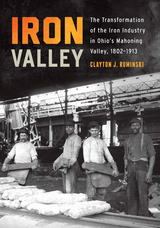
Youngstown, Ohio, and the surrounding Mahoning Valley supplied the iron that helped transform the United States into an industrial powerhouse in the nineteenth century. The story of the Mahoning Valley’s unorthodox rise from mid-scale iron producer to twentieth-century “Steel Valley” is a tale of innovation, stagnation, and, above all, extreme change. Located halfway between Pittsburgh and Cleveland, the Mahoning Valley became a major supplier of pig iron to America’s biggest industrial regions. For much of the nineteenth century, outside consumers relied on the Valley’s pig iron, but this reliance nurtured a reluctance on the part of Youngstown iron companies to diversify or expand their production.
In Iron Valley: The Transformation of the Iron Industry in Ohio’s Mahoning Valley, 1802–1913, Clayton J. Ruminski argues that Youngstown-area iron manufacturers were content to let others in the industry innovate, and only modernized when market conditions forced them to do so. Desperate to find new markets, some Youngstown iron manufacturers eventually looked toward steel and endured a rapid, but successful, industrial transformation that temporarily kept their old enterprises afloat in a rapidly evolving industry. Richly illustrated with rare photographs of Mahoning Valley ironmasters, mills, furnaces, and workers, Iron Valley sheds light on a previously underrepresented and vital region that built industrial America.

When, how, and why did the state enterprise system of modern China take shape? The conventional argument is that China borrowed its economic system and development strategy wholesale from the Soviet Union in the 1950s. In an important new interpretation, Morris Bian shows instead that the basic institutional arrangement of state-owned enterprise—bureaucratic governance, management and incentive mechanisms, and the provision of social services and welfare—developed in China during the war years 1937–1945.
Bian offers a new theory of institutional change that explains the formation of China’s state enterprise system as the outcome of the sustained systemic crisis triggered by the Sino–Japanese war. This groundbreaking work combines critical analysis of government policies with case studies of little-studied enterprises in heavy industries and the ordnance industry. Drawing on extensive research in previously unavailable archives, Bian adds a valuable historical perspective to the current debate on how to reform China’s sluggish and unprofitable state-owned firms.
“The principal authority for the general treatment of the history of coal, and of iron and steel, in
Alabama is the work of Miss Ethel Armes. The Story of Coal and Iron in Alabama is a comprehensive
and scholarly work portraying in attractive style the growth of the mineral industries in its
relation to the development of the state and of the South, in preparation of which the author spent
more than five years.”
—Thomas McAdory Owen, History of Alabama and Dictionary of Alabama Biography
READERS
Browse our collection.
PUBLISHERS
See BiblioVault's publisher services.
STUDENT SERVICES
Files for college accessibility offices.
RECENTLY PUBLISHED







UChicago Accessibility Resources
home | accessibility | search | about | contact us
BiblioVault ® 2001 - 2024
The University of Chicago Press