front cover of War Against the People
War Against the People
Israel, the Palestinians and Global Pacification
Jeff Halper
Pluto Press, 2015
* Shortlisted for the Palestine Book Awards 2016*

Modern warfare has a new form. The days of international combat are fading. So how do major world powers maintain control over their people today?

This book is a disturbing insight into the new ways world powers such as the US, Israel, Britain and China forge war today. It is a subliminal war of surveillance and whitewashed terror, conducted through new, high-tech military apparatuses, designed and first used in Israel against the Palestinian population. Including nano-technology, hidden camera systems, information databases on civilian activity, automated targeting systems and unmanned drones, it is used to control the very people the nation's leaders profess to serve.

Jeff Halper reveals that this practice is much more insidious than was previously thought. As Western governments claw back individual liberties, War Against the People is a reminder that fundamental human rights are being compromised for vast sections of the world, and that this is a subject that should concern everyone.
[more]

logo for Pluto Press
The West Bank Wall
Unmaking Palestine
Ray Dolphin
Pluto Press, 2006
Since Israel began its construction in 2002, the Wall has sparked intense debate, being condemned as illegal by the International Court of Justice. 

Israel claims it is a security measure to protect Israeli citizens from terrorist attacks. Opponents point to the serious impact on the rights of Palestinians, depriving them of their land, mobility and access to health and educational services. 

This book explores the Palestinian experience of the Wall in their international context. What are the real intentions behind the Israeli security argument? Is it a means of securing territory permanently through an illegal annexation of East Jerusalem? The West Bank Wall is a cutting account of the impact of the wall and how it affects prospects of a future peace in the Middle East.
[more]

front cover of What is Modern Israel?
What is Modern Israel?
Yakov M. Rabkin
Pluto Press, 2016
Few countries provoke as much passion and controversy as Israel. What is Modern Israel? convincingly demonstrates that its founding ideology - Zionism - is anything but a simple reaction to antisemitism. Dispelling the notion that every Jew is a Zionist and therefore a natural advocate for the state of Israel, Yakov Rabkin points to the Protestant roots of Zionism, in order to explain the particular support Israel musters in the United States. 

Drawing on many overlooked pages of history, including English, French, Hebrew, Yiddish and Russian sources, Yakov Rabkin shows that Zionism was conceived as a sharp break with Judaism and Jewish continuity. Israel’s past and present must be seen in the context of European ethnic nationalism, colonial expansion and geopolitical interests, rather than as an incarnation of Biblical prophecies or a culmination of Jewish history.
[more]

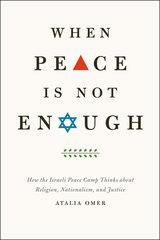
front cover of When Peace Is Not Enough
When Peace Is Not Enough
How the Israeli Peace Camp Thinks about Religion, Nationalism, and Justice
Atalia Omer
University of Chicago Press, 2013
The state of Israel is often spoken of as a haven for the Jewish people, a place rooted in the story of a nation dispersed, wandering the earth in search of their homeland. Born in adversity but purportedly nurtured by liberal ideals, Israel has never known peace, experiencing instead a state of constant war that has divided its population along the stark and seemingly unbreachable lines of dissent around the relationship between unrestricted citizenship and Jewish identity.
 
By focusing on the perceptions and histories of Israel’s most marginalized stakeholders—Palestinian Israelis, Arab Jews, and non-Israeli Jews—Atalia Omer cuts to the heart of the Israeli-Arab conflict, demonstrating how these voices provide urgently needed resources for conflict analysis and peacebuilding. Navigating a complex set of arguments about ethnicity, boundaries, and peace, and offering a different approach to the renegotiation and reimagination of national identity and citizenship, Omer pushes the conversation beyond the bounds of the single narrative and toward a new and dynamic concept of justice—one that offers the prospect of building a lasting peace.

[more]

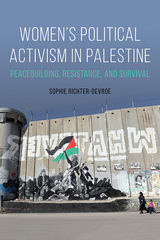
front cover of Women's Political Activism in Palestine
Women's Political Activism in Palestine
Peacebuilding, Resistance, and Survival
Sophie Richter-Devroe
University of Illinois Press, 2018
During the last twenty years, Palestinian women have practiced creative and often informal everyday forms of political activism. Sophie Richter-Devroe reflects on their struggles to bring about social and political change.

Richter-Devroe's ethnographic approach draws from revealing in-depth interviews and participant observation in Palestine. The result: a forceful critique of mainstream conflict resolution methods and the failed woman-to-woman peacebuilding projects so lauded around the world. The liberal faith in dialogue as core of "the political" and the assumption that women's "nurturing" nature makes them superior peacemakers, collapse in the face of past and ongoing Israeli state violences.

Instead, women confront Israeli settler colonialism directly and indirectly in their popular and everyday acts of resistance. Richter-Devroe's analysis zooms in on the intricate dynamics of daily life in Palestine, tracing the emergent politics that women articulate and practice there. In shedding light on contemporary gendered "politics from below" in the region, the book invites a rethinking of the workings, shapes, and boundaries of the political.


[more]

front cover of Writing and Literacy in the World of Ancient Israel
Writing and Literacy in the World of Ancient Israel
Epigraphic Evidence from the Iron Age
Christopher A. Rollston
SBL Press, 2010
Winner of the 2011 Frank Moore Cross Prize as the most substantial volume in the field of Northwest Semitic Epigraphy Ancient Northwest Semitic inscriptions from Israel, Phoenicia, Syria, Moab, Ammon, Edom, and Philistia enlighten and sharpen our vision of the Old Testament world in various ways. Writing and Literacy in the World of Ancient Israel focuses on this epigraphic evidence in order to broaden our understanding of the techniques and roles of writing, education, and literacy during this biblical period. To that end, the volume systematically covers scribal education; scribal implements; writing media such as stones, potsherds, and plaster; and the religious, administrative, and personal uses of writing. Its “handbook” format makes it easily accessible, including for use as a textbook in courses addressing the cultural context of ancient Israel.
[more]


Send via email Share on Facebook Share on Twitter