
 A SCHOLARLY BOOK REPOSITORY
Results by Title
4 books about Jewish Life
4 books about Jewish Life
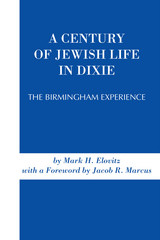
A Century of Jewish Life In Dixie
The Birmingham Experience
Mark H. Elovitz
University of Alabama Press, 2003
The first substantial history of the Jews in the industrial south
This is the first substantial history of the Jews in any inland town or city of the industrial South. The author starts with the Reconstruction Period when the community was established and he carries the story down into the 1970’s. First there were the “Germans,”' the pioneers who built the community; then came the East Euopean emigres who had to cope not only with the problem of survival but the disdain if not the hostility of the already acculturated Central European settlers who had forgotten their own humble beginnings. After World War I came the fusion of the two groups and the need to cooperate religiously and to integrate their cultural, social, and philanthropic institutions. Binding them together and speeding the rise of a total Jewish community was the ever present fear of anti-Jewish prejudice and the “peculiar” problem, a real one, of steering a course between the Christian Whites and the Christian Blacks.
This is the first substantial history of the Jews in any inland town or city of the industrial South. The author starts with the Reconstruction Period when the community was established and he carries the story down into the 1970’s. First there were the “Germans,”' the pioneers who built the community; then came the East Euopean emigres who had to cope not only with the problem of survival but the disdain if not the hostility of the already acculturated Central European settlers who had forgotten their own humble beginnings. After World War I came the fusion of the two groups and the need to cooperate religiously and to integrate their cultural, social, and philanthropic institutions. Binding them together and speeding the rise of a total Jewish community was the ever present fear of anti-Jewish prejudice and the “peculiar” problem, a real one, of steering a course between the Christian Whites and the Christian Blacks.
[more]
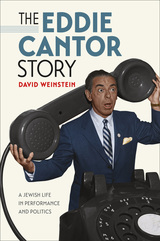
The Eddie Cantor Story
A Jewish Life in Performance and Politics
David Weinstein
Brandeis University Press, 2017
This absorbing biography chronicles the life and work of one of the most important entertainers of the twentieth century. Eddie Cantor (1892–1964) starred in theater, film, radio, and television. His immense popularity across a variety of media, his pride in his Jewish heritage, and his engagement with pressing political issues distinguished him from other headliners of his era. Paying equal attention to Cantor’s humor and politics, Weinstein documents his significance as a performer, philanthropist, and activist. Many show business figures quietly shed their Jewish backgrounds or did not call attention to the fact that they were Jewish. Cantor was different. He addressed the vital issues of his times, including acculturation, national identity, and antisemitism. He was especially forceful in opposing Nazism and paid a price for this activism in 1939, when a sponsor cancelled the actor’s radio program. In this carefully researched book, Weinstein uncovers sketches and routines filled with Jewish phrases, allusions, jokes, songs, and stories. Cantor frequently did not mark this material as “Jewish,” relying instead on attentive audiences to interpret his coded performances. Illustrated with thirty photographs, The Eddie Cantor Story examines the evolution, impact, and legacy of Cantor’s performance style. His music and comedy not only shaped the history of popular entertainment, but also provide a foundation for ongoing efforts to redefine Jewish culture and build community in contemporary America.
[more]
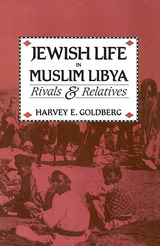
Jewish Life in Muslim Libya
Rivals and Relatives
Harvey E. Goldberg
University of Chicago Press, 1990
In 1949 more than 35,000 Jews lived in Libya, but close to ninety percent had left before Libya attained its independence in 1952. Jewish Life in Muslim Libya combines historical and anthropological perspectives in depicting the changing relations between Muslims and Jews in Libya from the early nineteenth century up to the middle of the twentieth century.
Harvey E. Goldberg shows that the cultural and religious worlds of the Jewish and Muslim communities in Libya were deeply intertwined in daily life and largely remained so despite political and social changes under successive Ottoman and Italian rule. He documents the intricate symbolic linkages of Jews and Muslims in different periods and in a variety of settings. His accounts of traditional Jewish weddings, of mock fights between Jewish teams that took place in early nineteenth-century Tripoli, and of the profession of street peddling demonstrate that, despite age-old images of Jews as outsiders or infidels, Jews were also an essential and familiar part of the local Islamic society.
Goldberg's narrative continues through the British Military Administration in Libya, a period which saw growing Libyan nationalism and, in 1945, three days of riots in which more than 130 Jews were killed. Goldberg reflects on how these events both expressed and exacerbated a rupture in the social fabric linking Muslims and Jews, setting the scene for the mass emigration of Libyan Jews from their homeland.
Harvey E. Goldberg shows that the cultural and religious worlds of the Jewish and Muslim communities in Libya were deeply intertwined in daily life and largely remained so despite political and social changes under successive Ottoman and Italian rule. He documents the intricate symbolic linkages of Jews and Muslims in different periods and in a variety of settings. His accounts of traditional Jewish weddings, of mock fights between Jewish teams that took place in early nineteenth-century Tripoli, and of the profession of street peddling demonstrate that, despite age-old images of Jews as outsiders or infidels, Jews were also an essential and familiar part of the local Islamic society.
Goldberg's narrative continues through the British Military Administration in Libya, a period which saw growing Libyan nationalism and, in 1945, three days of riots in which more than 130 Jews were killed. Goldberg reflects on how these events both expressed and exacerbated a rupture in the social fabric linking Muslims and Jews, setting the scene for the mass emigration of Libyan Jews from their homeland.
[more]
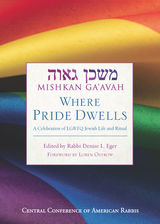
Mishkan Ga'avah
Where Pride Dwells: A Celebration of Jewish Life and Ritual
Rabbi Denise L. Eger
Central Conference of American Rabbis, 2020
This groundbreaking collection of LGBTQ prayers, poems, liturgy, and rituals is both a spiritual resource and a celebratory affirmation of Jewish diversity. Giving voice to the private and public sectors of queer Jewish experience, Mishkan Ga'avah is also a commemoration of the fiftieth anniversary of both the Stonewall Riots and the first pride march, reflecting the longtime advocacy of the Reform Movement for full LGBTQ inclusion.
[more]
READERS
Browse our collection.
PUBLISHERS
See BiblioVault's publisher services.
STUDENT SERVICES
Files for college accessibility offices.
RECENTLY PUBLISHED



UChicago Accessibility Resources
home | accessibility | search | about | contact us
BiblioVault ® 2001 - 2024
The University of Chicago Press