
 A SCHOLARLY BOOK REPOSITORY
This concise and accessible study provides an intimate view of the Court's case-selection process through an analysis of the docket books and other papers of Justice Harold H. Burton, who kept scrupulous records of the Court's work from 1945 to 1957. In her analysis of these invaluable records—the only records of case-selection votes made public since the advent of discretionary review in 1925—Provine provides two perspectives on the problematic issue of judicial motivation in case selection. The first perspective is an institutional one in which the Court is treated as the unit of analysis: the second is personal, in which differences among decision makers are the focus of analysis. Provine suggests that judicial role perceptions go far to explain both agreement and disagreement in case selection. She also considers the impact of the process upon litigants, since the system seems to favor petitioners with litigation expertise, especially the U.S. government. Yet, she claims, the secrecy of case selection fosters the popular misperception that any worthwhile case can be appealed "all the way to the Supreme Court." The Court thus maintains its image as a forum equally available to all litigants.

Pickerill combines legislative histories, extensive empirical findings, and interviews with current and former members of Congress, congressional staff, and others. He examines data related to all of the federal legislation struck down by the Supreme Court from the beginning of the Warren Court in 1953 through the 1996–97 term of the Rehnquist Court. By looking at the legislative histories of Congressional acts that invoked the Commerce Clause and presented Tenth Amendment conflicts—such as the Child Labor Act (1916), the Civil Rights Act (1965), the Gun-Free School Zones Act (1990), and the Brady Bill (1994)—Pickerill illuminates how Congressional deliberation over newly proposed legislation is shaped by the possibility of judicial review. The Court’s invalidation of the Gun-Free School Zones Act in its 1995 ruling United States v. Lopez signaled an increased judicial activism regarding issues of federalism. Pickerill examines that case and compares congressional debate over constitutional issues in key pieces of legislation that preceded and followed it: the Violence Against Women Act of 1994 and the Hate Crimes Prevention Act of 1997. He shows that Congressional attention to federalism increased in the 1990s along with the Court’s greater scrutiny.
Compared to previous editions of The Constitutional Jurisprudence of the Federal Republic of Germany, this third edition more closely tracks Germany's Basic Law and, therefore, the systematic approach reflected in the most-respected German constitutional law commentaries. Entirely new chapters address the relationship between German law and European and international law; social and economic rights, including the property and occupational rights cases that have emerged from Reunification; jurisprudence related to issues of equality, particularly gender equality; and the tension between Germany's counterterrorism efforts and its constitutional guarantees of liberty. Kommers and Miller have also updated existing chapters to address recent decisions involving human rights, federalism, European integration, and religious liberty.
Drawing on ethical theory, philosophy of science, and constitutional theory, Lipkin provides a progressive, postmodern, and pragmatic theory of constitutional law that justifies the critical role played by the judiciary in American democracy. Judicial review, he claims, operates as a mechanism to allow “second thought,” or principled reflection, on the values of the wider culture. Without this revolutionary function, American democracy would be left without an effective institutional means to formulate the community’s considered judgments about good government and individual rights. Although judicial review is not the only forum for protecting this dimension of constitutional democracy, Lipkin maintains that we would be wise not to abandon judicial review unless a viable alternative emerges.
Judges, lawyers, law professors, and constitutional scholars will find this book a valuable resource.
Most of us regard the Constitution as the foundation of American democracy. How, then, are we to understand the restrictions that it imposes on legislatures and voters? Why, for example, does the Constitution allow unelected judges to exercise so much power? And why is this centuries-old document so difficult to amend? In short, how can we call ourselves a democracy when we are bound by an entrenched, and sometimes counter-majoritarian, constitution?
In Constitutional Self-Government, Christopher Eisgruber focuses directly on the Constitution's seemingly undemocratic features. Whereas other scholars have tried to reconcile these features with majority rule, or simply acknowledged them as necessary limits on democracy, Eisgruber argues that constitutionalism is best regarded not as a constraint upon self-government, but as a crucial ingredient in a complex, non-majoritarian form of democracy. In an original and provocative argument, he contends that legislatures and elections provide only an incomplete representation of the people, and he claims that the Supreme Court should be regarded as another of the institutions able to speak for Americans about justice. At a pivotal moment of worldwide interest in judicial review and renewed national controversy over the Supreme Court's role in politics, Constitutional Self-Government ingeniously locates the Constitution's value in its capacity to sustain an array of institutions that render self-government meaningful for a large and diverse people.
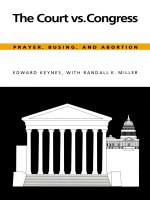
Edward Keynes and Randall Miller argue that Congress lacks the constitutional power to legislate away the powers of the federal courts and to prevent individuals from seeking redress for presumed infringements of their constitutional rights in these areas. They demonstrate that neither the framers nor ratifiers of the Constitution intended the Congress to exercise plenary power over the appellate jurisdiction of the Supreme Court. Throughout its history the Court has never conceded unlimited powers to Congress; and until the late 1950s Congress had not attempted to gerrymander the Court’s jurisdiction in response to specific decisions. But the authors contend this is just what the sponsors of recent legislative attacks on the Court intend, and they see such efforts as threatening the Court’s independence and authority as defined in the separation of powers clauses of the Constitution.
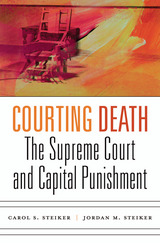
Unique among Western democracies in refusing to eradicate the death penalty, the United States has attempted instead to reform and rationalize state death penalty practices through federal constitutional law. Courting Death traces the unusual and distinctive history of top-down judicial regulation of capital punishment under the Constitution and its unanticipated consequences for our time.
In the 1960s and 1970s, in the face of widespread abolition of the death penalty around the world, provisions for capital punishment that had long fallen under the purview of the states were challenged in federal courts. The U.S. Supreme Court intervened in two landmark decisions, first by constitutionally invalidating the death penalty in Furman v. Georgia (1972) on the grounds that it was capricious and discriminatory, followed four years later by restoring it in Gregg v. Georgia (1976). Since then, by neither retaining capital punishment in unfettered form nor abolishing it outright, the Supreme Court has created a complex regulatory apparatus that has brought executions in many states to a halt, while also failing to address the problems that led the Court to intervene in the first place.
While execution chambers remain active in several states, constitutional regulation has contributed to the death penalty’s new fragility. In the next decade or two, Carol Steiker and Jordan Steiker argue, the fate of the American death penalty is likely to be sealed by this failed judicial experiment. Courting Death illuminates both the promise and pitfalls of constitutional regulation of contentious social issues.
This powerfully argued appraisal of judicial review may change the face of American law. Written for layman and scholar alike, the book addresses one of the most important issues facing Americans today: within what guidelines shall the Supreme Court apply the strictures of the Constitution to the complexities of modern life?
Until now legal experts have proposed two basic approaches to the Constitution. The first, “interpretivism,” maintains that we should stick as closely as possible to what is explicit in the document itself. The second, predominant in recent academic theorizing, argues that the courts should be guided by what they see as the fundamental values of American society. John Hart Ely demonstrates that both of these approaches are inherently incomplete and inadequate. Democracy and Distrust sets forth a new and persuasive basis for determining the role of the Supreme Court today.
Ely’s proposal is centered on the view that the Court should devote itself to assuring majority governance while protecting minority rights. “The Constitution,” he writes, “has proceeded from the sensible assumption that an effective majority will not unreasonably threaten its own rights, and has sought to assure that such a majority not systematically treat others less well than it treats itself. It has done so by structuring decision processes at all levels in an attempt to ensure, first, that everyone’s interests will be represented when decisions are made, and second, that the application of those decisions will not be manipulated so as to reintroduce in practice the sort of discrimination that is impermissible in theory.”
Thus, Ely’s emphasis is on the procedural side of due process, on the preservation of governmental structure rather than on the recognition of elusive social values. At the same time, his approach is free of interpretivism’s rigidity because it is fully responsive to the changing wishes of a popular majority. Consequently, his book will have a profound impact on legal opinion at all levels—from experts in constitutional law, to lawyers with general practices, to concerned citizens watching the bewildering changes in American law.
Moving next to de facto independence, Yadav and Mukherjee bring together data from 103 democracies in the developing world, complemented by case studies of Brazil, India, and Indonesia. Honing in on the effects of electoral institutions, the authors find that, when faced with short time horizons, governments that operate in personal vote electoral systems are likely to increase de facto judicial independence whereas governments in party-centered systems are likely to reduce it.
For more than a century, in settings where the political branches of government were unable or unwilling to exercise self-restraint, the Supreme Court was disposed to treat federal war powers legislation as exempt from judicial review, an attitude that permitted numerous abuses from Prohibition to press censorship.
Though the First World War officially ended in 1918, the Senate’s rejection of the Versailles Treaty kept the United States in a legal state of war until late 1921. Exploring the interplay between political and social events and the evolution of legal theory Christopher May tells how during this challenging three-year period, the government invoked the war powers to pursue ends otherwise beyond its reach: with the backing of Congress and seemingly free from judicial scrutiny, the Wilson administration took over the country’s rail and communications systems, outlawed profiteering, prosecuted strikers, suppressed “radicals” and censored the leftist press. None of these measures bore any true relation to the war, says the author, who then describes the course through which the Supreme Court, confronted by this pattern of abuse, finally abandoned its long-standing refusal to review the constitutionality of war powers legislation.
In the Name of War explores the roles played by Woodrow Wilson, Joseph Tumulty, Albert Burleson, and A. Mitchell Palmer—men whose personal ambitions frequently shaped official policy in the late Progressive Era. After analyzing the Court’s more recent record, including the internment of Japanese-Americans in World War II, May draws some practical conclusions about the use of judicial intervention in time of crisis that are sure to attract the attention of lawyers, legal scholars, historians, and students of the Constitution.
---Brian Z. Tamanaha, Chief Judge Benjamin N. Cardozo Professor of Law, St. John's University, and author of Law as a Means to an End: Threat to the Rule of Law
Originalism holds that the U.S. Constitution should be interpreted according to its meaning at the time it was enacted. In their innovative defense of originalism, John McGinnis and Michael Rappaport maintain that the text of the Constitution should be adhered to by the Supreme Court because it was enacted by supermajorities—both its original enactment under Article VII and subsequent Amendments under Article V. A text approved by supermajorities has special value in a democracy because it has unusually wide support and thus tends to maximize the welfare of the greatest number.
The authors recognize and respond to many possible objections. Does originalism perpetuate the dead hand of the past? How can following the original meaning be justified, given that African Americans and women were excluded from the enactment of the Constitution in 1787 and many of its subsequent Amendments? What is originalism’s place in interpretation of the Constitution, when after two hundred years there is so much non-originalist precedent?
A fascinating counterfactual they pose is this: had the Supreme Court not interpreted the Constitution so freely, perhaps the nation would have resorted to the Article V amendment process more often and with greater effect. Their book will be an important contribution to the literature on originalism, which is now the most prominent theory of constitutional interpretation.
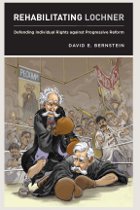
In this timely reevaluation of an infamous Supreme Court decision, David E. Bernstein provides a compelling survey of the history and background of Lochner v. New York. This 1905 decision invalidated state laws limiting work hours and became the leading case contending that novel economic regulations were unconstitutional. Sure to be controversial, Rehabilitating Lochner argues that the decision was well grounded in precedent—and that modern constitutional jurisprudence owes at least as much to the limited-government ideas of Lochner proponents as to the more expansive vision of its Progressive opponents.
Tracing the influence of this decision through subsequent battles over segregation laws, sex discrimination, civil liberties, and more, Rehabilitating Lochner argues not only that the court acted reasonably in Lochner, but that Lochner and like-minded cases have been widely misunderstood and unfairly maligned ever since.
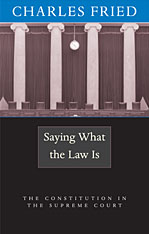
In a few thousand words the Constitution sets up the government of the United States and proclaims the basic human and political rights of its people. From the interpretation and elaboration of those words in over 500 volumes of Supreme Court cases comes the constitutional law that structures our government and defines our individual relationship to that government. This book fills the need for an account of that law free from legal jargon and clear enough to inform the educated layperson, yet which does not condescend or slight critical nuance, so that its judgments and analyses will engage students, practitioners, judges, and scholars.
Taking the reader up to and through such controversial recent Supreme Court decisions as the Texas sodomy case and the University of Michigan affirmative action case, Charles Fried sets out to make sense of the main topics of constitutional law: the nature of doctrine, federalism, separation of powers, freedom of expression, religion, liberty, and equality.
Fried draws on his knowledge as a teacher and scholar, and on his unique experience as a practitioner before the Supreme Court, a former Associate Justice of the Supreme Judicial Court of Massachusetts, and Solicitor General of the United States to offer an evenhanded account not only of the substance of constitutional law, but of its texture and underlying themes. His book firmly draws the reader into the heart of today's constitutional battles. He understands what moves today's Court and that understanding illuminates his analyses.
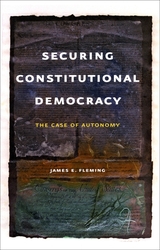
In this book, James Fleming responds to these controversies by arguing that the right to privacy or autonomy should be grounded in a theory of securing constitutional democracy. His framework seeks to secure the basic liberties that are preconditions for deliberative democracy—to allow citizens to deliberate about the institutions and policies of their government—as well as deliberative autonomy—to enable citizens to deliberate about the conduct of their own lives. Together, Fleming shows, these two preconditions can afford everyone the status of free and equal citizenship in our morally pluralistic constitutional democracy.
Choper's guidelines are designed to provide maximum protection for religious freedom without granting anyone an advantage, inflicting a disadvantage, or causing an unfair burden. Though not calling for the wholesale overturning of judicial precedents or established social practices, the standards he proposes would result in significant—and controversial—modifications to existing doctrines and customs. Choper argues, for instance, that while vocal prayer and Bible reading in public schools should continue to be prohibited, we can and should allow for silent prayer and objective courses in creation science. His standards would also, among other things, eliminate the tax exemption on property used exclusively for religious purposes while allowing parochial schools to receive public funds for the non-religious component of their education.
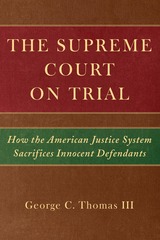
The chief mandate of the criminal justice system is not to prosecute the guilty but to safeguard the innocent from wrongful convictions; with this startling assertion, legal scholar George Thomas launches his critique of the U.S. system and its emphasis on procedure at the expense of true justice.
Thomas traces the history of jury trials, an important component of the U.S. justice system, since the American Founding. In the mid-twentieth century, when it became evident that racism and other forms of discrimination were corrupting the system, the Warren Court established procedure as the most important element of criminal justice. As a result, police, prosecutors, and judges have become more concerned about following rules than about ensuring that the defendant is indeed guilty as charged. Recent cases of prisoners convicted of crimes they didn't commit demonstrate that such procedural justice cannot substitute for substantive justice.
American justices, Thomas concludes, should take a lesson from the French, who have instituted, among other measures, the creation of an independent court to review claims of innocence based on new evidence. Similar reforms in the United States would better enable the criminal justice system to fulfill its moral and legal obligation to prevent wrongful convictions.
"Thomas draws on his extensive knowledge of the field to elaborate his elegant and important thesis---that the American system of justice has lost sight of what ought to be its central purpose---protection of the innocent."
—Susan Bandes, Distinguished Research Professor of Law, DePaul University College of Law
"Thomas explores how America's adversary system evolved into one obsessed with procedure for its own sake or in the cause of restraining government power, giving short shrift to getting only the right guy. His stunning, thought-provoking, and unexpected recommendations should be of interest to every citizen who cares about justice."
—Andrew E. Taslitz, Professor of Law, Howard University School of Law
"An unflinching, insightful, and powerful critique of American criminal justice---and its deficiencies. George Thomas demonstrates once again why he is one of the nation's leading criminal procedure scholars. His knowledge of criminal law history and comparative criminal law is most impressive."
—Yale Kamisar, Distinguished Professor of Law, University of San Diego and Clarence Darrow Distinguished University Professor Emeritus of Law, University of Michigan
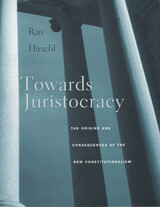
In countries and supranational entities around the globe, constitutional reform has transferred an unprecedented amount of power from representative institutions to judiciaries. The constitutionalization of rights and the establishment of judicial review are widely believed to have benevolent and progressive origins, and significant redistributive, power-diffusing consequences. Ran Hirschl challenges this conventional wisdom.
Drawing upon a comprehensive comparative inquiry into the political origins and legal consequences of the recent constitutional revolutions in Canada, Israel, New Zealand, and South Africa, Hirschl shows that the trend toward constitutionalization is hardly driven by politicians' genuine commitment to democracy, social justice, or universal rights. Rather, it is best understood as the product of a strategic interplay among hegemonic yet threatened political elites, influential economic stakeholders, and judicial leaders. This self-interested coalition of legal innovators determines the timing, extent, and nature of constitutional reforms.
Hirschl demonstrates that whereas judicial empowerment through constitutionalization has a limited impact on advancing progressive notions of distributive justice, it has a transformative effect on political discourse. The global trend toward juristocracy, Hirschl argues, is part of a broader process whereby political and economic elites, while they profess support for democracy and sustained development, attempt to insulate policymaking from the vicissitudes of democratic politics.
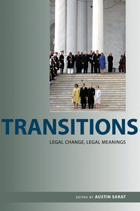
Transitions: Legal Change, Legal Meanings illustrates the various intersections, crises, and shifts that continually occur within the law, and how these moments of change interact with and comment on contemporary society.
Akhil Reed Amar / William L. Andreen /
Jack M. Beermann / Heather Elliott / Joshua
Alexander Geltzer / David Gray / Paul
Horwitz / Daniel H. Joyner / Nina
Mendelson / Meredith Render / Austin
Sarat / Ruti Teitel / Lindsey Ohlsson Worth
READERS
Browse our collection.
PUBLISHERS
See BiblioVault's publisher services.
STUDENT SERVICES
Files for college accessibility offices.
RECENTLY PUBLISHED




UChicago Accessibility Resources
home | accessibility | search | about | contact us
BiblioVault ® 2001 - 2024
The University of Chicago Press