
 A SCHOLARLY BOOK REPOSITORY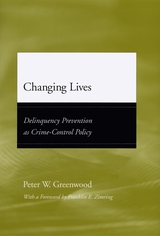
Peter W. Greenwood here demonstrates here that as crimes rates have fallen, researchers have identified more connections between specific risk factors and criminal behavior, while program developers have discovered a wide array of innovative interventions. The result of all this activity, he reveals, has been the revelation of a few prevention models that reduce crime much more cost-effectively than popular approaches such as tougher sentencing, D.A.R.E., boot camps, and "scared straight" programs. Changing Lives expertly presents the most promising of these prevention programs, their histories, the quality of evidence to support their effectiveness, the public policy programs involved in bringing them into wider use, and the potential for investments and developmental research to increase the range and quality of programs.
Received an Honorable Mention for the 2015 Society for Social Work and Research Outstanding Social Work Book Award
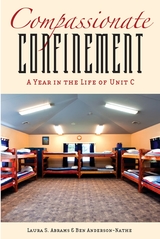
To date, knowledge of the everyday world of the juvenile correction institution has been extremely sparse. Compassionate Confinement brings to light the challenges and complexities inherent in the U.S. system of juvenile corrections. Building on over a year of field work at a boys’ residential facility, Laura S. Abrams and Ben Anderson-Nathe provide a context for contemporary institutions and highlight some of the system’s most troubling tensions.
This ethnographic text utilizes narratives, observations, and case examples to illustrate the strain between treatment and correctional paradigms and the mixed messages regarding gender identity and masculinity that the youths are expected to navigate. Within this context, the authors use the boys’ stories to show various and unexpected pathways toward behavior change. While some residents clearly seized opportunities for self-transformation, others manipulated their way toward release, and faced substantial challenges when they returned home.
Compassionate Confinement concludes with recommendations for rehabilitating this notoriously troubled system in light of the experiences of its most vulnerable stakeholders.
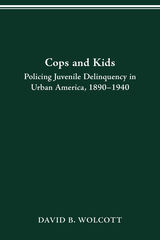
Cops and Kids analyzes how police regulated juvenile behavior in turn-of-the-century America. Focusing on Los Angeles, Chicago, and Detroit, it examines how police saw their mission, how they dealt with public demands, and how they coped daily with kids. Whereas most scholarship in the field of delinquency has focused on progressive-era reformers who created a separate juvenile justice system, David B. Wolcott’s study looks instead at the complicated, sometimes coercive, relationship between police officers and young offenders. Indeed, Wolcott argues, police officers used their authority in a variety of ways to influence boys’ and girls’ behavior. Prior to the creation of juvenile courts, police officers often disciplined kids by warning and releasing them, keeping them out of courts. Establishing separate juvenile courts, however, encouraged the police to cast a wider net, pulling more young offenders into the new system. While some departments embraced “child-friendly” approaches to policing, others clung to rough-and-tumble methods. By the 1920s and 1930s, many police departments developed new strategies that combined progressive initiatives with tougher law enforcement targeted specifically at growing minority populations.
Cops and Kids illuminates conflicts between reformers and police over the practice of juvenile justice and sheds new light on the origins of lasting tensions between America’s police and urban communities.
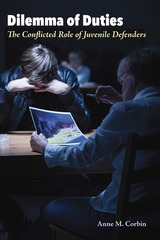
In Dilemma of Duties, Corbin outlines patterns of role conflict that defenders experience, details its impact on counselors and clients in the juvenile justice system, and addresses the powerful influence of the juvenile court culture and the lack of resources for defenders. Tasked with guiding these children, counselors frequently must contend with and manage their clients’ general distrust of adults as they attempt to serve as their voices to the court.
Understanding how juvenile defenders define their role and experience role conflict provides valuable insights into our juvenile justice system, especially its role in upholding due process rights. Such knowledge points to the importance of the training and practices of juvenile court functionaries and the efficacy, credibility, and legitimacy of the juvenile justice system itself.

Juvenile drug courts are on the rise in the United States, as a result of a favorable political climate and justice officials' endorsement of the therapeutic jurisprudence movement--the concept of combining therapeutic care with correctional discipline. The goal is to divert nonviolent youth drug offenders into addiction treatment instead of long-term incarceration. Discretionary Justice overviews the system, taking readers behind the scenes of the juvenile drug court. Based on fifteen months of ethnographic fieldwork and interviews at a California court, Leslie Paik explores the staff's decision-making practices in assessing the youths' cases, concentrating on the way accountability and noncompliance are assessed. Using the concept of "workability," Paik demonstrates how compliance, and what is seen by staff as "noncompliance," are the constructed results of staff decisions, fluctuating budgets, and sometimes questionable drug test results.
While these courts largely focus on holding youths responsible for their actions, this book underscores the social factors that shape how staff members view progress in the court. Paik also emphasizes the perspectives of children and parents. Given the growing emphasis on individual responsibility in other settings, such as schools and public welfare agencies, Paik's findings are relevant outside the juvenile justice system.

Double Jeopardy considers the newest data on the nature of youths' mental disorders—their relationships to delinquency, the values and limits of methods to treat them, and the common patterns of adolescent offending. That information is used to chart a rational course for fulfilling the juvenile justice system's duty—as a custodian of children in need of health care, as a legal system promoting fairness in youth adjudication, and as a protector of public safety—to respond to delinquent youths' mental disorders. Moreover, Double Jeopardy provides a scientific yet practical foundation for lawmakers, judges, attorneys, and mental health care professionals, as well as researchers who must fill the knowledge gaps that limit the juvenile justice system's abilities to meet youths' mental health needs.
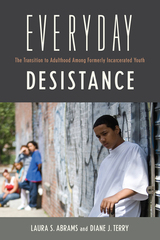
In Everyday Desistance, Laura Abrams and Diane J. Terry examine the lives of young people who spent considerable time in and out of correctional institutions as adolescents. These formerly incarcerated youth often struggle with the onset of adult responsibilities at a much earlier age than their more privileged counterparts. In the context of urban Los Angeles, with a large-scale gang culture and diminished employment prospects, further involvement in crime appears almost inevitable. Yet, as Abrams and Terry point out, these formerly imprisoned youth are often quite resilient and can be successful at creating lives for themselves after months or even years of living in institutions run by the juvenile justice system.
This book narrates the day-to-day experiences of these young men and women, focusing on their attempts to surmount the challenges of adulthood, resisting a return to criminal activity, and formulating long-term goals for a secure adult future.
Winner of the 2016 Outstanding Book for the Academy of Criminal Justice Science (ACJS)
2014 Scholarly Contribution Award from the Children and Youth Section of the American Sociological Association
Received an Honorable Mention for the American Sociological Association Race, Gender and Class Section's 2014 Distinguished Book Award
Named a 2013 Choice Outstanding Academic Title
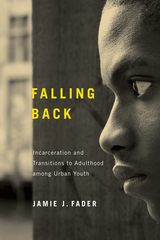
Jamie J. Fader documents the transition to adulthood for a particularly vulnerable population: young inner-city men of color who have, by the age of eighteen, already been imprisoned. How, she asks, do such precariously situated youth become adult men? What are the sources of change in their lives?
Falling Back is based on over three years of ethnographic research with black and Latino males on the cusp of adulthood and incarcerated at a rural reform school designed to address “criminal thinking errors” among juvenile drug offenders. Fader observed these young men as they transitioned back to their urban Philadelphia neighborhoods, resuming their daily lives and struggling to adopt adult masculine roles. This in-depth ethnographic approach allowed her to portray the complexities of human decision-making as these men strove to “fall back,” or avoid reoffending, and become productive adults. Her work makes a unique contribution to sociological understandings of the transitions to adulthood, urban social inequality, prisoner reentry, and desistance from offending.
In Human Targets, Rios takes us to the streets of California, where we encounter young men who find themselves in much the same situation as fifteen-year-old Victor. We follow young gang members into schools, homes, community organizations, and detention facilities, watch them interact with police, grow up to become fathers, get jobs, get rap sheets—and in some cases get killed. What is it that sets apart young people like Rios who succeed and survive from the ones who don’t? Rios makes a powerful case that the traditional good kid/bad kid, street kid/decent kid dichotomy is much too simplistic, arguing instead that authorities and institutions help create these identities—and that they can play an instrumental role in providing young people with the resources for shifting between roles. In Rios’s account, to be a poor Latino youth is to be a human target—victimized and considered an enemy by others, viewed as a threat to law enforcement and schools, and burdened by stigma, disrepute, and punishment. That has to change.
This is not another sensationalistic account of gang bangers. Instead, the book is a powerful look at how authority figures succeed—and fail—at seeing the multi-faceted identities of at-risk youths, youths who succeed—and fail—at demonstrating to the system that they are ready to change their lives. In our post-Ferguson era, Human Targets is essential reading.
Home to over 150 repeat offenders ranging in age from twelve to seventeen, the Catalina Mountain School is made up of a particular stratum of boys—those who have committed the most offenses but will still be released upon reaching adulthood. In an effort to understand the symbolic and emotional language of guns and gun carrying, Harcourt interviewed dozens of these incarcerated Catalina boys. What do these youths see in guns? What draws them to handguns? Why do some of them carry and others not? For Harcourt, their often surprising answers unveil many of the presuppositions that influence our laws and policies.
As educational and justice agencies increasingly turn to private subcontractors to deliver an array of services and growing numbers of young people are channeled into non-traditional educational settings and correctional institutions, it is imperative that educators and the general public understand how these institutions work and what problems their students and staffs encounter. This on-the-ground examination of the education within the juvenile justice system will open your eyes to how we educate some of our neediest children.
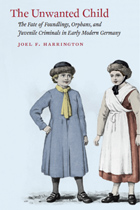
The baby abandoned on the doorstep is a phenomenon that has virtually disappeared from our experience, but in the early modern world, unwanted children were a very real problem for parents, government officials, and society. The Unwanted Child skillfully recreates sixteenth-century Nuremberg to explore what befell abandoned, neglected, abused, or delinquent children in this critical period.
Joel F. Harrington tackles this question by focusing on the stories of five individuals. In vivid and poignant detail, he recounts the experiences of an unmarried mother-to-be, a roaming mercenary who drifts in and out of his children’s lives, a civic leader handling the government’s response to problems arising from unwanted children, a homeless teenager turned prolific thief, and orphaned twins who enter state care at the age of nine. Braiding together these compelling portraits, Harrington uncovers and analyzes the key elements that link them, including the impact of war and the vital importance of informal networks among women. From the harrowing to the inspiring, The Unwanted Child paints a gripping picture of life on the streets five centuries ago.
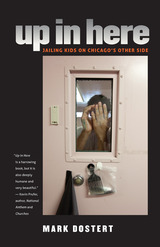
The juveniles’ attitudes toward Dostert change, however, once he begins working as a “Children’s Attendant” at the Audy Home, clocking in for eight hours every day to enforce rules and maintain order on the cellblocks. His colorblind, altruistic volunteer world fractures into a full-time, emotionally charged reality of white and black and brown. When the boys change, he must change too. Despite wanting to help them feel human in such a dehumanizing environment, Dostert realizes he needs to make sure his kindness is not perceived as weakness. Dostert learns to march the juveniles through the facility to school, recreation activities, and chapel. He must strip-search them, interrupt their brawls, root through their cells for drugs and handcrafted weapons, and monitor group showers to thwart sexual extortion and the inscription of gang symbols in soap on walls and mirrors. Week after week and month after month, the job exposes hidden views not only of the juveniles and the “system” incarcerating them, but of Children’s Attendant Dostert himself.
From one man’s struggle to reconcile his humanitarian intentions with his actual job responsibilities in what, to him, is a strange new world, emerges a sincere effort to confront the realities of America’s persisting racial tensions and institutionalized poverty. Dostert’s story is an honest and unflinching journey from thinking he has many of the answers for how to change this world to discovering how little he really knows about the world he is trying to change.
READERS
Browse our collection.
PUBLISHERS
See BiblioVault's publisher services.
STUDENT SERVICES
Files for college accessibility offices.
RECENTLY PUBLISHED




UChicago Accessibility Resources
home | accessibility | search | about | contact us
BiblioVault ® 2001 - 2024
The University of Chicago Press