
 A SCHOLARLY BOOK REPOSITORY
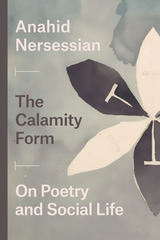
Anahid Nersessian explores works by Friedrich Hölderlin, William Wordsworth, John Keats, and others to argue that as the human and ecological costs of industry became clear, Romantic poetry adopted formal strategies—among them parataxis, the setting of elements side by side in a manner suggestive of postindustrial dissonance, and apostrophe, here an address to an absent or vanishing natural environment—as it tried and failed to narrate the calamities of capitalism. These tropes reflect how Romantic authors took their bewilderment and turned it into a poetics: a theory of writing, reading, and understanding poetry as an eminently critical act. Throughout, Nersessian pushes back against recent attempts to see literature as a source of information on par with historical or scientific data, arguing instead for an irreducibility of poetic knowledge. Revealing the ways in which these Romantic works are of their time but not about it, The Calamity Form ultimately exposes the nature of poetry’s relationship to capital—and capital’s ability to hide how it works.
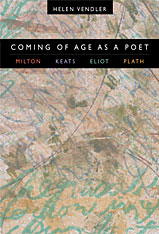
To find a personal style is, for a writer, to become adult; and to write one’s first “perfect” poem—a poem that wholly and successfully embodies that style—is to come of age as a poet. By looking at the precedents, circumstances, and artistry of the first perfect poems composed by John Milton, John Keats, T. S. Eliot, and Sylvia Plath, Coming of Age as a Poet offers rare insight into this mysterious process, and into the indispensable period of learning and experimentation that precedes such poetic achievement.
Milton’s L’Allegro, Keats’s On First Looking into Chapman’s Homer, Eliot’s The Love Song of J. Alfred Prufrock, and Plath’s The Colossus are the poems that Helen Vendler considers, exploring each as an accession to poetic confidence, mastery, and maturity. In meticulous and sympathetic readings of the poems, and with reference to earlier youthful compositions, she delineates the context and the terms of each poet’s self-discovery—and illuminates the private, intense, and ultimately heroic effort and endurance that precede the creation of any memorable poem.
With characteristic precision, authority, and grace, Vendler helps us to appreciate anew the conception and the practice of poetry, and to observe at first hand the living organism that breathes through the words of a great poem.
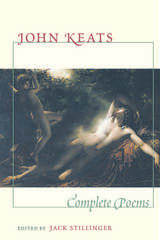
Here is the first reliable edition of John Keats’s complete poems designed expressly for general readers and students.
Upon its publication in 1978, Jack Stillinger’s The Poems of John Keats won exceptionally high praise: “The definitive Keats,” proclaimed The New Republic—“An authoritative edition embodying the readings the poet himself most probably intended, prepared by the leading scholar in Keats textual studies.”
Now this scholarship is at last available in a graceful, clear format designed to introduce students and general readers to the “real” Keats. In place of the textual apparatus that was essential to scholars, Stillinger here provides helpful explanatory notes. These notes give dates of composition, identify quotations and allusions, gloss names and words not included in the ordinary desk dictionary, and refer the reader to the best critical interpretations of the poems. The new introduction provides central facts about Keats’s life and career, describes the themes of his best work, and speculates on the causes of his greatness.
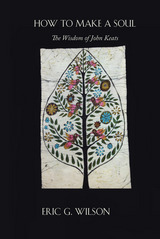
In this innovative hybrid of biography, memoir, and criticism, Eric G. Wilson describes how John Keats gave him solace during a bout of mental illness in spring 2012. While on a tour of the principal sites in Keats’s life—ranging from his London medical school to the small room in Rome where he died—Wilson discovered analogies between the poet’s troubles and his own. He was most struck by Keats’s enlivening vision of the soul.
For Keats, we don’t possess but rather make a soul. We do this by imaginatively transforming our suffering into empathy toward humans and nature alike. Tracking this idea in Keats’s tumultuous yet exhilarating life and work, Wilson struggles to envision his depression anew, desperate to overcome the apathy alienating him from his family.
How to Make a Soul offers fresh perspectives on Keats’s pragmatism, irony, comedy, ethics, and aesthetics, but is above all a lyrical celebration of those galvanizing instances when life springs into art.

From the mortal maidens of 1817 to the omnipotent goddesses of 1819, Keats uses successive female characters as symbols portraying the salvation and destruction, the passion and fear that the imagination elicits. Karla Alwes traces the change in these female figures—multidimensional and mysteriously protean—and shows that they do more than comprise a symbol of the female as a romantic lover. They are the gauge of Keats’s search for identity. As Keats’s poetry changes with experience, from celebration to denial of the earth, the females change from meek to threatening to a final maternal and conciliatory figure.
Keats consistently maintained a strict dichotomy between the flesh-and-blood women he referred to in his letters and the created females of his poetry, in the same way that he rigorously sought to abandon the real for the ideal in his poetry. In her study of Keats’s poetry, Alwes dramatizes the poet’s struggle to come to terms with his two consummate ideals—women and poetry. She demonstrates how his female characters, serving as lovers, guides, and nemeses to the male heroes of the poems, embody not only the hope but also the disappointment that the poet discovers as he strives to reconcile feminine and masculine creativity. Alwes also shows how the myths of Apollo, which Keats integrated into his poetry as early as February 1815, point up his contradictory need for, yet fear of, the feminine. She argues that Keats’s attempt to overcome this fear, impossible to do by concentrating solely on Apollo as a metaphor for the imagination, resulted in his eventual use of maternal goddesses as poetic symbols.
The goddess Moneta in "The Fall of Hyperion" reclaims the power of the maternal earth to represent the final stage in the development of the female. In combining the wisdom of the Apollonian realm with the compassion of the feminine earth, Moneta is more powerful than Apollo and able to show the poet who does not recognize both realms that he is only a "dreamer," one who "venoms all his days, / Bearing more woe than all his sins deserve."
Because of Moneta’s admonishment, Keats becomes the poet capable of creating "To Autumn." In this final ode, Keats taps the transcendent power inherent in the temporal beauty of the earth. His imagination, once attempting to leave the earth, now goes beyond the Apollonian ideal into the realm of salvation—the human heart—that connects him to the earth. And because of his poetic reconciliation between heaven and earth, Keats is ultimately able to portray an earthly timelessness in which "summer has o’er-brimmed" the bees’ "clammy cells," making for "warm days [that] will never cease."

After more than a century of study, we know more about John Keats than we do about most writers of the past, but we still cannot fully grasp the magical processes by which he created some of the most celebrated poems in all of English literature. This volume, containing 140 photographs of Keats’s own manuscripts, offers the most concrete evidence we have of the way in which his thoughts and feelings were transmuted into art.
The rough first drafts in particular are full of information about what occurred, if not in Keats’s mind, at least on paper when he had pen in hand: the headlong rush of ideas coming so fast that he had no time to punctuate or even form the letters of his words; the stumbling places where he had to begin again several times before the words resumed their flow; the efforts to integrate story, character, and theme with the formal requirements of rhyme and meter. Each revision teaches the inquiring reader something about Keats’s poetic practice.
Several of the manuscripts are unique authoritative sources, while others constitute our best texts among multiple existing versions. They reveal much about the maturation of the poet’s creativity during four years of his brief life, between “On Receiving a Curious Shell” (1815) and “To Autumn” (1819). Above all, they show us what is lost when penmanship yields to the printed page: what Helen Vendler, in her insightful essay on the manuscripts, calls “the living hand of Keats.” These sharply reproduced facsimiles provide compelling visual evidence of a mortal author in the act of composing immortal works.
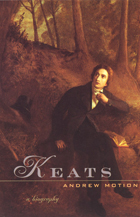
"Motion has given us a new Keats, one who is skinned alive, a genius who wrote in a single month all the poems we cherish, a victim who was tormented by the best doctors of the age. . . . This portrait, stripped of its layers of varnish and restored to glowing colours, should last us for another generation."—Edmund White, The Observer Review
"Keats's letters fairly leap off the page. . . . [Motion] listens for the 'freely associating inquiry and incomparable verve and dash,' the 'headlong charge,' of Keats's jazzlike improvisations, which give us, like no other writing in English, the actual rush of a man thinking, a mind hurtling forward unpredictably and sweeping us along."—Morris Dickstein, New York Times Book Review
"Scrupulous and eloquent."—Gregory Feeley, Philadelphia Inquirer
John and George Keats—Man of Genius and Man of Power, to use John’s words—embodied sibling forms of the phenomenon we call Romanticism. George’s 1818 move to the western frontier of the United States, an imaginative leap across four thousand miles onto the tabula rasa of the American dream, created in John an abysm of alienation and loneliness that would inspire the poet’s most plangent and sublime poetry. Denise Gigante’s account of this emigration places John’s life and work in a transatlantic context that has eluded his previous biographers, while revealing the emotional turmoil at the heart of some of the most lasting verse in English.
In most accounts of John’s life, George plays a small role. He is often depicted as a scoundrel who left his brother destitute and dying to pursue his own fortune in America. But as Gigante shows, George ventured into a land of prairie fires, flat-bottomed riverboats, wildcats, and bears in part to save his brothers, John and Tom, from financial ruin. There was a vital bond between the brothers, evident in John’s letters to his brother and sister-in-law, Georgina, in Louisville, Kentucky, which run to thousands of words and detail his thoughts about the nature of poetry, the human condition, and the soul. Gigante demonstrates that John’s 1819 Odes and Hyperion fragments emerged from his profound grief following George’s departure and Tom’s death—and that we owe these great works of English Romanticism in part to the deep, lasting fraternal friendship that Gigante reveals in these pages.
In 1819, the poet John Keats wrote six poems that would become known as the Great Odes. Some of them—“Ode to a Nightingale,” “To Autumn”—are among the most celebrated poems in the English language. Anahid Nersessian here collects and elucidates each of the odes and offers a meditative, personal essay in response to each, revealing why these poems still have so much to say to us, especially in a time of ongoing political crisis. Her Keats is an unflinching antagonist of modern life—of capitalism, of the British Empire, of the destruction of the planet—as well as a passionate idealist for whom every poem is a love poem.
The book emerges from Nersessian’s lifelong attachment to Keats’s poetry; but more, it “is a love story: between me and Keats, and not just Keats.” Drawing on experiences from her own life, Nersessian celebrates Keats even as she grieves him and counts her own losses—and Nersessian, like Keats, has a passionate awareness of the reality of human suffering, but also a willingness to explore the possibility that the world, at least, could still be saved. Intimate and speculative, this brilliant mix of the poetic and the personal will find its home among the numerous fans of Keats’s enduring work.
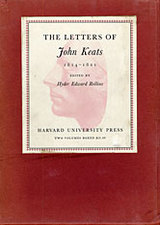
For many years one of the most serious needs in the literary world has been for a definitive edition of the letters of Keats. Now one of the world's foremost Keats authorities, Hyder Edward Rollins of Harvard, has prepared a completely new edition of all the extant letters, with an extensive listing of the letters presumed missing.
With impeccable scholarship and total faithfulness to the originals, Professor Rollins here is able to redate and rearrange sixty of the letters. Through full documentation for each letter, understanding of the content is considerably amplified both through the correction of errors, and through application of the results of the editor's life-long study of Keats and his work. In addition to many letters from Keats' relatives and friends, the present work includes seven letters or other documents signed or written by Keats that appear in no English edition, and also new texts of seven other letters by the poet. Furthermore, all the letters known only in Woodhouse's transcripts and in Jeffrey's transcripts are here printed for the first time exactly as Woodhouse and Jeffrey copied them.
The letters of Joseph Severn describing the last illness and death of Keats are given in their entirety. These letters are invaluable historically and biographically, and are also exceptionally good reading.
For many years one of the most serious needs in the literary world has been for a definitive edition of the letters of Keats. Now one of the world's foremost Keats authorities, Hyder Edward Rollins of Harvard, has prepared a completely new edition of all the extant letters, with an extensive listing of the letters presumed missing.
With impeccable scholarship and total faithfulness to the originals, Professor Rollins here is able to redate and rearrange sixty of the letters. Through full documentation for each letter, understanding of the content is considerably amplified both through the correction of errors, and through application of the results of the editor's life-long study of Keats and his work. In addition to many letters from Keats' relatives and friends, the present work includes seven letters or other documents signed or written by Keats that appear in no English edition, and also new texts of seven other letters by the poet. Furthermore, all the letters known only in Woodhouse's transcripts and in Jeffrey's transcripts are here printed for the first time exactly as Woodhouse and Jeffrey copied them.
The letters of Joseph Severn describing the last illness and death of Keats are given in their entirety. These letters are invaluable historically and biographically, and are also exceptionally good reading.
Helen Vendler widens her exploration of lyric poetry with a new assessment of the six great odes of John Keats and in the process gives us, implicitly, a reading of Keats’s whole career. She proposes that these poems, usually read separately, are imperfectly seen unless seen together—that they form a sequence in which Keats pursued a strict and profound inquiry into questions of language, philosophy, and aesthetics.
Vendler describes a Keats far more intellectually intent on creating an aesthetic, and on investigating poetic means, than we have yet seen, a Keats inquiring into the proper objects of worship for man, the process of soul making, the female Muse, the function of aesthetic reverie, and the ontological nature of the work of art. We see him questioning the admissibility of ancient mythology in a post Enlightenment art, the hierarchy of the arts, the role of the passions in art, and the rival claims of abstraction and representation. In formal terms, he investigates in the odes the appropriateness of various lyric structures. And in debating the value to poetry of the languages of personification, mythology, philosophical discourse, and trompe l’oeil description, Keats more and more clearly distinguishes the social role of lyric from those of painting, philosophy, or myth.
Like Vendler’s previous work on Yeats, Stevens, and Herbert, this finely conceived volume suggests that lyric poetry is best understood when many forms of inquiry—thematic, linguistic, historical, psychological, and structural—are brought to bear on it at once.
Here at last is the definitive Keats—an edition of John Keats’s poems that embodies the readings the poet himself most probably intended. The culmination of a tradition of literary and textual scholarship, it is the work of the one scholar best qualified to do the job.
Largely because of the wealth and complexity of the manuscript materials and the frequency with which first printings were based on inferior sources, there has never been a thoroughly reliable edition of Keats. Indeed, in The Texts of Keats’s Poems Jack Stillinger demonstrated that fully one third of the poems as printed in current standard editions contain substantive errors. This edition is the first in the history of Keats scholarship to be based on a systematic investigation of the transmission of the texts. The readings given here represent in each case, as exactly as can be determined, the version that Keats preferred. The chronological arrangement of the poems and the full record of variants and manuscript alterations (presented in a style that will be clear to the general reader as well as useful to the scholar) display the development of Keats’s poetic artistry. Notes at the back provide dates of composition, relate extant manuscripts and early printings, and explain the choices of texts.
The London Times said of Stillinger’s earlier study of the texts: “Thanks to Mr. Stillinger a revolution in Keats studies is at hand.” Here is the crucial step in that revolution.
For six years of his brief like, Keats studied medicine, first as an apprentice in Edmonton and then as a medical student at Guy’s Hospital in London. His biographers have generally glossed over this period of his life, and critics have ignored it and denied the influence of medical training on his poetry and thought.
In this challenging reappraisal, Goellnicht argues that Keats’ writings reveal a distinct influence of science and medicine. Goellnicht researches Keats’ course work and texts to reconstruct the milieu of the early nineteenth-century medical student. He then explores the scientific resonances in Keats’’ individual works, and convincingly shows the influence of his early medical training.
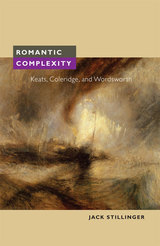
In Romantic Complexity, Jack Stillinger examines three of the most admired poets of English Romanticism--Keats, Coleridge, and Wordsworth--with a focus on the complexity that results from the multiple authorship, the multiple textual representation, and the multiple reading and interpretation of their best works.
Specific topics include the joint authorship of Wordsworth and Coleridge in the Lyrical Ballads, an experiment of 1798 that established the most essential characteristics of modern poetry; Coleridge's creation of eighteen or more different versions of The Ancient Mariner and how this textual multiplicity affects interpretation; the historical collaboration between Keats and his readers to produce fifty-nine separate but entirely legitimate readings of The Eve of St. Agnes; and a number of practical and theoretical matters bearing on the relationships among these writers and their influences on one another.
Stillinger shows his deep understanding of the poets' lives, works, and the history of their reception, in chapters rich with intriguing questions and answers sure to engage students and teachers of the world's greatest poetry.
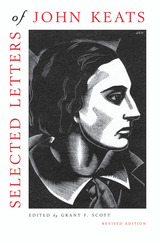
The letters of John Keats are, T. S. Eliot remarked, "what letters ought to be; the fine things come in unexpectedly, neither introduced nor shown out, but between trifle and trifle." This new edition, which features four rediscovered letters, three of which are being published here for the first time, affords readers the pleasure of the poet's "trifles" as well as the surprise of his most famous ideas emerging unpredictably.
Unlike other editions, this selection includes letters to Keats and among his friends, lending greater perspective to an epistolary portrait of the poet. It also offers a revealing look at his "posthumous existence," the period of Keats's illness in Italy, painstakingly recorded in a series of moving letters by Keats's deathbed companion, Joseph Severn. Other letters by Dr. James Clark, Percy Bysshe Shelley, and Richard Woodhouse--omitted from other selections of Keats's letters--offer valuable additional testimony concerning Keats the man.
Edited for greater readability, with annotations reduced and punctuation and spelling judiciously modernized, this selection recreates the spontaneity with which these letters were originally written.
Jack Stillinger's concern is with the words of Keats's texts: “I wish,” he says, “to get rid of the wrong ones and to suggest how to go about constructing texts with a greater proportion of the right ones.” He finds that in the two best modern editions of Keats, one third of the texts have one or more wrong words. Modern editors have sometimes based their texts on inferior holograph, transcript, or printed versions; sometimes combined readings from separate versions; sometimes retained words added by copyists and early editors (who frequently made “improvements” when they thought the poems needed them); and sometimes, of course, introduced independent errors of their own.
The heart of this book is a systematic account of the textual history of each of the 150 poems that can reasonably be assigned to Keats. In each history Stillinger dates the work, as closely as it can be dated; gives the details of first publication; specifies the existing variant readings and their sources; and suggests what might be the basis for a standard text.
READERS
Browse our collection.
PUBLISHERS
See BiblioVault's publisher services.
STUDENT SERVICES
Files for college accessibility offices.
RECENTLY PUBLISHED



UChicago Accessibility Resources
home | accessibility | search | about | contact us
BiblioVault ® 2001 - 2024
The University of Chicago Press