
 A SCHOLARLY BOOK REPOSITORY
31 start with A start with A

What can abortion and divorce laws in other countries teach Americans about these thorny issues? In this incisive new book, noted legal scholar Mary Ann Glendon looks at the experiences of twenty Western nations, including the United States, and shows how they differ, subtly but profoundly, from one another. Her findings challenge many widely held American beliefs. She reveals, for example, that a compromise on the abortion question is not only possible but typical, even in societies that are deeply divided on the matter. Regarding divorce, the extensive reliance on judicial discretion in the United States is not the best way to achieve fairness in arranging child support, spousal maintenance, or division of property—to judge by the experience of other countries. Glendon's analysis, by searching out alternatives to current U.S. practice, identities new possibilities of reform in these areas. After the late 1960s abortion and divorce became more readily available throughout the West—and most readily in this country—but the approach of American law has been anomalous. Compared with other Western nations, the United States permits less regulation of abortion in the interest of the fetus, provides less public support for maternity and child-rearing, and does less to mitigate the economic hardships of divorce through public assistance or enforcement of private obligations of support.
Glendon looks at these and more profound differences in the light of a powerful new method of legal interpretation. She sees each country's laws as part of a symbol-creating system that yields a distinctive portrait of individuals, human life, and relations between men and women, parents and children, families and larger communities. American law, more than that of other countries, employs a rhetoric of rights, individual liberty, and tolerance for diversity that, unchecked, contributes to the fragmentation of community and its values. Contemporary U.S. family law embodies a narrative about divorce, abortion, and dependency that is probably not the story most Americans would want to tell about these sad and complex matters but that is recognizably related to many of their most cherished ideals.
A comprehensive history of abortion in Renaissance Italy.
In this authoritative history, John Christopoulos provides a provocative and far-reaching account of abortion in sixteenth- and seventeenth-century Italy. His poignant portraits of women who terminated or were forced to terminate pregnancies offer a corrective to longstanding views: he finds that Italians maintained a fundamental ambivalence about abortion. Italians from all levels of society sought, had, and participated in abortions. Early modern Italy was not an absolute anti-abortion culture, an exemplary Catholic society centered on the “traditional family.” Rather, Christopoulos shows, Italians held many views on abortion, and their responses to its practice varied.
Bringing together medical, religious, and legal perspectives alongside a social and cultural history of sexuality, reproduction, and the family, Christopoulos offers a nuanced and convincing account of the meanings Italians ascribed to abortion and shows how prevailing ideas about the practice were spread, modified, and challenged. Christopoulos begins by introducing readers to prevailing ideas about abortion and women’s bodies, describing the widely available purgative medicines and surgeries that various healers and women themselves employed to terminate pregnancies. He then explores how these ideas and practices ran up against and shaped theology, medicine, and law. Catholic understanding of abortion was changing amid religious, legal, and scientific debates concerning the nature of human life, women’s bodies, and sexual politics. Christopoulos examines how ecclesiastical, secular, and medical authorities sought to regulate abortion, and how tribunals investigated and punished its procurers—or did not, even when they could have. Abortion in Early Modern Italy offers a compelling and sensitive study of abortion in a time of dramatic religious, scientific, and social change.

One of the most private decisions a woman can make, abortion is also one of the most contentious topics in American civic life. Protested at rallies and politicized in party platforms, terminating pregnancy is often characterized as a selfish decision by women who put their own interests above those of the fetus. This background of stigma and hostility has stifled women’s willingness to talk about abortion, which in turn distorts public and political discussion. To pry open the silence surrounding this public issue, Sanger distinguishes between abortion privacy, a form of nondisclosure based on a woman’s desire to control personal information, and abortion secrecy, a woman’s defense against the many harms of disclosure.
Laws regulating abortion patients and providers treat abortion not as an acceptable medical decision—let alone a right—but as something disreputable, immoral, and chosen by mistake. Exploiting the emotional power of fetal imagery, laws require women to undergo ultrasound, a practice welcomed in wanted pregnancies but commandeered for use against women with unwanted pregnancies. Sanger takes these prejudicial views of women’s abortion decisions into the twenty-first century by uncovering new connections between abortion law and American culture and politics.
New medical technologies, women’s increasing willingness to talk online and off, and the prospect of tighter judicial reins on state legislatures are shaking up the practice of abortion. As talk becomes more transparent and acceptable, women’s decisions about whether or not to become mothers will be treated more like those of other adults making significant personal choices.
For those who find themselves in a battle for public records, Access with Attitude: An Advocate’s Guide to Freedom of Information in Ohio is an indispensable weapon. First Amendment lawyer David Marburger and investigative journalist Karl Idsvoog have written a simply worded, practical guide on how to take full advantage of Ohio’s so-called Sunshine Laws.
Journalists, law firms, labor unions, private investigators, genealogists, realty companies, banks, insurers—anyone who regularly needs access to publicly held information—will find this comprehensive and contentious guide to be invaluable. Marburger, who drafted many of the provisions that Ohio adopted in its open records law, and coauthor Idsvoog have been fighting for broader access to public records their entire careers. They offer field-tested tips on how to avoid “no,” and advise readers on legal strategies if their requests for information go unmet. Step by step, they show how to avoid delays and make the law work.
Whether you’re a citizen, a nonprofit organization, a journalist, or an attorney going after public records, Access with Attitude is an essential resource.

In the five decades after the Civil War, the United States witnessed a profusion of legal institutions designed to cope with the nation’s exceptionally acute industrial accident crisis. Jurists elaborated the common law of torts. Workingmen’s organizations founded a widespread system of cooperative insurance. Leading employers instituted welfare-capitalist accident relief funds. And social reformers advocated compulsory insurance such as workmen’s compensation.
John Fabian Witt argues that experiments in accident law at the turn of the twentieth century arose out of competing views of the loose network of ideas and institutions that historians call the ideology of free labor. These experiments a century ago shaped twentieth- and twenty-first-century American accident law; they laid the foundations of the American administrative state; and they occasioned a still hotly contested legal transformation from the principles of free labor to the categories of insurance and risk. In this eclectic moment at the beginnings of the modern state, Witt describes American accident law as a contingent set of institutions that might plausibly have developed along a number of historical paths. In turn, he suggests, the making of American accident law is the story of the equally contingent remaking of our accidental republic.
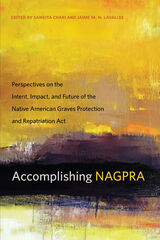
NAGPRA requires museums and federal agencies to return requested Native American cultural items to lineal descendants, culturally affiliated Indian tribes, and Native Hawai’ian organizations. Since the 1990 passage of the act, museums and federal agencies have made more than one million cultural items—and the remains of nearly forty thousand Native Americans—available for repatriation.
Drawing on case studies, personal reflections, historical documents, and statistics, the volume examines NAGPRA and its grassroots, practical application throughout the United States.? Accomplishing NAGPRA will appeal to professionals and academics with an interest in cultural resource management, Indian and human rights law, Indigenous studies, social justice movements, and public policy.
At a time when legal and social prohibitions on sexual relationships are declining, Americans are still nearly unanimous in their condemnation of adultery. Over 90 percent disapprove of cheating on a spouse. In her comprehensive account of the legal and social consequences of infidelity, Deborah Rhode explores why. She exposes the harms that criminalizing adultery inflicts, and she makes a compelling case for repealing adultery laws and prohibitions on polygamy.
In the twenty-two states where adultery is technically illegal although widely practiced, it can lead to civil lawsuits, job termination, and loss of child custody. It is routinely used to threaten and tarnish public officials and undermine military careers. And running through the history of anti-adultery legislation is a double standard that has repeatedly punished women more severely than men. An “unwritten law” allowing a man to avoid conviction for killing his wife’s lover remained common well into the twentieth century. Murder under these circumstances was considered an act of understandable passion.
Adultery has been called the most creative of sins, and novelists and popular media have lavished attention on sexual infidelity. As a focus of serious study, however, adultery has received short shrift. Rhode combines a comprehensive account of the legal and social consequences of adultery with a forceful argument for halting the state’s policing of fidelity.
Based on a survey of admissions officers for law and medical schools and national enrollment data, the authors give us the first analysis of the real impact of the Bakke decision and affirmative action programs on enrollments in medical and law schools. Admission to medical schools and law schools is much sought after and is highly competitive. In examining admissions patterns to these schools the authors are able to identify the effects of affirmative action programs and the Bakke decision in what may be the most challenging case.
This book will appeal to scholars of race and gender in political science, sociology and education as well as those interested in the study of affirmative action policies. Susan Welch is Dean of the College of Liberal Arts and Professor of Political Science, Pennsylvania State University. John Gruhl is Professor of Political Science, University of Nebraska-Lincoln.
Forty years after the U.S. Supreme Court handed down its decision legalizing abortion, Roe v. Wade continues to make headlines. After Roe: The Lost History of the Abortion Debate cuts through the myths and misunderstandings to present a clear-eyed account of cultural and political responses to the landmark 1973 ruling in the decade that followed. The grassroots activists who shaped the discussion after Roe, Mary Ziegler shows, were far more fluid and diverse than the partisans dominating the debate today.
In the early years after the decision, advocates on either side of the abortion battle sought common ground on issues from pregnancy discrimination to fetal research. Drawing on archives and more than 100 interviews with key participants, Ziegler’s revelations complicate the view that abortion rights proponents were insensitive to larger questions of racial and class injustice, and expose as caricature the idea that abortion opponents were inherently antifeminist. But over time, “pro-abortion” and “anti-abortion” positions hardened into “pro-choice” and “pro-life” categories in response to political pressures and compromises. This increasingly contentious back-and-forth produced the interpretation now taken for granted—that Roe was primarily a ruling on a woman’s right to choose.
Peering beneath the surface of social-movement struggles in the 1970s, After Roe reveals how actors on the left and the right have today made Roe a symbol for a spectrum of fervently held political beliefs.
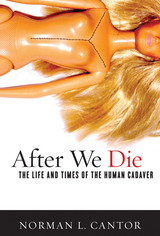
What will become of our earthly remains? What happens to our bodies during and after the various forms of cadaver disposal available? Who controls the fate of human remains? What legal and moral constraints apply? Legal scholar Norman Cantor provides a graphic, informative, and entertaining exploration of these questions. After We Die chronicles not only a corpse’s physical state but also its legal and moral status, including what rights, if any, the corpse possesses.
In a claim sure to be controversial, Cantor argues that a corpse maintains a “quasi-human status" granting it certain protected rights—both legal and moral. One of a corpse’s purported rights is to have its predecessor’s disposal choices upheld. After We Die reviews unconventional ways in which a person can extend a personal legacy via their corpse’s role in medical education, scientific research, or tissue transplantation. This underlines the importance of leaving instructions directing post-mortem disposal. Another cadaveric right is to be treated with respect and dignity. After We Die outlines the limits that “post-mortem human dignity” poses upon disposal options, particularly the use of a cadaver or its parts in educational or artistic displays.
Contemporary illustrations of these complex issues abound. In 2007, the well-publicized death of Anna Nicole Smith highlighted the passions and disputes surrounding the handling of human remains. Similarly, following the 2003 death of baseball great Ted Williams, the family in-fighting and legal proceedings surrounding the corpse’s proposed cryogenic disposal also raised contentious questions about the physical, legal, and ethical issues that emerge after we die. In the tradition of Sherwin Nuland's How We Die, Cantor carefully and sensitively addresses the post-mortem handling of human remains.
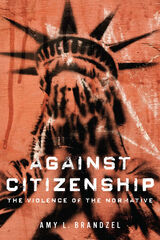
Brandzel's focus on three legal case studies--same-sex marriage law, hate crime legislation, and Native Hawaiian sovereignty and racialization--exposes how citizenship confounds and obscures the mutual processes of settler colonialism, racism, sexism, and heterosexism. In this way, Brandzel argues that citizenship requires anti-intersectionality, that is, strategies that deny the mutuality and contingency of race, class, gender, sexuality, and nation--and how, oftentimes, progressive left activists and scholars follow suit.
Against Citizenship is an impassioned plea for a queer, decolonial, anti-racist coalitional stance against the systemized human de/valuing and anti-intersectionalities of citizenship.
Nearly every middle-aged and older worker, at some time during his or her career, will suffer age discrimination in the workplace. Employers too often use early-retirement plans, restructurings, and downsizings to dismiss older workers. Many of these individuals are unwillingly ushered into earlier-than-planned retirements, are denied promotions, or are terminated. The baby-boomer generation now accounts for just under 50 percent of the entire workforce. A vast army of workers now stands ready to contest employer acts of age discrimination.
Attorney Raymond Gregory addresses himself to the millions of workers who think they might be facing age discrimination and traces the history of the federal measures enacted to assist workers in contesting unlawful employer conduct. He explains how the law works and presents actual court cases to demonstrate the ways that workers have challenged their employers. The cases help to illustrate legal principles in real-life experiences and many of the cases relate compelling stories of workers caught up in a web of employer discriminatory conduct. Gregory has eliminated all legal jargon, ensuring that all concepts are clear to his readers. Individuals will turn to this book again and again to obtain authoritative background on this important topic.
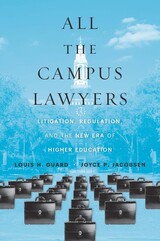
How colleges and universities can respond to legal pressures while remaining true to their educational missions.
Not so long ago, colleges and universities had little interaction with the law. In the 1970s, only a few well-heeled universities even employed in-house legal counsel. But now we live in the age of tenure-denial lawsuits, free speech battles, and campus sexual assault investigations. Even athletics rules violations have become a serious legal matter. The pressures of regulation, litigation, and legislation, Louis Guard and Joyce Jacobsen write, have fostered a new era in higher education, and institutions must know how to respond.
For many higher education observers and participants, including most administrators and faculty, the maze of legal mandates and potential risks can seem bewildering. Guard, a general counsel with years of higher education law experience, and Jacobsen, a former college president, map this unfamiliar terrain. All the Campus Lawyers provides a vital, up-to-date assessment of the impact of legal concerns on higher education and helps readers make sense of the most pressing trends and issues, including civil rights; free speech and expression; student life and wellness; admissions, advancement, and community relations; governance and oversight; the higher education business model; and on-campus crises, from cyberattacks to pandemics.
As well as informing about the latest legal and regulatory developments affecting higher education, Guard and Jacobsen offer practical guidance to those in positions of campus authority. There has never been a more crucial time for college and university boards, presidents, inside and outside counsel, and other higher education leaders to know the law and prepare for legal challenges.
Understanding the processes and policies of urbanization and suburbanization in American Indian communities
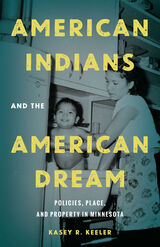
Nearly seven out of ten American Indians live in urban areas, yet studies of urban Indian experiences remain scant. Studies of suburban Natives are even more rare. Today’s suburban Natives, the fastest-growing American Indian demographic, highlight the tensions within federal policies working in tandem to move and house differing groups of people in very different residential locations. In American Indians and the American Dream, Kasey R. Keeler examines the long history of urbanization and suburbanization of Indian communities in Minnesota.
At the intersection of federal Indian policy and federal housing policy, American Indians and the American Dream analyzes the dispossession of Indian land, property rights, and patterns of home ownership through programs and policies that sought to move communities away from their traditional homelands to reservations and, later, to urban and suburban areas. Keeler begins this analysis with the Homestead Act of 1862, then shifts to the Indian Reorganization Act in the early twentieth century, the creation of Little Earth in Minneapolis, and Indian homeownership during the housing bubble of the early 2000s.
American Indians and the American Dream investigates the ways American Indians accessed homeownership, working with and against federal policy, underscoring American Indian peoples’ unequal and exclusionary access to the way of life known as the American dream.
Cover alt text: Vintage photo of Native person bathing smiling child in the sink of a midcentury kitchen. Title in yellow.
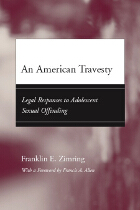
An American Travesty is the first scholarly book in half a century to analyze the justice system’s response to sexual misconduct by children and adolescents in the United States. Writing with a refreshing dose of common sense, Franklin E. Zimring discusses our society's failure to consider the developmental status of adolescent sex offenders. Too often, he argues, the American legal system ignores age and developmental status when adjudicating young sexual offenders, in many cases responding as they would to an adult.
“An opinionated, articulate, and forceful critique of current politics and practices. . . . I would recommend this book for anyone interested in rethinking the fundamental questions of how our courts and systems should respond to these cases.”—Law and Politics Book Review
“One of the most important new books in the field of juvenile justice. . . . Zimring offers a thoughtful, research-based analysis of what went wrong with legal policy development.”—Barry Krisberg, President, National Council on Crime and Delinquency
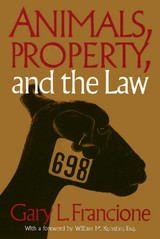
"Pain is pain, irrespective of the race, sex, or species of the victim," states William Kunstler in his foreword. This moral concern for the suffering of animals and their legal status is the basis for Gary L. Francione's profound book, which asks, Why has the law failed to protect animals from exploitation?
Francione argues that the current legal standard of animal welfare does not and cannot establish fights for animals. As long as they are viewed as property, animals will be subject to suffering for the social and economic benefit of human beings.
Exploring every facet of this heated issue, Francione discusses the history of the treatment of animals, anticruelty statutes, vivisection, the Federal Animal Welfare Act, and specific cases such as the controversial injury of anaesthetized baboons at the University of Pennsylvania. He thoroughly documents the paradoxical gap between our professed concern with humane treatment of animals and the overriding practice of abuse permitted by U.S. law.

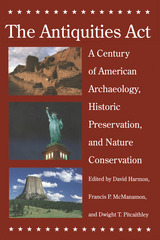
Enacted in 1906, the Antiquities Act is one of the most important pieces of conservation legislation in American history and has had a far-reaching influence on the preservation of our nation’s cultural and natural heritage. Thanks to the foresight of thirteen presidents, parks as diverse as Acadia, Grand Canyon, and Olympic National Park, along with historic and archaeological sites such as Thomas Edison’s Laboratory and the Gila Cliff Dwellings, have been preserved for posterity.
A century after its passage, this book presents a definitive assessment of the Antiquities Act and its legacy, addressing the importance and breadth of the act—as well as the controversy it has engendered. Authored by professionals intimately involved with safeguarding the nation’s archaeological, historic, and natural heritage, it describes the applications of the act and assesses its place in our country’s future. With a scope as far-reaching as the resources the act embraces, this book offers an unparalleled opportunity for today’s stewards to reflect on the act’s historic accomplishments, to remind fellow professionals and the general public of its continuing importance, and to look ahead to its continuing implementation in the twenty-first century.
The Antiquities Act invites all who love America’s natural and cultural treasures not only to learn about the act’s rich legacy but also to envision its next hundred years.
Markets run on information. Buyers make decisions by relying on their knowledge of the products available, and sellers decide what to produce based on their understanding of what buyers want. But the distribution of market information has changed, as consumers increasingly turn to sources that act as intermediaries for information—companies like Yelp and Google. Antitrust Law in the New Economy considers a wide range of problems that arise around one aspect of information in the marketplace: its quality.
Sellers now have the ability and motivation to distort the truth about their products when they make data available to intermediaries. And intermediaries, in turn, have their own incentives to skew the facts they provide to buyers, both to benefit advertisers and to gain advantages over their competition. Consumer protection law is poorly suited for these problems in the information economy. Antitrust law, designed to regulate powerful firms and prevent collusion among producers, is a better choice. But the current application of antitrust law pays little attention to information quality.
Mark Patterson discusses a range of ways in which data can be manipulated for competitive advantage and exploitation of consumers (as happened in the LIBOR scandal), and he considers novel issues like “confusopoly” and sellers’ use of consumers’ personal information in direct selling. Antitrust law can and should be adapted for the information economy, Patterson argues, and he shows how courts can apply antitrust to address today’s problems.
How does a prison achieve institutional order while safeguarding prisoners' rights? Since the early 1960s, prison reform advocates have aggressively used the courts to extend rights and improve life for inmates, while prison administrators have been slow to alter the status quo. Litigated reform has been the most significant force in obtaining change.
An Appeal to Justice is a critical tudy of how the Texas Department of Corrections was transformed by Ruiz v. Estelle, the most sweeping class-action suit in correctional law history. Orders from federal judge William W. Justice rapidly moved the Texas system from one of the most autonomous, isolated, and paternalistic system to a more constitutional bureaucracy. In many respects the Texas experience is a microcosm of the transformation of American corrections over the second half of the twentieth century.
This is a careful account of TDC's fearful past as a plantation system, its tumultuous litigated reform, and its subsequent efforts to balance prisoner rights and prison order. Of major importance is the detailed examination of the broad stages of the reform process (and its costs and benefits) and an intimate look at prison brutality and humanity. The authors examine the terror tactics of the inmate guards, the development of prisoner gangs and widespread violence during the reforms, and the stability that eventually emerged. They also detail the change of the guard force from a relatively small, cohesive cadre dependent on discretion, personal loyalty, and physical dominance to a larger and more fragmented security staff controlled by formal procedures.
Drawing on years of research in archival sources and on hundreds of interviews with prisoners, administrators, and staff, An Appeal to Justice is a unique basis for assessing the course and consequences of prison litigation and will be valuable reading for legislators, lawyers, judges, prison administrators, and concerned citizens, as well as prison and public policy scholars.
The Aquatic Frontier explores the forms this debate took between 1870 and 1920 in law enforcement, legislative advising, natural science, and oyster cartography. Samuel P. Hanes argues that the effort to centralize and privatize the industry failed due to a lack of understanding of the complex social-ecological systems in place—a common dilemma for environmental managers in this time period and for fisheries management confronting dangers from dwindling populations today.
The relationship between religious belief and sexuality as personal attributes exhibits some provocative comparisons. Despite the nonestablishment of religion in the United States and the constitutional guarantee of free exercise, Christianity functions as the religious and moral standard in America. Ethical views that do not fit within this consensus often go unrecognized as moral values. Similarly, in the realm of sexual orientation, heterosexuality is seen as the yardstick by which sexual practices are measured. The notion that "alternative" sexual practices like homosexuality could possess ethical significance is often overlooked or ignored.
In her new book, An Argument for Same-Sex Marriage, political scientist Emily Gill draws an extended comparison between religious belief and sexuality, both central components of one’s personal identity. Using the religion clause of the First Amendment as a foundation, Gill contends that, just as US law and policy ensure that citizens may express religious beliefs as they see fit, it should also ensure that citizens may marry as they see fit. Civil marriage, according to Gill, is a public institution, and the exclusion of some couples from a state institution is a public expression of civic inequality.
An Argument for Same-Sex Marriage is a passionate and timely treatment of the various arguments for and against same-sex marriage and how those arguments reflect our collective sense of morality and civic equality. It will appeal to readers who have an interest in gay and lesbian studies, political theory, constitutional law, and the role of religion in the contemporary United States.
As Loewenstein shows, copyright is a form of monopoly that developed alongside a range of related protections such as commercial trusts, manufacturing patents, and censorship, and cannot be understood apart from them. The regulation of the press pitted competing interests and rival monopolistic structures against one another—guildmembers and nonprofessionals, printers and booksellers, authors and publishers. These struggles, in turn, crucially shaped the literary and intellectual practices of early modern authors, as well as early capitalist economic organization.
With its probing look at the origins of modern copyright, The Author's Due will prove to be a watershed for historians, literary critics, and legal scholars alike.
READERS
Browse our collection.
PUBLISHERS
See BiblioVault's publisher services.
STUDENT SERVICES
Files for college accessibility offices.
RECENTLY PUBLISHED



UChicago Accessibility Resources
home | accessibility | search | about | contact us
BiblioVault ® 2001 - 2024
The University of Chicago Press