
 A SCHOLARLY BOOK REPOSITORY
Butterfly, the Bride looks at law from the outside, using narrative to provide a fresh perspective on the issues of law and social structure---and individual responses to law. This book thoroughly explores relationships between inner and public lives by examining what is ordinarily classified as the sphere of private life---the world of family relationships.
Citizenship defines the U.S. political experiment, but the modern legal category that it now names is a relatively recent invention. There was no Constitutional definition of citizenship until the ratification of the Fourteenth Amendment in 1868, almost a century after the Declaration of Independence. Civic Longing looks at the fascinating prehistory of U.S. citizenship in the years between the Revolution and the Civil War, when the cultural and juridical meaning of citizenship—as much as its scope—was still up for grabs. Carrie Hyde recovers the numerous cultural forms through which the meaning of citizenship was provisionally made and remade in the early United States.
Civic Longing offers the first historically grounded account of the formative political power of the imaginative traditions that shaped early debates about citizenship. In the absence of a centralized legal definition of citizenship, Hyde shows, politicians and writers regularly turned to a number of highly speculative traditions—political philosophy, Christian theology, natural law, fiction, and didactic literature—to authorize visions of what citizenship was or ought to be. These speculative traditions sustained an idealized image of citizenship by imagining it from its outer limits, from the point of view of its “negative civic exemplars”—expatriates, slaves, traitors, and alienated subjects.
By recovering the strange, idiosyncratic meanings of citizenship in the early United States, Hyde provides a powerful critique of originalism, and challenges anachronistic assumptions that read the definition of citizenship backward from its consolidation in the mid-nineteenth century as jus soli or birthright citizenship.
A guide to the colonization and projected decolonization of Native America
In The Colonial Construction of Indian Country, Eric Cheyfitz mounts a pointed historical critique of colonialism through careful analysis of the dialogue between Native American literatures and federal Indian law. Illuminating how these literatures indict colonial practices, he argues that if the decolonization of Indian country is to be achieved, then federal Indian law must be erased and replaced with independent Native nation sovereignty—because subordinate sovereignty, the historical regime, is not sovereignty at all.
At the same time, Cheyfitz argues that Native American literatures, specifically U.S. American Indian literatures, cannot be fully understood without a knowledge of U.S. federal Indian law: the matrix of colonialism in Indian country. Providing intersectional readings of a range of literary and legal texts, he discusses such authors as Louise Erdrich, Frances Washburn, James Welch, Gerald Vizenor, Simon Ortiz, Leslie Marmon Silko, and others. Cheyfitz examines how American Indian writers and critics have responded to the impact of law on Native life, revealing recent trends in Native writing that build upon traditional modes of storytelling and governance.
With a focus on resistance to the colonial regime of federal Indian law, The Colonial Construction of Indian Country not only elucidates how Native American literatures and federal Indian law are each crucial to any reading of the other, it also guides readers to better understand the genocidal assault on Indigenous peoples by Western structures of literacy, politics, and law.
Surprisingly, de Legibus has been one of Cicero's most neglected works. Andrew R. Dyck's commentary is the first to appear on the complete work in well over one hundred years. Dyck provides a detailed interpretation and sets the essay into the context of the politics and philosophical thought of its time. While previous commentaries focused primarily on grammar and textual criticism, this one also seeks to relate Cicero's text to the political, philosophical, and religious trends of his day. The author identifies the influences on Cicero's thinking and analyzes the relation of this theoretical treatise to his other works. This commentary is based on a new text, worked out in consultations between the author and Jonathan Powell of Royal Holloway, London.
Andrew Dyck is Professor of Classics, University of California at Los Angeles.
In her engaging book, Constructing the Enemy, Rajini Srikanth probes the concept of empathy, attempting to understand its different types and how it is—or isn't—generated and maintained in specific circumstances.
Using literary texts to illuminate issues of power and discussions of law, Srikanth focuses on two case studies— the internment of Japanese citizens and Japanese Americans in World War II, after the bombing of Pearl Harbor, and the detainment of Muslim Americans and individuals from various nations in the U.S. prison at Guantanamo Bay.
Through primary documents and interviews that reveal why and how lawyers become involved in defending those who have been designated “enemies,” Srikanth explores the complex conditions under which engaged citizenship emerges. Constructing the Enemy probes the seductive promise of legal discourse and analyzes the emergence and manifestation of empathy in lawyers and other concerned citizens and the wider consequences of this empathy on the institutions that regulate our lives.
Surveying Milton’s early pamphlets, divorce tracts, late political tracts, and major prose works in comparison with the writings and cases of some of Milton’s contemporaries—including George Herbert, John Donne, Ben Jonson, and John Bunyan—Chapman reveals the variety and nuance in Milton’s juridical toolkit and his subtle use of competing legal traditions in pursuit of justice.
More than a survey or work of advocacy, A Death of One’s Own examines the consequences and limits of the three reasons most often cited for supporting a person’s right to die: that it is justified as an expression of personal autonomy or self-ownership; that it constitutes an act of self-authorship, of “choosing a final chapter” in one’s life; and that it enables what has come to be called “death with dignity.” Probing the intersections of law and literature, Stark interweaves close discussion of major legal, political, and philosophical arguments with revealing readings of literary and testimonial texts by writers including Balzac, Melville, Benjamin, and Améry.
A thought-provoking work that will be of interest to those concerned with law and humanities, biomedical ethics, cultural history, and human rights, A Death of One’s Own opens new and suggestive paths for thinking about the history of modern death as well as the unsettled future of the right to die.
Androboros was not just the first of its kind, it was also ahead of its time in many ways, preceding the harsh political satires and farces of the later eighteenth century by some fifty years. Such plays served a small but essential role in promoting political thought among the colonists. Written by anonymous authors and passed from hand to hand, these short, crude, and often bawdy plays and dialogues were rarely acted due to their inflammatory lampoonery. Nevertheless, they provided an opportunity for disgruntled colonists to vent their grievances and promote their ideas to fellow citizens. The farces of the late eighteenth century drove home the meaning and message of the American Revolution.
Equally significant is that Androboros may have influenced a few of the key political discourses published in the 1730s, and these works in turn may well have shaped the future of the American political landscape for the next several decades and even into the modern era. But as a closet drama intended only to be read by close friends and political supporters, this play has languished as a minor footnote in American intellectual history. Scholarly research published to date has been, for the most part, inadequate and occasionally inaccurate. This study remedies that oversight, providing a full analysis as well as an annotated typescript and facsimiles of the original printing.
Best also argues that legal principles dealing with fugitives and indebted persons provided a sophisticated precursor to intellectual property law as it dealt with rights in appearance, expression, and other abstract aspects of personhood. In this conception of property as fleeting, indeed fugitive, American law preserved for much of the rest of the century slavery's most pressing legal imperative: the production of personhood as a market commodity. By revealing the paradoxes of this relationship between fugitive slave law and intellectual property law, Best helps us to understand how race achieved much of its force in the American cultural imagination. A work of ambitious scope and compelling cross-connections, The Fugitive's Properties sets new agendas for scholars of American literature and legal culture.
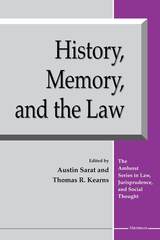
Law looks to the past as it speaks to present needs. In the production of judicial opinions--supposedly definitive statements of what the law is--judges reconstruct law's past, tracing out lines of legal precedent that arguably "compel" their decisions. These essays consider how law treats history, how history appears in legal decisions, and how the authority of history is used to authorize legal decisions.
Furthermore, law plays a role in the construction of memory. The writers here ask how law remembers and records the past as well as how it helps us to remember our past. Law in the modern era is one of the most important of our society's technologies for preserving memory. In helping to construct our memory in certain ways law participates in the writing of our collective history. It plays a crucial role in knitting together our past, present, and future.
The essays in this volume present grounded examinations of particular problems, places, and practices and address the ways in which memory works in and through law, the sites of remembrance that law provides, the battles against forgetting that are fought in and around those sites, and the resultant role law plays in constructing history. The writers also inquire about the way history is mobilized in legal decision making, the rhetorical techniques for marshalling and for overcoming precedent, and the different histories that are written in and through the legal process.
The contributors are Joan Dayan, Soshana Felman, Dominic La Capra, Reva Siegel, Brook Thomas, and G. Edward White.
Austin Sarat is William Nelson Cromwell Professor of Jurisprudence and Political Science and Professor of Law, Jurisprudence, and Social Thought, Amherst College. He is past President of the Law and Society Association and current President of the Association for the Study of Law, Culture, and the Humanities. Thomas R. Kearns is William H. Hastie Professor of Philosophy and Professor of Law, Jurisprudence, and Social Thought, Amherst College.
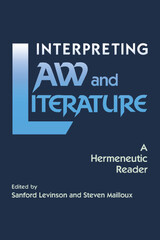
"Contemporary theory has usefully analyzed how alternative modes of interpretation produce different meanings, how reading itself is constituted by the variable perspectives of readers, and how these perspectives are in turn defined by prejudices, ideologies, interests, and so forth. Some theorists gave argued persuasively that textual meaning, in literature and in literary interpretation, is structured by repression and forgetting, by what the literary or critical text does not say as much as by what it does. All these claims are directly relevant to legal hermeneutics, and thus it is no surprise that legal theorists have recently been turning to literary theory for potential insight into the interpretation of law. This collection of essays is designed to represent the especially rich interactive that has taken place between legal and literary hermeneutics during the past ten years."
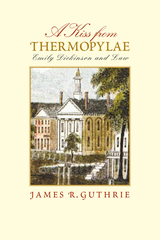
Yet Dickinson was also capable of criticizing, even satirizing, law and lawyers. Her poetic personae inhabit various legal roles including those of jurymen, judges, and attorneys, and some poems simulate courtroom contests pitting the rights of individuals against the power of the state. She was keenly interested in legal matters pertaining to women, such as breach of promise, dower, and trusts. With her tone ranging from subservient to domineering, from reverential to ridiculing, Dickinson's writings reflect an abiding concern with philosophic and political principles underpinning the law, as well as an identification with the plight of individuals who dared confront authority.
A Kiss from Thermopylae reveals a new dimension of Dickinson's writing and thinking, one indicating that she was thoroughly familiar with the legal community's idiomatic language, actively engaged with contemporary political and ethical questions, and skilled at deploying a poetic register ranging from high romanticism to low humor.
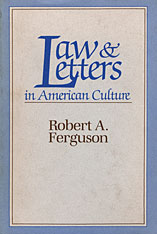
The role of religion in early American literature has been endlessly studied; the role of the law has been virtually ignored. Robert A. Ferguson’s book seeks to correct this imbalance.
With the Revolution, Ferguson demonstrates, the lawyer replaced the clergyman as the dominant intellectual force in the new nation. Lawyers wrote the first important plays, novels, and poems; as gentlemen of letters they controlled many of the journals and literary societies; and their education in the law led to a controlling aesthetic that shaped both the civic and the imaginative literature of the early republic. An awareness of this aesthetic enables us to see works as diverse as Jefferson’s Notes on the State of Virginia and Irving’s burlesque History of New York as unified texts, products of the legal mind of the time.
The Declaration of Independence, the Constitution, and the great political orations were written by lawyers, and so too were the literary works of Trumbull, Tyler, Brackenridge, Charles Brockden Brown, William Cullen Bryant, Richard Henry Dana, Jr., and a dozen other important writers. To recover the original meaning and context of these writings is to gain new understanding of a whole era of American culture.
The nexus of law and letters persisted for more than a half-century. Ferguson explores a range of factors that contributed to its gradual dissolution: the yielding of neoclassicism to romanticism; the changing role of the writer; the shift in the lawyer’s stance from generalist to specialist and from ideological spokesman to tactician of compromise; the onslaught of Jacksonian democracy and the problems of a country torn by sectional strife. At the same time, he demonstrates continuities with the American Renaissance. And in Abraham Lincoln he sees a memorable late flowering of the earlier tradition.

Hailed in its first edition as an "outstanding work, as stimulating as it is intellectually distinguished" (New York Times), Richard A. Posner's Law and Literature has handily lived up to the Washington Post's prediction that the book would "remain essential reading for many years to come." This new edition, extensively revised and enlarged, continues to emphasize the essential differences between law and literature, which are rooted in the different social functions of legal and literary texts. But it also explores areas of mutual illumination and expands its range to include new topics such as popular fiction about law, literary education for lawyers, the legal narrative movement, and judicial biography.
Literary works from classics by Sophocles, Shakespeare, Dostoevsky, Melville, Kafka, and Camus to contemporary fiction by William Gaddis, Tom Wolfe, and John Grisham come under Posner's scrutiny, as do recent attempts to apply the techniques of literary analysis to statutes, judicial opinions, and the Constitution. In a section entirely new in this edition, Posner discusses the increasing efforts of legal scholars to enrich their scholarship by borrowing the methods and insights of literature--even by insisting that legal education is incomplete without the ethical insights afforded by an immersion in literature.
Thoroughly rewritten and updated, free of legal and literary jargon, and informed by Posner's extensive erudition and legal experience, this book remains the most clear, acute, and comprehensive account of the intersection of law and literature--"a wonderfully original and instructive study of what literature has to teach us about the law, the methods of legal argument, and the interpretation of statutes and the Constitution" (Wall Street Journal).
Hailed in its first edition as an “outstanding work, as stimulating as it is intellectually distinguished” (New York Times), Law and Literature has handily lived up to the Washington Post’s prediction that the book would “remain essential reading for many years to come.” This third edition, extensively revised and enlarged, is the only comprehensive book-length treatment of the field. It continues to emphasize the essential differences between law and literature, which are rooted in the different social functions of legal and literary texts. But it also explores areas of mutual illumination and expands its range to include new topics such as the cruel and unusual punishments clause of the Constitution, illegal immigration, surveillance, global warming and bioterrorism, and plagiarism.
In this edition, literary works from classics by Homer, Shakespeare, Milton, Dostoevsky, Melville, Kafka, and Camus to contemporary fiction by Tom Wolfe, Margaret Atwood, John Grisham, and Joyce Carol Oates come under Richard Posner’s scrutiny, as does the film The Matrix.
The book remains the most clear, acute account of the intersection of law and literature.
Alison A. Chapman argues that Milton’s Paradise Lost sits at the apex of the early modern period’s long fascination with law and judicial processes. Milton’s world saw law and religion as linked disciplines and thought therefore that in different ways, both law and religion should reflect the will of God. Throughout Paradise Lost, Milton invites his readers to judge actions using not only reason and conscience but also core principles of early modern jurisprudence. Law thus informs Milton’s attempt to “justify the ways of God to men” and points readers toward the types of legal justice that should prevail on earth.
Adding to the growing interest in the cultural history of law, The Legal Epic shows that England’s preeminent epic poem is also a sustained reflection on the role law plays in human society.
Drawing on an eclectic range of sources including newspaper arrest reports, prison reform periodicals, popular literary magazines, transatlantic travel narratives, popular crime novels, anthologies of prison poetry, and the memoirs of prison chaplains, Ostrowski analyzes how authors as canonical as Nathaniel Hawthorne and as obscure as counterfeiter/poet/prison inmate Christian Meadows adapted, manipulated, or rejected prevailing narratives about criminality to serve their artistic and rhetorical ends. These narratives led to the creation of new literary subgenres while also ushering in psychological interiority as an important criterion by which serious fiction was judged. Ostrowski joins and extends recent scholarly conversations on subjects including African American civic agency, literary sentimentalism, outsider authorship, and the racial politics of antebellum prison reform.
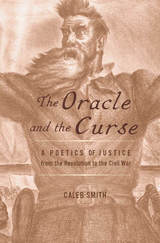
Condemned to hang after his raid on Harper’s Ferry, John Brown prophesied that the crimes of a slave-holding land would be purged away only with blood. A study of omens, maledictions, and inspired invocations, The Oracle and the Curse examines how utterances such as Brown’s shaped American literature between the Revolution and the Civil War.
In nineteenth-century criminal trials, judges played the role of law’s living oracles, but offenders were also given an opportunity to address the public. When the accused began to turn the tables on their judges, they did so not through rational arguments but by calling down a divine retribution. Widely circulated in newspapers and pamphlets, these curses appeared to channel an otherworldly power, condemning an unjust legal system and summoning readers to the side of righteousness.
Exploring the modes of address that communicated the authority of law and the dictates of conscience in antebellum America’s court of public opinion, Caleb Smith offers a new poetics of justice which assesses the nonrational influence that these printed confessions, trial reports, and martyr narratives exerted on their first audiences. Smith shows how writers portrayed struggles for justice as clashes between human law and higher authority, giving voice to a moral protest that transformed American literature.

Today, copyright is everywhere, surrounded by a thicket of no trespassing signs that mark creative work as private property. Caren Irr’s Pink Pirates asks how contemporary novelists—represented by Ursula Le Guin, Andrea Barrett, Kathy Acker, and Leslie Marmon Silko—have read those signs, arguing that for feminist writers in particular copyright often conjures up the persistent exclusion of women from ownership. Bringing together voices from law schools, courtrooms, and the writer's desk, Irr shows how some of the most inventive contemporary feminist novelists have reacted to this history.
Explaining the complex, three-century lineage of Anglo-American copyright law in clear, accessible terms and wrestling with some of copyright law's most deeply rooted assumptions, Irr sets the stage for a feminist reappraisal of the figure of the literary pirate in the late twentieth century—a figure outside the restrictive bounds of U.S. copyright statutes.
Going beyond her readings of contemporary women authors, Irr’s exhaustive history of how women have fared under intellectual property regimes speaks to broader political, social, and economic implications and engages digital-era excitement about the commons with the most utopian and materialist strains in feminist criticism.
A Power to Do Justice shows how Renaissance writers engaged the practical and conceptual dynamics of jurisdiction, both as a subject for critical investigation and as a frame for articulating literature’s sense of itself. Reassessing the relation between English literature and law from More to Shakespeare, Cormack argues that where literary texts attend to jurisdiction, they dramatize how boundaries and limits are the very precondition of law’s power, even as they clarify the forms of intensification that make literary space a reality.
Tracking cultural responses to Renaissance jurisdictional thinking and legal centralization, A Power to Do Justice makes theoretical, literary-historical, and methodological contributions that set a new standard for law and the humanities and for the cultural history of early modern law and literature.
The second half of the book turns from the rule of law to the issue of property, specifically the Lockean version of the self that tied identity to legal conceptions of property and economic value. In separate discussions of Charles Chesnutt, Edith Wharton, and Theodore Dreiser, Reconstituting Authority reveals authors as closely engaged with those changing perspectives on property and identity, in ways that challenged the racial, gendered, and economic consequences of America's possessive individualism.
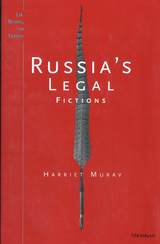
The conflict between the Russian writer and the law is a well-known feature of Russian literary life in the past two centuries. With one exception, the authors discussed in this book--Sukhovo-Kobylin, Akhsharumov, Suvorin, and Dostoevsky in the nineteenth century and Solzhenitsyn and Siniavskii in the twentieth--were all put on trial. In Russia's Legal Fictions, Harriet Murav starts with the authors' own writings about their experience with law and explores the history of these Russian literary trials, including censorship, libel cases, and one case of murder, in their specific historical context, showing how particular aspects of the culture of the time relate to the case.
The book explores the specifically Russian literary and political conditions in which writers claim the authority not only as the authors of fiction but as lawgivers in the realm of the real, and in which the government turns to the realm of the literary to exercise its power. The author uses specific aspects of Russian culture, history and literature to consider broader theoretical questions about the relationship between law, narrative, and authority. Murav offers a history of the reception of the jury trial and the development of a professional bar in late Imperial Russia as well as an exploration of theories of criminality, sexuality, punishment, and rehabilitation in Imperial and Soviet Russia.
This book will be of interest to scholars of law and literature and Russian law, history and culture.
Harriet Murav is Associate Professor of Russian and Comparative Literature, University of California at Davis.
Wallace Stevens was not only one of America's outstanding modernist poets but also a successful insurance lawyer--a fact that continues to intrigue many readers. Though Stevens tried hard to separate his poetry from his profession, legal theorist Thomas Grey shows that he did not ultimately succeed. After stressing how little connection appears on the surface between the two parts of Stevens's life, Grey argues that in its pragmatic account of human reasoning, the poetry distinctively illuminates the workings of the law.
In this important extension of the recent law-and-literature movement, Grey reveals Stevens as a philosophical poet and implicitly a pragmatist legal theorist, who illustrates how human thought proceeds through "assertion, qualification, and qualified reassertion," and how reason and passion fuse together in the act of interpretation. Above all, Stevens's poetry proves a liberating antidote to the binary logic that is characteristic of legal theory: one side of a case is right, the other wrong; conduct is either lawful or unlawful.
At the same time as he discovers in Stevens a pragmatist philosopher of law, Grey offers a strikingly new perspective on the poetry itself. In the poems that develop Stevens's "reality-imagination complex"--poems often criticized as remote, apolitical, and hermetic--Grey finds a body of work that not only captivates the reader but also provides a unique instrument for scrutinizing the thought processes of lawyers and judges in their exercise of social power.
READERS
Browse our collection.
PUBLISHERS
See BiblioVault's publisher services.
STUDENT SERVICES
Files for college accessibility offices.
RECENTLY PUBLISHED





UChicago Accessibility Resources
home | accessibility | search | about | contact us
BiblioVault ® 2001 - 2024
The University of Chicago Press