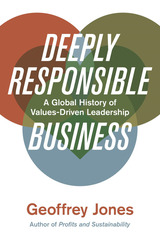
Corporate social responsibility has entered the mainstream, but what does it take to run a successful purpose-driven business? A Harvard Business School professor examines leaders who put values alongside profits to showcase the challenges and upside of deeply responsible business.
For decades, CEOs have been told that their only responsibility is to the bottom line. But consensus is that companies—and their leaders—must engage with their social and environmental contexts. The man behind one of Harvard Business School's most popular courses, Geoffrey Jones distinguishes deep responsibility, which can deliver radical social and ecological responses, from corporate social responsibility, which is often little more than window dressing.
Deeply Responsible Business offers an invaluable historical perspective, going back to the Quaker capitalism of George Cadbury and the worker solidarity of Edward Filene. Through a series of in-depth profiles of business leaders and their companies, it carries us from India to Japan and from the turmoil of the nineteenth century to the latest developments in impact investing and the B-corps. Jones profiles business leaders from around the world who combined profits with social purpose to confront inequality, inner-city blight, and ecological degradation, while navigating restrictive laws and authoritarian regimes.
He found that these leaders were motivated by bedrock values and sometimes—but not always—driven by faith. They chose to operate in socially productive fields, interacted with humility with stakeholders, and felt a duty to support their communities. While far from perfect—some combined visionary practices with vital flaws—each one showed that profit and purpose could be reconciled. Many of their businesses were highly successful—though financial success was not their only metric of achievement.
As companies seek to coopt ethically sensitized consumers, Jones gives us a new perspective to tackle tough questions. Inspired by these passionate and pragmatic business leaders, he envisions a future in which companies and entrepreneurs can play a key role in healing our communities and protecting the natural world.