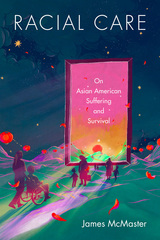
front cover of Racial Care
Racial Care
On Asian American Suffering and Survival
James McMaster
Duke University Press, 2025
In Racial Care, James McMaster studies the forms of care that Asian Americans have taken up to survive the suffering they experience under neoliberal capitalism and white supremacy in the United States. He shows that racialized labors of care can cut multiple ways: sustaining life for its recipients, draining life from its performers. Uplifting examples of this dynamic from Asian American theater, performance art, visual culture, film, poetry, protest, and everyday life, McMaster advances a racialized ethics and politics of care forged from the insights of feminist, queer, and disability theory. He argues that racial care in the Asian American case must respond both to the specific sort of neglect Asian Americans face as a consequence of model minority racialization and to the urgent needs for care that exist among other racialized and colonized peoples. Following the lead of artists and writers like Kristina Wong, Mark Aguhar, Kimberly Alidio, Julia Cho, kt shorb, and Jess X. Snow, Racial Care provides a path forward for all seeking to sustain multiply marginalized Asian American life in times of overlapping crisis.
[more]


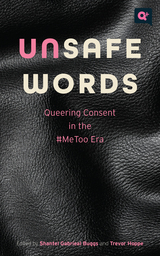
front cover of Unsafe Words
Unsafe Words
Queering Consent in the #MeToo Era
Shantel Gabrieal Buggs
Rutgers University Press, 2023
Queer people may not have invented sex, but queers have long been pioneers in imagining new ways to have it. Yet their voices have been largely absent from the #MeToo conversation. What can queer people learn from the #MeToo conversation? And what can queer communities teach the rest of the world about ethical sex? This provocative book brings together academics, activists, artists, and sex workers to tackle challenging questions about sex, power, consent, and harm. While responding to the need for sex to be consensual and mutually pleasurable, these chapter authors resist the heteronormative assumptions, class norms, and racial privilege underlying much #MeToo discourse. The essays reveal the tools that queer communities themselves have developed to practice ethical sex—from the sex worker negotiating with her client to the gay man having anonymous sex in the back room. At the same time, they explore how queer communities might better prevent and respond to sexual violence without recourse to a police force that is frequently racist, homophobic, and transphobic. 
 
Telling a queerer side of the #MeToo story, Unsafe Words dares to challenge dogmatic assumptions about sex and consent while developing tools and language to promote more ethical and more pleasurable sex for everyone.
[more]


Send via email Share on Facebook Share on Twitter