logo for University of Chicago Press
BEYOND SCHENKERISM
Eugene Narmour
University of Chicago Press, 1977

logo for University of Minnesota Press
Deconstructive Variations
Music and Reason in Western Society
Rose Rosengard Subotnik
University of Minnesota Press, 1995

Deconstructive Variations was first published in 1995. Minnesota Archive Editions uses digital technology to make long-unavailable books once again accessible, and are published unaltered from the original University of Minnesota Press editions.

Unique in its focus and its interdisciplinary reach, Rose Rosengard Subotnik's work is among the most original and challenging being done in American musicology. Her concerns are both formal and sociological, firmly linking music to social and cultural context and breaking down the barriers between music and life.

Deconstructive Variations is a sequel to Subotnik's previous collection, Developing Variations. It expands and continues her achievement-the promotion of humanistic criticism as a significant activity in music scholarship and the portrayal of Western art music in relation to the social structures and cultural values of the society that created it.

Bringing to her subject a vast range of philosophical, artistic, and historical knowledge, Subotnik applies the insights of Kant, Adorno, Bakhtin, and Derrida to major works of Mozart and Chopin. Each of these essays functions as an argument between two views: for and against the ideal of structural listening; Enlightenment and Romantic readings of The Magic Flute; high-modernist and postmodernist readings of Chopin's A-Major Prelude; and conceptions of reason put forward by Allan Bloom and Spike Lee.

Rose Rosengard Subotnik is professor emerita in the department of music at Brown University, and is the author of Developing Variations: Style and Ideology in Western Music (Minnesota, 1991).


[more]

front cover of Here for the Hearing
Here for the Hearing
Analyzing the Music in Musical Theater
Michael Buchler and Gregory J. Decker, Editors
University of Michigan Press, 2023
This book offers a series of essays that show the integrated role that musical structure (including harmony, melody, rhythm, meter, form, and musical association) plays in making sense of what transpires onstage in musicals. Written by a group of music analysts who care deeply about musical theater, this collection provides new understanding of how musicals are put together, how composers and lyricists structure words and music to complement one another, and how music helps us understand the human relationships and historical and social contexts. Using a wide range of musical examples, representing the history of musical theater from the 1920s to the present day, the book explores how music interacts with dramatic elements within individual shows and other pieces within and outside of the genre. These essays invite readers to consider issues that are fundamental both to our understanding of musical theater and to the multiple ways we engage with music.
[more]

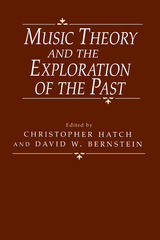
front cover of Music Theory and the Exploration of the Past
Music Theory and the Exploration of the Past
Edited by Christopher Hatch and David W. Bernstein
University of Chicago Press, 1993
In recent decades, increased specialization has sharply separated music theory from historical musicology. Music Theory and the Exploration of the Past brings together a group of essays—written by theorists and musicologists—that seek to bridge this gap. This collection shows that music theory can join forces with historical musicology to produce a more humanistic form of musical scholarship.

In nineteen essays dealing with musical theories from the twelfth to the twentieth century, two recurring themes emerge. One is the need to understand the historical circumstances of the writing and reception of theory, a humanistic approach that gives theory a place within social and intellectual history. The other is the advantages of applying contemporaneous theory to the music of a given period, thus linking theory to the history of musical styles and structures. The periods given principal attention in these essays are the Renaissance, the years around 1800, and the twentieth century.

Abundantly illustrated with musical examples, Music Theory and the Exploration of the Past offers models of new practical applications of theory to the analysis of music. At the same time, it raises the broader question of how historical knowledge can deepen the understanding of an art and of systematic writings about that art.
[more]

logo for Harvard University Press
New Images of Musical Sound
Robert Cogan
Harvard University Press, 1984


Send via email Share on Facebook Share on Twitter