
 A SCHOLARLY BOOK REPOSITORY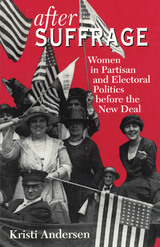
Andersen shows how women's participation was based on a conception of women's citizenship as indirect and disinterested. Gaining the right to vote, campaign, and run for office transformed women's citizenship; at the same time, women's independent partisan stance, their focus on social welfare concerns, and their use of new political techniques such as lobbying all helped to redefine politics.
This fresh, nuanced analysis of women voters, activists, candidates, and officeholders will interest scholars in political science and women's studies.
"In this rich and engaging book, Kristi Anderson presents a convincing argument that woman suffrage deserves greater scrutiny as a social, cultural, and political force in the development of American electoral and party politics."—Jane Junn, Political Science Quarterly
"Anderson's innovation in this book is to change the dominant question asked about American women's suffrage. . . . This book offers a much-needed corrective to the conventional conception that the enfranchisement of women had no significant effect on American society."—Inderjeet Parmar, Political Studies
"Anderson's book is an excellent treatment . . . and a sterling example of the value of using multiple research methods—also steeped within a deep understanding of context, culture, and historic trends—to explain something as complicated and nuanced as the impact of women's votes after suffrage."—Laura R. Woliver, Journal of Politics
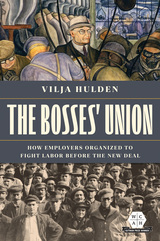
Vilja Hulden reveals how this tension provided the opening for pro-business organizations to shift public attention from concerns about inequality and dangerous working conditions to a belief that unions trampled on an individual's right to work. Inventing the term closed shop, employers mounted what they called an open-shop campaign to undermine union demands that workers at unionized workplaces join the union. Employer organizations lobbied Congress to resist labor's proposals as tyrannical, brought court cases to taint labor's tactics as illegal, and influenced newspaper coverage of unions. While employers were not a monolith nor all-powerful, they generally agreed that unions were a nuisance. Employers successfully leveraged money and connections to create perceptions of organized labor that still echo in our discussions of worker rights.

In a powerful new narrative, G. Edward White challenges the reigning understanding of twentieth-century Supreme Court decisions, particularly in the New Deal period. He does this by rejecting such misleading characterizations as "liberal," "conservative," and "reactionary," and by reexamining several key topics in constitutional law.
Through a close reading of sources and analysis of the minds and sensibilities of a wide array of justices, including Holmes, Brandeis, Sutherland, Butler, Van Devanter, and McReynolds, White rediscovers the world of early-twentieth-century constitutional law and jurisprudence. He provides a counter-story to that of the triumphalist New Dealers. The deep conflicts over constitutional ideas that took place in the first half of the twentieth century are sensitively recovered, and the morality play of good liberals vs. mossbacks is replaced. This is the only thoroughly researched and fully realized history of the constitutional thought and practice of all the Supreme Court justices during the turbulent period that made America modern.
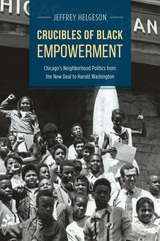
In Crucibles of Black Empowerment, Jeffrey Helgeson recounts the rise of African American political power and activism from the 1930s onward, revealing how it was achieved through community building. His book tells stories of the housewives who organized their neighbors, building tradesmen who used connections with federal officials to create opportunities in a deeply discriminatory employment sector, and the social workers, personnel managers, and journalists who carved out positions in the white-collar workforce. Looking closely at black liberal politics at the neighborhood level in Chicago, Helgeson explains how black Chicagoans built the networks that eventually would overthrow the city’s seemingly invincible political machine.
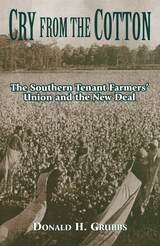
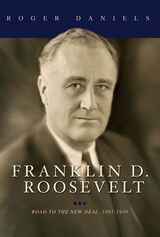
Very little has been written about Harold Ickes, one of the most important, complex, and colorful figures of the New Deal. By any standards his public career was remarkable. For thirteen turbulent years as Interior Secretary and as head of the Public Works Administration he was an uncommonly effective official and a widely acknowledged leader of liberal reform. As the foremost conservationist of his time, he saved millions of acres of land from decimation. He was matchless, too, as a fighter for just causes, and used his formidable talent for invective and his inexhaustible supply of moral fervor to flay representatives of prejudice and self-interest, whether in the cause of Negro rights or that of the common man against economic royalists.
Despite a long and distinguished public life, Ickes is an enigma because of his inability to control his rage, to temper his public criticism, to respond objectively to situations. At the heart of his public and private life was constant moral outrage. This astute study by a historian and a psychologist probes the sources and consequences of Ickes' abnormal combativeness.
White and Maze uncover the psychological imperatives and conscious ideals of Ickes' unknown private life that illuminate his public career. Some of the episodes include sadistic attacks by an elder brother; young Harold contemplating shooting his father; bitter and physical brawls with his imperious, wealthy, and previously married socialite wife, Anna Wilmarth Thompson of Chicago; and thoughts of suicide.
Richard Polenberg calls this book "Superb [and] one of the most informative and interesting I have read on the New Deal. The story shows Ickes' weaknesses and flaws, but it puts them in context. The authors have not tried to explain everything Ickes ever did wholly in psychological terms, but the particular insights they bring to bear help present a rounded view of the man. The book is beautifully written."
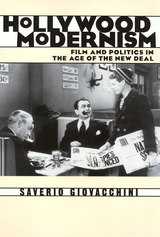
Seeing Hollywood as a forcefield, Giovacchini examines the social networks, working relationships, and political activities of artists, intellectuals, and film workers who flocked to Hollywood from Europe and the eastern United States before and during the second world war. He creates a complex and nuanced portrait of this milieu, adding breadth and depth to the conventional view of the era's film industry as little more than an empire for Jewish moguls or the major studios. In his rendering Hollywood's newcomers joined with its established elite to develop a modernist aesthetic for film that would bridge popular and avant-garde sensibilities; for them, realism was the most effective vehicle for conveying their message and involving a mass audience in the democratic struggle for process.
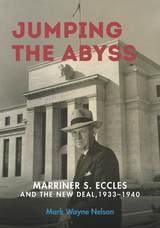
Mark Wayne Nelson details the efforts of one of America’s most underappreciated public servants. In 1934, Franklin D. Roosevelt invited Marriner S. Eccles, a Mormon from Utah, to join his administration. As a Republican businessman, Eccles seemed an unlikely candidate for the role of leading crusader for a fairer and more economically sound distribution of the nation’s wealth. From his first position in the Treasury Department, though, he emerged as the central mover in revolutionizing the mortgage structure of the private home market in the United States.
After FDR appointed him to head the Federal Reserve, Eccles drafted legislation that restructured that institution as well. Throughout the remainder of the New Deal, he was the most powerful advocate of what came to be called “Keynesian Policy,” which involved direct federal stimulus of the economy. Presenting the first comprehensive and independent analysis of Eccles’s influential career, Jumping the Abyss wrestles with economic issues that remain relevant today.
Finalist for the Utah State Historical Society Best Book Award.
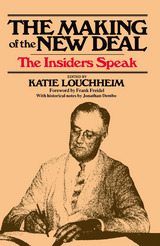
There has never been a phenomenon in American life to equal the invasion of Washington by the young New Dealers—hundreds of men and women still in their twenties and thirties, brilliant and dedicated, trained in the law, economics, public administration, technology, pouring into public life to do nothing less than restructure American society. They proposed new programs, drafted legislation, staffed the new agencies. They were active in the Administration, the Congress, the courts, the news media. They fanned out all over America to discover the facts, plan ways of easing the pain of their foundering country, and report on the results. Many of them went on to be rich, famous, and powerful, but their early experience in Washington was perhaps the most inspiriting of their lives.
Katie Louchheim was among those who arrived in Washington in the 1930s, and being a keen writer as well as the wife of a member of the SEC, she had a front-row seat for the spectacle of social progress. Now, a half-century later, she has gathered reminiscences from her old friends and colleagues, interviewed others, and woven them together into a lively, informal word-picture of that exciting time. Among the many insiders who recount their views are Alger Hiss, Robert C. Weaver, Paul A. Freund, James H. Rowe, Wilbur J. Cohen, Abe Fortas, David Riesman, and Joseph L. Rauh. This book, a singular and uplifting primary document of an extraordinary period, is destined to appeal across a wide spectrum of readers of American history.
Applying the insights of Weber and Bourdieu to the sociology of the legal profession, Shamir shows that elite members of the bar had a keen self-interest in blocking the expansion of administrative law. He dismisses as oversimplified the view that elite lawyers were "hired guns" who argued that New Deal legislation was unconstitutional solely because of their duty to represent their capitalist clients. Instead, Shamir suggests, their alignment with the capitalist class was an incidental result of their attempt to articulate their vision of the law as scientific, apolitical, and judicially oriented—and thereby to defend their own position within the law profession. The academic legal realists on the other side of the constitutional debates criticized the rigidity of the traditional judicial process and insisted that flexibility of interpretation and the uncertainty of legal outcomes was at the heart of the legal system. The author argues that many legal realists, encouraged by the experimental nature of the New Deal, seized an opportunity to improve on their marginal status within the legal profession by moving their discussions from academic circles to the national policy agenda.
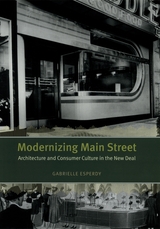
Esperdy argues that these updated storefronts served a range of complex purposes, such as stimulating public consumption, extending the New Deal’s influence, reviving a stagnant construction industry, and introducing European modernist design to the everyday landscape. She goes on to show that these diverse roles are inseparable, woven together not only by the crisis of the Depression, but also by the pressures of bourgeoning consumerism. As the decade’s two major cultural forces, Esperdy concludes, consumerism and the Depression transformed the storefront from a seemingly insignificant element of the built environment into a potent site for the physical and rhetorical staging of recovery and progress.
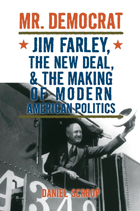
Mr. Democrat tells the story of Jim Farley, Franklin D. Roosevelt's campaign manager. As party boss, Farley experienced unprecedented success in the New Deal years. And like his modern counterpart Karl Rove, Farley enjoyed unparalleled access and power. Unlike Rove, however, Farley was instrumental in the creation of an overwhelming new majority in American politics, as the emergence of the New Deal transformed the political landscape of its time.
Mr. Democrat is timely and indispensable not just because Farley was a fascinating and unduly neglected figure, but also because an understanding of his career advances our knowledge of how and why he revolutionized the Democratic Party and American politics in the age of the New Deal.
Daniel Scroop is Lecturer in American History, University of Liverpool School of History.
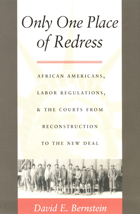
A pioneer in applying the insights of public choice theory to legal history, Bernstein contends that the much-maligned jurisprudence of the Lochner era—with its emphasis on freedom of contract and private market ordering—actually discouraged discrimination and assisted groups with little political clout. To support this thesis he examines the motivation behind and practical impact of laws restricting interstate labor recruitment, occupational licensing laws, railroad labor laws, minimum wage statutes, the Davis-Bacon Act, and New Deal collective bargaining. He concludes that the ultimate failure of Lochnerism—and the triumph of the regulatory state—not only strengthened racially exclusive labor unions but contributed to a massive loss of employment opportunities for African Americans, the effects of which continue to this day.
Scholars and students interested in race relations, labor law, and legal
or constitutional history will be fascinated by Bernstein’s daring—and controversial—argument.
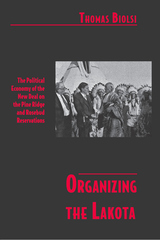
Biolsi pays particular attention to the administrative means by which the OIA retained the power to design and implement tribal "self-government" as well as the power to control the flow of critical resources—rations, relief employment, credit—to the reservations. He also shows how this imbalance of power between the tribes and the federal bureaucracy influenced politics on the reservations, and argues that the crisis of authority faced by the Lakota tribal governments among their own would-be constituents—most dramatically demonstrated by the 1973 Wounded Knee occupation—is a direct result of their disempowerment by the United States.

State parks across Texas offer a world of opportunities for recreation and education. Yet few park visitors or park managers know the remarkable story of how this magnificent state park system came into being during the depths of the Great Depression in the 1930s. Drawing on archival records and examining especially the political context of the New Deal, James Wright Steely here provides the first comprehensive history of the founding and building of the Texas state park system.
Steely's history begins in the 1880s with the movement to establish parks around historical sites from the Texas Revolution. He follows the fits-and-starts progress of park development through the early 1920s, when Governor Pat Neff envisioned the kind of park system that ultimately came into being between 1933 and 1942.
During the Depression an amazing cast of personalities from Franklin D. Roosevelt to Lyndon Johnson led, followed, or obstructed the drive to create this state park system. The New Deal federal-state partnerships for depression relief gave Texas the funding and personnel to build 52 recreational parks under the direction of the National Park Service. Steely focuses in detail on the activities of the Civilian Conservation Corps, whose members built parks from Caddo Lake in the east to the first park improvements in the Big Bend out west. An appendix lists and describes all the state parks in Texas through 1945, while Steely's epilogue brings the parks' story up to the present.
Although Americans claim to revere the Constitution, relatively few understand its workings. Its real importance for the average citizen is as an enduring reminder of the moral vision that shaped the nation's founding. Yet scholars have paid little attention to the broader appeal that constitutional idealism has always made to the American imagination through publications and films. Maxwell Bloomfield draws upon such neglected sources to illustrate the way in which media coverage contributes to major constitutional change.
Successive generations have sought to reaffirm a sense of national identity and purpose by appealing to constitutional norms, defined on an official level by law and government. Public support, however, may depend more on messages delivered by the popular media. Muckraking novels, such as Upton Sinclair's The Jungle (1906), debated federal economic regulation. Woman suffrage organizations produced films to counteract the harmful gender stereotypes of early comedies. Arguments over the enforcement of black civil rights in the Civil Rights Cases and Plessy v. Ferguson took on new meaning when dramatized in popular novels.
From the founding to the present, Americans have been taught that even radical changes may be achieved through orderly constitutional procedures. How both elite and marginalized groups in American society reaffirmed and communicated this faith in the first three decades of the twentieth century is the central theme of this book.

Despite uncertain beginnings, public broadcasting emerged as a noncommercial media industry that transformed American culture. Josh Shepperd looks at the people, institutions, and influences behind the media reform movement and clearinghouse the National Association of Educational Broadcasters (NAEB) in the drive to create what became the Public Broadcasting Service and National Public Radio.
Founded in 1934, the NAEB began as a disorganized collection of undersupported university broadcasters. Shepperd traces the setbacks, small victories, and trial and error experiments that took place as thousands of advocates built a media coalition premised on the belief that technology could ease social inequality through equal access to education and information. The bottom-up, decentralized network they created implemented a different economy of scale and a vision of a mass media divorced from commercial concerns. At the same time, they transformed advice, criticism, and methods adopted from other sectors into an infrastructure that supported public broadcasting in the 1960s and beyond.
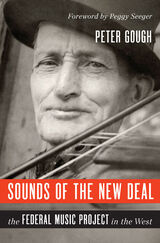
From the onset, administrators and artists debated whether to represent highbrow, popular, or folk music in FMP activities. Though the administration privileged using "good" music to educate the public, in the West local preferences regularly trumped national priorities and allowed diverse vernacular musics to be heard. African American and Hispanic music found unprecedented popularity while the cultural mosaic illuminated by American folksong exemplified the spirit of the Popular Front movement. These new musical expressions combined the radical sensibilities of an invigorated Left with nationalistic impulses. At the same time, they blended traditional patriotic themes with an awareness of the country's varied ethnic musical heritage and vast--but endangered--store of grassroots music.

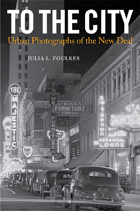
In the 1930s and 1940s, as the United States moved from a rural to an urban nation, the pull of the city was irrepressible. It was so strong that even a photographic mission designed to record the essence of rural America could not help but capture the energy of urbanization too. To the City showcases over 100 photographs from the Farm Security Administration (FSA) project along with extracts from the Works Progress Administration (WPA) guidebooks and oral histories, to convey the detail and dimensions of that transformation.
This artfully grouped collection of photographs includes magnificent images by notable photographers Dorothea Lange, Walker Evans and Gordon Parks, among many others. Foulkes organizes this history of Americana into five themes: Intersection; Traffic; High Life and Low Life; The City in the Country; and Citizens to illuminate the changes in habits, landscapes, and aspirations that the march to cities encompassed.
As the rural past holds symbolic sway and the suburb presents demographic force, the urban portion of our history—why and how cities have been a destination for hope—recedes from view. To the City is a thoughtful, engaging reminder.
Toward a National Power Policy offers a comprehensive analysis of the conflict between Franklin D. Roosevelt's New Deal and the electric utility industry. Philip J. Funigiello outlines the origins and evolution of the privately owned industry, and the growth of an anti-monopoly movement in the 1920s. He details the four major areas of conflict between public and private interests: the Holding Company Act, the Rural Electrification Administration, the Bonneville Power Administration, and power planning for the second World War. Funigiello reveals the complexities of top-level policymaking and the networks of interpersonal relationships that led to both conflict and compromise, and concludes that the failure of the Roosevelt administration to develop a well-defined philosophy prevented the development of a national power policy.
They came from all corners of the country-fifteen young, idealistic, educated men and women drawn to Knoxville, Tennessee, to work for the Tennessee Valley Authority, one of the first of President Franklin D. Roosevelt's New Deal projects. Mostly holding entry-level jobs, these young people became friends and lovers, connecting to one another at work and through other social and political networks..
What the fifteen failed to realize was that these activities-union organizing and, for most, membership in the Communist Party-would plunge them into a maelstrom that would endanger, and for some, destroy their livelihoods, social standing, and careers. White Collar Radicals follows their lives from New Deal activism in the 1930s through the 1940s and 1950s government investigations into what were perceived as subversive deeds.
Aaron D. Purcell shows how this small group of TVA idealists was unwillingly thrust from obscurity into the national spotlight, victims and participants of the second? [not sure is it is needed] Red Scare in the years following World War II. The author brings into sharp focus the determination of the government to target and expose alleged radicals of the 1930s during the early Cold War period. The book also demonstrates how the national hysteria affected individual lives.
White Collar Radicals is both a historical study and a cautionary tale. The Knoxville Fifteen, who endured the dark days of the McCarthy Era, now have their story told for the first time-a story that offers modern-day lessons on freedom, civil liberties, and the authority of the government.
Aaron D. Purcell is an associate professor and director of special collections at Virginia Tech in Blacksburg
READERS
Browse our collection.
PUBLISHERS
See BiblioVault's publisher services.
STUDENT SERVICES
Files for college accessibility offices.
RECENTLY PUBLISHED






UChicago Accessibility Resources
home | accessibility | search | about | contact us
BiblioVault ® 2001 - 2024
The University of Chicago Press