
 A SCHOLARLY BOOK REPOSITORY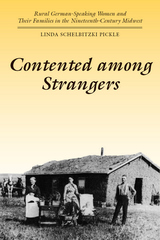
German-Americans make up one of the largest ethnic groups in the United States, yet their very success at assimilating has also made them one of the least visible. Contented among Strangers examines the central role German-speaking women in rural areas of the Midwest played in preserving their ethnic and cultural identity. Even while living far from their original homelands, these women applied traditional European patterns of rural family life and values to their new homes in Illinois, Iowa, Kansas, Missouri, and Nebraska. As a result they were more content with their modest lives than were their Anglo-American counterparts. Through personal recollections--including interesting diary material translated by the author, church and community documents, and migration and census data--Pickle reveals the diversity and richness of the women's experiences.
An unprecedented study that puts mixed-ancestry Native Americans back into the heart of Indigenous history
Historical accounts tend to neglect mixed-ancestry Native Americans: racially and legally differentiated from nonmixed Indigenous people by U.S. government policy, their lives have continually been treated as peripheral to Indigenous societies. Mixed-Blood Histories intervenes in this erasure. Using legal, linguistic, and family-historical methods, Jameson R. Sweet writes mixed-ancestry Dakota individuals back into tribal histories, illuminating the importance of mixed ancestry in shaping and understanding Native and non-Native America from the nineteenth century through today.
When the U.S. government designated mixed-ancestry Indians as a group separate from both Indians and white Americans—a distinction born out of the perception that they were uniquely assimilable as well as manipulable intermediate figures—they were afforded rights under U.S. law unavailable to other Indigenous people, albeit inconsistently, which included citizenship and the rights to vote, serve in public office, testify in court, and buy and sell land. Focusing on key figures and pivotal “mixed-blood histories” for the Dakota nation, Sweet argues that in most cases, they importantly remained Indians and full participants in Indigenous culture and society. In some cases, they were influential actors in establishing reservations and negotiating sovereign treaties with the U.S. government.
Culminating in a pivotal reexamination of the U.S.-Dakota War of 1862, Mixed-Blood Histories brings greater diversity and complexity to existing understandings of Dakota kinship, culture, and language while offering insights into the solidification of racial categories and hierarchies in the United States.
Retail e-book files for this title are screen-reader friendly with images accompanied by short alt text and/or extended descriptions.
READERS
Browse our collection.
PUBLISHERS
See BiblioVault's publisher services.
STUDENT SERVICES
Files for college accessibility offices.
RECENTLY PUBLISHED




UChicago Accessibility Resources
home | accessibility | search | about | contact us
BiblioVault ® 2001 - 2025
The University of Chicago Press