
 A SCHOLARLY BOOK REPOSITORY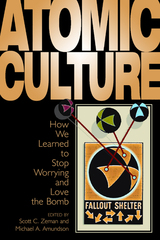
Despite the growing interest in atomic culture and history, the body of relevant scholarship is relatively sparse. Atomic Culture opens new doors into the field by providing a substantive, engaging, and historically based consideration of the topic that will appeal to students and scholars of the Atomic Age as well as general readers.
Contributors include Michael A. Amundson, Mick Broderick, Peter Goin, John Hunner, Ferenc M. Szasz, A. Costandina Titus, Peter C. van Wyck, and Scott C. Zeman.
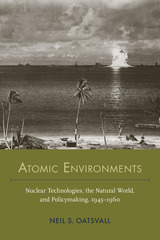
In Atomic Environments: Nuclear Technologies, the Natural World, and Policymaking, 1945–1960, Neil S. Oatsvall examines how top officials in the Truman and Eisenhower administrations used environmental science to develop nuclear strategy at the beginning of the Cold War. While many people were involved in research and analysis during the period in question, it was at highest levels of executive decision-making where environmental science and nuclear science most clearly combined to shape the nation’s policies.
Oatsvall clearly demonstrates how the natural world and the scientific disciplines that study it became integral parts of nuclear science rather than adversarial fields of knowledge. But while nuclear technologies heavily depended on environmental science to develop, those same technologies frequently caused great harm to the natural world. Moreover, while some individuals expressed real anxieties about the damage wrought by nuclear technologies, policymakers as a class consistently made choices that privileged nuclear boosterism and secrecy, prioritizing institutional values over the lives and living systems that they were ostensibly charged to protect.
By scrutinizing institutional policymaking practices and agendas at the birth of the nuclear age, a constant set of values becomes clear. Oatsvall reveals an emerging technocratic class that routinely valued knowledge about the environment to help create and maintain a nuclear arsenal, despite its existential threat to life on earth and the negative effects many nuclear technologies had on ecosystems and the American people alike. Although policymakers took their charge to protect and advance the welfare of the United States and its people seriously, Atomic Environments demonstrates how they often failed to do so because their allegiance to the US nuclear hierarchy blinded them to the real risks and dangers of the nuclear age.
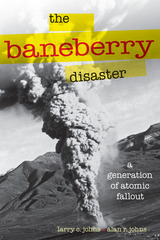
The authors are attorneys from Las Vegas who spent 25 years pursuing a lawsuit for the victims at Baneberry. The story begins in 1971, just after the Baneberry test vented, and takes the reader through the years leading up to the trial, the 41-day trial in 1979, and the multiple appeals following the trial. It discusses the claims and lawsuits filed by others exposed to atomic testing, and the congressional investigations that led to the enactment of the Radiation Exposure Compensation Act in 1990.
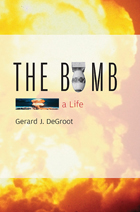
Bombs are as old as hatred itself. But it was the twentieth century--one hundred years of incredible scientific progress and terrible war--that brought forth the Big One, the Bomb, humanity's most powerful and destructive invention. In The Bomb: A Life, Gerard DeGroot tells the story of this once unimaginable weapon that--at least since 8:16 a.m. on August 6, 1945--has haunted our dreams and threatened our existence.
The Bomb has killed hundreds of thousands outright, condemned many more to lingering deaths, and made vast tracts of land unfit for life. For decades it dominated the psyches of millions, becoming a touchstone of popular culture, celebrated or decried in mass political movements, films, songs, and books. DeGroot traces the life of the Bomb from its birth in turn-of-the-century physics labs of Europe to a childhood in the New Mexico desert of the 1940s, from adolescence and early adulthood in Nagasaki and Bikini, Australia and Kazakhstan to maturity in test sites and missile silos around the globe. His book portrays the Bomb's short but significant existence in all its scope, providing us with a portrait of the times and the people--from Oppenheimer to Sakharov, Stalin to Reagan--whose legacy still shapes our world.
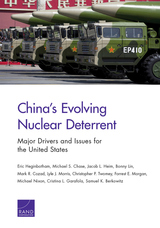

A critical look at how China’s growing strategic arsenal could impact a rapidly changing world order
China’s strategic capabilities and doctrine have historically differed from the United States’ and Russia’s. China has continued to modernize and expand its arsenal despite its policy of no first use, while the United States and Russia have decreased deployed weapons stocks.
This volume brings together an international group of distinguished scholars to provide a fresh assessment of China's strategic military capabilities, doctrines, and political perceptions in light of rapidly advancing technologies, an expanding and modernizing nuclear arsenal, and an increased great-power competition with the United States.
Analyzing China's strategic arsenal is critical for a deeper understanding of China’s relations with both its neighbors and the world. Without a doubt, China’s arsenal is growing in size and sophistication, but key uncertainties also lie ahead. Will China’s new capabilities and confidence lead it to be more assertive and take more risks? Will China’s nuclear traditions change as the strategic balance improves? Will China’s approach to military competition be guided by a notion of strategic stability or not? Will there be a strategic arms race with the United States? China's Strategic Arsenal provides a current understanding of these issues as we strive for a stable strategic future with China.
Critical Masses and Critical Choices examines American attitudes on issues of national and international security. Based on over 13,000 in-depth interviews conducted over a ten-year period, Kerry Herron and Hank Jenkins-Smith have created a unique and rich set of data providing insights into public opinion on nuclear deterrence, terrorism, and other security issues from the end of the Cold War to the present day. Their goal is to shed light not only on changes in public opinion about a range of security-related policy issues, but also to gauge the depth of the public’s actual understanding of these matters. Prior to this study, the predominant view held that the American people were incapable of articulate and consistent thought on complex political subjects. This book overturns that notion and demonstrates the sometimes surprisingly cogent positions held by ordinary members of the public on intricate national issues.
The book’s solid data, based on long-term studies, combined with crisp writing and often startling conclusions, will appeal to a wide range of readers: scholars, journalists, and policy makers. Critical Masses and Critical Choices is the definitive account of the change in public perceptions on security threats and reactive strategies from the early 1990s to the post 9/11 period. This broad and highly original study will prove an indispensable tool for policy makers and scholars alike.
Every culture throughout history has obsessed over various “end of the world” scenarios. The dawn of the Atomic Age marked a new twist in this tale. For the first time, our species became aware of its capacity to deliberately destroy itself. Since that time the Bomb has served as an organizing metaphor, a symbol of human annihilation, a stand-in for the unspeakable void of extinction, and a discursive construct that challenges the limits of communication itself. The parallel fascination with and abhorrence of nuclear weapons has metastasized into a host of other end-of-the-world scenarios, from global pandemics and climate change to zombie uprisings and asteroid collisions.
Desiring the Bomb: Communication, Psychoanalysis, and the Atomic Age explores these world-ending fantasies through the lens of psychoanalysis to reveal their implications for both contemporary apocalyptic culture and the operations of language itself. What accounts for the enduring power of the Bomb as a symbol? What does the prospect of annihilation suggest about language and its limits? Thoroughly researched and accessibly written, this study expands on the theories of Kenneth Burke, Jacques Lacan, Sigmund Freud, and many others from a variety of disciplines to arrive at some answers to these questions.
Calum L. Matheson undertakes a series of case studies—including the Trinity test site, nuclear war games, urban shelter schemes, and contemporary survivalism—and argues that contending with the anxieties (individual, social, cultural, and political) born of the Atomic Age depends on rhetorical conceptions of the “real,” an order of experience that cannot be easily negotiated in language. Using aspects of media studies, rhetorical theory, and psychoanalysis, the author deftly engages the topics of Atomic Age survival, extinction, religion, and fantasy, along with their enduring cultural legacies, to develop an account of the Bomb as a signifier and to explore why some Americans have become fascinated with fantasies of nuclear warfare and narratives of postapocalyptic rebirth.
During the Cold War, many believed that the superpowers shared a conception of strategic stability, a coexistence where both sides would compete for global influence but would be deterred from using nuclear weapons. In actuality, both sides understood strategic stability and deterrence quite differently. Today’s international system is further complicated by more nuclear powers, regional rivalries, and nonstate actors who punch above their weight, but the United States and other nuclear powers still cling to old conceptions of strategic stability.
The purpose of this book is to unpack and examine how different states in different regions view strategic stability, the use or non-use of nuclear weapons, and whether or not strategic stability is still a prevailing concept. The contributors to this volume explore policies of current and potential nuclear powers including the United States, Russia, China, India, Iran, Israel, Pakistan, and Saudi Arabia. This volume makes an important contribution toward understanding how nuclear weapons will impact the international system in the twenty-first century and will be useful to students, scholars, and practitioners of nuclear weapons policy.
Among the monuments to tragedy and hope in Hiroshima’s Peace Park stands a statue of Sadako Sasaki holding a crane in her outstretched arms. Sadako was two years old when the atomic bomb was dropped on her city; she was diagnosed with leukemia ten years later. According to popular Japanese belief, folding a thousand paper cranes brings good fortune. Sadako spent the last months of her young life folding hundreds of paper cranes. She folded 644 before she died.
As he journeys from the Geiger counters, radioactive dust, and mushroom clouds of the Nevada desert to the bronze and ivory memorials for the dead in Japan, Bird—himself a survivor of radiation-induced cancer—seeks to make peace with his past and with a future shadowed by nuclear proliferation. His paper cranes are the poetry and prose of this haunting memoir.
Moral theologians, defense analysts, conflict scholars, and nuclear experts imagine a world free from nuclear weapons
At a 2017 Vatican conference, Pope Francis condemned nuclear weapons. This volume, issued after the 60th anniversary of the Cuban Missile Crisis, presents essays from moral theologians, defense analysts, conflict transformation scholars, and nuclear arms control experts, with testimonies from witnesses. It is a companion volume to A World Free from Nuclear Weapons: The Vatican Conference on Disarmament (Georgetown University Press, 2020).
Chapters from the perspectives of missile personnel and the military chain of command, industrialists and legislators, and citizen activists show how we might achieve a nuclear-free world. Key to this transition is the important role of public education and the mobilization of lay movements to raise awareness and effect change. This essential collection prepares military professionals, policymakers, everyday citizens, and the pastoral workers who guide them, to make decisions that will lead us to disarmament.
Friendly Fallout 1953 is a hybrid work of literature that combines the actual history of aboveground atomic testing in the Nevada desert in 1953 with fictional vignettes that explore the impact of the tests on the people who participated in them and on civilian "downwinders." The book brings to life a turbulent era when Cold War fears, patriotic enthusiasm, scientific progress, and unacknowledged political agendas often collided with the welfare of ordinary citizens and the environment.
Are NATO’s mutual security commitments strong enough today to deter all adversaries? Is the nuclear umbrella as credible as it was during the Cold War? Backed by the full range of US and allied military capabilities, NATO’s mutual defense treaty has been enormously successful, but today’s commitments are strained by military budget cuts and antinuclear sentiment. The United States has also shifted its focus away from European security during the wars in Afghanistan and Iraq and more recently with the Asia rebalance. Will a resurgent Russia change this?
The Future of Extended Deterrence brings together experts and scholars from the policy and academic worlds to provide a theoretically rich and detailed analysis of post–Cold War nuclear weapons policy, nuclear deterrence, alliance commitments, nonproliferation, and missile defense in NATO but with implications far beyond. The contributors analyze not only American policy and ideas but also the ways NATO members interpret their own continued political and strategic role in the alliance.
In-depth and multifaceted, The Future of Extended Deterrence is an essential resource for policy practitioners and scholars of nuclear deterrence, arms control, missile defense, and the NATO alliance.
Are nuclear arsenals safe from cyber-attack? Could terrorists launch a nuclear weapon through hacking? Are we standing at the edge of a major technological challenge to global nuclear order? These are among the many pressing security questions addressed in Andrew Futter’s ground-breaking study of the cyber threat to nuclear weapons.
Hacking the Bomb provides the first ever comprehensive assessment of this worrying and little-understood strategic development, and it explains how myriad new cyber challenges will impact the way that the world thinks about and manages the ultimate weapon. The book cuts through the hype surrounding the cyber phenomenon and provides a framework through which to understand and proactively address the implications of the emerging cyber-nuclear nexus. It does this by tracing the cyber challenge right across the nuclear weapons enterprise, explains the important differences between types of cyber threats, and unpacks how cyber capabilities will impact strategic thinking, nuclear balances, deterrence thinking, and crisis management. The book makes the case for restraint in the cyber realm when it comes to nuclear weapons given the considerable risks of commingling weapons of mass disruption with weapons of mass destruction, and argues against establishing a dangerous norm of “hacking the bomb.”
This timely book provides a starting point for an essential discussion about the challenges associated with the cyber-nuclear nexus, and will be of great interest to scholars and students of security studies as well as defense practitioners and policy makers.
India's nuclear profile, doctrine, and practices have evolved rapidly since the country’s nuclear breakout in 1998. However, the outside world's understanding of India's doctrinal debates, forward-looking strategy, and technical developments are still two decades behind the present. India and Nuclear Asia will fill that gap in our knowledge by focusing on the post-1998 evolution of Indian nuclear thought, its arsenal, the triangular rivalry with Pakistan and China, and New Delhi's nonproliferation policy approaches. Yogesh Joshi and Frank O'Donnell show how India's nuclear trajectory has evolved in response to domestic, regional, and global drivers.
The authors argue that emerging trends in all three states are elevating risks of regional inadvertent and accidental escalation. These include the forthcoming launch of naval nuclear forces within an environment of contested maritime boundaries; the growing employment of dual-use delivery vehicles; and the emerging preferences of all three states to employ missiles early in a conflict. These dangers are amplified by the near-absence of substantive nuclear dialogue between these states, and the growing ambiguity of regional strategic intentions.
Based on primary-source research and interviews, this book will be important reading for scholars and students of nuclear deterrence and India's international relations, as well as for military, defense contractor, and policy audiences both within and outside South Asia.

The 1950 espionage case of Klaus Fuchs, who betrayed British and American atomic secrets to the Soviet Union, touched off a witch hunt in the United States that led to the capture of the Rosenbergs and many other alleged spies. The case fueled the fires of national concern over communism, Soviet espionage, internal subversion, and security in the nuclear age. Robert C. Williams has tenaciously retraced Fuchs's trail from Nazi Germany to Britain, Canada, Los Alamos, and finally to Dresden, where Fuchs now lives the life of a successful retired nuclear physicist. In his search Williams has not only uncovered Fuchs's personal story but has also established that his espionage was part of a much larger Soviet effort to penetrate and control British intelligence.
Klaus Fuchs had access to the most highly classified secrets of the wartime Manhattan Project. Cleared eight times by British security, and consequently accepted without investigation by the Americans, Fuchs worked in a hermetic world of security through secrecy—a world whose rules he publicly defended and privately betrayed. He played his role carefully for almost a decade, passing classified information to Soviet intelligence through a German communist espionage ring that operated under the very nose of the British government during and after the war. As part of the secret Anglo-American bomb project, he brought to Britain—and gave to Russia—technological know-how that helped both countries develop their own A-bombs.
This first full-length portrait of Klaus Fuchs and his case, based in part on newly available American and British archives on the subject, is an exciting find for general readers in the history of science, espionage, World War II, and the Cold War. It will also be of high professional interest to historians and physicists.
From 2017 to 2020, Jacob Hamblin and Linda Richards ran the Oregon State University Downwinders Project, sponsored by the National Science Foundation, to support research and scholarship on the Hanford downwinders cases. Additionally, each summer the project team sponsored a workshop that brought a variety of stakeholders together to explore the science, history, and lived experiences of nuclear exposure. These workshops took a broad view of nuclear exposure, beyond Hanford, beyond the United States, and beyond academia. Community members and activists presented their testimonies and creative work alongside scholars studying exposure worldwide.
Making the Unseen Visible collects the best work arising from the project and its workshops. Scholarly research chapters and reflective essays cover topics and experiences ranging from colonial nuclear testing in North Africa, to Hiroshima survivor stories, to uranium mining in the Navajo Nation, to battles over public memory around Hanford. Scholarship on nuclear topics has largely happened on a case study basis, focusing on individual disasters or locations. Making the Unseen Visible brings a variety of current community and scholarly work together to create a clearer, larger web uniting nuclear humanities research across time and geography.
North Korea is perilously close to developing strategic nuclear weapons capable of hitting the United States and its East Asian allies. Since their first nuclear test in 2006, North Korea has struggled to perfect the required delivery systems. Kim Jong-un’s regime now appears to be close, however. Sung Chull Kim, Michael D. Cohen, and the volume contributors contend that the time to prevent North Korea from achieving this capability is virtually over; scholars and policymakers must turn their attention to how to deter a nuclear North Korea. The United States, South Korea, and Japan must also come to terms with the fact that North Korea will be able to deter them with its nuclear arsenal. How will the erratic Kim Jong-un behave when North Korea develops the capability to hit medium- and long-range targets with nuclear weapons? How will and should the United States, South Korea, Japan, and China respond, and what will this mean for regional stability in the short term and long term? The international group of authors in this volume address these questions and offer a timely analysis of the consequences of an operational North Korean nuclear capability for international security.
Once dismissed as ineffectual, the International Atomic Energy Agency (IAEA) has in the past twenty years emerged as a powerful international organization. Member states allow the IAEA to render judgment on matters vital to peace and security while nations around the globe comply with its rules and commands on proliferation, safety, and a range of other issues.
Robert L. Brown details the IAEA’s role in facilitating both control of nuclear weapons and the safe exploitation of nuclear power. As he shows, the IAEA has acquired a surprising amount of power as states, for political and technological reasons, turn to it to supply policy cooperation and to act as an agent for their security and safety. The agency’s success in gaining and holding authority rests in part on its ability to apply politically neutral expertise that produces beneficial policy outcomes. But Brown also delves into the puzzle of how an agency created by states to aid cooperation has acquired power over them.
On the fiftieth anniversary of Hiroshima, Nobel-winning physicist Hans Bethe called on his fellow scientists to stop working on weapons of mass destruction. What drove Bethe, the head of Theoretical Physics at Los Alamos during the Manhattan Project, to renounce the weaponry he had once worked so tirelessly to create? That is one of the questions answered by Nuclear Forces, a riveting biography of Bethe’s early life and development as both a scientist and a man of principle.
As Silvan Schweber follows Bethe from his childhood in Germany, to laboratories in Italy and England, and on to Cornell University, he shows how these differing environments were reflected in the kind of physics Bethe produced. Many of the young quantum physicists in the 1930s, including Bethe, had Jewish roots, and Schweber considers how Liberal Judaism in Germany helps explain their remarkable contributions. A portrait emerges of a man whose strategy for staying on top of a deeply hierarchical field was to tackle only those problems he knew he could solve.
Bethe’s emotional maturation was shaped by his father and by two women of Jewish background: his overly possessive mother and his wife, who would later serve as an ethical touchstone during the turbulent years he spent designing nuclear bombs. Situating Bethe in the context of the various communities where he worked, Schweber provides a full picture of prewar developments in physics that changed the modern world, and of a scientist shaped by the unprecedented moral dilemmas those developments in turn created.
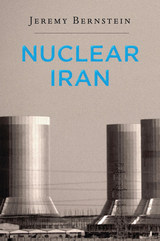
Iran’s nuclear program has generated intense controversy ever since the International Atomic Energy Agency reported in 2003 that Iran was secretly pursuing enrichment activities. Although Iranian officials insist the program is peaceful, many in the international community are skeptical of Iran’s stated aims—and some allege there is no greater nuclear-weapons proliferation danger in the world today.
Nuclear Iran guides readers through the intricate maze of science and secrecy that lies at the heart of Iran’s nuclear ambitions. Writing for the general reader, Jeremy Bernstein brings his knowledge as a physicist to bear on the issues, offering elucidations of the scientific principles and technical hurdles involved in creating nuclear reactors and bombs. His explanations range from the physics of fission to methods of isotope separation to the technologies required for weaponizing fissile uranium and plutonium. Iran’s construction of centrifuges capable of producing weapons-grade uranium has received much media attention, and Bernstein explains how these complex devices work. He intersperses many elements of the human story into his discussions of technology, such as the fact that centrifuges were first invented by German war prisoners working in the Soviet Union.
Nuclear Iran turns a spotlight on the controversial underground uranium-enrichment facility in Natanz and heavy water reactor in Arak, and profiles key figures in the ongoing international trade in weapons technology, including the Pakistani physicist A. Q. Khan. This succinct book is timely reading for anyone who wishes to understand the science behind the international crisis surrounding Iran’s nuclear program.
Nuclear terrorism is such a disturbing prospect that we shy away from its details. Yet as a consequence, we fail to understand how best to defeat it. Michael Levi takes us inside nuclear terrorism and behind the decisions a terrorist leader would be faced with in pursuing a nuclear plot. Along the way, Levi identifies the many obstacles, large and small, that such a terrorist scheme might encounter, allowing him to discover a host of ways that any plan might be foiled.
Surveying the broad universe of plots and defenses, this accessible account shows how a wide-ranging defense that integrates the tools of weapon and materials security, law enforcement, intelligence, border controls, diplomacy, and the military can multiply, intensify, and compound the possibility that nuclear terrorists will fail. Levi draws from our long experience with terrorism and cautions us not to focus solely on the most harrowing yet most improbable threats. Nuclear terrorism shares much in common with other terrorist threats--and as a result, he argues, defeating it is impossible unless we put our entire counterterrorism and homeland security house in order.
As long as we live in a nuclear age, no defense can completely eliminate nuclear terrorism. But this book reminds us that the right strategy can minimize the risks and shows us how to do it.
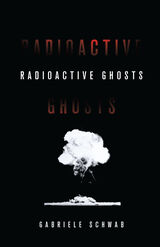
A pioneering examination of nuclear trauma, the continuing and new nuclear peril, and the subjectivities they generate
Amid resurgent calls for widespread nuclear energy and “limited nuclear war,” the populations that must live with the consequences of these decisions are increasingly insecure. The nuclear peril combined with the looming threat of climate change means that we are seeing the formation of a new kind of subjectivity: humans who are in a position of perpetual ontological insecurity. In Radioactive Ghosts, Gabriele Schwab articulates a vision of these “nuclear subjectivities” that we all live with.
Focusing on the legacies of the Manhattan Project, Hiroshima, and nuclear energy politics, Radioactive Ghosts takes us on a tour of the little-seen sides of our nuclear world. Examining devastating uranium mining on Native lands, nuclear sacrifice zones, the catastrophic accidents at Chernobyl and Fukushima, and the formation of a new transspecies ethics, Schwab shows how individuals threatened with extinction are creating new adaptations, defenses, and communal spaces. Ranging from personal accounts of experiences with radiation to in-depth readings of literature, film, art, and scholarly works, Schwab gives us a complex, idiosyncratic, and personal analysis of one of the most overlooked issues of our time.
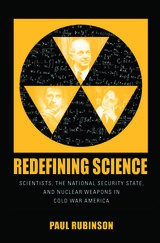
Redefining Science shows that the government achieved its Cold War "consensus" only by active opposition to powerful dissenters and helps explain the current and uneasy relationship between scientists, the public, and government in debates over issues such as security, energy, and climate change.
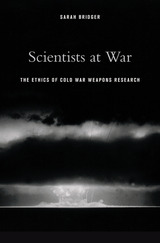
Scientists at War examines the ethical debates that severely tested the American scientific community during the Cold War. Sarah Bridger highlights the contributions of scientists to military technologies and strategic policymaking, from the dawning atomic age in the 1940s through the Strategic Defense Initiative (“Star Wars”) in the 1980s, which sparked a cross-generational opposition among scientists.
The Manhattan Project in the early 1940s and the crisis provoked by the launch of Sputnik in 1957 greatly enhanced the political clout of American scientists. Yet many who took up government roles felt a duty to advocate arms control. Bridger investigates the internal debate over nuclear weapons policy during the Eisenhower and Kennedy administrations, when scientific advisors did not restrict themselves to technical assessments but made an impassioned moral case for a nuclear test ban. The relationship between government and science began to fray further during the Vietnam War, as younger scientists inside and outside of government questioned the morality of using chemical defoliants, napalm, and other non-nuclear weapons. With campuses erupting in protest over classified weapons research conducted in university labs, many elder statesmen of science, who once believed they could wield influence from within, became alienated. The result was a coalition that opposed “Star Wars” during the 1980s—and a diminished role for scientists as counselors to future presidents.
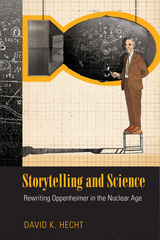
From the outset, accounts of Oppenheimer's life and work were deployed for multiple ends: to trumpet or denigrate the value of science, to settle old scores or advocate new policies, to register dissent or express anxieties. In these different renditions, Oppenheimer was alternately portrayed as hero and villain, establishment figure and principled outsider, "destroyer of worlds" and humanist critic. Yet beneath the varying details of these stories, Hecht discerns important patterns in the way that audiences interpret, and often misinterpret, news about science. In the end, he argues, we find that science itself has surprisingly little to do with how its truths are assimilated by the public. Instead its meaning is shaped by narrative traditions and myths that frame how we think and write about it.
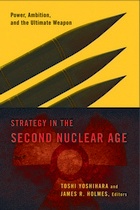
A “second nuclear age” has begun in the post-Cold War world. Created by the expansion of nuclear arsenals and new proliferation in Asia, it has changed the familiar nuclear geometry of the Cold War. Increasing potency of nuclear arsenals in China, India, and Pakistan, the nuclear breakout in North Korea, and the potential for more states to cross the nuclear-weapons threshold from Iran to Japan suggest that the second nuclear age of many competing nuclear powers has the potential to be even less stable than the first.
Strategy in the Second Nuclear Age assembles a group of distinguished scholars to grapple with the matter of how the United States, its allies, and its friends must size up the strategies, doctrines, and force structures currently taking shape if they are to design responses that reinforce deterrence amid vastly more complex strategic circumstances. By focusing sharply on strategy—that is, on how states use doomsday weaponry for political gain—the book distinguishes itself from familiar net assessments emphasizing quantifiable factors like hardware, technical characteristics, and manpower. While the emphasis varies from chapter to chapter, contributors pay special heed to the logistical, technological, and social dimensions of strategy alongside the specifics of force structure and operations. They never lose sight of the human factor—the pivotal factor in diplomacy, strategy, and war.
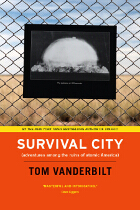
On the road to Survival City, Tom Vanderbilt maps the visible and invisible legacies of the cold war, exhuming the blueprints for the apocalypse we once envisioned and chronicling a time when we all lived at ground zero. In this road trip among ruined missile silos, atomic storage bunkers, and secret test sites, a lost battleground emerges amid the architecture of the 1950s, accompanied by Walter Cotten’s stunning photographs. Survival City looks deep into the national soul, unearthing the dreams and fears that drove us during the latter half of the twentieth century.
“A crucial and dazzling book, masterful, and for me at least, intoxicating.”—Dave Eggers
“A genuinely engaging book, perhaps because [Vanderbilt] is skillful at conveying his own sense of engagement to the reader.”—Los Angeles Times
“A retracing of Dr. Strangelove as ordinary life.”—Greil Marcus, Bookforum
Terre Ryan examines this phenomenon by exploring the overlapping trails of national mythology, landscape aesthetics, patriotic discourse, and public policy. Tracing her journeys around bombing grounds in Nevada, logging sites in Oregon, and energy fields in Wyoming, she argues that business and government agencies often frame commercial projects and national myths according to nineteenth-century beliefs about landscape and bounty. Advertisements and political promotional materials following this aesthetic framework perpetuate frontier-era ideas about the environment as commodity, scenery, and cultural trashlands. Transmitted through all types of media, nineteenth-century perspectives on landscape continue to inform mainstream perceptions of the environment, environmental policies, and representations of American patriotism.
Combining personal narrative with factual reportage, political and cultural critique, and historical analysis, Ryan reframes the images we see every day and places them into a larger national narrative.
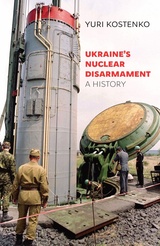
In December 1994, Ukraine gave up the third-largest nuclear arsenal in the world and signed the Non-Proliferation Treaty, having received assurances that its sovereignty would be respected and secured by Russia, the United States, and the United Kingdom. Based on original and heretofore unavailable documents, Yuri Kostenko’s account of the negotiations between Ukraine, Russia, and the US reveals for the first time the internal debates of the Ukrainian government as well as the pressure exerted upon it by its international partners.
Kostenko presents an insider’s view on the issue of nuclear disarmament and raises the question of whether the complete and immediate dismantlement of the country’s enormous nuclear arsenal was strategically the right decision, especially in view of the 2014 annexation of Crimea by Russia, one of the guarantors of Ukraine’s sovereignty under denuclearization.
Does state acquisition of nuclear weapons lead to stability and peace or instability and crises? This is one of the great debates in international relations scholarship. Michael D. Cohen argues that nuclear weapons acquisition often does dangerously embolden the acquiring state to undertake coercion and aggression, but that this behavior moderates over time as leaders learn the dangers and limitations of nuclear coercion. This book examines the historical cases of the Soviet Union and Pakistan in depth and also looks at mini-cases involving the United States, China, and India. This book broadens our understanding of how leaders and states behave when they acquire nuclear weapons and is important reading for scholars and students of international relations, security studies, and political psychology.
READERS
Browse our collection.
PUBLISHERS
See BiblioVault's publisher services.
STUDENT SERVICES
Files for college accessibility offices.
RECENTLY PUBLISHED




UChicago Accessibility Resources
home | accessibility | search | about | contact us
BiblioVault ® 2001 - 2024
The University of Chicago Press