
 A SCHOLARLY BOOK REPOSITORY
Results by Title
3 books about Object (Aesthetics)
3 books about Object (Aesthetics)
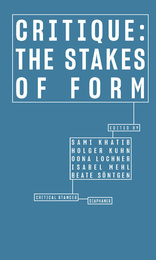
Critique
The Stakes of Form
Edited by Sami Khatib, Holger Kuhn, Oona Lochner, Isabel Mehl, and Beate Söntgen
Diaphanes, 2020
Critique is a form of thinking and acting. Since the end of the 18th century, there has been a dynamization and fluidization of the understanding of form, as concepts such as the break, marginalization, tearing, and opening indicate. As a philosophical problem, the question of form arises in critical theory from Marx to Adorno. Since the 1960s, literary practices have proliferated that generate critical statements less through traditional argument and more through the programmatic use of formal means. At the same time, the writing self, along with its attitudes, reflections, affects, and instruments, visibly enters the critical scene. This volume examines how the interdependence of critique, object, and form translates into critical stances, understood as learnable, reproducible gestures, which bear witness to changing conditions and media of critical practice.
[more]
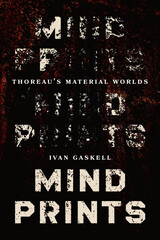
Mindprints
Thoreau's Material Worlds
Ivan Gaskell
University of Chicago Press, 2024
A rediscovery of Thoreau’s interactions with everyday objects and how they shaped his thought.
Though we may associate Henry David Thoreau with ascetic renunciation, he accumulated a variety of tools, art, and natural specimens throughout his life as a homebuilder, surveyor, and collector. In some of these objects, particularly Indigenous artifacts, Thoreau perceived the presence of their original makers, and he called such objects “mindprints.” Thoreau believed that these collections could teach him how his experience, his world, fit into the wider, more diverse (even incoherent) assemblage of other worlds created and re-created by other beings every day. In this book, Ivan Gaskell explores how a profound environmental aesthetics developed from this insight and shaped Thoreau’s broader thought.
Though we may associate Henry David Thoreau with ascetic renunciation, he accumulated a variety of tools, art, and natural specimens throughout his life as a homebuilder, surveyor, and collector. In some of these objects, particularly Indigenous artifacts, Thoreau perceived the presence of their original makers, and he called such objects “mindprints.” Thoreau believed that these collections could teach him how his experience, his world, fit into the wider, more diverse (even incoherent) assemblage of other worlds created and re-created by other beings every day. In this book, Ivan Gaskell explores how a profound environmental aesthetics developed from this insight and shaped Thoreau’s broader thought.
[more]
Object—Event— Performance
Art, Materiality, and Continuity Since the 1960s
Edited by Hanna B. Hölling
Bard Graduate Center, 2021
A volume considering questions of conservation that arise with new artistic mediums and practices.
Much of the artwork that rose to prominence in the second half of the twentieth century took on novel forms—such as installation, performance, event, video, film, earthwork, and intermedia works with interactive and networked components—that pose a new set of questions about what art actually is, both physically and conceptually. For conservators, this raises an existential challenge when considering what elements of these artworks can and should be preserved.
This provocative volume revisits the traditional notions of conservation and museum collecting that developed over the centuries to suit a conception of art as static, fixed, and permanent objects. Conservators and museums increasingly struggle with issues of conservation for works created from the mid-twentieth to the twenty-first century that are unstable over time. The contributors ask what it means to conserve artworks that fundamentally address and embody the notion of change and, through this questioning, guide us to reevaluate the meaning of art, of objects, and of materiality itself. Object—Event—Performance considers a selection of post-1960s artworks that have all been chosen for their instability, changeability, performance elements, and processes that pose questions about their relationship to conservation practices. This volume will be a welcome resource on contemporary conservation for art historians, scholars of dance and theater studies, curators, and conservators.
Much of the artwork that rose to prominence in the second half of the twentieth century took on novel forms—such as installation, performance, event, video, film, earthwork, and intermedia works with interactive and networked components—that pose a new set of questions about what art actually is, both physically and conceptually. For conservators, this raises an existential challenge when considering what elements of these artworks can and should be preserved.
This provocative volume revisits the traditional notions of conservation and museum collecting that developed over the centuries to suit a conception of art as static, fixed, and permanent objects. Conservators and museums increasingly struggle with issues of conservation for works created from the mid-twentieth to the twenty-first century that are unstable over time. The contributors ask what it means to conserve artworks that fundamentally address and embody the notion of change and, through this questioning, guide us to reevaluate the meaning of art, of objects, and of materiality itself. Object—Event—Performance considers a selection of post-1960s artworks that have all been chosen for their instability, changeability, performance elements, and processes that pose questions about their relationship to conservation practices. This volume will be a welcome resource on contemporary conservation for art historians, scholars of dance and theater studies, curators, and conservators.
[more]
READERS
Browse our collection.
PUBLISHERS
See BiblioVault's publisher services.
STUDENT SERVICES
Files for college accessibility offices.
RECENTLY PUBLISHED





UChicago Accessibility Resources
home | accessibility | search | about | contact us
BiblioVault ® 2001 - 2025
The University of Chicago Press