
 A SCHOLARLY BOOK REPOSITORY
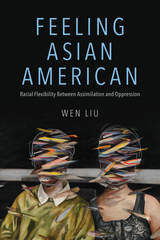
Asian Americans have become the love-hate subject of the American psyche: at times celebrated as the model minority, at other times hated as foreigners. Wen Liu examines contemporary Asian American identity formation while placing it within a historical and ongoing narrative of racial injury. The flexible racial status of Asian Americans oscillates between oppression by the white majority and offers to assimilate into its ranks. Identity emerges from the tensions produced between those two poles. Liu dismisses the idea of Asian Americans as a coherent racial population. Instead, she examines them as a raced, gendered, classed, and sexualized group producing varying physical and imaginary boundaries of nation, geography, and citizenship. Her analysis reveals repeated norms and acts that capture Asian Americanness as part of a racial imagination that buttresses capitalism, white supremacy, neoliberalism, and the US empire.
An innovative challenge to persistent myths, Feeling Asian American ranges from the wartime origins of Asian American psychology to anti-Asian attacks to present Asian Americanness as a complex political assemblage.
Combining rich empirical analysis with theoretical synthesis, these studies examine how homophobia travels across complex and ambiguous transnational networks, how it achieves and exerts decisive power, and how it shapes the collective identities and strategies of those groups it targets. The first comparative volume to focus specifically on the global diffusion of homophobia and its implications for an emerging worldwide LGBT movement, Global Homophobia opens new avenues of debate and dialogue for scholars, students, and activists.
Contributors are Mark Blasius, Michael J. Bosia, David K. Johnson, Kapya J. Kaoma, Christine (Cricket) Keating, Katarzyna Korycki, Amy Lind, Abouzar Nasirzadeh, Conor O'Dwyer, Meredith L. Weiss, and Sami Zeidan.

Africa is often seen as a place to be pitied or feared as an area of instability. This book challenges these complacent assumptions, showing how our demand for oil contributes to the chronic problems plaguing the continent.
Douglas A. Yates shows how the 'scramble' by the great powers for African oil has fed corruption and undermined democracy. Yates documents how Africans have refused to remain passive in the face of such developments, forming movements to challenge this new attempt at domination.
This book is an urgent challenge to our understanding of Africa, raising questions about the consequences of our reliance on foreign resources. It will be vital reading for all those studying development and global political economy.
READERS
Browse our collection.
PUBLISHERS
See BiblioVault's publisher services.
STUDENT SERVICES
Files for college accessibility offices.
RECENTLY PUBLISHED






UChicago Accessibility Resources
home | accessibility | search | about | contact us
BiblioVault ® 2001 - 2024
The University of Chicago Press