
 A SCHOLARLY BOOK REPOSITORY
Contributors. Sonia E. Alvarez, Kiran Asher, Leonardo Avritzer, Gianpaolo Baiocchi, Andrea Cornwall, Graciela DiMarco, Arturo Escobar, Raphael Hoetmer, Benjamin Junge, Luis E. Lander, Agustín Laó-Montes, Margarita López Maya, José Antonio Lucero, Graciela Monteagudo, Amalia Pallares, Jeffrey W. Rubin, Ana Claudia Teixeira, Millie Thayer

The field of development is subject to shifts in paradigms, and it is important to examine systematically how these are realized in actual practice. Two currently favored approaches are participation and indigenous knowledge. In this volume's collected papers, development researchers and practitioners share their ideas and experience on the different forms taken by participation and knowledge, not limited to "indigenous" knowledge, in the practice of development. The "development encounters" they describe took place in sites ranging from villages in the Amazon, India, and southern Africa to research laboratories and corporate boardrooms in central Africa, Latin America, and the United States.
This timely and grounded account of participation and knowledge in the front lines will be of interest to a range of practitioners, analysts, and students of development.
Beginning with an overview of the formation process, A Guide to Formation Advising for Seminarians/Seminary Faculty explains the role of the formation advisor and the skills required for that ministry. It describes the various ways the formation advisor accompanies a person through the formation process. McCormack also provides concrete suggestions for how to promote in seminarians’ active participation in the process. Formators will also find explanation of the evaluation process with a style sheet and examples of written evaluations. The handbook contains an annotated bibliography on all the major topics a formation advisor comes across.
Humane Development seeks to show that the Sadama are a people quite adaptable to change on their own terms. According to their narrative history and from what is know from documents in recent times, individuals have often taken risks that have sometimes favored and at other times gone against the enhancement of their lifestyle.
Certainly people can, as the experience of the Sadama shows, effectively participate in change at the local level. They bring a vast experience to the challenge of choosing, and also a knowledge of the relationship between their environment, tools, and organization that has enabled them to survive through the millennia. When people are permitted to draw upon their heritage in making choices, they approach the changing situation with confidence. Moreover, the opportunity to choose among alternatives, rather than being subjected to an externally made choice, maximizes the possibility for innovation.
Since their publication in 1957, Downs's seminal ideas -- tweedledum and tweedledee politics and the "rationality" of political ignorance and nonparticipation on the part of voters--have shaped an ongoing debate about how politics actually work. The debate pits a public-choice model inspired by microeconomic precepts against a traditional textbook model that presumes a responsible, informed, and civic-minded citizenry and a set of elected officials motivated by concern for the public interest and policy convictions.
The essays comprising Information, Participation, and Choice, by leading political scientists and economists, provide both a summary of Downs's key theoretical insights and an empirical examination of how well models inspired by Downs accurately describe U.S. political competition for Congress and the presidency.
Bernard Grofman is Professor of Political Science and Social Psychology, University of California, Irvine.
Knowing by Heart describes the movement of loving as a participation that bears on all beings. Eschewing the dichotomy of rationalism and sensibility that has dominated discussions of love and emotion, Steinbock understands the heart as a vast schema ranging from the deepest loving to affects and felt conditions. The book brings into focus the importance of a full‑bodied relational account of a normative critique based in emotion. From a phenomenological description of diverse feelings to the normativity of loving as the discernment of the heart, this work evaluates hating’s relation to loving. At the basis of all this is a phenomenological and philosophical anthropology in response to the basic question: In reality, who and what are we?
Mobilizing Science theoretically and empirically explores the rise of a new kind of social movement—one that attempts to empower citizens through the use of expert scientific research. Sabrina McCormick advances theories of social movements, development, and science and technology studies by examining how these fields intersect in cases around the globe.
McCormick grounds her argument in two very different case studies: the anti-dam movement in Brazil and the environmental breast cancer prevention movement in the U.S. These, and many other cases, show that the scientization of society, where expert knowledge is inculcated in multiple institutions and lay people are marginalized, gives rise to these new types of movements. While activists who consequently engage in science often instigate new methods that result in new findings and scientific tools, these movements still often fail due to superficial participatory institutions and tightly knit corporate/government relationships.
Turino begins by developing tools to think about the special properties of music and dance that make them fundamental resources for connecting with our own lives, our communities, and the environment. These concepts are then put into practice as he analyzes various musical examples among indigenous Peruvians, rural and urban Zimbabweans, and American old-time musicians and dancers. To examine the divergent ways that music can fuel social and political movements, Turino looks at its use by the Nazi Party and by the American civil rights movement. Wide-ranging, accessible to anyone with an interest in music’s role in society, and accompanied by a compact disc, Music as Social Life is an illuminating initiation into the power of music.
In this book, Christopher M. Kelty traces four stories of participation across the twentieth century, showing how they are part of a much longer-term problem in relation to the individual and collective experience of representative democracy. Kelty argues that in the last century or so, the power of participation has dwindled; over time, it has been formatted in ways that cramp and dwarf it, even as the drive to participate has spread to nearly every kind of human endeavor, all around the world. The Participant is a historical ethnography of the concept of participation, investigating how the concept has evolved into the form it takes today. It is a book that asks, “Why do we participate?” And sometimes, “Why do we refuse?”
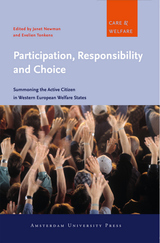
Faced with budget problems and an aging population, European governments in recent years have begun reconsidering the structure and extent of the welfare state. Guarantees and directives have given way to responsibilities and choice. This volume analyzes the effect of this change on the citizens of Germany, Finland, Norway, the Netherlands, France, Italy and the United Kingdom. It traces the emergence of new discourses around social movements for greater independence, power, and control, and the way these discourses serve to reframe the struggle at hand. Making use of ethnographic research and policy analysis, the authors analyze the cultural transition, tensions, and trajectory of this call toward active citizenship.


Is the "private" experience of religion counterproductive to engagement in public life? Does the "public" experience of religion contribute anything distinctive to civic engagement? Pews, Prayers, and Participation offers a fresh approach to key questions about what role religion plays in fostering civic responsibility in contemporary American society. Written by five prominent scholars of religion and politics, led by Calvin College's Corwin Smidt, the book brilliantly articulates how religion shapes participation in a range of civic activities—from behaviors (such as membership in voluntary associations, volunteering, and charitable contributions) to capacities (such as civic skills and knowledge), to virtues (such as law-abidingness, tolerance, and work ethic).
In the course of their study the authors examine whether an individual exhibits a diminished, a privatized, a public, or an integrated form of religious expression, based on the individual's level of participation in both the public (worship) or private (prayer) dimensions of religious life. They question whether the privatization of religious life is counterproductive to engagement in public life, and they show that religion does indeed play a significant role in fostering civic responsibility across each of its particular facets.
Pews, Prayers, and Participation is a bold and provocative clarion call to the continuing importance and changing nature of religion in American public life. It will be of particular interest to students and scholars of religion and politics, and culture and politics, as well as general readers with an interest in the impact of religion in the public sphere.
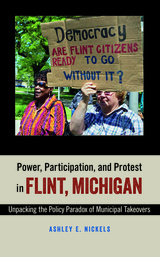
When the 2011 municipal takeover in Flint, Michigan placed the city under state control, some supported the intervention while others saw it as an affront to democracy. Still others were ambivalent about what was supposed to be a temporary disruption. However, the city’s fiscal emergency soon became a public health emergency—the Flint Water Crisis—that captured international attention.
But how did Flint’s municipal takeovers, which suspended local representational government, alter the local political system? In Power, Participation, and Protest in Flint, Michigan, Ashley Nickels addresses the ways residents, groups, and organizations were able to participate politically—or not—during the city’s municipal takeovers in 2002 and 2011. She explains how new politics were created as organizations developed, new coalitions emerged and evolved, and people’s understanding of municipal takeovers changed.
Inwalking readers through the policy history of, implementation of, and reaction to Flint’s two municipal takeovers, Nickels highlights how the ostensibly apolitical policy is, in fact, highly political.

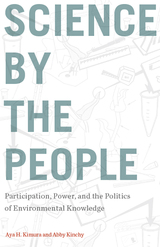
Citizen science—research involving nonprofessionals in the research process—has attracted both strong enthusiasts and detractors. Many environmental professionals, activists, and scholars consider citizen science part of their toolkit for addressing environmental challenges. Critics, however, contend that it represents a corporate takeover of scientific priorities. In this timely book, two sociologists move beyond this binary debate by analyzing the tensions and dilemmas that citizen science projects commonly face. Key lessons are drawn from case studies where citizen scientists have investigated the impact of shale oil and gas, nuclear power, and genetically engineered crops. These studies show that diverse citizen science projects face shared dilemmas relating to austerity pressures, presumed boundaries between science and activism, and difficulties moving between scales of environmental problems. By unpacking the politics of citizen science, this book aims to help people negotiate a complex political landscape and choose paths moving toward social change and environmental sustainability.

The field of bioethics was deeply influenced by religious thinkers as it emerged in the 1960s and early 1970s. Since that time, however, a seemingly neutral political liberalism has pervaded the public sphere, resulting in a deep suspicion of those bringing religious values to bear on questions of bioethics and public policy.
As a theological ethicist and progressive Catholic, Lisa Sowle Cahill does not want to cede the "religious perspective" to fundamentalists and the pro-life movement, nor does she want to submit to the gospel of a political liberalism that champions individual autonomy as holy writ. In Theological Bioethics, Cahill calls for progressive religious thinkers and believers to join in the effort to reclaim the best of their traditions through jointly engaging political forces at both community and national levels.
In Cahill's eyes, just access to health care must be the number one priority for this type of "participatory bioethics." She describes a new understanding of theological bioethics that must go beyond decrying injustice, beyond opposing social practices that commercialize human beings, beyond painting a vision of a more egalitarian future. Such a participatory bioethics, she argues, must also take account of and take part in a global social network of mobilization for change; it must seek out those in solidarity, those involved in a common calling to create a more just social, political, and economic system.
During the past two decades Cahill has made profound contributions to theological ethics and bioethics. This is a magisterial and programmatic statement that will alter how the religiously inclined understand their role in the great bioethics debates of today and tomorrow that yearn for clear thinking and prophetic wisdom.
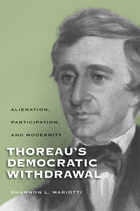
Separated by time, space, and context, Thoreau and Adorno share a common belief that critical inquiry is essential to democracy but threatened by modern society. While walking, huckleberrying, and picking wild apples, Thoreau tries to recover the capacities for independent perception and thought that are blunted by “Main Street,” conventional society, and the rapidly industrializing world that surrounded him. Adorno’s thoughts on particularity and the microscopic gaze he employs to work against the alienated experience of modernity help us better understand the value of Thoreau’s excursions into nature. Reading Thoreau with Adorno, we see how periodic withdrawals from public spaces are not necessarily apolitical or apathetic but can revitalize our capacity for the critical thought that truly defines democracy.
In graceful, readable prose, Mariotti reintroduces us to a celebrated American thinker, offers new insights on Adorno, and highlights the striking common ground they share. Their provocative and challenging ideas, she shows, still hold lessons on how we can be responsible citizens in a society that often discourages original, critical analysis of public issues.
Unwanted Claims is a work of political sociology that provides an illuminating account of political life in the U.S. welfare system that should be of interest to scholars, students, policy practitioners, and the general public. Written in a style that minimizes technical jargon, avoids complex statistical presentations, and makes extensive use of clients' own descriptions of their experiences, beliefs, and actions, it offers an accessible and humanizing portrait of welfare participation that challenges conventional wisdom and raises important questions about poverty, welfare, and democracy in America.
Joe Soss is Assistant Professor of Government, The American University.
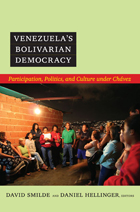
Contributors
Carolina Acosta-Alzuru
Julia Buxton
Luis Duno Gottberg
Sujatha Fernandes
María Pilar García-Guadilla
Kirk A. Hawkins
Daniel Hellinger
Michael E. Johnson
Luis E. Lander
Margarita López-Maya
Elizabeth Gackstetter Nichols
Coraly Pagan
Guillermo Rosas
Naomi Schiller
David Smilde
Alejandro Velasco
READERS
Browse our collection.
PUBLISHERS
See BiblioVault's publisher services.
STUDENT SERVICES
Files for college accessibility offices.
RECENTLY PUBLISHED





UChicago Accessibility Resources
home | accessibility | search | about | contact us
BiblioVault ® 2001 - 2024
The University of Chicago Press