
 A SCHOLARLY BOOK REPOSITORY
Unsentimental about his education, Farred’s critique recognizes the impact of four exceptional teachers—all engaging pedagogical figures who cultivated a great sense of possibility in how thinking could be learned through a disenfranchised South African education.
The Perversity of Gratitude brings to bear the work of influential philosophers such as Martin Heidegger and Jacques Derrida. The book tackles broad philosophical concepts—transgression, withdrawal, and the dialectic. This leads to the creation of a new concept, “the diaspora-in-place,” which Farred explains, “is having left a place before one physically removes oneself from this place.”
Farred’s apartheid education in South Africa instilled in him a lifelong commitment to learning thinking. “And for that I am grateful,” Farred writes in The Perversity of Gratitude. His autopoiesis is sure to provoke and inspire readers.

In 1905, a young Jewish immigrant from Luxembourg founded an electrical supply shop in New York. This inventor, writer, and publisher Hugo Gernsback would later become famous for launching the first science fiction magazine, Amazing Stories, in 1926. But while science fiction’s annual Hugo Awards were named in his honor, there has been surprisingly little understanding of how the genre began among a community of tinkerers all drawn to Gernsback’s vision of comprehending the future of media through making. In The Perversity of Things, Grant Wythoff makes available texts by Hugo Gernsback that were foundational both for science fiction and the emergence of media studies.
Wythoff argues that Gernsback developed a means of describing and assessing the cultural impact of emerging media long before media studies became an academic discipline. From editorials and blueprints to media histories, critical essays, and short fiction, Wythoff has collected a wide range of Gernsback’s writings that have been out of print since their magazine debut in the early 1900s. These articles cover such topics as television; the regulation of wireless/radio; war and technology; speculative futures; media-archaeological curiosities like the dynamophone and hypnobioscope; and more. All together, this collection shows how Gernsback’s publications evolved from an electrical parts catalog to a full-fledged literary genre.
The Perversity of Things aims to reverse the widespread misunderstanding of Gernsback within the history of science fiction criticism. Through painstaking research and extensive annotations and commentary, Wythoff reintroduces us to Gernsback and the origins of science fiction.
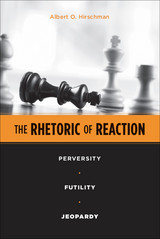
With engaging wit and subtle irony, Albert Hirschman maps the diffuse and treacherous world of reactionary rhetoric in which conservative public figures, thinkers, and polemicists have been arguing against progressive agendas and reforms for the past two hundred years.
Hirschman draws his examples from three successive waves of reactive thought that arose in response to the liberal ideas of the French Revolution and the Declaration of the Rights of Man, to democratization and the drive toward universal suffrage in the nineteenth century, and to the welfare state in our own century. In each case he identifies three principal arguments invariably used: (1) the perversity thesis, whereby any action to improve some feature of the political, social, or economic order is alleged to result in the exact opposite of what was intended; (2) the futility thesis, which predicts that attempts at social transformation will produce no effects whatever—will simply be incapable of making a dent in the status quo; (3) the jeopardy thesis, holding that the cost of the proposed reform is unacceptable because it will endanger previous hard-won accomplishments. He illustrates these propositions by citing writers across the centuries from Alexis de Tocqueville to George Stigler, Herbert Spencer to Jay Forrester, Edmund Burke to Charles Murray. Finally, in a lightning turnabout, he shows that progressives are frequently apt to employ closely related rhetorical postures, which are as biased as their reactionary counterparts. For those who aspire to the genuine dialogue that characterizes a truly democratic society, Hirschman points out that both types of rhetoric function, in effect, as contraptions designed to make debate impossible. In the process, his book makes an original contribution to democratic thought.
The Rhetoric of Reaction is a delightful handbook for all discussions of public affairs, the welfare state, and the history of social, economic, and political thought, whether conducted by ordinary citizens or academics.
READERS
Browse our collection.
PUBLISHERS
See BiblioVault's publisher services.
STUDENT SERVICES
Files for college accessibility offices.
RECENTLY PUBLISHED




UChicago Accessibility Resources
home | accessibility | search | about | contact us
BiblioVault ® 2001 - 2025
The University of Chicago Press