front cover of Knowing as Moving
Knowing as Moving
Perception, Memory, and Place
Susan Leigh Foster
Duke University Press, 2025
In Knowing as Moving, Susan Leigh Foster theorizes how the act of moving in and through the world creates the potential for individual and collective bodies to connect. Starting from the assertion that knowing takes place through bodily movement, Foster moves away from the Western philosophical traditions of dance, critiquing the Cartesian mind-body duality and its colonizing politics. She draws on Native and Indigenous studies, ecological cognitive science, disability studies, phenomenology, and new materialism to explore how knowledge is neither static nor storable. Thinking is a physical action and the product of an entire neuromuscular system with its mobile postural and gestural configurations, perceptual systems, and brain activity. Foster outlines how reading, examining, talking, and remembering are all forms of moving and contends that any process of knowing establishes one’s identity and relationality. By focusing on the centrality of bodily movement to thought and self, she contributes a decolonial critique of the study of knowledge and being. In so doing, Foster replaces the Cartesian-colonial “I think, therefore I am” with a decolonial “I move, and therefore I know.”
[more]

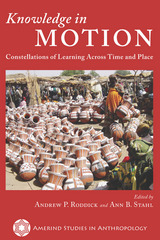
front cover of Knowledge in Motion
Knowledge in Motion
Constellations of Learning Across Time and Place
Edited by Andrew P. Roddick and Ann B. Stahl
University of Arizona Press, 2019
Spirit mediums of East Africa. Healers and fishermen of the Amazon River Basin. Potters of the American Southwest. People contending with climate change long ago. All share “knowledge in motion,” a process of drawing on experiences past and present while engaging in daily practice in relation to contexts of time, place, and power.

In the last twenty-five years, scholars from a number of disciplines have explored “situated learning,” specifically investigating how learning relates to social reproduction and daily life. In Knowledge in Motion, contributors focus on learning through time and at a variety of scales, particularly as they relate to power and politics, with implications for emergent communities and constellations of practice.

This volume brings together archaeologists, historians, and cultural anthropologists to examine communities engaged in a range of learning practices around the globe, from Africa to the Americas. Contributors draw on the growing interdisciplinary scholarship on situated learning to explore those processes in relation to power and broader forces that shape knowledge during times of turbulent change.

Enriching the diversity of regions and disciplines, Knowledge in Motion focuses on how learning, knowledge transmission, and the emergent qualities of communities and constellations of practice are shaped by changing spheres of interaction or other unstable events and influences. The contributions forge productive theories and methodologies for exploring situated learning and its broad-ranging outcomes.

[more]


Send via email Share on Facebook Share on Twitter