
 A SCHOLARLY BOOK REPOSITORY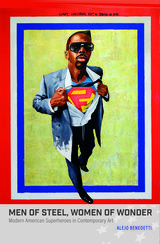
Saturated in patriotic colors, Superman and Wonder Woman are about as American as baseball and apple pie. Superman, created in 1938, materialized as the brawny answer to the Great Depression, and when Wonder Woman arrived three years later, she supported her adopted country by fighting alongside Allied troops in World War II. As the proverbial mother and father of the superhero genre, these icons appeared to a society in crisis as unwavering beacons of national morality, a quality that lent them success on the battlefield—and on the newsstand.
As new crises arise our comic-book champions continue to be called into action. They adapt and evolve but remain the same potent, if flawed, symbols of the American way. The artists in Men of Steel, Women of Wonder, an exhibition organized by Crystal Bridges Museum of American Art, wrestle with Wonder Woman’s standing as a feminist icon, position Superman as a Soviet-era weapon, and question the immigration status of both characters. Featuring more than seventy artworks that range from loving endorsements to brutal critiques of American culture, this exhibition catalog reveals the enduring presence of these characters and the diverse ways artists employ them.
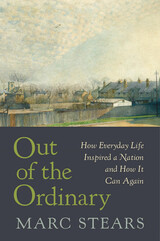
From a major British political thinker and activist, a passionate case that both the left and right have lost their faith in ordinary people and must learn to find it again.
This is an age of polarization. It’s us vs. them. The battle lines are clear, and compromise is surrender.
As Out of the Ordinary reminds us, we have been here before. From the 1920s to the 1950s, in a world transformed by revolution and war, extreme ideologies of left and right fueled utopian hopes and dystopian fears. In response, Marc Stears writes, a group of British writers, artists, photographers, and filmmakers showed a way out. These men and women, including J. B. Priestley, George Orwell, Barbara Jones, Dylan Thomas, Laurie Lee, and Bill Brandt, had no formal connection to one another. But they each worked to forge a politics that resisted the empty idealisms and totalizing abstractions of their time. Instead they were convinced that people going about their daily lives possess all the insight, virtue, and determination required to build a good society. In poems, novels, essays, films, paintings, and photographs, they gave witness to everyday people’s ability to overcome the supposedly insoluble contradictions between tradition and progress, patriotism and diversity, rights and duties, nationalism and internationalism, conservatism and radicalism. It was this humble vision that animated the great Festival of Britain in 1951 and put everyday citizens at the heart of a new vision of national regeneration.
A leading political theorist and a veteran of British politics, Stears writes with unusual passion and clarity about the achievements of these apostles of the ordinary. They helped Britain through an age of crisis. Their ideas might do so again, in the United Kingdom and beyond.
READERS
Browse our collection.
PUBLISHERS
See BiblioVault's publisher services.
STUDENT SERVICES
Files for college accessibility offices.
RECENTLY PUBLISHED



UChicago Accessibility Resources
home | accessibility | search | about | contact us
BiblioVault ® 2001 - 2025
The University of Chicago Press