
 A SCHOLARLY BOOK REPOSITORY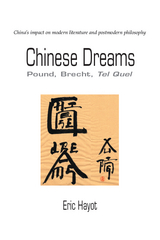
China’s profound influence on the avant-garde in the 20th century was nowhere more apparent than in the work of Ezra Pound, Bertolt Brecht, and the writers associated with the Parisian literary journal Tel quel. Chinese Dreams explores the complex, intricate relationship between various “Chinas”—as texts—and the nation/culture known simply as “China”—their context—within the work of these writers. Eric Hayot calls into question the very means of representing otherness in the history of the West and ultimately asks if it might be possible to attend to the political meaning of imagining the other, while still enjoying the pleasures and possibilities of such dreaming. The latest edition of this critically acclaimed book includes a new preface by the author.
“Lucid and accessible . . . an important contribution to the field of East-West comparative studies, Asian studies, and modernism.”
—Comparative Literature Studies
“Instead of trying to decipher the indecipherable ‘China’ in Western literary texts and critical discourses, Hayot chose to show us why and how ‘China’ has remained, and will probably always be, an enchanting, ever-elusive dream. His approach is nuanced and refreshing, his analysis rigorous and illuminating.”
—Michelle Yeh, University of California, Davis
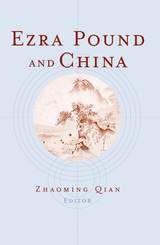
Richly illustrated, the book draws readers closer to the heart of Pound's vision. Ezra Pound and China will become an invaluable resource to students and scholars of Pound, cultural studies, translation theory, poetics, Confucianism, and literary transmission and reception.
Zhaoming Qian is Professor of English, the University of New Orleans.

Pound was deeply affected by her death, as was the poet H. D., who had recently come to know her. Pound's letters to Cravens, extensively annotated, are published here for the first time; her suicide note to him is also included. Ezra Pound and Margaret Cravens contains photographs and previously unpublished material by Pound and H.D., as well as an excerpt from H.D.'s autobiographical novel Asphodel, in which Cravens figures prominently. This portrait of a friendship provides insight into the literary achievements of Pound and H.D. and tells the unknown story of Margaret Cravens's tragic life.

Written by Pound in the months following his first visit, the four poems grouped as "The Malatesta Cantos" celebrate the church and the man who sponsored its construction, Sigismondo Malatesta. Upon receiving news of the building's devastation by Allied bombings in 1944, Pound wrote two more cantos that invoked the event as a rallying point for the revival of fascist Italy. These "forbidden" cantos were excluded from collected editions of his works until 1987. Pound even announced an abortive plan in 1958 to build a temple inspired by the church, and in 1963, at the age of eighty, he returned to Rimini to visit the Tempio Malatestiano one last, haunting time.
Drawing from hundreds of unpublished materials, Rainey explores the intellectual heritage that surrounded the church, Pound's relation to it, and the interpretation of his work by modern critics. The Malatesta Cantos, which have been called "one of the decisive turning-points in modern poetics" and "the most dramatic moment in The Cantos," here engender an intricate allegory of Pound's entire career, the central impulses of literary modernism, the growth of intellectual fascism, and the failure of critical culture in the twentieth century. Included are two-color illustrations from the 1925 edition of Pound's cantos and numerous black-and-white photographs.
Drawing upon this key five-volume work, as well as comprehensive research in both primary and secondary sources, Miyake brings the partial perceptions of other critics and commentators into an illuminating whole. Disclosing the deliberateness of The Cantos, Miyake provides new insight into Pound’s sense of culture and into the nature of his Confucianism. She sheds light on the disastrous path Pound followed into Fascism and anti-Semitism, and, in contrast to the image of a “pagan” Pound that has emerged in recent years, reveals a poet writing as a Christian from within the Christian mythical tradition.
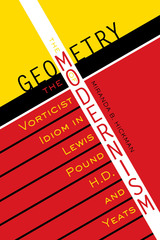
Addressing both the literature and the visual arts of Anglo-American modernism, The Geometry of Modernism recovers a crucial development of modernism's early years that until now has received little sustained critical attention: the distinctive idiom composed of geometric forms and metaphors generated within the early modernist movement of Vorticism, formed in London in 1914. Focusing on the work of Wyndham Lewis, leader of the Vorticist movement, as well as Ezra Pound, H.D., and William Butler Yeats, Hickman examines the complex of motives out of which Lewis initially forged the geometric lexicon of Vorticism—and then how Pound, H.D., and Yeats later responded to it and the values that it encoded, enlisting both the geometric vocabulary and its attendant assumptions and ideals, in transmuted form, in their later modernist work.
Placing the genesis and appropriation of the geometric idiom in historical context, Hickman explores how despite its brevity as a movement, Vorticism in fact exerted considerable impact on modernist work of the years between the wars, in that its geometric idiom enabled modernist writers to articulate their responses to both personal and political crises of the 1930s and 1940s. Informed by extensive archival research as well as treatment of several of the least-known texts of the modernist milieu, The Geometry of Modernism clarifies and enriches the legacy of this vital period.
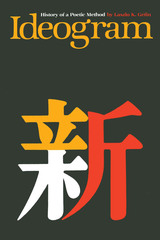
The ideogram changed the course of modern American poetry, and Ideogram is the first history of this important poetic tradition.
In modern poetry the ideogram is an idea presented to the reader by means of the juxtaposition of concrete particulars, usually without connective words or phrases. The poem is therefore presented in precise images, usually very tersely, and free from conventional form and meter. The idea of presenting a concept in this manner derives in part from Ernest Fenollosa's essay "The Chinese Character as a Medium for Poetry," the Chinese written character itself being a juxtaposition of pictographs to form a new meaning.
Ezra Pound's search for an alternative to traditional forms of verse composition resulted in his use of the ideogrammic method which, Laszlo K. Géfin asserts, became the major mode of presentation in twentieth-century American poetry. Two generations of avant-garde, experimental poets since Pound have turned to it for inspiration, evolving their own methods from its principles.
Géfin begins by tracing the development of Pound's poetics from the pre-Imagist stage through Imagism and Vorticism to the formulation of the ideogrammic method. He then examines the Objectivist poetics of Louis Zukofsky, Charles Reznikoff, and George Oppen; the contributions to the ideogrammic tradition of William Carlos Williams; and the Projectivist theories of Charles Olson, Robert Duncan, and Robert Creeley. He concludes with an exploration of Allen Ginsberg's theory of the ellipse and Gary Snyder's "riprap" method. Throughout, Géfin maintains that the ideogrammic mode is the literary representation of the twentieth-century post-logical—even post-humanist—world view.

At the beginning of this century, Remy de Gourmont was the embodiment of the literary avant-garde, not only for urbane European writers but for “American imbeciles,” in Ezra Pound's term. As this book shows, Pound himself was one of the many young artists who learned from him. Gourmont was a brilliant teacher, and the breadth of his imagination and the scope of his interests had a special impact on Pound, whose “provincial” mind was moving in the same ways but without the so-called civilized places to go.
Instead of elaborately tracing influences or sources, Sieburth juxtaposes various aspects of Gourmont's and Pound's works in order to arrive at a better understanding of their individual achievements as “instigators.” In doing so, he reveals unexplored dimensions of Pound's development—from his early reading of vers fibre to his discovery, through Gourmont, of the French Enlightenment. Pound emerges as a modern-day philosophe, and Sieburth's reevaluation casts new light on Pound's complex political ideas and on difficult areas of the late Cantos.
Reading various works by U.S. expatriates Ezra Pound and Gertrude Stein, Parry compares the cultural politics of U.S. canonical modernism with alternative representations of temporality, hybridity, erasure, and sexuality in the work of the Taiwanese writers Yü Kwang-chung and Hsia Yü and the Asian American immigrant author Theresa Hak Kyung Cha. Juxtaposing poems by Pound and Yü Kwang-chung, Parry shows how Yü’s fragmented, ambivalent modernist form reveals the effects of neocolonialism while Pound denies and obscures U.S. imperialism in Asia, asserting a form of nondevelopmental universalism through both form and theme. Stein appropriates discourses of American modernity and identity to represent nonnormative desire and sexuality, and Parry contrasts this tendency with representations of sexuality in the contemporary experimental poetry of Hsia Yü. Finally, Parry highlights the different uses of modernist forms by Pound in his Cantos—which incorporate a multiplicity of decontextualized and ahistorical voices—and by Cha in her 1982 novel Dictee, a historicized, multilingual work. Parry’s sophisticated readings provide a useful critical framework for apprehending how “minor modernisms” illuminate the histories erased by certain canonical modernist texts.
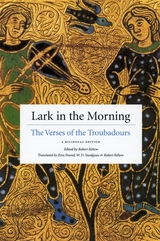
Lark in the Morning honors the meter, word play, punning, and sound effects in the troubadours' works while celebrating the often playful, bawdy, and biting nature of the material. Here, Robert Kehew augments his own verse translations with those of two seminal twentieth-century poets—Ezra Pound and W. D. Snodgrass—to provide a collection that captures both the poetic pyrotechnics of the original verse and the astonishing variety of troubadour voices. This bilingual edition contains an introduction to the three major periods of the troubadours—their beginning, rise, and decline—as well as headnotes that briefly put each poet in context. Lark in the Morning will become an essential collection for those interested in learning about and teaching the origins of Western vernacular poetry.
The essays in this volume address Pound’s diverse aesthetic concerns, including his Vorticism and his criticism of Western metaphysics, his advancement of the machine as a new criterion for beauty, his encounter with the German Bauhaus movement, and his search for a type of writing ruled by mathematical rather than grammatical laws. Machine Art and Other Writings documents the wide proportions of Pound’s polemic against the abstractions of modernism and reveals the extent to which he was at odds with the metaphysical assumptions of his time. The volume, edited by Ardizzone, is the result of years of systematic and intensive study of Pound’s manuscripts, including glosses from the texts of his personal library. Proposing an unconventional approach to Pound studies that focuses on marginality and intertextuality, she subverts the canonical hierarchy of Pound’s works by revealing the power of texts considered marginalia.
General readers, students and scholars in the fields of European and American modernism, aesthetics, the history of technology, and art history, as well as Pound specialists and the many poets and writers influenced by Pound, will greet the publication of Machine Art and Other Writings with interest and anticipation.
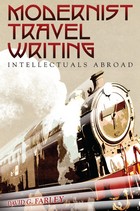
Modernist Travel Writing argues that the travel book is a crucial genre for understanding the development of modernism in the years between the wars, despite the established view that travel writing during the interwar period was largely an escapist genre—one in which writers hearkened back to the realism of nineteenth-century literature in order to avoid interwar anxiety. Farley analyzes works that exist on the margins of modernism, generically and geographically, works that have yet to receive the critical attention they deserve, partly due to their classification as travel narratives and partly because of their complex modernist styles.
The book begins by examining the ways that travel and the emergent travel regulations in the wake of the First World War helped shape Ezra Pound’s Cantos. From there, it goes on to examine E. E. Cummings’s frustrated attempts to navigate the “unworld” of Soviet Russia in his book Eimi,Wyndham Lewis’s satiric journey through colonial Morocco in Filibusters in Barbary,and Rebecca West’s urgent efforts to make sense of the fractious Balkan states in Black Lamb and Grey Falcon. These modernist writers traveled to countries that experienced most directly the tumult of revolution, the effects of empire, and the upheaval of war during the years between World War I and World War II. Farley’s study focuses on the question of what constitutes “evidence” for Pound, Lewis, Cummings, and West as they establish their authority as eyewitnesses, translate what they see for an audience back home, and attempt to make sense of a transformed and transforming modern world.
Modernist Travel Writing makes an original contribution to the study of literary modernism while taking a distinctive look at a unique subset within the growing field of travel writing studies. David Farley’s work will be of interest to students and teachers in both of these fields as well as to early-twentieth-century literary historians and general enthusiasts of modernist studies.
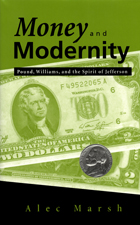
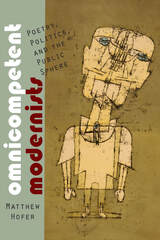
“It is difficult / to get the news from poems / yet men die miserably every day / for lack / of what is found there,” as the poet William Carlos Williams memorably declared. In Omnicompetent Modernists: Poetry, Politics, and the Public Sphere, Matthew Hofer examines, through a multilayered literary critique of interwar modernist poetry, what it might mean to get the news, and more, from a poet.
Using pragmatist ideas about the public sphere as a tool, Hofer reveals how Langston Hughes, Ezra Pound, and Mina Loy sought to use literature to both express and enable thought. In Hughes, Pound, and Loy, Hofer attends to poets whose work vigorously imagined possible new relationships between language, thinking, and public society. Each poet had different goals and used different methods, but all found both inspiration and encouragement in popular political theory. Hughes advocated for a more just vision of color and class in the United States. Pound sought to condemn those whom he associated with public harm, linguistically, socially, economically, and politically. Loy championed the “psycho-democratic” representation of women, in both public and private life.
Although Hughes, Pound, and Loy are rarely considered together, what unites these three writers is how each reconceived the public realm, and revolutionized aesthetic form to articulate those visions. Hofer combines sharp intellectual historiography with rigorous literary criticism and the result is a study that reinvigorates both the poems and poets under consideration and speaks to the immense power of language in manipulating public opinion—with pertinent implications for the politics of the present.

Beyond Lionel Trilling's classic definition of Modernism as anticultural and subversive, Margaret Dickie posits American Modernist poetry as both conservative and affirmative—conservative because it was dominated by the composition of the long poem, affirmative because these poems aimed to restore public themes to poetry, to instruct and improve, to "affirm the gold thread in the pattern," as Ezra Pound claimed.
Each poet discussed in this new study—T. S. Eliot, Hart Crane, William Carlos Williams, and Ezra Pound—began his career as an experimenter in brief lyrics and then, paradoxically, developed an ambition to write a long public poem. The poems they wrote—The Waste Land, The Bridge, Paterson, and The Cantos—differed in length, in program, and in composition, but all were alike in their idealization of form, their commitment to the long poem, and the troubled and difficult process of their composition. Read together, they offer a new understanding of the Modernist sense of form shared by these quite different writers.
Tracing the development of each poem from the poet's initial announced plans through the lengthy writing and reconsideration of purpose, Dickie offers a new history not only of each poem but of the American Modernists and the ways they adapted the avant-garde tendencies of European Modernism to their own native needs.
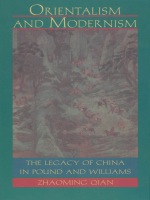
Consulting rare and unpublished materials, Qian traces Pound’s and Williams’s remarkable dialogues with the great Chinese poets—Qu Yuan, Li Bo, Wang Wei, and Bo Juyi—between 1913 and 1923. His investigation reveals that these exchanges contributed more than topical and thematic ideas to the Americans’ work and suggests that their progressively modernist style is directly linked to a steadily growing contact and affinity for similar Chinese styles. He demonstrates, for example, how such influences as the ethics of pictorial representation, the style of ellipsis, allusion, and juxtaposition, and the Taoist/Zen–Buddhist notion of nonbeing/being made their way into Pound’s pre-Fenollosan Chinese adaptations, Cathay, Lustra, and the Early Cantos, as well as Williams’s Sour Grapes and Spring and All. Developing a new interpretation of important work by Pound and Williams, Orientalism and Modernism fills a significant gap in accounts of American Modernism, which can be seen here for the first time in its truly multicultural character.
T. S. Eliot and Ezra Pound dominated English poetry and criticism in the first half of the twentieth century. At the center of their practice is what Maud Ellmann calls the poetics of impersonality. Her examination yields a set of superb readings of the major poems of the modernist canon. Eliot and Pound mounted attack after attack on nineteenth-century poetry from Wordsworth to Swinburne, poetry they believed nurtured an unhealthy cult of the self. They wanted poetry to be a transparent medium that gives its readers access to reality and meaning. Poetry, they argued, should efface itself, because writing that calls attention to itself calls attention to the distinctive personality of the writer. Ellmann convincingly shows that their arguments are self-contradictory and that their efforts to eliminate personality merely reinstate it in a different guise.
After an initial section on Eliot’s relation to Bergson, Ellmann goes on to analyze Eliot’s “Tradition and the Individual Talent” and the later After Strange Gods, the early poems, The Waste Land, and Four Quartets; she then turns to Pound’s Personae, particularly “Mauberley,” and the Cantos. Ellmann looks for the contradictions inherent in modernist literary ideology and deftly teases out their implications. Her writing is stylish in the best sense and, in terms of its theoretical vocabulary and assumptions, impeccable. This book marks the debut of a major literary critic.
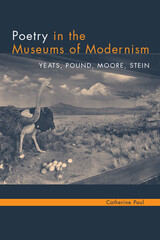
Although critics have attested to the importance of the visual arts to literary modernists and have begun to explore the relationships between literary production and social institutions, before now no one has examined the particular institutions in which modernist poets found the artworks, specimens, and other artifacts that inspired their literary innovations. Catherine Paul's book offers the reader a fresh encounter with modernism that will interest literary and art historians, literary theorists, critics, and scholars in cultural studies and museum studies.
Catherine Paul is Associate Professor of English, Clemson University.
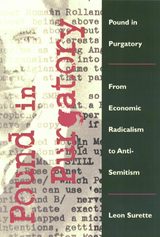
From 1931 to 1945 Pound's poetry took a back seat to his activities as an economic reformer and propagandist for the corporate state. Pound believed he had a simple and practical solution for the economic woes of the world brought on by the Great Depression, and he became increasingly preoccupied with capturing political power for the economic reform he envisioned.
As the world spiraled toward war, Pound's program of economic reform foundered and he gradually succumbed to a paranoid belief in a Jewish conspiracy. Through an incisive analysis of Pound's correspondence and writings, much of it previously unexamined, Surette shows how this belief fostered the virulent anti-Semitism that pervades his work-–both poetry and prose-–from this time forward.
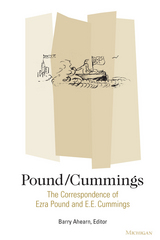
Throughout the correspondence both poets reveal themselves and their beliefs to a remarkable degree. Pound entrusted to Cummings details of his political outlook in the 1930s and 1940s, including his opinions about Mussolini's Italy. The letters to Cummings also shed new light on the question of Pound's sanity after World War II. Although he was diagnosed as mentally unfit, the letters generally show no evidence of paranoia, only of his characteristic eccentricity.
Similarly, these letters should provoke a reevaluation of Cummings. Critics have treated Cummings's political views as either strictly private matters or merely incidental to his art. The letters, however, show that Cummings's radically conservative political opinions are wholly consistent with his poetics, and raise the question of the relation between Cummings's political principles and his enthusiasm for particular forms (and particular stars) of mass entertainment.
In addition to their political revelations, the letters are steeped in the literary climate--and literary gossip--of the times. Pound comments often and candidly on Cummings's poetry and prose; both Pound and Cummings send light verse to each other. And the poets exchange anecdotes about such figures as Henry James, Wyndham Lewis, T. S. Eliot, Edmund Grosse, Max Eastman, and Aldous Huxley, among other writers.
There is much here to interest and delight both fans and foes of Pound and Cummings. The book will be of primary importance to students and scholars of modern poetry, especially those who emphasize the intersection of literary works and political history.
Barry Ahearn is Associate Professor of English, Tulane University.
About the origins of Anglo-American poetic modernism, one thing is certain: it started with a notion of the image, described variously by Ezra Pound as an ideogram and a vortex. We have reason to be less confident, however, about the relation between these puzzling conceptions of the image and the doctrine of literary positivism that is generally held to be the most important legacy of Imagism. No satisfactory account exists, moreover, of what bearing these foundational principles may have on Pound's later engagement with fascism. Nor is it clear how figures such as the vortex and the ideogram might contribute generally to our understanding of modern visual culture and its compulsive appeal.
Radio Corpse addresses these issues and offers a fundamental revision of one of the most powerful and persistent aesthetic ideologies of modernism. Focusing on the necrophilic dimension of Pound's earliest poetry and on the inflections of materiality authorized by the modernist image, Daniel Tiffany establishes a continuum between Decadent practice and the incipient avant-garde, between the prehistory of the image and its political afterlife, between what Pound calls the "corpse language" of late Victorian poetry and a conception of the image that borrows certain "radioactive" qualities from the historical discovery of radium and the development of radiography. Emphasizing the phantasmic effects of translation (and exchange) in Pound's poetry, Tiffany argues that the cadaverous--and radiological--properties of the image culminate, formally and ideologically, in Pound's fascist radio broadcasts during World War II. Ultimately, the invisibility of these "radiant" images places in question basic assumptions regarding the optical character of images--assumptions currently being challenged by imageric technologies such as magnetic resonance imaging and positron emission tomography.
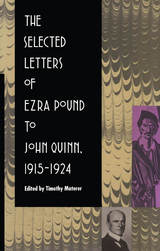
Pound wrote to John Quinn—a New York lawyer, an expert in business law, and a collector of unusual taste and discrimination—about these artists and many more, urging him to support their journals, collect their manuscripts, and buy and exhibit their paintings and sculptures. Quinn at one time owned manuscripts of Ulysses and The Waste Land, Brancusi’s sculpture Mlle. Pogany, and Picasso’s painting Three Musicians. Yet he was often skeptical about the value of new schools of art, such as Vorticism, and disturbed by the outspokenness of authors such as Joyce. Pound’s letters are unusually tactful when he counters Quinn’s doubts and explains the premises of experimental art. Pound’s letters to Quinn are touched with his characteristic humor and wordplay and are especially notable for their lucidity of expression, engendered by Pound’s deep respect for Quinn.
READERS
Browse our collection.
PUBLISHERS
See BiblioVault's publisher services.
STUDENT SERVICES
Files for college accessibility offices.
RECENTLY PUBLISHED



UChicago Accessibility Resources
home | accessibility | search | about | contact us
BiblioVault ® 2001 - 2024
The University of Chicago Press