
 A SCHOLARLY BOOK REPOSITORY
This book gathers the best of philosopher Mark Johnson’s essays addressing questions of our embodiment as they deal with aesthetics—which, he argues, we need to rethink so that it takes into account the central role of body-based meaning. Viewed that way, the arts can give us profound insights into the processes of meaning making that underlie our conceptual systems and cultural practices. Johnson shows how our embodiment shapes our philosophy, science, morality, and art; what emerges is a view of humans as aesthetic, meaning-making creatures who draw on their deepest physical processes to make sense of the world around them.
An incisive argument for the relevance of political philosophy and its possibility of effecting change.
The appeal of political philosophy is that it will answer questions about justice for the sake of political action. But contemporary political philosophy struggles to live up to this promise. Since the death of John Rawls, political philosophers have become absorbed in methodological debates, leading to an impasse between two unattractive tendencies: utopians argue that philosophy should focus uncompromisingly on abstract questions of justice, while pragmatists argue that we should concern ourselves only with local efforts to ameliorate injustice. Agents of Change shows a way forward.
Ben Laurence argues that we can combine utopian justice and the pragmatic response to injustice in a political philosophy that unifies theory and practice in pursuit of change. Political philosophy, on this view, is not a purely normative theory disconnected from practice. Rather, political philosophy is itself a practice—an exercise of practical reason issuing in action. Laurence contends that this exercise begins in ordinary life with the confrontation with injustice. Philosophy draws ideas about justice from this encounter to be pursued through political action. Laurence shows that the task of political philosophy is not complete until it asks the question “What is to be done?” and deliberates actionable answers.
An Alternate Pragmatism for Going Public interrogates composition’s most prominent responses to contemporary K–16 education reform. By “going public,” teachers, scholars, and administrators rightfully reassert their expertise against corporate-political standards and assessments like the Common Core, Complete College America, and the Collegiate Learning Assessment. However, author Jim Webber shows that composition’s professional imperative for self-defense only partly fulfils the broader aims of “going public,” which include fostering public participation that can assess and potentially affirm the public good of professional judgment.
Drawing on the pragmatic/democratic tradition, Webber envisions an alternate rhetoric of professionalism, one that not only reasserts compositionists’ expertise but also expands opportunities for publics to authorize this expertise. While this public inquiry and engagement may not safeguard professional standing against neoliberal reform, it reorients composition toward an equally important goal, enabling publics to gauge the adequacy of the educational standardization so often advocated by contemporary reform.
An Alternate Pragmatism for Going Public shows how public engagement can serve composition’s efforts related to “going public.”
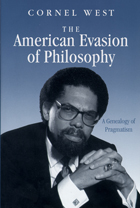
Taking Emerson as his starting point, Cornel West’s basic task in this ambitious enterprise is to chart the emergence, development, decline, and recent resurgence of American pragmatism. John Dewey is the central figure in West’s pantheon of pragmatists, but he treats as well such varied mid-century representatives of the tradition as Sidney Hook, C. Wright Mills, W. E. B. Du Bois, Reinhold Niebuhr, and Lionel Trilling. West’s "genealogy" is, ultimately, a very personal work, for it is imbued throughout with the author’s conviction that a thorough reexamination of American pragmatism may help inspire and instruct contemporary efforts to remake and reform American society and culture.
"West . . . may well be the pre-eminent African American intellectual of our generation."—The Nation
"The American Evasion of Philosophy is a highly intelligent and provocative book. Cornel West gives us illuminating readings of the political thought of Emerson and James; provides a penetrating critical assessment of Dewey, his central figure; and offers a brilliant interpretation—appreciative yet far from uncritical—of the contemporary philosopher and neo-pragmatist Richard Rorty. . . . What shines through, throughout the work, is West's firm commitment to a radical vision of a philosophic discourse as inextricably linked to cultural criticism and political engagement."—Paul S. Boyer, professor emeritus of history, University of Wisconsin–Madison.
Wisconsin Project on American Writers
Frank Lentricchia, General Editor
American philosophers like Peirce, James, Royce, and
Dewey have forged a unique philosophical tradition—one
that is rich and complex enough to represent a genuine
alternative to the analytic, phenomenological, and
hermeneutical traditions which have originated in Britain
or Europe.
"In my judgment, John Smith has no equal today in
combining two scholarly qualities: the analysis of
philosophical texts with penetration and rigor, and the
discernment of what it is in these texts that matters.
These qualities are in evidence throughout the essays in
America's Philosophical Vision. Whether he is
evaluating Rorty's view of Dewey; the pragmatic theory of
experience and truth; theories of freedom, creativity,
and the self; Royce's conception of community; or
synoptic philosophic visions, Smith always succeeds in
uniting a comprehensive understanding of philosophic
writings with a sure grasp of their import for human
culture and aspiration. It is a great benefit to
students of American thought that these papers have now
been collected into one volume."—James Gouinlock, Emory
University
In the fall semester of 1772/73 at the Albertus University of Königsberg, Immanuel Kant, metaphysician and professor of logic and metaphysics, began lectures on anthropology, which he continued until 1776, shortly before his retirement from public life. His lecture notes and papers were first published in 1798, eight years after the publication of the Critique of Judgment, the third of his famous Critiques. The present edition of the Anthropology is a translation of the text found in volume 7 of Kants gesammelte Schriften, edited by Oswald Külpe.
Kant describes the Anthropology as a systematic doctrine of the knowledge of humankind. (He does not yet distinguish between the academic discipline of anthropology as we understand it today and the philosophical.) Kant’s lectures stressed the "pragmatic" approach to the subject because he intended to establish pragmatic anthropology as a regular academic discipline. He differentiates the physiological knowledge of the human race—the investigation of "what Nature makes of man"—from the pragmatic—"what man as a free being makes of himself, what he can make of himself, and what he ought to make of himself." Kant believed that anthropology teaches the knowledge of humankind and makes us familiar with what is pragmatic, not speculative, in relation to humanity. He shows us as world citizens within the context of the cosmos.
Summarizing the cloth edition of the Anthropology, Library Journal concludes: "Kant’s allusions to such issues as sensation, imagination, judgment, (aesthetic) taste, emotion, passion, moral character, and the character of the human species in regard to the ideal of a cosmopolitan society make this work an important resource for English readers who seek to grasp the connections among Kant’s metaphysics of nature, metaphysics of morals, and political theory. The notes of the editor and translator, which incorporate material from Ernst Cassirer’s edition and from Kant’s marginalia in the original manuscript, shed considerable light on the text."
He finds the terms for answering these questions in a more inclusive, cosmopolitan pragmatism—one willing to explore fundamental values without recourse to absolutist arguments. Drawing on the work of William and Henry James, John Dewey, Primo Levi, Richard Rorty, and many others, as well as postcolonial writing, Jewish literature of the Holocaust, and the cultural and religious experience of African Americans in slavery, Gunn points pragmatism in a transnational direction and shows how it can better account for the consequences of diversity. Beyond Solidarity, then, is a study of the difference that difference makes in a globalized world.

Pragmatism emerged as a characteristically American response to an inheritance of British empiricism.
Presenting a radical reconception of the nature of experience, pragmatism represents a belief that ideas are not merely to be contemplated but must be put into action, tested and refined through experience. At the same time, the American pragmatists argued for an emphasis on human community that would offset the deep-seated American bias in favor of individualism. Far from being a relic of the past, pragmatism offers a dynamic and substantive approach to questions of human conduct, social values, scientific inquiry, religious belief, and aesthetic experience that lie at the center of contemporary life. This volume is an invaluable introduction to a school of thought that remains vital, instructive, and provocative.
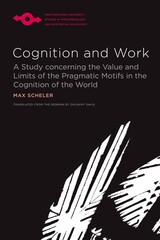
Max Scheler’s Cognition and Work (Erkenntnis und Arbeit) first appeared in German in 1926, just two years before his death. The first part of the book offers one of the earliest critical analyses of American pragmatism, an analysis that would come to have a significant impact on the reception of pragmatism in Germany and western Europe. The second part of the work contains Scheler’s phenomenological account of perception and the experience of reality, an account that is as original as both Husserl’s and Merleau-Ponty’s phenomenologies of perception. Scheler aims to show that the modern mechanistic view of nature fails to account for the dynamic relation that not only the human being but all living beings have to the environment they inhabit.
Available in English translation for the first time, Cognition and Work pushes the boundaries of phenomenology as it is traditionally understood and offers insight into Scheler’s distinct metaphysics. This book is essential reading for those interested in phenomenology, pragmatism, perception, and living beings in their relation to the natural world.
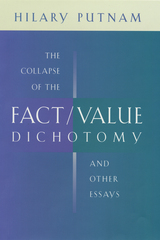
If philosophy has any business in the world, it is the clarification of our thinking and the clearing away of ideas that cloud the mind. In this book, one of the world's preeminent philosophers takes issue with an idea that has found an all-too-prominent place in popular culture and philosophical thought: the idea that while factual claims can be rationally established or refuted, claims about value are wholly subjective, not capable of being rationally argued for or against. Although it is on occasion important and useful to distinguish between factual claims and value judgments, the distinction becomes, Hilary Putnam argues, positively harmful when identified with a dichotomy between the objective and the purely "subjective."
Putnam explores the arguments that led so much of the analytic philosophy of language, metaphysics, and epistemology to become openly hostile to the idea that talk of value and human flourishing can be right or wrong, rational or irrational; and by which, following philosophy, social sciences such as economics have fallen victim to the bankrupt metaphysics of Logical Positivism. Tracing the problem back to Hume's conception of a "matter of fact" as well as to Kant's distinction between "analytic" and "synthetic" judgments, Putnam identifies a path forward in the work of Amartya Sen. Lively, concise, and wise, his book prepares the way for a renewed mutual fruition of philosophy and the social sciences.
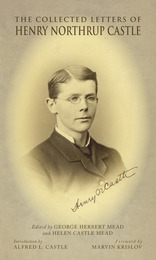
George Herbert Mead, one of America’s most important and influential philosophers, a founder of pragmatism, social psychology, and symbolic interactionism, was also a keen observer of American culture and early modernism. In the period from the 1870s to 1895, Henry Northrup Castle maintained a correspondence with family members and with Mead—his best friend at Oberlin College and brother-in-law—that reveals many of the intellectual, economic, and cultural forces that shaped American thought in that complex era. Close friends of John Dewey, Jane Addams, and other leading Chicago Progressives, the author of these often intimate letters comments frankly on pivotal events affecting higher education, developments at Oberlin College, Hawaii (where the Castles lived), progressivism, and the general angst that many young intellectuals were experiencing in early modern America.
The letters, drawn from the Mead-Castle collection at the University of Chicago, were collected and edited by Mead after the tragic death of Henry Castle in a shipping accident in the North Sea. Working with his wife Helen Castle (one of Henry’s sisters), he privately published fifty copies of the letters to record an important relationship and as an intellectual history of two progressive thinkers at the end of the nineteenth century. American historians, such as Robert Crunden and Gary Cook, have noted the importance of the letters to historians of the late nineteenth century.
The letters are made available here using the basic Mead text of 1902. Additional insights into the connection between Mead, John Dewey, Henry and Harriet Castle, and Hawaii’s progressive kindergarten system are provided by the foundation’s executive director Alfred L. Castle. Marvin Krislov, president of Oberlin College, has added additional comments on the importance of the letters to understanding the intellectual relationship that flourished at Oberlin College.
Published with the support of the Samuel N. and Mary Castle Foundation.
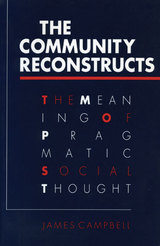
James Campbell explores the Pragmatists' contributions to American social
thought, drawing upon the writings of William James, John Dewey, George Herbert
Mead, James Hayden Tufts, and their various critics. He explores the Pragmatic
analysis of society's potential for ongoing intelligent inquiry and cooperative
evaluation to address social ills. Campbell also considers the nature of political
language, the relative importance of the moral and political values of liberty
and equality, and the vital role of commitment to the life of a democratic community.
Drawing on ethical theory, philosophy of science, and constitutional theory, Lipkin provides a progressive, postmodern, and pragmatic theory of constitutional law that justifies the critical role played by the judiciary in American democracy. Judicial review, he claims, operates as a mechanism to allow “second thought,” or principled reflection, on the values of the wider culture. Without this revolutionary function, American democracy would be left without an effective institutional means to formulate the community’s considered judgments about good government and individual rights. Although judicial review is not the only forum for protecting this dimension of constitutional democracy, Lipkin maintains that we would be wise not to abandon judicial review unless a viable alternative emerges.
Judges, lawyers, law professors, and constitutional scholars will find this book a valuable resource.
This selection of articles by Lewis E. Hahn addresses the philosophical school of contextualism and four contemporary American philosophers: John Dewey, Henry Nelson Wieman, Stephen C. Pepper, and Brand Blanshard.
Stressing the relatively recent contextualistic worldview, which he considers one of the best world hypotheses, Hahn seeks to achieve a broad perspective within which all things may be given their due place. After providing a brief outline, Hahn explains contextualism in relation to other philosophies. In his opening chapter, as in later chapters, he expresses contextualism as a form of pragmatic naturalism. In spite of Hahn’s high regard for contextualism, however, he does not think it would be good if we were limited to a single worldview. “The more different views we have and the more different sources of possible light we have, the better our chances that some of these cosmic maps will shed light on our world and our place in it.”
From Emerson to Rorty, American criticism has grappled in one way or another with the problem of modernity—specifically, how to determine critical and cultural standards in a world where every position seems the product of an interpretation. Part intellectual history, part cultural critique, this provocative book is an effort to shake American thought out of the grip of the nineteenth century—and out of its contingency blues.
Paul Jay focuses his analysis on two strands of American criticism. The first, which includes Richard Poirier and Giles Gunn, has attempted to revive what Jay insists is an anachronistic pragmatism derived from Emerson, James, and Dewey. The second, represented most forcefully by Richard Rorty, tends to reduce American criticism to a metadiscourse about the contingent grounds of knowledge. In chapters on Emerson, Whitman, Santayana, Van Wyck Brooks, Dewey, and Kenneth Burke, Jay examines the historical roots of these two positions, which he argues are marked by recurrent attempts to reconcile transcendentalism and pragmatism. A forceful rejection of both kinds of revisionism, Contingency Blues locates an alternative in the work of the “border studies” critics, those who give our interest in contingency a new, more concrete form by taking a more historical, cultural, and anthropological approach to the invention of literature, subjectivity, community, and culture in a pan-American context.

Principles of right and wrong guide the lives of almost all human beings, but we often see them as external to ourselves, outside our own control. In a revolutionary approach to the problems of moral philosophy, Philip Kitcher makes a provocative proposal: Instead of conceiving ethical commands as divine revelations or as the discoveries of brilliant thinkers, we should see our ethical practices as evolving over tens of thousands of years, as members of our species have worked out how to live together and prosper. Elaborating this radical new vision, Kitcher shows how the limited altruistic tendencies of our ancestors enabled a fragile social life, how our forebears learned to regulate their interactions with one another, and how human societies eventually grew into forms of previously unimaginable complexity. The most successful of the many millennia-old experiments in how to live, he contends, survive in our values today.
Drawing on natural science, social science, and philosophy to develop an approach he calls "pragmatic naturalism," Kitcher reveals the power of an evolving ethics built around a few core principles-including justice and cooperation-but leaving room for a diversity of communities and modes of self-expression. Ethics emerges as a beautifully human phenomenon-permanently unfinished, collectively refined and distorted generation by generation. Our human values, Kitcher shows, can be understood not as a final system but as a project-the ethical project-in which our species has engaged for most of its history, and which has been central to who we are.
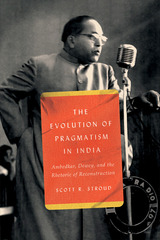
In The Evolution of Pragmatism in India, Scott R. Stroud delivers a comprehensive exploration of the influence of John Dewey’s pragmatism on Bhimrao Ambedkar, architect of the Republic of India’s constitution. Stroud traces Ambedkar’s development in Dewey’s Columbia University classes in 1913–1916 through his final years in 1950s India when he rewrote the story of Buddhism. Stroud examines pragmatism’s influence not only on the philosophical ideas underpinning Ambedkar’s fight against caste oppression but also how his persuasive techniques drew on pragmatism’s commitment to reconstruction and meliorism. At the same time, Stroud is careful to point out the ways that Ambedkar pushed back against Dewey’s paradigm and developed his own approach to challenges in India. The result is a nuanced study of one of the most important figures in Indian history.
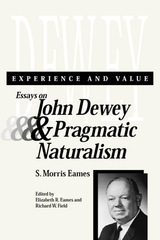
Experience and Value: Essays on John Dewey and Pragmatic Naturalism brings together twelve philosophical essays spanning the career of noted Dewey scholar, S. Morris Eames. The volume includes both critiques and interpretations of important issues in John Dewey’s value theory as well as the application of Eames’s pragmatic naturalism in addressing contemporary problems in social theory, education, and religion.
The collection begins with a discussion of the underlying principles of Dewey’s pragmatic naturalism, including the concepts of nature, experience, and philosophic method. Essays “Experience and Philosophical Method in John Dewey” and “Primary Experience in the Philosophy of John Dewey” develop what Eames believed to be a central theme in Dewey’s thought and provide a theoretical framework for subsequent discussion.
The volume continues with specific applications of this framework in the areas of value theory, moral theory, social philosophy, and the philosophy of religion. Eames’s analysis of value exposes the connection between the immediately felt values of experience and the more sophisticated judgments of value that are the product of reflection. From this basis in moral theory, Eames considers the derivation of judgments of obligation from judgments of fact. This discussion provides a grounding for a consideration of contemporary social issues directed by naturalistic and scientific principles.
In the third section, with regard to educational theory, Eames considers possible resolutions of the current dichotomy between the factual worldview of science and the humanistic worldview of the liberal arts. The comprehensive article, “Dewey’s Views of Truth, Beauty, and Goodness,” connects the essays of the first and second sections and explores the placement of Dewey’s value theory with respect to morals and aesthetics. With “Creativity and Democracy,” in the fourth section, Eames also considers the concept of democracy from the standpoint of current and historical issues faced by society. This article hints at a major project of Eames’s intellectual life—the theory of democracy.
The volume concludes with a discussion of the difficulty of maintaining the values of religious experience in a scientifically and technologically sophisticated world, the very topic that first brought Eames to philosophy—the meaning of religion and the religious life. Suggested solutions are offered in “The Lost Individual and Religious Unity.”
Experience and Value: Essays on John Dewey and Pragmatic Naturalism illuminates Eames’ life of inquiry, a life that included moral, social, aesthetic, and religious dimensions of value—all suffused with the influence of John Dewey.
The American philosopher Wilfrid Sellars ranks as one of the leading twentieth-century critics of empiricism—a philosophical approach to knowledge that seeks to ground it in human sense experience. Sellars stood in the forefront of a recoil within analytic philosophy from the foundationalist assumptions of contemporary empiricists. From Empiricism to Expressivism is a far-reaching reinterpretation of Sellars from one of the philosopher’s most brilliant intellectual heirs.
Unifying and extending Sellars’s most important ideas, Robert Brandom constructs a theory of pragmatic expressivism which, in contrast to empiricism, understands meaning and knowledge in terms of the role expressions play in social practices. The key lies in Sellars’s radical reworking of Kant’s idea of the categories: the idea that the expressive job characteristic of many of the most important philosophical concepts is not to describe or explain the empirical world but rather to make explicit essential features of the conceptual framework that makes description and explanation possible.
Brandom reconciles otherwise disparate elements of Sellars’s system, revealing a greater level of coherence and consistency in the philosopher’s arguments against empiricism than has usually been acknowledged. From Empiricism to Expressivism clarifies what Sellars had in mind when he talked about moving analytic philosophy from its Humean to its Kantian phase, and why such a move might be of crucial importance today.
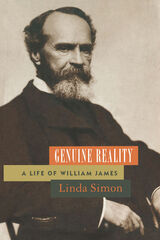
"William James . . . has never seemed so vulnerably human as in Linda Simon's biography. . . . [S]he vivifies James in such a way that his life and thought come freshly alive for the modern reader."—David S. Reynolds, New York Times Book Review
"Superb. . . . Genuine Reality is recommended reading for all soul-searchers."—George Gurley, Chicago Tribune
"Ms. Simon . . . has provided an ideal pathway for James's striding. . . . [Y]ou become engaged in his struggles as if they were your own."—Christopher Lehmann-Haupt, New York Times
"[A]n excellent narrative biography at once sensitively told and lucidly written."—John Patrick Diggins, Wall Street Journal
On the one hundredth anniversary of the death of William James, Robert Richardson, author of the magisterial William James: In the Maelstrom of American Modernism, assembles a wide-ranging selection of essays and writings that reveal the evolution of James’s thought over time, especially as it was continually being shaped by the converging influences of psychology, philosophy, and religion throughout his life.
Proceeding chronologically, the volume begins with “What Is an Emotion,” James’s early, notable, and still controversial argument that many of our emotions follow from (rather than cause) physical or physiological reactions. The book concludes with “The Moral Equivalent of War,” one of the greatest anti-war pieces ever written, perhaps even more relevant now than when it was first published. In between, in essays on “The Dilemma of Determinism,” “The Hidden Self,” “Habit,” and “The Will”; in chapters from The Principles of Psychology and The Varieties of Religious Experience; and in such pieces as “On a Certain Blindness in Human Beings,” “What Makes a Life Significant,” and “Philosophical Conceptions and Practical Results,” we witness the evolution of James’s philosophical thinking, his pragmatism, and his radical empiricism. Throughout, Richardson’s deeply informed introductions place James’s work in its proper biographical, historical, and philosophical context.
In essay after essay, James calls us to live a fuller, richer, better life, to seek out and use our best energies and sympathies. As every day is the day of creation and judgment, so every age was once the new age—and as this book makes abundantly clear, William James’s writings are still the gateway to many a new world.
In the 1930s, George Herbert Mead and other leading social scientists established the modern empirical analysis of social interaction and communication, enabling theories of cognitive development, language acquisition, interaction, government, law and legal processes, and the social construction of the self. However, they could not provide a comparably empirical analysis of human organization.
The theory in this book fills in the missing analysis of organizations and specifies more precisely the pragmatic analysis of communication with an adaptation of information theory to ordinary unmediated communications. The study also provides the theoretical basis for understanding the success of pragmatically grounded public policies, from the New Deal through the postwar reconstruction of Europe and Japan to the ongoing development of the European Union, in contrast to the persistent failure of positivistic and Marxist policies and programs.
“Eddie Glaude is poised to become the leading intellectual voice of our generation, raising questions that make us reexamine the assumptions we hold by expanding our inventory of ideas.”—Tavis Smiley
Presenting Dewey’s new view of philosophical inquiry
This critical edition of The Influence of Darwin on Philosophy and Other Essays in Contemporary Thought presents the results of John Dewey’s patient construction, throughout the previous sixteen years, of the radically new view of the methods and concerns of philosophical inquiry. It was a view that he continued to defend for the rest of his life.
In the 1910 The Influence of Darwin on Philosophy and Other Essays in Contemporary Thought—the first collection of Dewey’s previously published, edited essays—John Dewey provided readers with an overview of the scope and direction of his philosophical vision in one volume. The order in which the eleven essays were presented was a reverse chronology, with more recently published essays appearing first. The collection of eleven essays offered a detailed portrait of Dewey’s proposed reconstruction of the traditional concepts of knowledge and truth. It furthermore elaborated on how his new logic and his proposal regarding knowledge and truth fit comfortably together, not only with each other but also with a pragmatically proper understanding of belief, reality, and experience.
Because material in the Collected Works of John Dewey, 1882–1953 was published chronologically, however, the essays published together in the 1910 Darwin book have appeared in seven different volumes in the Collected Works. This new, critical edition restores a classic collection of essays authored and edited by John Dewey as they originally appeared in the volume. The edition is presented with ancillary materials, including responses by Dewey’s critics and an introduction by Douglas Browning.
Examining essays Addams wrote in the 1890s and showing how they were revised for Democracy and Social Ethics, Fischer draws from philosophy, history, literature, rhetoric, and more to uncover the array of social evolutionary thought Addams engaged with in her texts—from British socialist writings on the evolution of democracy to British and German anthropological accounts of the evolution of morality. By excavating Addams’s evolutionary reasoning and rhetorical strategies, Fischer reveals the depth, subtlety, and richness of Addams’s thought.
“These essays build a valuable, if virtual, bridge between the thought of John Dewey and that of a host of modern European philosophers. They invite us to entertain a set of imagined conversations among the mighty dead that no doubt would have intrigued Dewey and each of the interlocutors gathered here.”—Robert Westbrook, author of John Dewey and American Democracy and/or Democratic Hope: Pragmatism and the Politics of Truth.
John Dewey and Continental Philosophy provides a rich sampling of exchanges that could have taken place long ago between the traditions of American pragmatism and continental philosophy had the lines of communication been more open between Dewey and his European contemporaries. Since they were not, Paul Fairfield and thirteen of his colleagues seek to remedy the situation by bringing the philosophy of Dewey into conversation with several currents in continental philosophical thought, from post-Kantian idealism and the work of Friedrich Nietzsche to twentieth-century phenomenology, hermeneutics, and poststructuralism.
John Dewey and Continental Philosophy demonstrates some of the many connections and opportunities for cross-traditional thinking that have long existed between Dewey and continental thought, but have been under-explored. The intersection presented here between Dewey’s pragmatism and the European traditions makes a significant contribution to continental and American philosophy and will spur new and important developments in the American philosophical debate.
John Dewey’s Educational Philosophy in International Perspective brings together eleven experts from around the globe to examine the international legacy of the famous philosopher. Placing special emphasis on Dewey’s theories of education, Larry A. Hickman and Giuseppe Spadafora have gathered some of the world’s most noted scholars of educational philosophy to present a thorough exploration of Dewey’s enduring relevance and potential as a tool for change in twenty-first-century political and social institutions.
This collection offers close examinations of the global impact of Dewey’s philosophies, both in his time and our own. Included are discussions of his reception as a much-respected yet criticized philosopher among European Catholics both before and after World War I; the utilization of his pragmatic theories in Italian education and the continuing quest to reinterpret them; his emergence as a source of inspiration to new democracies in Central and Eastern Europe; and his recently renewed popularity in the Hispanic world, particularly in South America and Spain. In addition, authors delve into Dewey’s notion of democracy as a personal way of life and his views on the important ties between education and the democratic state.
Also discussed are Dewey’s philosophies regarding school and society, including the understanding of educational trends as reflections of their social context; the contrast between his methods of applying intelligence to ethical problems and the theory of orthodox utilitarianism; responses to criticisms of Dewey’s controversial belief that the sciences can be applied directly to educational practices; and incisive queries into how he would have responded to the crucial role the Internet now plays in primary and secondary education.
This well-rounded volume provides international insight into Dewey’s philosophies and contains a wealth of information never before published in English, resulting in an indispensable resource for anyone interested in John Dewey and his lasting role in education around the world.
Contributors
Viviana Burza
Franco Cambi
Giorgio Chiosso
Jim Garrison
Jaime Nubiola
Hilary Putnam
Ruth Anna Putnam
Giuseppe Spadafora
Emil Višnovský
Leonard J. Waks
Krystyna Wilkoszewska
John Dewey's classical pragmatism, Daniel M. Savage asserts, can be used to provide a self-development-based justification of liberal democracy that shows the current debate between liberal individualism and republican communitarianism to be based largely on a set of pseudoproblems.
From Dewey's classical pragmatism, Savage derives a conception of individual autonomy that, while meeting all of the criteria for a conception of autonomy, does not, as the dominant Kantian variant does, require transcendence from any particular language community. The Deweyan conception of autonomy that Savage derived from classical pragmatism, in fact, requires that the individual be situated within a context of cultural beliefs. Savage argues that this particular conception of autonomy is necessary if one wants to conceive of life, as communitarians do, as a quest for the good life within a social context.
Thus, Savage constructs a conception of autonomy that consists of a set of intellectual virtues, each of which can be understood, like Aristotle's moral virtues, as a mean between two extremes (or vices). The virtue of critical reflection is the mean between the vices of dogmatism on the one hand and philosophical skepticism on the other. The virtue of creative individuality is the mean between the opposing vices of conformity and eccentricity. Finally, the virtue of sociability is the mean between the extremes of docility and rebelliousness.
The three virtues together provide a natural method of adapting to change. The method is natural because it is in accord with a continuous cycle of activity—tension/movement/harmony—that is generic to all living things, Dewey's method of adapting to change requires, in both the individual and in the community, the synthesis of integrating and differentiating forces.
With the exception of Experience and Nature, (Volume 1 of the Later Works), this volume contains all of Dewey’s writings for 1925 and 1926, as well as his 1927 book, The Public and Its Problems. A Modern Language Association’s Committee on Scholarly Editions textual edition.
The first essay in this volume, “The Development of American Pragmatism,” is perhaps Dewey’s best-known article of these years, emphasizing the uniquely American origins of his own philosophical innovations. Other essays focus on Dewey’s continuing investigation of the “nature of intelligent conduct,” as, for example, his debate with David Wight Prall on the underpinnings of value, his study of sense-perception, and his support for outlawing of war. Also appearing here are Dewey’s final articles on the culture of the developing world, written for the New Republic after his travels to China, Turkey, and Mexico.
All of Dewey’s writings for 1927 and 1928 with the exception of The Public and Its Problems, which appears in Volume 2, A Modern Language Association’s Committee on Scholarly Editions textual edition.
These essays are, as Sidorsky says in his Introduction, “framed, in great measure, by those two poles of his philosophical interest: looking backward, in a sense, to the defense of naturalistic metaphysics and moving forward to the justification and to the implications for practice of an empirical theory.”
Dewey’s five essays on education are evidence of his continued interest in that field. Among them is the frequently quoted “Why I Am a Member of the Teachers Union,” which is still used by the American Federation of Teachers in its recruiting efforts. Other highlights of this volume include the famous exchange between George Santayana and Dewey on Experience and Nature; an impassioned condemnation of the miscarriage of justice Dewey saw in the Sacco-Vanzetti trial; and a series of six articles on the Soviet Union based on Dewey’s trip to that country in 1928.
A liberal state is a representative democracy constrained by the rule of law. Richard Posner argues for a conception of the liberal state based on pragmatic theories of government. He views the actions of elected officials as guided by interests rather than by reason and the decisions of judges by discretion rather than by rules. He emphasizes the institutional and material, rather than moral and deliberative, factors in democratic decision making.
Posner argues that democracy is best viewed as a competition for power by means of regular elections. Citizens should not be expected to play a significant role in making complex public policy regarding, say, taxes or missile defense. The great advantage of democracy is not that it is the rule of the wise or the good but that it enables stability and orderly succession in government and limits the tendency of rulers to enrich or empower themselves to the disadvantage of the public. Posner’s theory steers between political theorists’ concept of deliberative democracy on the left and economists’ public-choice theory on the right. It makes a significant contribution to the theory of democracy—and to the theory of law as well, by showing that the principles that inform Schumpeterian democratic theory also inform the theory and practice of adjudication. The book argues for law and democracy as twin halves of a pragmatic theory of American government.
Logic and Pragmatism features a number of the key writings of Giovanni Vailati (1863–1909), the Italian mathematician and philosopher renowned for his work in mechanics, geometry, logic, and epistemology. The selections in this book—many of which are available here for the first time in English—focus on Vailati’s significant contributions to the field of pragmatism. Accompanying these pieces are introductory essays by the volume’s editors that outline the traits of Vailati’s pragmatism and provide insights into the scholar’s life.

When William James died in 1910 he left a large body of manuscript material that has never appeared in print. Much of it is of biographical interest only, but the largest part is concerned with James's work. The present volume, the first of two that will bring The Works of William James to completion, includes the manuscripts devoted to work in progress on philosophical and psychological subjects. The last volume will bring together the manuscripts relating to James's public lectures and teaching.
The most important of these manuscripts are those of the years 1903 and 1904 called "The Many and the One." This was material for the book that James hoped would be the full technical exposition of his philosophy of radical empiricism. It contains discussions of problems and concepts that are not found in his published work. Closely related to this are his responses to the so-called Miller-Bode objections, which charged that his philosophy of pure experience could not solve the problem of the many and the one or the question "How can two minds know the same thing?" James's notes record his offers to work his way out of the impasse, which eventually led to his formulation of radical empiricism and his total rejection of the mind-body dualism that had dominated Western philosophy since Descartes.
The manuscripts in the rest of the volume contain James's reflections over a period of forty years in the form of drafts, memoranda, and notebook entries. The diverse subjects are arranged under the headings of Philosophy, Psychology, Aesthetics, Ethics, and Religion. Of special interest are the early notes in which James began to work out his own philosophical point of view.
This final volume of The Works of William James provides a full record of James's teaching career at Harvard from 1872 to 1907. It includes extensive working notes for lectures in more than twenty courses. Some of the notes contain summary statements of views of James's that have never been published before, such as his treatment of the question of proof in ethics, in the only course he ever taught in that subject; others reflect contemporary controversies in philosophy, notably the famous debate on Idealism and the nature of the Absolute; still others illuminate early stages of James's thinking on crucial problems in what was to become his philosophy of radical empiricism. Often the notes yield information about his sources that is not to be found in the published writings. Because James's teaching was so closely involved with the development of his thought, this unpublished material adds a new dimension to our understanding of his philosophy.
James's public lectures gained him world renown, and most of them were subsequently published. There are, however, several sets of notes for and drafts of important lectures that he never wrote out for publication; these are included in the present volume. Among them are his two series of lectures in 1878 on the physiology of the brain and its relation to the mind; the Lowell Lectures of 1896 on exceptional mental states; and the lectures of 1902 on intellect and feeling in religions, which were designed to supplement Varieties of Religious Experience and were intended to be his last word on the psychology of religion.
In Pragmatism, William James attacked the transcendental, rationalist tradition in philosophy and tried to clear the ground for the doctrine he called radical empiricism. The book caused an uproar; it was greeted with praise, hostility, and ridicule. Determined to clarify the pragmatic conception of truth, James collected nine essays he had written on this subject before he wrote Pragmatism and six written later in response to criticisms of that volume by Bertrand Russell and others. He published the collection under the title “The Meaning of Truth” in 1909, the year before his death.
The Meaning of Truth shows James at his best—clear and readable as always, and full of verve and good humor. Intent upon making difficult ideas clear, he is also forceful in his effort to make them prevail.
A collection of all of Dewey’s writings for 1920 with the exception of Letters from China and Japan. A Modern Language Association Committee on Scholarly Editions textual edition.
The nineteen items collected here, including his major work, Reconstruction in Philosophy, evolved in the main from Dewey’s travel, touring, lecturing, and teaching in Japan and China. Ralph Ross notes in his Introduction to this volume that Reconstruction in Philosophy is “a radical book . . . a pugnacious book by a gentle man.” It is in this book that Dewey summarizes his version of pragmatism, then called Instrumentalism. For Dewey, the pragmatist, it was people acting on the strength of intelligence modeled on science who could find true ideas, ones “we can assimilate, validate, corroborate, and verify.” Optimism pervades Reconstruction of Philosophy; in keeping with Dewey’s world of open possibilities, the book recognizes that the observation and thought of human striving can make the difference between despair and affirmation of life.
The seven essays on Chinese politics and social tradition that Dewey sent back from the Orient exhibit both the liveliness and the sensitive power of an insightful mind. Set against a backdrop of Japanese hegemony in China, the last days of Manchu imperialism, Europe’s carving of China into concessions, and China’s subsequent refusal to accept the terms of the Treaty of Versailles, the essays were startlingly relevant in this time of Eastern turbulence and change.
At the National University of Peking, Dewey delivered a series of lectures on “Three Contemporary Philosophers: William James, Henri Bergson, and Bertrand Russell.” The James and Bergson lectures are published for the first time in this volume. Dewey chose these philosophers, according to Ralph Ross, because he was trying to show “his oriental audience what he believed and hoped about man and society and was talking about those fellow philosophers who shared the same beliefs and hopes.”
Volume 13 in The Middle Works of John Dewey, 1899–1924, series brings together Dewey’s writings for 1921 and 1922,with the exception of Human Nature and Conduct. A Modern Language Association Committee on Scholarly Editions textual edition.
Ralph Ross notes in his Introduction that the 53 items constituting this volume “defend Dewey’s beliefs at 63 and look forward to what he was yet to write.” The essays to which Dewey responded, as well as abstracts of articles that have been published only in Japanese, appear as appendixes.
The article “Valuation and Experimental Knowledge” treats a favorite Dewey theme: “Most of the important crises of life are cases where tastes are the only things worth discussing, and where, if the life of reason is to exist and prevail, judgment must be performed with regard for its logical implications.” The philosophical articles stress Dewey’s view that, as Ross remarks, “philosophies are not timeless and universal, but speak to times, places and conditions.”
Volume 14 of The Middle Works of John Dewey, 1899–1924, series provides an authoritative edition of Dewey’s Human Nature and Conduct. A Modern Language Association Committee on Scholarly Editions textual edition.
Human Nature and Conduct evolved from the West Memorial Foundation lectures at Stanford University. The lectures were extensively rewritten and expanded into one of Dewey’s best-known works. As Murray G. Murphey says in his Introduction, “It was a work in which Dewey sought to make explicit the social character of his psychology and philosophy—something which had long been evident but never so clearly spelled out.”
Subtitled “An Introduction to Social Psychology,” Human Nature and Conduct sets forth Dewey’s view that habits are social functions, and that social phenomena, such as habit and custom and scientific methods of inquiry are moral and natural. Dewey concludes, “Within the flickering inconsequential acts of separate selves dwells a sense of the whole which claims and dignifies them. In its presence we put off mortality and live in the universal.”
William James, remarking in 1909 on the differences among the three leading spokesmen for pragmatism—himself, F. C. S. Schiller, and John Dewey—said that Schiller’s views were essentially “psychological,” his own, “epistemological,” whereas Dewey’s “panorama is the widest of the three.”
The two main subjects of Dewey’s essays at this time are also two of the most fundamental and persistent philosophical questions: the nature of knowledge and the meaning of truth. Dewey’s distinctive analysis is concentrated chiefly in seven essays, in a long, significant, and previously almost unknown work entitled “The Problem of Truth,” and in his book How We Think. As a whole, the 1910–11 writings illustrate especially well that which the Thayers identify in their Introduction as Dewey’s “deepening concentration on questions of logic and epistemology as contrasted with the more pronounced psychological and pedagogical treatment in earlier writings.”
During the three years embraced by Volume 7, Dewey published twenty articles and reviews, one of the articles of monograph-length, “The Psychology of Social Behavior,” one small book, Interest and Effort in Education, and seventy encyclopedia articles.
A salient and arresting feature of the essays is the continuing polemic between Dewey and some of his critics. Ralph Ross, whose perceptive Introduction to the volume provides a broad perspective of the various philosophical controversies in which Dewey was engaged, comments that “when Dewey was pitting himself against important adversaries, his talents as a critic were fully evident.”
In an argument both compelling and provocative, Marion Smiley demonstrates how attributions of blame—far from being based on an objective process of factual discovery—are instead judgments that we ourselves make on the basis of our own political and social points of view. She argues that our conception of responsibility is a singularly modern one that locates the source of blameworthiness in an individual's free will. After exploring the flaws inherent in this conception, she shows how our judgments of blame evolve out of our configuration of social roles, our conception of communal boundaries, and the distribution of power upon which both are based.
The great strength of Smiley's study lies in the way in which it brings together both rigorous philosophical analysis and an appreciation of the dynamics of social and political practice. By developing a pragmatic conception of moral responsibility, this work illustrates both how moral philosophy can enhance our understanding of social and political practices and why reflection on these practices is necessary to the reconstruction of our moral concepts.
Jerome A. Popp examines the role of Dewey-based pragmatism in the past, present, and future of philosophy of education. He insists that even though Marx-ian utopian thought subjugated Dewey’s ideas during the 1970s, Dewey’s epistemological arguments are directly relevant to contemporary philosophy. He contends that not only are Dewey’s arguments related to how we think about philosophy of education; they actually improve the thinking reflected in the literature. Dewey’s arguments, he demonstrates, provide the basis for both a rejuvenated account of conceptual analysis and a criticism of the utopian relativism currently dominating the literature.
Popp notes that empiricism, manifested in the philosophy of education as analytic philosophy, holds that scientific findings, especially from psychology, have no place in philosophy. But contemporary writers in the philosophy of science contend that to justify the methods of science we must consider what is known about intelligence and cognitive processes. These arguments are relevant to the ways in which we justify claims about proper education.
Naturalizing epistemology (using the results of science in philosophic theories) leads to an enhanced account of Dewey’s instrumental approach to normative inquiry and strengthens attempts to justify educational practices. Dewey’s critique of utopian approaches to social theory is bolstered by contemporary arguments in epistemology and the philosophy of science. These arguments reject the attempt by some in philosophy of education to solve value questions through an appeal to utopian thinking. Popp agrees with Dewey’s view that the proper goals of education cannot be stated in these terms.
Identifying Dewey's differences with his pragmatist forerunners, Charles Sanders Peirce and William James, Sleeper elucidates Dewey's reshaping of pragmatism and the radical significance of his philosophy of culture. In this first paperback edition, a new introduction by Tom Burke establishes the ongoing importance of Sleeper's analysis of the integrity of Dewey's work and its implications for mathematics, aesthetics, and the cognitive sciences.
Pragmatism has been reinvented in every generation since its beginnings in the late nineteenth century. This book, by one of today’s most distinguished contemporary heirs of pragmatist philosophy, rereads cardinal figures in that tradition, distilling from their insights a way forward from where we are now.
Perspectives on Pragmatism opens with a new accounting of what is living and what is dead in the first three generations of classical American pragmatists, represented by Charles Sanders Peirce, William James, and John Dewey. Post-Deweyan pragmatism at midcentury is discussed in the work of Wilfrid Sellars, one of its most brilliant and original practitioners. Sellars’ legacy in turn is traced through the thought of his admirer, Richard Rorty, who further developed James’s and Dewey’s ideas within the professional discipline of philosophy and once more succeeded, as they had, in showing the more general importance of those ideas not only for intellectuals outside philosophy but for the wider public sphere.
The book closes with a clear description of the author’s own analytic pragmatism, which combines all these ideas with those of Ludwig Wittgenstein, and synthesizes that broad pragmatism with its dominant philosophical rival, analytic philosophy, which focuses on language and logic. The result is a treatise that allows us to see American philosophy in its full scope, both its origins and its promise for tomorrow.

A literary discovery of considerable magnitude, these 98 previously unpublished poems by John Dewey, written principally in the 1910–18 period, illuminate an emotive aspect in his intellectual life often not manifest in the prose works.
Rumors of the existence of the poems have circulated among students of Dewey’s life and writings since 1957,when Mrs. Roberta Dewey gained possession of them from the Columbia University Columbiana collection. But except for the few persons who saw copies made by the French scholar Deladelle five years after Dewey’s death, the poems have remained inaccessible until now.
None of the poems has hitherto been published. Mrs. Roberta Dewey and Dewey’s children from his first marriage seem not to have known of Dewey’s experiments in verse during his lifetime. And, as evidence presented here now shows, only two or three acquaintances knew of actual poems written by Dewey, one of them the Polish-American novelist Anzia Yezierska, who had a brief emotional involvement with Dewey in the 1917–18 period. The factual, rather than inferential, evidence of Dewey’s relationship with Anzia Yezierska appears in the poems, which, taken as a whole, provide revealing insights into Dewey’s feelings and illuminate not only aspects of his emotions but of his thought as well.
The fact that Dewey did not publish the poetry himself, together with the circumstances of its discovery and unusual history, has led to the exceptionally careful editorial treatment of the poems given here. Scholars will find all the evidence for the authorship of the manuscripts clearly presented and all the changes and alterations carefully recorded. This edition has received the Modern Language Association of America Center for Editions of American Authors Seal as an “approved text.”
Levin draws on the pragmatist and neopragmatist writings of William James, John Dewey, George Santayana, Richard Rorty, and Cornel West to illuminate the work of modernist literature. In turn, he illuminates the poetic imperatives of pragmatism by tracing the ways in which Henry James, Gertrude Stein, and Wallace Stevens capture the moment of transition—a paradoxical moment that, once it is represented in language or art, requires its own perpetual overcoming. Throughout, he explores how modernist writers, who are masters at recording such “illegible” moments of transition in their poetry and prose, significantly contribute to an expanded understanding of pragmatism and its underlying aesthetics. By linking Emerson with the progressive philosophy of turn-of-the-century pragmatism and the experimentation of American literary modernism, Levin offers new insight into Emerson’s lasting influence on later American philosophers, novelists, and poets.
The Poetics of Transition will interest scholars and students in the fields of literary criticism, neopragmatism, literary modernism, and American literature.
Richard Poirier, one of America's most eminent critics, reveals in this book the creative but mostly hidden alliance between American pragmatism and American poetry. He brilliantly traces pragmatism as a philosophical and literary practice grounded in a linguistic skepticism that runs from Emerson and William James to the work of Robert Frost, Gertrude Stein, and Wallace Stevens, and on to the cultural debates of today.
More powerfully than ever before, Poirier shows that pragmatism had its start in Emerson, the great example to all his successors of how it is possible to redeem even as you set out to change the literature of the past. Poirier demonstrates that Emerson—and later William James—were essentially philosophers of language, and that it is language that embodies our cultural past, an inheritance to be struggled with, and transformed, before being handed on to future generations. He maintains that in Emersonian pragmatist writing, any loss—personal or cultural—gives way to a quest for what he calls “superfluousness,” a kind of rhetorical excess by which powerfully creative individuals try to elude deprivation and stasis. In a wide-ranging meditation on what James called “the vague,” Poirier extols the authentic voice of individualism, which, he argues, is tentative and casual rather than aggressive and dogmatic.
The concluding chapters describe the possibilities for criticism created by this radically different understanding of reading and writing, which are nothing less than a reinvention of literary tradition itself. Poirier's discovery of this tradition illuminates the work of many of the most important figures in American philosophy and poetry. His reanimation of pragmatism also calls for a redirection of contemporary criticism, so that readers inside as well as outside the academy can begin to respond to poetic language as the source of meaning, not to meaning as the source of language.

Bauerlein extracts from Emerson, James, and Peirce an intellectual focus that can be used to advance the broad social and academic reforms that the new pragmatists hail. He claims that, in an effort to repudiate the phony universalism of much contemporary theory, the new generation of theorists has ignored the fact that its visions of pragmatic action are grounded in this "old" school, not just in a way of doing things but also in a way of thinking about things. In other words, despite its inclination to regard psychological questions as irrelevant, Bauerlein shows that the pragmatic method demands a pragmatic mind—that is, a concept of cognition, judgment, habit, and belief. He shows that, in fact, such a concept of mind does exist, in the work of the "old" pragmatists.
It is said that America came of age intellectually with the appearance of the pragmatic movement in philosophy. Pragmatic Naturalism presents a selective and interpretative overview of this philosophy as developed in the writings of its intellectual founders and chief exponents—Charles Sanders Peirce, William James, George Herbert Mead, and John Dewey. Mr. Eames groups the leading ideas of these pragmatic naturalists around the general fields of “Nature and Human Life,” “Knowledge,” “Value,” and “Education,” treating the primary concerns and special emphasis of each philosopher to these issues.
Philosophy students, teachers of philosophy, and general readers will find this book a comprehensive overview of American philosophy.
"It is absolutely the only philosophy with no humbug in it," an exhilarated William James wrote to a friend early in 1907. And later that year, after finishing the proofs of his "little book," he wrote to his brother Henry: "I shouldn't be surprised if ten years hence it should be rated as 'epoch-making,' for of the definitive triumph of that general way of thinking I can entertain no doubt whatever—I believe it to be something quite like the protestant reformation."
Both the acclaim and outcry that greeted Pragmatism: A New Name for Some Old Ways of Thinking helped to affirm James's conviction. For it was in Pragmatism that he confronted older philosophic methods with the "pragmatic" method, demanding that ideas be tested by their relation to life and their effects in experience. James's reasoning and conclusions in Pragmatism have exerted a profound influence on philosophy in this century, and the book remains a landmark.
With careful attention to their interwoven histories and contemporary concerns, Pragmatism and Feminism effectively invigorates both traditions, opening them to new interpretations and appropriations and asserting their timely philosophical relevance. This foundational work in feminist theory simultaneously invites and guides future scholarship in an area of rapidly emerging significance.
The book's second part traces how Dewey's approach has been differently developed, especially in the work of three contemporary pragmatic thinkers: Richard Rorty, Jurgen Habermas, and Hilary Putnam. This first full-length critical study of the relationship between the pragmatist tradition and political philosophy fills a significant gap in contemporary thought.
Along with pragmatism's impact on American sociology and social research from 1895 to the 1940s, Joas traces its reception by French and German traditions during this century. He explores the influences of pragmatism—often misunderstood—on Emile Durkheim's sociology of knowledge, and on German thought, with particularly enlightening references to its appropriation by Nazism and its rejection by neo-Marxism. He also explores new currents of social theory in the work of Habermas, Castoriadis, Giddens, and Alexander, fashioning a bridge between Continental thought, American philosophy, and contemporary sociology; he shows how the misapprehension and neglect of pragmatism has led to systematic deficiencies in contemporary social theory.
From this skillful historical and theoretical analysis, Joas creates a powerful case for the enduring legacy of Peirce, James, Dewey, and Mead for social theorists today.
Pragmatism is the most famous single work of American philosophy. Its sequel, The Meaning of Truth, is its imperative and inevitable companion. The definitive texts of both works are here available for the first time in one volume, with an introduction by the distinguished contemporary philosopher A. J. Ayer.
In Pragmatism, William James attacked the transcendental, rationalist tradition in philosophy and tried to clear the ground for the doctrine he called radical empiricism. When first published, the book caused an uproar. It was greeted with praise, hostility, ridicule. Determined to clarify his views, James collected nine essays he had written on this subject before he wrote Pragmatism and six written later in response to criticisms by Bertrand Russell and others. He published The Meaning of Truth in 1909, the year before his death.
These two works show James at his best full of verve and good humor. Intent upon making difficult ideas clear, he is characteristically vigorous in his effort to make them prevail.
Throughout his diverse and highly influential career, Hilary Putnam was famous for changing his mind. As a pragmatist he treated philosophical “positions” as experiments in deliberate living. His aim was not to fix on one position but to attempt to do justice to the depth and complexity of reality. In this new collection, he and Ruth Anna Putnam argue that key elements of the classical pragmatism of William James and John Dewey provide a framework for the most progressive and forward-looking forms of philosophy in contemporary thought. The Putnams present a compelling defense of the radical originality of the philosophical ideas of James and Dewey and their usefulness in confronting the urgent social, political, and moral problems of the twenty-first century.
Pragmatism as a Way of Life brings together almost all of the Putnams’ pragmatist writings—essays they wrote as individuals and as coauthors. The pragmatism they endorse, though respectful of the sciences, is an open experience-based philosophy of our everyday lives that trenchantly criticizes the fact/value dualism running through contemporary culture. Hilary Putnam argues that all facts are dependent on cognitive values, while Ruth Anna Putnam turns the problem around, illuminating the factual basis of moral principles. Together, they offer a shared vision which, in Hilary’s words, “could serve as a manifesto for what the two of us would like philosophy to look like in the twenty-first century and beyond.”
“Provocative and engaging…The array of urgent questions and crises facing our democracy makes one miss Richard Rorty’s voice: insistent, relentlessly questioning, and dedicated to the proposition that we can’t afford to let our democracy fail.”
—Chris Lehmann, New Republic
“Richard Rorty was the most iconoclastic and dramatic philosopher of the last half-century. In this final book, his unique literary style, singular intellectual zest, and demythologizing defiance of official philosophy are on full display.”
—Cornel West
“Coherent, often brilliant, and it presents a clear and timely case for political pragmatism.”
—Jonathan Rée, Prospect
“Today, there are few philosophers left whose thoughts are inspired by a unifying vision; there are even fewer who can articulate such a view in terms of such a ravishing flow of provocative, but sharp and differentiated, arguments.”
—Jürgen Habermas
Richard Rorty’s final masterwork offers his culminating thoughts on the influential version of pragmatism he began to articulate decades ago in his groundbreaking Philosophy and the Mirror of Nature. He identifies anti-authoritarianism as the principal impulse and virtue of pragmatism. Anti-authoritarianism, in this view, means acknowledging that our cultural inheritance is always open to revision because no authority exists to ascertain the truth, once and for all. If we cannot rely on the unshakable certainties of God or nature, then all we have left to go on—and argue with—are the opinions and ideas of our fellow humans. The test of these ideas, Rorty suggests, is relatively simple: Do they work? Do they produce the peace, freedom, and happiness we desire? To achieve this enlightened pragmatism is not easy, though. Pragmatism demands trust. It demands that we think and care about what others think and care about, and that we account for their doubts of and objections to our own beliefs.
No book offers a more accessible account of pragmatism, just as no philosopher has more eloquently challenged the hidebound traditions arrayed against the goals of social justice.
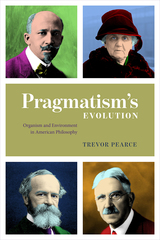
Although the various thinkers associated with pragmatism—from Charles Sanders Peirce to Jane Addams and beyond—were towering figures in American intellectual life, few realize the full extent of their engagement with the life sciences. In his analysis, Pearce focuses on a series of debates in biology from 1860 to 1910—from the instincts of honeybees to the inheritance of acquired characteristics—in which the pragmatists were active participants. If we want to understand the pragmatists and their influence, Pearce argues, we need to understand the relationship between pragmatism and biology.
Jose Ortega y Gasset (1883-1955), the most widely known and well liked of Spanish philosophers, was much admired in the United States from the 1930s through the 1960s for Revolt of the Masses, History as a System, and Dehumanization of Art, among other works. Those popular works, however, poorly reflected the complexity of Ortega's philosophy. In this first historical analysis of all the parts of Ortega's total thought, John Graham explores the extent to which Ortega's metaphysics was built not only on a native Spanish realism but also upon the pragmatism of William James. Graham details the extent to which Ortega developed an existentialsim before Martin Heidegger and a new historicism less absolute than Benedetto Croce's, by means of a phenomenological method-all within a comprehensive philosophy of life similar to Wilhelm Dilthey's, but more realist and social. In addition, an extensive bibliographical essay examines how Ortega's philosophy, as a whole and in each part, has stood in the estimation of critics worldwide from the 1920s to the present.
Over ten years in preparation, A Pragmatist Philosophy of Life in Ortega y Gasset reveals how open, adaptable, and inventive was pragmatism as Ortega elaborated its philosophical implications and applications for Spain, Europe, and the Americas. It is based on extensive use of the twelve volumes of Ortega's Obras completas, the eighty microfilm reels of his archive in the Library of Congress, and his private library of fifteen hundred volumes in Madrid. These sources, many of which have not been available previously, provide the essential evidence needed to demonstrate the novelty and subtlety, the diversity and unity, of Ortega's thematic "system" of thought.
Students and scholars of intellectual history, Spanish literature, and philosophy will welcome this important new study.
"Diggins, an eminent historian of American intellectual life, has written a timely and impressive book charting the rich history of American pragmatism and placing William James, Charles Peirce, John Dewey, George Herbert Mead, Sidney Hook, and Richard Rorty in their times and in the light of contemporary concerns. The book also draws on an alternative set of American thinkers to explore the blind spots in the pragmatic temper."—William Connolly, New York Times Book Review
"An extraordinarily ambitious work of both analysis and synthesis. . . . Diggins's book is rewarding in its thoughtfulness and its nuanced presentation of ideas."—Daniel J. Silver, Commentary
"Diggins's superbly informed book comprises a comprehensive history of American pragmatic thought. . . . It contains expert descriptions of James, John Dewey and Charles Sanders Peirce, the first generation of American pragmatists. . . . Diggins is just as good on the revival of pragmatism that's taken place over the last 20 years in America. . . . [A] richly intelligent book."—Mark Edmundson, Washington Post Book World
Can a liberal polity act on pressing matters of public concern in a way that respects the variety of beliefs and commitments that its citizens hold? Recent efforts to answer this question typically begin by seeking an uncontroversial starting point from which legitimate public ends can be said to follow. This reluctance to admit controversial beliefs as legitimate grounds for public action threatens to prevent us from responding effectively to many of the leading social and political challenges that we face.
Eric MacGilvray argues that we should shift our attention away from the problem of identifying uncontroversial public ends in the present and toward the problem of evaluating potentially controversial public ends through collective inquiry over time. Rather than ask ourselves which public ends are justified, we must instead decide which public ends we should seek to justify.
Reconstructing Public Reason offers a fundamental rethinking of the nature and aims of liberal toleration, and of the political implications of pragmatic philosophy. It also provides fresh interpretations of founding pragmatic thinkers such as John Dewey and William James, and of leading contemporary figures such as John Rawls and Richard Rorty.
Providing a bold and original rethinking of environmental ethics, Ben Minteer's Refounding Environmental Ethics will help ethicists and their allies resolve critical debates in environmental policy and conservation practice.
Minteer considers the implications of John Dewey's pragmatist philosophy for environmental ethics, politics, and practice. He provides a new and compelling intellectual foundation for the field—one that supports a more activist, collaborative and problem-solving philosophical enterprise.
Combining environmental ethics, democratic theory, philosophical pragmatism, and the environmental social sciences, Minteer makes the case for a more experimental, interdisciplinary, and democratic style of environmental ethics—one that stands as an alternative to the field's historically dominant “nature-centered” outlook.
Minteer also provides examples of his pragmatic approach in action, considering a wide range of application and issues, including invasive species, ecological research, biodiversity loss, protected area management, and conservation under global climate change.
The turmoil and brutality of the twentieth century have made it increasingly difficult to maintain faith in the ability of reason to fashion a stable and peaceful world. After the ravages of global conflict and a Cold War that divided the world's loyalties, how are we to master our doubts and face the twenty-first century with hope?
In Return to Reason, Stephen Toulmin argues that the potential for reason to improve our lives has been hampered by a serious imbalance in our pursuit of knowledge. The centuries-old dominance of rationality, a mathematical mode of reasoning modeled on theory and universal certainties, has diminished the value of reasonableness, a system of humane judgments based on personal experience and practice. To this day, academic disciplines such as economics and professions such as law and medicine often value expert knowledge and abstract models above the testimony of diverse cultures and the practical experience of individuals.
Now, at the beginning of a new century, Toulmin sums up a lifetime of distinguished work and issues a powerful call to redress the balance between rationality and reasonableness. His vision does not reject the valuable fruits of science and technology, but requires awareness of the human consequences of our discoveries. Toulmin argues for the need to confront the challenge of an uncertain and unpredictable world, not with inflexible ideologies and abstract theories, but by returning to a more humane and compassionate form of reason, one that accepts the diversity and complexity that is human nature as an essential beginning for all intellectual inquiry.
As the twenty-five intellectuals who take part in this discussion show, pragmatism has become a complex terrain on which a rich variety of contemporary debates have been played out. Contributors such as Richard Rorty, Stanley Cavell, Nancy Fraser, Robert Westbrook, Hilary Putnam, and Morris Dickstein trace pragmatism’s cultural and intellectual evolution, consider its connection to democracy, and discuss its complex relationship to the work of Emerson, Nietzsche, and Wittgenstein. They show the influence of pragmatism on black intellectuals such as W. E. B. Du Bois, explore its view of poetic language, and debate its effects on social science, history, and jurisprudence. Also including essays by critics of the revival such as Alan Wolfe and John Patrick Diggins, the volume concludes with a response to the whole collection from Stanley Fish.
Including an extensive bibliography, this interdisciplinary work provides an in-depth and broadly gauged introduction to pragmatism, one that will be crucial for understanding the shape of the transformations taking place in the American social and philosophical scene at the end of the twentieth century.
Contributors. Richard Bernstein, David Bromwich, Ray Carney, Stanley Cavell, Morris Dickstein, John Patrick Diggins, Stanley Fish, Nancy Fraser, Thomas C. Grey, Giles Gunn, Hans Joas, James T. Kloppenberg, David Luban, Louis Menand, Sidney Morgenbesser, Richard Poirier, Richard A. Posner, Ross Posnock, Hilary Putnam, Ruth Anna Putnam, Richard Rorty, Michel Rosenfeld, Richard H. Weisberg, Robert B. Westbrook, Alan Wolfe
First published in 1899,The School and Society describes John Dewey’s experiences with his own famous Laboratory School, started in 1896.
Dewey’s experiments at the Laboratory School reflected his original social and educational philosophy based on American experience and concepts of democracy, not on European education models then in vogue. This forerunner of the major works shows Dewey’s pervasive concern with the need for a rich, dynamic, and viable society.
In his introduction to this volume, Joe R. Burnett states Dewey’s theme. Industrialization, urbanization, science, and technology have created a revolution the schools cannot ignore. Dewey carries this theme through eight chapters: The School and Social Progress; The School and the Life of the Child; Waste in Education; Three Years of the University Elementary School; The Psychology of Elementary Education; Froebel’s Educational Principles; The Psychology of Occupations; and the Development of Attention.
In what kind of world and for what kind of thought is time real, history open, and novelty possible? In what kind of world and for what kind of thought does it make sense for a human being to look for trouble rather than to stay out of trouble?In this long-awaited work of general philosophy, Roberto Mangabeira Unger proposes a radical reorientation of established ideas about nature, mind, society, politics, and religion. He shows how we have to change our beliefs if we are to succeed in doing justice to our most distinctive contemporary experiences, discoveries, and ideals.
The Self Awakened mobilizes the resources of several philosophical traditions, and develops the unrecognized revolutionary implications of the most influential of these traditions today--pragmatism. Avoiding technical jargon and needless complication, this book makes a case for philosophy as the supreme activity of the intellect at war, insisting on its power to deal with what matters most.
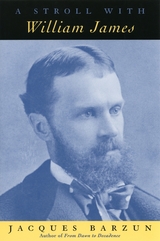
As evidenced in the self-reliance of the great Ralph Waldo Emerson, who went so far as to refer to the early part of the nineteenth century as the age of Swedenborg, the socialist tendencies of Henry James, Sr., and the pragmatic philosophy of his highly esteemed son William James, Swedenborg has had a powerful impact on a number of prominent individual thinkers and their lasting traditions.
With love for one’s neighbor sharing pride of place among his ideas, it comes as no surprise that Swedenborg’s outlook on human interaction worked its way into the various social reform movements that vitalized the American landscape during the nineteenth and early twentieth centuries. From the more politically oriented single-tax movement of Henry George to the utopian aspirations of Charles Fourier and the more spiritually inclined social gospel and pastoral clinical movements, those who took Swedenborg’s principles of usefulness to heart sought ways to reflect the divine design in human society.
John Haller’s treatment of the era draws a magnifying glass to those intellectual titans whose fortitude in the face of psychological and social adversities stands as a testament to the robustness of Swedenborg’s concept of usefulness. As James F. Lawrence, Dean of the Center for Swedenborgian Studies at the Graduate Theological Union in Berkeley, California, so aptly states in his foreword, “this book tells stories and builds perspectives that will prove without a doubt to be very useful.”
In this study of the practice of contemporary painter Gerhard Richter, Florian Klinger proposes a fundamental change in the way we think about art today. In reaction to the exhaustion of the modernist-postmodernist paradigm’s negotiation of the “essence of art,” he takes Richter to pursue a pragmatist model that understands artistic form as action. Here form is no longer conceived according to what it says—as a vehicle of expression, representation, or realization of something other than itself—but strictly according to what it does.
Through its doing, Klinger argues, artistic form is not only more real but also more shared than non-artistic reality, and thus enables interaction under conditions where it would otherwise not be possible. It is a human practice aimed at testing and transforming the limits of shared reality, urgently needed in situations where such reality breaks down or turns precarious. Drawing on pragmatist thought, philosophical aesthetics, and art history, Klinger’s account of Richter’s practice offers a highly distinctive conceptual alternative for contemporary art in general.
major contribution to the current revival of pragmatism in
America by showing how it provides the most critically
resilient and constructive response to the intellectual
challenges of postmodernism.
Gunn reclaims and refurbishes elements of the pragmatic
tradition that either have been lost or have undergone
important changes and shows how newer critical approaches
have strong roots in the pragmatic tradition. For Gunn,
pragmatism is no longer concerned solely with the nature of
knowledge and the meaning of truth. Because of its
insistence on critical self-awareness, its opposition to
closed systems of thought, and its concern with the ethical,
political, and practical contexts of ideas, pragmatism offers
a blueprint for performing intellectual work in a world
without absolutes. The world Gunn's pragmatism recognizes is
one of multiple truths, unstable interpretations, and
competing interests.
After critically reexamining the nature and scope of the
pragmatic legacy, Gunn explores the way pragmatism
successfully responds to conceptual and methodological
controversies, from the rebirth of ideology, the spread of
interdisciplinarity, and the development of the new
historicism, to the revolt against theory, the erosion of
public discourse, and the problematics of American civil
religion. Drawing throughout on the work of William James,
Henry James, Sr., John Dewey, Kenneth Burke, W. E. B. Du
Bois, Richard Poirier, Stanley Cavell, Clifford Geertz, Frank
Lentricchia, Richard Rorty, Richard J. Bernstein, and
others, Gunn shows that pragmatism, because it offers a way
of thinking across the categories of modern intellectual
specializations, is located at the intersection of these
critical, and often competitive, discourses. The postmodern
challenge for the pragmatist thinker is not only how to
render these different discourses conversible with one
another, but how to turn the salient insights of each into
elements of a new democratic and critical public culture, one
able to counter the twin threats of ideology and solipsism.
Giles Gunn is one of our most acclaimed contemporary critics,
and this broad and ambitious book is certain to become one of
the central works in the current revival of critical
pragmatism and cultural studies.
Contrary to Kierkegaard's ideal of moral personhood and orthodox Christian identity, Mehl aims to acknowledge the possibility of pluralism in existential identities. By demanding sensitivity to the deep ways social and cultural context influences human perception, interpretation and self?representation, Mehl argues that Kierkegaard is not simply discovering but also participating in a cultural construction of the human being.
Drawing on accounts of what it is to be a person by prominent philosophers outside of Kierkegaard scholarship, including Charles Taylor, Owen Flanagan, Alasdair MacIntyre, and Thomas Nagel, Mehl also works to bridge the analytic and continental traditions and reestablishes Kierkegaard as a rich resource for situating moral and spiritual identity. This reexamination of Kierkegaard is recommended for anyone interested in what it means to be a person.
Edited by well-respected Mead scholars Hans Joas and Daniel R. Huebner, the volume as a whole makes a coherent statement that places Mead in dialogue with current research, pushing these domains of scholarship forward while also revitalizing the growing literature on an author who has an ongoing and major influence on sociology, psychology, and philosophy.
In Toward a Pragmatist Sociology, Robert Dunn explores the relationship between the ideas of philosopher and educator John Dewey and those of sociologist C. Wright Mills in order to provide a philosophical and theoretical foundation for the development of a critical and public sociology. Dunn recovers an intellectual and conceptual framework for transforming sociology into a more substantive, comprehensive, and socially useful discipline.
Toward a Pragmatist Sociology argues that Dewey and Mills shared a common vision of a relevant, critical, public sociology dedicated to the solution of societal problems. Dunn investigates the past and present state of the discipline, critiquing its dominant tendencies, and offering historical examples of alternatives to conventional sociological approaches.
By stressing the similar intellectual and moral visions of both men, Toward a Pragmatist Sociology provides an original treatment of two important American thinkers whose work offers a conception and model of a sociology with a sense of moral and political purpose and public relevance. It should liberate future sociologists and others to regard the discipline as not only a science but an intellectual, moral, and political enterprise.
A reclamation of experience as the foremost concept in the work of William James, and a powerful argument for the continuing importance of his philosophy.
How does one deploy experience without succumbing to a foundationalist epistemology or an account of the subject rooted in immediately given objects of consciousness? In the wake of the so-called linguistic turn of the twentieth century, this is a question anyone thinking philosophically about experience must ask.
Alexis Dianda answers through a reading of the pragmatic tradition, culminating in a defense of the role of experience in William James’s thought. Dianda argues that by reconstructing James’s philosophical project, we can locate a model of experience that not only avoids what Wilfrid Sellars called “the myth of the given” but also enriches pragmatism broadly. First, Dianda identifies the motivations for and limitations of linguistic nominalism, insisting that critics of experience focus too narrowly on justification and epistemic practices. Then, by emphasizing how James’s concept of experience stresses the lived, affective, and nondiscursive, the argument holds that a more robust notion of experience is necessary to reflect not just how we know but how we act.
The Varieties of Experience provides a novel reconstruction of the relationship between psychology, moral thought, epistemology, and religion in James’s work, demonstrating its usefulness in tackling issues such as the relevance of perception to knowledge and the possibility of moral change. Against the tide of neopragmatic philosophers such as Richard Rorty and Robert Brandom, who argue that a return to experience must entail appeals to foundationalism or representationalism, Dianda’s intervention rethinks not only the value and role of experience but also the aims and resources of pragmatic philosophy today.
From the author of the New York Times bestseller Begin Again, a politically astute, lyrical meditation on how ordinary people can shake off their reliance on a small group of professional politicians and assume responsibility for what it takes to achieve a more just and perfect democracy.
“Like attending a jazz concert with all of one’s favorite musicians…James Baldwin, Martin Luther King, Jr., Malcolm X, Ella Baker, Toni Morrison, and more…Glaude brilliantly takes us on an epic tour through their lives and work.”
―Henry Louis Gates, Jr., author of The Black Box: Writing the Race
We are more than the circumstances of our lives, and what we do matters. In We Are the Leaders We Have Been Looking For, one of the nation’s preeminent scholars and a New York Times bestselling author, Eddie S. Glaude Jr., makes the case that the hard work of becoming a better person should be a critical feature of Black politics. Through virtuoso interpretations of Martin Luther King, Jr., Malcolm X, and Ella Baker, Glaude shows how we have the power to be the heroes that our democracy so desperately requires.
Based on the Du Bois Lectures delivered at Harvard University, the book begins with Glaude’s unease with the Obama years. He felt then, and does even more urgently now, that the excitement around the Obama presidency constrained our politics as we turned to yet another prophet-like figure. He examines his personal history and the traditions that both shape and overwhelm his own voice.
Glaude weaves anecdotes about his evolving views on Black politics together with the writings of Ralph Waldo Emerson, John Dewey, Toni Morrison, James Baldwin, and Ralph Ellison, encouraging us to reflect on the lessons of these great thinkers and address imaginatively the challenges of our day in voices uniquely our own.
Narrated with passion and philosophical intensity, this book is a powerful reminder that if American democracy is to survive, we must step out from under the shadows of past giants to build a better society—one that derives its strength from the pew, not the pulpit.
What was the goal of this unusual speech? Rather than an oddity, Francesca Bordogna asserts that the APA address was emblematic—it was just one of many gestures that James employed as he plowed through the barriers between academic, popular, and pseudoscience, as well as the newly emergent borders between the study of philosophy, psychology, and the “science of man.” Bordogna reveals that James’s trespassing of boundaries was an essential element of a broader intellectual and social project. By crisscrossing divides, she argues, James imagined a new social configuration of knowledge, a better society, and a new vision of the human self. As the academy moves toward an increasingly interdisciplinary future, William James at the Boundaries reintroduces readers to a seminal influence on the way knowledge is pursued.
Works of John Dewey, 1886–2012 is an invaluable and meticulously compiled resource for the growing number of scholars and researchers seeking a deeper understanding of the work of the prominent American philosopher, psychologist, and educational reformer.
Dewey (1859–1952), an influential philosopher credited with the founding of pragmatism and also recognized as a pioneer in functional psychology and the progressive moment in education, was hailed by Life magazine in 1990 as one of the one hundred most important Americans of the twentieth century. This rich and continually expanding compendium of historical and more recent essays, research, and references is a testament to the growing interest in Dewey’s intellectual work and his measurable impact in the United States and throughout the world.
In Works of John Dewey, 1886–2012, some four thousand new entries are presented in ebook format, in addition to those from earlier print and electronic editions dating back to 1995. Copies of most of the works have been obtained and are stored at the Center for Dewey Studies. For the first time, users can access all items from all editions in one user-friendly format. Jump links to alphabetical sections facilitate movement through the vast collection of entries. Users can search by keyword and author.
READERS
Browse our collection.
PUBLISHERS
See BiblioVault's publisher services.
STUDENT SERVICES
Files for college accessibility offices.
RECENTLY PUBLISHED




UChicago Accessibility Resources
home | accessibility | search | about | contact us
BiblioVault ® 2001 - 2024
The University of Chicago Press