
 A SCHOLARLY BOOK REPOSITORY
A Telegraph Book of the Year
A Washington Post Notable Work
A Times Book of the Year
A Hughes Award Finalist
“An indisputable masterpiece…comprehensive, fascinating, and persuasive.”
—Wall Street Journal
“Brimming with wisdom and brio, this masterful work spans the history of psychiatry. Exceedingly well-researched, wide-ranging, provocative in its conclusions, and magically compact, it is riveting from start to finish. Mark my words, Desperate Remedies will soon be a classic.”
—Susannah Cahalan, author of Brain on Fire
“Compulsively readable…Scull has joined his wide-ranging reporting and research with a humane perspective on matters that many of us continue to look away from.”
—Daphne Merkin, The Atlantic
"Scull's fascinating and enraging book is the story of the quacks and opportunists who have claimed to offer cures for mental illness...Madness remains the most fascinating—arguably the defining—aspect of Homo sapiens."
—Sebastian Faulks, Sunday Times
“I would recommend this fascinating, alarming, and alerting book to anybody. For anyone referred to a psychiatrist it is surely essential.”
—The Spectator
For more than two hundred years disturbances of the mind have been studied and treated by the medical profession. Mental illness, some insist, is a disease like any other, from which one can be cured. But is this true?
From the birth of the asylum to the latest drug trials, Desperate Remedies brings together a galaxy of mind doctors working in and out of institutional settings: psychologists and psychoanalysts, neuroscientists and cognitive behavioral therapists, as well as patients and their families desperate for relief. Surprising, disturbing, and compelling, this passionate account of America’s long battle with mental illness challenges us to revisit some of our deepest assumptions and to confront the epidemic of mental illness so visible all around us.
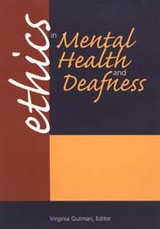
This volume explores ethical issues specific to working with deaf clients, particularly matters of confidentiality, managing multiple relationships, and the clinician’s competency to provide services, particularly in communicating with and understanding deaf people. Led by editor Virginia Gutman, a unique assembly of respected mental health professionals share their experiences and knowledge in working with deaf clients.
Irene Leigh commences Ethics in Mental Health and Deafness with her varied experiences as a deaf mental health practitioner, and Gutman follows with insights on ethics in the “small world” of the Deaf community. William McCrone discusses the law and ethics, and Patrick Brice considers ethical issues regarding deaf children, adolescents, and their families. In contrast, Janet Pray addresses concerns about deaf and hard of hearing older clients.
Minority deaf populations pose additional ethical aspects, which are detailed by Carolyn Corbett. Kathleen Peoples explores the challenges of training professionals in mental health services specifically for deaf clients. Closely related to these topics is the influence of interpreters with deaf clients in mental health settings, which Lynnette Taylor thoroughly treats. Ethics and Mental Health in Deafness also features a chapter on genetic counseling and testing for deafness by Kathleen Arnos. The final section, written by Robert Pollard, examines ethical conduct in research with deaf people, a fitting conclusion to a volume that will become required reading for all professionals and students in this discipline.
READERS
Browse our collection.
PUBLISHERS
See BiblioVault's publisher services.
STUDENT SERVICES
Files for college accessibility offices.
RECENTLY PUBLISHED






UChicago Accessibility Resources
home | accessibility | search | about | contact us
BiblioVault ® 2001 - 2025
The University of Chicago Press