
 A SCHOLARLY BOOK REPOSITORY
Loomis provides a clear and disturbing picture of military land-use planning and how it has affected residents in Nevada. He contends that a lack of citizen participation in the development of land-use plans is a weakness in the planning process and that both the military and the citizenry should take an active role to avoid future conflicts.
This lecture was presented on March 14, 2018, at the 23rd annual symposium of the Wallace Stegner Center for Land, Resources and the Environment at the S.J. Quinney College of Law, University of Utah
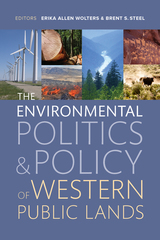
While a number of scholars work on the politics and policy of public land management, there has been no central book on the topic since the publication of Charles Davis's Western Public Lands and Environmental Politics (Westview, 2001). In The Environmental Politics and Policy of Western Public Lands, Erika Allen Wolters and Brent Steel have assembled a stellar cast of scholars to consider long-standing issues and topics such as endangered species, land use, and water management while addressing more recent challenges to western public lands like renewable energy siting, fracking, Native American sovereignty, and land use rebellions. Chapters also address the impact of climate change on policy dimensions and scope.
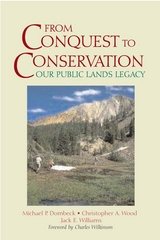
From Conquest to Conservation is a visionary new work from three of the nation’s most knowledgeable experts on public lands. As chief of the Forest Service, Mike Dombeck became a lightning rod for public debate over issues such as the management of old-growth forests and protecting roadless areas. Dombeck also directed the Bureau of Land Management from 1994 to 1997 and is the only person ever to have led the two largest land management agencies in the United States. Chris Wood and Jack Williams have similarly spent their careers working to steward public resources, and the authors bring unparalleled insight into the challenges facing public lands and how those challenges can be met.
Here, they examine the history of public lands in the United States and consider the most pressing environmental and social problems facing public lands. Drawing heavily on fellow Forest Service employee Aldo Leopold’s land ethic, they offer specific suggestions for new directions in policy and management that can help maintain and restore the health, diversity, and productivity of public land and water resources, both now and into the future.
Also featured are lyrical and heartfelt essays from leading writers, thinkers, and scientists— including Bruce Babbitt, Rick Bass, Patricia Nelson Limerick, and Gaylord Nelson—about the importance of public lands and the threats to them, along with original drawings by William Millonig.
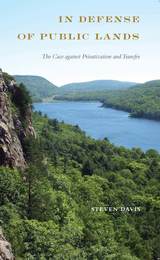
Debates continue to rage over the merits or flaws of public land and whether or not it should be privatized—or at least, radically reconfigured in some way. In Defense of Public Lands offers a comprehensive refutation of the market-oriented arguments. Steven Davis passionately advocates that public land ought to remain firmly in the public’s hands. He reviews empirical data and theoretical arguments from biological, economic, and political perspectives in order to build a case for why our public lands are an invaluable and irreplaceable asset for the American people.
In Defense of Public Lands briefly lays out the history and characteristics of public lands at the local, state, and federal levels while examining the numerous policy prescriptions for their privatization or, in the case of federal lands, transfer. He considers the dimensions of environmental health; markets and valuation of public land, the tensions between collective values and individual preferences, the nature and performance of bureaucratic management, and the legitimacy of interest groups and community decision-making. Offering a fair, good faith overview of the privatizers’ best arguments before refuting them, this timely book contemplates both the immediate and long-term future of our public lands.
In Lost in Transition: Removing, Resettling, and Renewing Appalachia, Aaron D. Purcell presents a thematic and chronological exploration of twentieth-century removal and resettlement projects across southern Appalachia. The book shares complex stories of loss and recollection that have grown and evolved over time.
This edited volume contains seven case studies of public land removal actions in Virginia, Kentucky, the Carolinas, and Tennessee from the 1930s through the 1960s. Some of the removals include the Tennessee Valley Authority and the Norris Basin, Shenandoah National Park and the New River, the Great Smoky Mountains National Park, and the Keowee-Toxaway Project in northwestern South Carolina. Each essay asks key questions: How did governmental entities throughout the twentieth century deal with land acquisition and removal of families and communities? What do the oral histories of the families and communities, particularly from different generations, tell us about the legacies of these removals? This collection reveals confrontations between past and present, federal agencies and citizens, and the original accounts of removal and resettlement and contemporary interpretations. The result is a blending of practical historical concerns with contemporary nostalgia and romanticism, which often deepen the complexity of Appalachian cultural life.
Lost in Transition provides a nuanced and insightful study of removal and resettlement projects that applies critical analysis of fact, mythology, and storytelling. It illustrates the important role of place in southern Appalachian history. This collection is a helpful resource to anthropologists, folklorists, and Appalachian studies scholars, and a powerful volume of stories for all readers who reflect upon the importance of place and home.
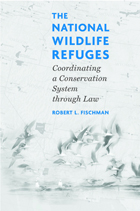
The National Wildlife Refuges provides a comprehensive examination of the laws and policies governing management of the national wildlife refuges, offering for the first time a practical description and analysis of the management regime outlined in the 1997 National Wildlife Refuge System Improvement Act. The 1997 act is the first new statute governing a system of federal public lands enacted since the 1970s. The evolution of law governing the refuge system parallels broader trends in public land management and environmental protection, making the refuge system a valuable case study for those interested in environmental management, policy, and law. The book:
- describes the National Wildlife Refuge System and its legal history
- offers a detailed breakdown of the 1997 act, including its purpose, designated uses, comprehensive planning provisions, substantive management criteria, and public participation aspects
- considers individual refuges and specific issues that apply to only certain refuges
- discusses oil and gas development in refuges
- offers observations about how well the refuge system law resolves historic tensions and achieves modern conservation goals
A separate chapter examines the special rules governing refuges in Alaska and considers the contentious debate over the Arctic National Wildlife Refuge. Appendixes offer a reference of acronyms and abbreviations, a chronology of the refuge system's development, key statutory provisions (including the full text of the 1997 act), and basic information about each national wildlife refuge.
With an approach to conservation that is increasingly prevalent around the world, the National Wildlife Refuge System is an important model for sustainable resource management, and the book's analyses of the refuge system's ecological management criteria, conflicts between primary and subsidiary uses, and tension between site-specific standards and uniform national goals all offer important lessons for environmental governance generally.
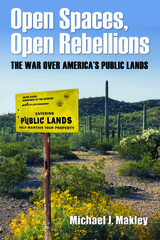
In Open Spaces, Open Rebellions, Michael J. Makley offers a succinct and compelling history of the federal government's management of public lands. As Makley reveals, beginning in the nineteenth century and continuing to the present day, debates over how best to balance the use of these lands by the general public, fee-paying ranchers, and resource developers have always been complex and contentious. Indeed, these debates have often been met with demands for privatization or state control, best exemplified by the Sagebrush Rebellion of the 1980s and the 2016 occupation of Oregon's Malheur National Wildlife Refuge.
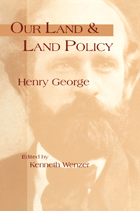
Even before the publication of Progress and Poverty in 1879, San Francisco political economist and publisher Henry George (1839-1897) had written extensively about what he considered to be the causes for worldwide economic inequity—land monopolization and speculation by wealthy entrepreneurs and corrupt politicians. But his attacks on these evils were coupled with a plan for a possible brighter future, for a world in which disparities between people of different classes could be adjusted. By the time he died in 1897, his assessments of liberal 19th-century economic theory were critically acclaimed in Europe and the United States.
Michigan State University Press's new edition of Our Land and Land Policy includes the texts of speeches George delivered and essays he published during three decades of political activism. These pieces were chosen originally in 1901 by George's son, Henry George, Jr., to portray the expansiveness and depth of his father's philosophy and the sincerity with which the elder George struggled throughout his life for social justice.
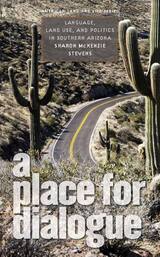
In A Place for Dialogue, Sharon McKenzie Stevens views the contradictions and collaborations involved in the management of public land in southern Arizona—and by extension the entire arid West—through the lens of political rhetoric. Revealing the socioecological relationships among cattlemen and environmentalists as well as developers and recreationists, she analyzes the ways that language shapes landscape by shaping decisions about land use.
Stevens focuses on the collaborative Sonoran Desert Conservation Plan initiated by Pima County, Arizona, the ubiquitous use of scientific argument to defend contradictory practices, and the construction and negotiation of rancher/environmentalist identities to illuminate both literally and metaphorically the dynamics of land use politics. Drawing specifically upon extensive interviews with a diverse array of agents on all sides of the debate—ranchers, environmentalists, scientists, land managers, government officials—on historical narratives, and on her own conflicting experiences as someone who grew up with those who work the western lands, she demonstrates that it is possible to use differences to solve, rather than to aggravate, the entrenched problems that bridge land and language.
By integrating her richly textured case study of a fragile region with rhetorical approaches to narrative, science-based argument, and collective identities, Stevens makes a significant contribution to the fields of rhetoric, land management, and cultural studies.
—Char Miller, from the introduction
The grazing rights battle between Nevada rancher Cliven Bundy and the federal government, resulting in a tense, armed standoff between Bundy’s supporters and federal law enforcement officers, garnered international media attention in 2014. Saints, Sinners, and Sovereign Citizens places the Bundy conflict into the larger context of the Sagebrush Rebellion and the long struggle over the use of federal public lands in the American West.
Author John L. Smith skillfully captures the drama of the Bundy legal tangle amid the current political climate. Although no shots were fired during the standoff itself, just weeks later self-proclaimed Bundy supporters murdered two Las Vegas police officers and a civilian. In Eastern Oregon, other Bundy supporters occupied the federal offices of the Malheur National Wildlife Refuge, and one of them died in a hail of bullets.
While examining the complex history of federal public land policies, Smith exposes both sides of this story. He shows that there are passionate true believers on opposite sides of the insurrection, along with government agents and politicians in Washington complicit in efforts to control public lands for their wealthy allies and campaign contributors. With the promise of billions of dollars in natural resource profits and vast tracts of environmentally sensitive lands hanging in the balance, the West’s latest range war is the most important in the nation’s history. This masterful exposé raises serious questions about the fate of America’s public lands and the vehement arguments that are framing the debate from all sides.
In detailing political and environmental squabbles over the San Rafael Swell, Durrant illuminates issues that confront land managers, bureaucrats, and elected officials throughout the country. He describes struggles between county commissioners and environmental activists, conflicts over water rights, proposals that repeatedly fail to gain government approval, and political posturings. Caught in the crossfire, and often overwhelmed, the Bureau of Land Management has seen its long-time mission—once centered on grazing and mining rights—transmogrify into a new and, to some, unsettling responsibility for recreation and preservation.
The sandstone crags and twisting valleys of the San Rafael Swell present a formidable landscape, but as this book clearly shows, the political landscape may be even more daunting, strewn with bureaucratic boulders and embedded with fixed positions on the functions and values of public land.
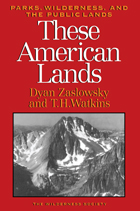
Over 634 million acres of the United States -- nearly a million square miles -- are federally owned. These American Lands is both a history and a celebration of that inheritance. First published in 1986, the book was hailed by Wallace Stegner as "the only indispensable narrative history of the public lands." This completely revised and updated edition is an unsurpassed resource for everyone who cares about, visits, or works with public land in the United States. With over 75 pages of new material, the volume covers:
- national parks
- national forests
- national resource lands
- wildlife refuges
- designated wildernesses
- wild and scenic rivers
- Alaska lands
- national trails
Each chapter outlines the history of the unit of public lands under discussion, clarifies the resource use and policy conflicts that are currently besetting it, and provides a detailed agenda of management, expansion, and preservation goals.
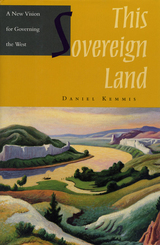
In the eight states of the interior West (Arizona, Colorado, Idaho, Montana, Nevada, New Mexico, Utah, and Wyoming), 260 million acres -- more than 48 percent of the land base -- are owned by the federal government and managed by its Washington, D.C.-based agencies. Like many other peoples throughout history who have bristled under the controlling hand of a remote government, westerners have long nursed a deep resentment toward our nation's capital. Rumblings of revolution have stirred for decades, bolstered in recent years by increasing evidence of the impossibility of a distant, centralized government successfully managing the West's widespread and far-flung lands.
In This Sovereign Land, Daniel Kemmis offers a radical new proposal for giving the West control over its land. Unlike those who wish to privatize the public lands and let market forces decide their fate, Kemmis, a leading western Democrat and committed environmentalist, argues for keeping the public lands public, but for shifting jurisdiction over them from nation to region. In place of the current centralized management, he offers a regional approach that takes into account natural topographical and ecological features, and brings together local residents with a vested interest in ensuring the sustainability of their communities. In effect, Kemmis carries to their logical conclusion the recommendations about how the West should be governed made by John Wesley Powell more than a century ago.
Throughout, Kemmis argues that the West no longer needs to be protected against itself by a paternalistic system and makes a compelling case that the time has come for the region to claim sovereignty over its own landscape. This Sovereign Land provides a provocative opening to a much-needed discussion about how democracy and ecological sustainability can go hand in hand, and will be essential reading for anyone interested in the West and western issues, as well as for all those concerned with place-based conservation, public lands management, bioregionalism, or related topics.
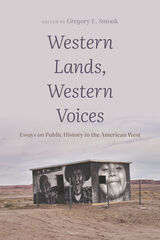
Inspired by the fiftieth anniversary of the University of Utah’s American West Center, the oldest regional studies center in the United States, Western Lands, Western Voices explores the many dimensions of public history. This collection of thirteen essays is rooted in the real-world experiences of the authors and is the first volume to focus specifically on regional public history.
Contributors include tribal government officials, state and federal historians, independent scholars and historical consultants, and academics. Some are distinguished historians of the American West and others are emerging voices that will shape publicly engaged scholarship in the years to come. Among the issues they address are community history and public interpretation, tribal sovereignty, and the importance of historical research for land management. The volume will be indispensable to researchers and general readers interested in museum studies, Native American studies, and public lands history and policy.
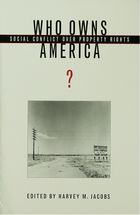
Land ownership by individual citizens is a cornerstone of American heritage and a centerpiece of the American dream. Thomas Jefferson called it the key to our success as a democracy. Yet the question of who owns America not only remains unanswered but is central to a fundamental conflict that can pit private property rights advocates against government policymakers and environmentalists.
Land use authority Harvey M. Jacobs has gathered a provocative collection of perspectives from eighteen contributors in the fields of law, history, anthropology, economics, sociology, forestry, and environmental studies. Who Owns America? begins with the popular view of land ownership as seen though the television show Bonanza! It examines public regulation of private land; public land management; the roles culture and ethnic values play in land use; and concludes with Jacobs’ title essay.
Who Owns America? is a powerful and illuminating exploration of the very terrain that makes us Americans. Its broad set of theoretical and historical perspectives will fascinate historians, environmental activists, policy makers, and all who care deeply about the land we share.
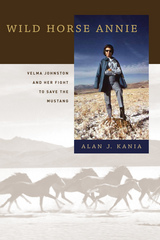
Wild horses have been a subject of bitter controversy in the West for decades. To some, they are symbols of the West’s wild, free heritage. To others, they are rapacious grazers that destroy habitat and compete with domestic livestock and indigenous wildlife for scanty food and water. For years, free-ranging horses and burros were rounded up and shipped to slaughterhouses to be killed and turned into pet food. This practice provided an income for the “mustangers” who trapped and sold them, but it also involved horrendous cruelty and abuse of the animals.
Velma Johnston, who became known as “Wild Horse Annie,” undertook to stop the removal of wild horses and burros from US public lands and protect them from the worst aspects of mustanging. Her campaign attracted nationwide attention, as it led her from her rural Nevada County to state offices and finally to Washington, DC. Author Alan J. Kania worked closely with Johnston for seven years, and his biography provides unique insight into Wild Horse Annie’s life and her efforts to save the West’s wild horse herds through the passage of protective legislation.
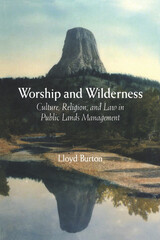
Questions about land use, conservation, and preservation—already so perplexing and contentious—take on a new complexity and greater urgency when the land in question is understood as sacred. This is a view increasingly held, as adherents of mainstream religions come to recognize what indigenous peoples knew centuries ago—that the sacred inheres in nature itself. What such a trend means and how it involves the forces of culture, religion, and constitutional law (especially First Amendment clauses concerning the free exercise of religion) are considered with a remarkable breadth and depth of understanding in this important new work.
Drawing on case studies of national parks and monuments, national forests, and other public lands and resources, Lloyd Burton gives a clear and comprehensive account of how the intertwining influences of culture, religion, and law have affected the management of public lands and resources in the recent past and how they may do so in the future. In a unique and unprecedented way, his book weaves together teachings on nature and the sacred among indigenous and immigrant culture groups in the United States; the relevant constitutional history of religion and government action; and analysis of contemporary conflicts over culture, religion, and public lands management. As such, Worship and Wilderness is essential reading not only for public land managers and environmental policy makers but also for anyone interested in the growing significance of religious interests in the use of resources that constitute our national commons and our common natural heritage.
READERS
Browse our collection.
PUBLISHERS
See BiblioVault's publisher services.
STUDENT SERVICES
Files for college accessibility offices.
RECENTLY PUBLISHED



UChicago Accessibility Resources
home | accessibility | search | about | contact us
BiblioVault ® 2001 - 2024
The University of Chicago Press