
 A SCHOLARLY BOOK REPOSITORY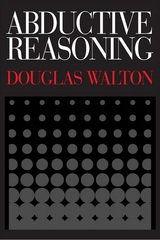
Examines three areas in which abductive reasoning is especially important: medicine, science, and law. The reader is introduced to abduction and shown how it has evolved historically into the framework of conventional wisdom in logic. Discussions draw upon recent techniques used in artificial intelligence, particularly in the areas of multi-agent systems and plan recognition, to develop a dialogue model of explanation. Cases of causal explanations in law are analyzed using abductive reasoning, and all the components are finally brought together to build a new account of abductive reasoning.
By clarifying the notion of abduction as a common and significant type of reasoning in everyday argumentation, Abductive Reasoning will be useful to scholars and students in many fields, including argumentation, computing and artificial intelligence, psychology and cognitive science, law, philosophy, linguistics, and speech communication and rhetoric.

In spite of soaring tuition costs, more and more students go to college every year. A bachelor’s degree is now required for entry into a growing number of professions. And some parents begin planning for the expense of sending their kids to college when they’re born. Almost everyone strives to go, but almost no one asks the fundamental question posed by Academically Adrift: are undergraduates really learning anything once they get there?
For a large proportion of students, Richard Arum and Josipa Roksa’s answer to that question is a definitive no. Their extensive research draws on survey responses, transcript data, and, for the first time, the state-of-the-art Collegiate Learning Assessment, a standardized test administered to students in their first semester and then again at the end of their second year. According to their analysis of more than 2,300 undergraduates at twenty-four institutions, 45 percent of these students demonstrate no significant improvement in a range of skills—including critical thinking, complex reasoning, and writing—during their first two years of college. As troubling as their findings are, Arum and Roksa argue that for many faculty and administrators they will come as no surprise—instead, they are the expected result of a student body distracted by socializing or working and an institutional culture that puts undergraduate learning close to the bottom of the priority list.
Academically Adrift holds sobering lessons for students, faculty, administrators, policy makers, and parents—all of whom are implicated in promoting or at least ignoring contemporary campus culture. Higher education faces crises on a number of fronts, but Arum and Roksa’s report that colleges are failing at their most basic mission will demand the attention of us all.
A vital contribution to legal theory and media and civic discourse
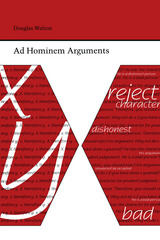
In the 1860s, northern newspapers attacked Abraham Lincoln's policies by attacking his character, using the terms "drunk," "baboon," "too slow," "foolish," and "dishonest." Steadily on the increase in political argumentation since then, the argumentum ad hominem, or personal attack argument, has now been carefully refined as an instrument of "oppo tactics" and "going negative" by the public relations experts who craft political campaigns at the national level. In this definitive treatment of one of the most important concepts in argumentation theory and informal logic, Douglas Walton presents a normative framework for identifying and evaluating ad hominem or personal attack arguments.
Personal attack arguments have often proved to be so effective, in election campaigns, for example, that even while condemning them, politicians have not stopped using them. In the media, in the courtroom, and in everyday confrontation, ad hominem arguments are easy to put forward as accusations, are difficult to refute, and often have an extremely powerful effect on persuading an audience.
Walton gives a clear method for analyzing and evaluating cases of ad hominem arguments found in everyday argumentation. His analysis classifies the ad hominem argument into five clearly defined subtypes—abusive (direct), circumstantial, bias, "poisoning the well," and tu quoque ("you're just as bad") arguments—and gives methods for evaluating each type. Each subtype is given a well-defined form as a recognizable type of argument. The numerous case studies show in concrete terms many practical aspects of how to use textual evidence to identify and analyze fallacies and to evaluate argumentation as fallacious or not in particular cases.

The Anatomy of Judgment was first published in 1990. Minnesota Archive Editions uses digital technology to make long-unavailable books once again accessible, and are published unaltered from the original University of Minnesota Press editions.
"The Anatomy of Judgment is a unique and valuable contribution to the literature of the social and humanistic contexts for science . . . The book will illuminate dark corners for any reader, and dozens of interesting points come to light." –Neil Greenberg, University of Tennessee
Tracing the emergence of science and the social institutions that govern it, The Anatomy of Judgment is an odyssey into what human thinking or judgment means. Philip Regal moves deftly from the history of Western philosophy to concepts of rationality in non-Western cultures, from the conceptual issues of the Salem witch trials to the basic structure of the human brain. The Anatomy of Judgment offers new perspectives on the workings of individual judgment and the social responsibility it entails.
Philip Regal is a professor of ecology and behavioral biology at the University of Minnesota. He served, during his pre- and postdoctoral work, as Coordinator's Appointee to the Mental Health Training Program at UCLA's Brain Research Institute.
"Full of matter for anyone interested in language, religion, and politics in the ancient world."—R. T. Ridley, Journal of Religious History
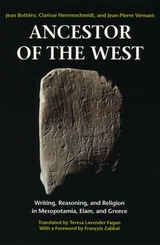
"In this accessible introduction to the ancient world, three leading French scholars explore the emergence of rationality and writing in the West, tracing its development and its survival in our own traditions. . . . Jean Bottero focuses on writing and religion in ancient Mesopotamia, Clarisse Herrenschmidt considers a broader history of ancient writing, and Jean-Pierre Vernant examines classical Greek civilization in the context of Near Eastern history."—Translation Review
Robert B. Brandom is one of the most original philosophers of our day, whose book Making It Explicit covered and extended a vast range of topics in metaphysics, epistemology, and philosophy of language--the very core of analytic philosophy. This new work provides an approachable introduction to the complex system that Making It Explicit mapped out. A tour of the earlier book's large ideas and relevant details, Articulating Reasons offers an easy entry into two of the main themes of Brandom's work: the idea that the semantic content of a sentence is determined by the norms governing inferences to and from it, and the idea that the distinctive function of logical vocabulary is to let us make our tacit inferential commitments explicit.
Brandom's work, making the move from representationalism to inferentialism, constitutes a near-Copernican shift in the philosophy of language--and the most important single development in the field in recent decades. Articulating Reasons puts this accomplishment within reach of nonphilosophers who want to understand the state of the foundations of semantics.

Philosophy, economics, and decision theory have long been dominated by the idea that rational choice consists of seeking or achieving one’s own greatest good. Beyond Optimizing argues that our ordinary understanding of practical reason is more complex than this, and also that optimizing/maximizing views are inadequately supported by the considerations typically offered in their favor.
Michael Slote challenges the long-dominant conception of individual rationality, which has to a large extent shaped the very way we think about the essential problems and nature of rationality, morality, and the relations between them. He contests the accepted view by appealing to a set of real-life examples, claiming that our intuitive reaction to these examples illustrates a significant and prevalent, if not always dominant, way of thinking. Slote argues that common sense recognizes that one can reach a point where “enough is enough,” be satisfied with what one has, and, hence, rationally decline an optimizing alternative. He suggests that, in the light of common sense, optimizing behavior is often irrational. Thus, Slote is not merely describing an alternative mode of rationality; he is offering a rival theory. And the numerous parallels he points out between this common-sense theory of rationality and common-sense morality are then shown to have important implications for the long-standing disagreement between commonsense morality and utilitarian consequentialism.
Beyond Optimizing is notable for its use of a much richer vocabulary of criticism than optimizing/maximizing models ever call upon. And it further argues that recent empirical investigations of the development of altruism and moral motivation need to be followed up by psychological studies of how moderation, and individual rationality more generally, take shape within developing individuals.
“A history of philosophy in twelve thinkers…The whole performance combines polyglot philological rigor with supple intellectual sympathy, and it is all presented…in a spirit of fun…This bracing and approachable book [shows] that there is life in philosophy yet.”
—Times Literary Supplement
“Exceptionally engaging…Geuss has a remarkable knack for putting even familiar thinkers in a new light.”
—Notre Dame Philosophical Reviews
“Geuss is something like the consummate teacher, his analyses navigable and crystal, his guidance on point.”
—Doug Phillips, Key Reporter
Raymond Geuss explores the ideas of twelve philosophers who broke dramatically with prevailing wisdom, from Socrates and Plato in the ancient world to Nietzsche, Wittgenstein, and Adorno. The result is a striking account of some of the most innovative thinkers in Western history and an indirect manifesto for how to pursue philosophy today. Geuss cautions that philosophers’ attempts to break from convention do not necessarily make the world a better place. Montaigne’s ideas may have been benign, but the fate of those of Hobbes, Hegel, and Nietzsche has been more varied. Yet in the act of provoking people to think differently, philosophers remind us that we are not fated to live within the systems of thought we inherit.

Garver roots deliberation and persuasion in political friendship instead of a neutral, impersonal framework of justice. Through incisive readings of examples in modern legal and political history, from Brown v. Board of Education to the South African Truth and Reconciliation Commission, he demonstrates how acts of deliberation and persuasion foster friendship among individuals, leading to common action amid diversity. In an Aristotelian sense, there is a place for pathos and ethos in rational thought. Passion and character have as pivotal a role in practical reasoning as logic and language.

In The Intelligibility of Nature, Peter Dear considers how science as such has evolved and how it has marshaled itself to make sense of the world. His intellectual journey begins with a crucial observation: that the enterprise of science is, and has been, directed toward two distinct but frequently conflated ends—doing and knowing. The ancient Greeks developed this distinction of value between craft on the one hand and understanding on the other, and according to Dear, that distinction has survived to shape attitudes toward science ever since.
Teasing out this tension between doing and knowing during key episodes in the history of science—mechanical philosophy and Newtonian gravitation, elective affinities and the chemical revolution, enlightened natural history and taxonomy, evolutionary biology, the dynamical theory of electromagnetism, and quantum theory—Dear reveals how the two principles became formalized into a single enterprise, science, that would be carried out by a new kind of person, the scientist.
Finely nuanced and elegantly conceived, The Intelligibility of Nature will be essential reading for aficionados and historians of science alike.
On the precipice of the Sixth Extinction, we face a frightening fate—ongoing ecological crises that may result in not only the extinction of a million species within decades but another mass extinction event like the one that wiped out the dinosaurs. In Kairotic Inspiration: Imagining the Future in the Sixth Extinction, Sarah Allen suggests that humans face this future, whatever it brings, by attending to the ways in which all beings are caught in the entangled processes of becoming. But change is often painful and requires inspiration. Allen explores a theory that shifts the concept of inspiration away from the unique genius of the individual and instead situates it within conceptual, human and nonhuman animal relations that can disrupt the state of being. To expand the understanding of change beyond the polarized binary that defines difference, the author builds on Nietzsche’s conceptualization of the Dionysian, which explains how the self is unmade through immersive experiences. This unmaking creates room for a different experience of becoming, one which Donna Haraway calls “becoming-with” and “producing-with.” In the end, Allen demonstrates how deepening kairotic connections can transform us as beings, thrusting us further into the processes of becoming and embracing the change that is possible in this living, changing, endangered world.
Intended to introduce novices to rational choice theory, this accessible, interdisciplinary book collects writings by leading researchers. The Limits of Rationality illuminates the rational choice paradigm of social and political behavior itself, identifies its limitations, clarifies the nature of current controversies, and offers suggestions for improving current models.
In the first section of the book, contributors consider the theoretical foundations of rational choice. Models of rational choice play an important role in providing a standard of human action and the bases for constitutional design, but do they also succeed as explanatory models of behavior? Do empirical failures of these explanatory models constitute a telling condemnation of rational choice theory or do they open new avenues of investigation and theorizing?
Emphasizing analyses of norms and institutions, the second and third sections of the book investigate areas in which rational choice theory might be extended in order to provide better models. The contributors evaluate the adequacy of analyses based on neoclassical economics, the potential contributions of game theory and cognitive science, and the consequences for the basic framework when unequal bargaining power and hierarchy are introduced.
The Limits of Scientific Reasoning was first published in 1984. Minnesota Archive Editions uses digital technology to make long-unavailable books once again accessible, and are published unaltered from the original University of Minnesota Press editions.
The study of human judgment and its limitations is essential to an understanding of the processes involved in the acquisition of scientific knowledge. With that end in mind, David Faust has made the first comprehensive attempt to apply recent research on human judgment to the practice of science. Drawing upon the findings of cognitive psychology, Faust maintains that human judgment is far more limited than we have tended to believe and that all individuals - scientists included—have a surprisingly restricted capacity to interpret complex information. Faust's thesis implies that scientists do not perform reasoning tasks, such as theory evaluation, as well as we assume they do, and that there are many judgments the scientist is expected to perform but cannot because of restrictions in cognitive capacity.
"This is a very well-written, timely, and important book. It documents and clarifies, in a very scholarly fashion, what sociologists and psychologists of science have been flirting with for several decades—namely, inherent limitations of scientific judgment," –Michael Mahoney, Pennsylvania State University
David Faust is director of psychology at Rhode Island Hospital and a faculty member of the Brown University Medical School. He is co-author of Teaching Moral Reasoning: Theory and Practice.
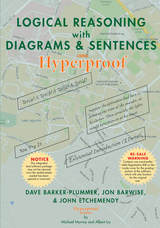
Unlike traditional formal treatments of reasoning, this package uses both graphical and sentential representations to reflect common situations in everyday reasoning where information is expressed in many forms, such as finding your way to a location using a map and an address. It also teaches students how to construct and check the logical validity of a variety of proofs—of consequence and non-consequence, consistency and inconsistency, and independence—using an intuitive proof system which extends standard proof treatments with sentential, graphical, and heterogeneous inference rules, allowing students to focus on proof content rather than syntactic structure. Building upon the widely used Tarski’s World and Language, Proof and Logic courseware packages, Logical Reasoning with Diagrams and Sentences contains more than three hundred exercises, most of which can be assessed by the Grade Grinder online assessment service; is supported by an extensive website through which students and instructors can access online video lectures by the authors; and allows instructors to create their own exercises and assess their students’ work.
Logical Reasoning with Diagrams and Sentences is an expanded revision of the Hyperproof courseware package.
What would something unlike us--a chimpanzee, say, or a computer--have to be able to do to qualify as a possible knower, like us? To answer this question at the very heart of our sense of ourselves, philosophers have long focused on intentionality and have looked to language as a key to this condition. Making It Explicit is an investigation into the nature of language--the social practices that distinguish us as rational, logical creatures--that revises the very terms of this inquiry. Where accounts of the relation between language and mind have traditionally rested on the concept of representation, this book sets out an alternate approach based on inference, and on a conception of certain kinds of implicit assessment that become explicit in language. Making It Explicit is the first attempt to work out in detail a theory that renders linguistic meaning in terms of use--in short, to explain how semantic content can be conferred on expressions and attitudes that are suitably caught up in social practices.
At the center of this enterprise is a notion of discursive commitment. Being able to talk--and so in the fullest sense being able to think--is a matter of mastering the practices that govern such commitments, being able to keep track of one's own commitments and those of others. Assessing the pragmatic significance of speech acts is a matter of explaining the explicit in terms of the implicit. As he traces the inferential structure of the social practices within which things can be made conceptually explicit, the author defines the distinctively expressive role of logical vocabulary. This expressive account of language, mind, and logic is, finally, an account of who we are.
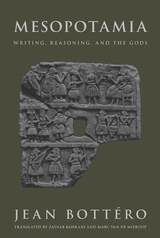
To give the reader some sense of how Mesopotamian civilization has been mediated and interpreted in its transmission through time, Bottero begins with an account of Assyriology, the discipline devoted to the ancient culture. This transmission, compounded with countless discoveries, would not have been possible without the surprising decipherment of the cuneiform writing system. Bottero also focuses on divination in the ancient world, contending that certain modes of worship in Mesopotamia, in their application of causality and proof, prefigure the "scientific mind."

Kroll cultivates a bodily investigation of noncombative argument, offering direct pedagogical strategies anchored in three modalities of learning—conceptual-procedural, kinesthetic, and contemplative—and projects, activities, assignments, informal responses, and final papers for students. Kinesthetic exercises derived from martial arts and contemplative meditation and mindfulness practices are key to the approach, with Kroll specifically using movement as a physical analogy for tactics of arguing.
Collaboration, mediation, and empathy are important yet overlooked values in communicative exchange. This practical, engaging, and accessible guide for teachers contains clear examples and compelling discussions of pedagogical strategies that teach students not only how to write persuasively but also how to deal with personal conflict in their daily lives.
Today we associate prejudice with ignorance and bigotry and consider it a source of injustice. So how can prejudice have a legitimate place in moral and political judgment? In this ambitious work, Adam Sandel shows that prejudice, properly understood, is not an unfortunate obstacle to clear thinking but an essential aspect of it. The aspiration to reason without preconceptions, he argues, is misguided.
Ranging across philosophy from Aristotle to Heidegger and Gadamer, Sandel demonstrates that we inherit our "prejudice against prejudice" from the Enlightenment. By detaching reason from habit and common opinion, thinkers such as Bacon, Descartes, and Kant invented prejudice--as we understand it today--as an obstacle to freedom and a failure to think for oneself.
The Place of Prejudice presents a powerful challenge to this picture. The attempt to purge understanding of culture and history leads not to truth, Sandel warns, but to shallowness and confusion. A purely detached notion of reason deprives judgment of all perspective, disparages political rhetoric as mere pandering, and denies us the background knowledge we need to interpret literature, law, and the past. In a clear, eloquent voice, Sandel presents instead a compelling case for reasoning within the world.
Practical reasoning is not just a matter of determining how to get what you want, but of working out what to want in the first place. In Practical Induction Elijah Millgram argues that experience plays a central role in this process of deciding what is or is not important or worth pursuing. He takes aim at instrumentalism, a view predominant among philosophers today, which holds that the goals of practical reasoning are basic in the sense that they are given by desires that are not themselves the product of practical reasoning. The view Millgram defends is "practical induction," a method of reasoning from experience similar to theoretical induction.
What are the practical observations that teach us what to want? Millgram suggests they are pleasant and unpleasant experiences on the basis of which we form practical judgments about particular cases. By generalizing from these judgments--that is, by practical induction--we rationally arrive at our views about what matters. Learning new priorities from experience is necessary if we are to function in a world of ever-changing circumstances. And we need to be able to learn both from our own and from others' experience. It is this, Millgram contends, that explains the cognitive importance of both our capacity for pain and pleasure and our capacity for love. Pleasure's role in cognition is not that of a goal but that of a guide. Love's role in cognition derives from its relation to our trusting the testimony of others about what does and does not matter and about what merits our desire.
Itself a pleasure to read, this book is full of inventive arguments and conveys Millgram's bold thesis with elegance and force. It will alter the direction of current debates on practical reasoning.

In this original study, Jonathan Jacobs provides a new account of ethical realism that combines both abstract meta-ethical issues defining the debate on realism and concrete topics in moral psychology. Jacobs argues that practical reasoners can both understand the ethical significance of facts and be motivated to act by that understanding. In that sense, objective considerations are prescriptive. In his discussion of the theory of practical realism, he extends themes and claims originating in Aristotelian ethics while engaging with the most important contemporary literature.
Arguing that desire and reason can agree on what is good, Jacobs explains how good action is naturally pleasing to the agent. In acting well, the agent affirms certain values and enjoys doing so. Jacobs grounds his explanation of ethical value in detailed explorations of the moral psychology of self-love, friendship, and respect. Students and scholars of philosophy will be intrigued by this integrated account of meta-ethics, practical reason, and moral psychology.
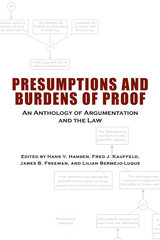
In the last fifty years, the study of argumentation has become one of the most exciting intellectual crossroads in the modern academy. Two of the most central concepts of argumentation theory are presumptions and burdens of proof. Their functions have been explicitly recognized in legal theory since the middle ages, but their pervasive presence in all forms of argumentation and in inquiries beyond the law—including politics, science, religion, philosophy, and interpersonal communication—have been the object of study since the nineteenth century.
However, the documents and essays central to any discussion of presumptions and burdens of proof as devices of argumentation are scattered across a variety of remote sources in rhetoric, law, and philosophy. Presumptions and Burdens of Proof: An Anthology of Argumentation and the Law brings together for the first time key texts relating to the history of the theory of presumptions along with contemporary studies that identify and give insight into the issues facing students and scholars today.
The collection’s first half contains historical sources and begins with excerpts from Aristotle’s Topics and goes on to include the locus classicus chapter from Bishop Whately’s crucial Elements of Rhetoric as well as later reactions to Whately’s views. The second half of the collection contains contemporary essays by contributors from the fields of law, philosophy, rhetoric, and argumentation and communication theory. These essays explore contemporary understandings of presumptions and burdens of proof and their role in numerous contexts today. This anthology is the definitive resource on the subject of these crucial rhetorical modes and will be a vital resource to all scholars of communication and rhetoric, as well as legal scholars and practicing jurists.
Divided into four sections—Conceptual Understandings of The New Rhetoric, Extensions of The New Rhetoric, The Ethical Turn in Perelman and The New Rhetoric, and Uses of The New Rhetoric—this insightful volume covers a wide variety of topics. It includes general assessments of The New Rhetoric and its central concepts, as well as applications of those concepts to innovative areas in which argumentation is being studied, such as scientific reasoning, visual media, and literary texts. Additional essays compare Perelman’s ideas with those of other significant thinkers like Kenneth Burke and Richard McKeon, explore his career as a philosopher and activist, and shed new light on Perelman and Olbrechts- Tyteca’s collaboration. Two contributions present new scholarship based on recent access to letters, interviews, and archival materials housed in the Université Libre de Bruxelles. Among the volume’s unique gifts is a personal memoir from Perelman’s daughter, Noémi Perelman Mattis, published here for the first time.
The Promise of Reason, expertly compiled and edited by John T. Gage, is the first to investigate the pedagogical implications of Perelman and Olbrechts- Tyteca’s groundbreaking work and will lead the way to the next generation of argumentation studies.
"'Is there any other point to which you would wish to draw my attention?' 'To the curious incident of the dog in the night-time.' 'The dog did nothing in the night-time.' 'That was the curious incident,' remarked Sherlock Holmes." The quotation from A. Conan Doyle with which this book begins, is a delightfully appropriate summation of the authors' point of view garnered from their fifteen years of experiments on the psychology of reasoning.
Dr. Wason and Dr. Johnson-Laird are intrigued by the extent to which most individuals can be considered naturally rational thinkers. They present here the surprising results of their comprehensive investigations of how humans draw explicit conclusions from evidence. "Given a set of assertions," the authors write, "to what extent can the individual appreciate all that follows from them by virtue of logic alone, and remain unseduced by plausible, but fallacious conclusions? We are not concerned with whether these assertions are true or false, nor with whether the individual holds them among his beliefs, nor with whether they are sane or silly."
At the core of the Psychology of Reasoning is a vigorous discussion that incorporates various illustrations--some of them humorous, all of them fascinating--of the use of reason under a wide variety of different conditions. Particular emphasis is placed on the difficulties involved in dealing with negatively marked information that must be combined and used with other information for reaching conclusions. Thorough treatment is given as well to the search for plausible contexts that will render anomalous or ambiguous statements "sensible."
The authors have strived to isolate the components of inference, the basic steps of any kind of deductive activity, in order to determine the psychological processes involved in them. What has been the outcome of this research? Dr. Wason and Dr. Johnson-Laird conclude, "our research has suggested that the individual's logical competence may be either enhanced or limited by performance variables. And, of these, content has turned out to be vitally important for revealing, or obscuring structure. At best, we can all think like logicians; at worst, logicians all think like us."
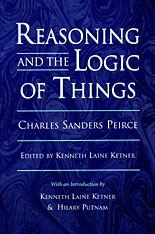
Charles Sanders Peirce (1839–1914) was an American philosopher, physicist, mathematician, and the founder of pragmatism. Despite his importance in the history of philosophy, a unified statement of his thought has been unavailable. With this publication, readers at long last are offered the philosopher’s only known, complete, and coherent account of his own work. Originally delivered as the Cambridge Conferences Lectures of 1898, Reasoning and the Logic of Things is the most accessible and thorough introduction to Peirce’s mature thought to be found within the compass of a single book.
Beginning with an explanation of the nature of philosophy, Peirce proceeds to illustrate his claim that mathematics provides the foundation of our logic and metaphysics. We find here the clearest formulation of an idea present in Peirce’s thought since the 1860s, the distinction between three kinds of reasoning: induction, deduction, and retroduction. Then follows an introduction to Peirce’s chief logical doctrines, as well as his attempts to provide a classification of the sciences, a theory of categories, and a theory of science. In conclusion, turning from “reasoning” to the “logic of things,” Peirce called for an evolutionary cosmology to explain the reality of laws and described the kinds of reasoning he employed in developing this cosmology.
At the urging of his friend William James, Peirce made an uncharacteristic effort in these lectures to present his ideas in terms intelligible to a general audience—those without advanced training in logic and philosophy. The introductory materials by Kenneth Ketner and Hilary Putman add to the volume’s lucidity. Consequently, this book will be a valuable source for readers outside of the circle of Peirce specialists.

Informed in 1944 that she was “not of the sex” entitled to be admitted to Harvard Law School, African American activist Pauli Murray confronted the injustice she called “Jane Crow.” In the 1960s and 1970s, the analogies between sex and race discrimination pioneered by Murray became potent weapons in the battle for women’s rights, as feminists borrowed rhetoric and legal arguments from the civil rights movement. Serena Mayeri’s Reasoning from Race is the first book to explore the development and consequences of this key feminist strategy.
Mayeri uncovers the history of an often misunderstood connection at the heart of American antidiscrimination law. Her study details how a tumultuous political and legal climate transformed the links between race and sex equality, civil rights and feminism. Battles over employment discrimination, school segregation, reproductive freedom, affirmative action, and constitutional change reveal the promise and peril of reasoning from race—and offer a vivid picture of Pauli Murray, Ruth Bader Ginsburg, and others who defined feminists’ agenda.
Looking beneath the surface of Supreme Court opinions to the deliberations of feminist advocates, their opponents, and the legal decision makers who heard—or chose not to hear—their claims, Reasoning from Race showcases previously hidden struggles that continue to shape the scope and meaning of equality under the law.
"One of Michael Blay's many fine achievements in Reasoning with the Infinite is to make us realize how velocity, and later instantaneous velocity, came to play a vital part in the development of a rigorous mathematical science of motion."—Margaret Wertheim, New Scientist
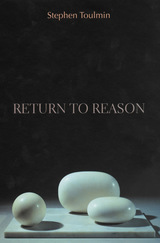
The turmoil and brutality of the twentieth century have made it increasingly difficult to maintain faith in the ability of reason to fashion a stable and peaceful world. After the ravages of global conflict and a Cold War that divided the world's loyalties, how are we to master our doubts and face the twenty-first century with hope?
In Return to Reason, Stephen Toulmin argues that the potential for reason to improve our lives has been hampered by a serious imbalance in our pursuit of knowledge. The centuries-old dominance of rationality, a mathematical mode of reasoning modeled on theory and universal certainties, has diminished the value of reasonableness, a system of humane judgments based on personal experience and practice. To this day, academic disciplines such as economics and professions such as law and medicine often value expert knowledge and abstract models above the testimony of diverse cultures and the practical experience of individuals.
Now, at the beginning of a new century, Toulmin sums up a lifetime of distinguished work and issues a powerful call to redress the balance between rationality and reasonableness. His vision does not reject the valuable fruits of science and technology, but requires awareness of the human consequences of our discoveries. Toulmin argues for the need to confront the challenge of an uncertain and unpredictable world, not with inflexible ideologies and abstract theories, but by returning to a more humane and compassionate form of reason, one that accepts the diversity and complexity that is human nature as an essential beginning for all intellectual inquiry.
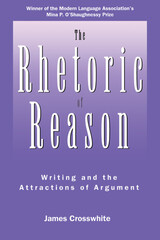
To those who have lost faith in the abilities of people to reach reasoned mutual agreements, and to others who have attacked the right-or-wrong model of formal logic, this book offers the reminder that the rhetorical tradition has always viewed argumentation as a dialogue, a response to changing situations, an exchange of persuading, listening, and understanding. Crosswhite’s aim is to give new purpose to writing instruction and to students’ writing, to reinvest both with the deep ethical interests of the rhetorical tradition. In laying out the elements of argumentation, for example, he shows that claiming, questioning, and giving reasons are not simple elements of formal logic, but communicative acts with complicated ethical features. Students must learn not only how to construct an argument, but the purposes, responsibilities, and consequences of engaging in one.
Crosswhite supports his aims through a rhetorical reconstruction of reason, offering new interpretations of Plato and Aristotle and of the concepts of reflection and dialogue from early modernity through Hegel to Gadamer. And, in his conclusion, he ties these theoretical and historical underpinnings to current problems of higher education, the definition of the liberal arts, and, especially, the teaching of written communication.
Establishes a theoretical context for, and to elaborate the implications of, the claim that argument is a form of interaction in which two or more people maintain what they construe to be incompatible positions
The thesis of this book is that argument is not a kind of logic but a kind of communication—conversation based on disagreement. Claims about the epistemic and political effects of argument get their authority not from logic but from their “fit with the facts” about how communication works. A Theory of Communication thus offers a picture of communication—distilled from elements of symbolic interactionism, personal construct theory, constructivism, and Barbara O’Keefe’s provocative thinking about logics of message design. The picture of argument that emerges from this tapestry is startling, for it forces revisions in thinking about knowledge, rationality, freedom, fallacies, and the structure and content of the argumentation discipline.
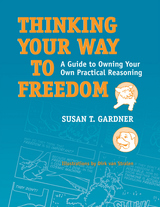
Thinking Your Way to Freedom is a critical-thinking textbook with a difference. Rather than focusing exclusively on improving college students’ academic achievement, Susan Gardner seeks to dramatically change how students think through issues that are important in their lives beyond school. Gardner created 66 original and entertaining comic strips—featuring her dogs, Diva and Ben—that add a light touch as they encourage intellectual and personal autonomy. Through a clear step-by-step method of practical reasoning, students are taught how to think impartially and how to neutralize invisible biases that limit their freedom of thought and action. With the help of Diva and Ben, readers learn to evaluate the strengths of arguments and to recognize fallacies, all the while avoiding the paralyzing effects of relativism.
Thinking Your Way to Freedom includes the writing of short essays so that students can improve their critical thinking and writing at the same time. A Teacher’s Manual for this book will be available online.
The highly engaging introduction to thinking like an economist, updated for a new generation of readers.
When economists wrestle with any social issue—be it unemployment, inflation, healthcare, or crime and punishment—they do so impersonally. The big question for them is: what are the costs and benefits, or trade-offs, of the solutions to such matters? These trade-offs constitute the core of how economists see the world—and make the policies that govern it.
Trade-Offs is an introduction to the economic approach of analyzing controversial policy issues. A useful introduction to the various factors that inform public opinion and policymaking, Trade-Offs is composed of case studies on topics drawn from across contemporary law and society.
Intellectually stimulating yet accessible and entertaining, Trade-Offs will be appreciated by students of economics, public policy, health administration, political science, and law, as well as by anyone following current social policy debates.
Harold Winter provides readers with the analytical tools needed to identify and understand the trade-offs associated with these topics. By considering both the costs and benefits of potential policy solutions, Winter stresses that real-world policy decision making is best served by an explicit recognition of as many trade-offs as possible.
Intellectually stimulating yet accessible and entertaining, Trade-Offs will be appreciated by students of economics, public policy, health administration, political science, and law, as well as by anyone who follows current social policy debates.

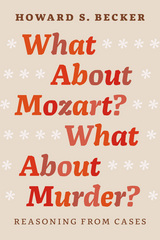
Becker draws on a lifetime of sociological research and wisdom to show, in helpful detail, how to use a variety of kinds of cases to build sociological knowledge. With his trademark conversational flair and informal, personal perspective Becker provides a guide that researchers can use to produce general sociological knowledge through case studies. He champions research that has enough data to go beyond guesswork and urges researchers to avoid what he calls “skeleton cases,” which use fictional stories that pose as scientific evidence. Using his long career as a backdrop, Becker delivers a winning book that will surely change the way scholars in many fields approach their research.
READERS
Browse our collection.
PUBLISHERS
See BiblioVault's publisher services.
STUDENT SERVICES
Files for college accessibility offices.
RECENTLY PUBLISHED






UChicago Accessibility Resources
home | accessibility | search | about | contact us
BiblioVault ® 2001 - 2024
The University of Chicago Press