
 A SCHOLARLY BOOK REPOSITORY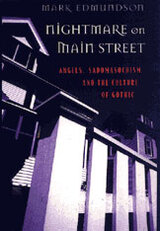
Once we've terrified ourselves reading Anne Rice or Stephen King, watching Halloween or following the O. J. Simpson trial, we can rely on the comfort of our inner child or Robert Bly's bongos, an angel, or even a crystal. In a brilliant assessment of American culture on the eve of the millennium, Mark Edmundson asks why we're determined to be haunted, courting the Gothic at every turn--and, at the same time, committed to escape through any new scheme for ready-made transcendence.
Nightmare on Main Street depicts a culture suffused with the Gothic, not just in novels and films but even in the nonfictive realms of politics and academic theories, TV news and talk shows, various therapies, and discourses on AIDS and the environment. Gothic's first wave, in the 1790s, reflected the truly terrifying events unfolding in revolutionary France. What, Edmundson asks, does the ascendancy of the Gothic in the 1990s tell us about our own day?
And what of another trend, seemingly unrelated--the widespread belief that re-creating oneself is as easy as making a wish? Looking at the world according to Forrest Gump, Edmundson shows how this parallel culture actually works reciprocally with the Gothic.
An unchecked fixation on the Gothic, Edmundson argues, would result in a culture of sadomasochism. Against such a rancorous and dispiriting possibility, he draws on the work of Nietzsche and Shelley, and on the recent creations of Toni Morrison and Tony Kushner, to show how the Gothic and the visionary can come together in persuasive and renovating ways.
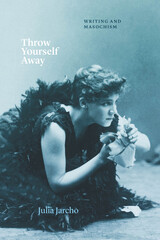
In a series of readings that engage American and European works of fiction, drama, and theory from the late nineteenth through the early twenty-first centuries, critic and playwright Julia Jarcho argues that these works conceive writing itself as masochistic, and masochism as sexuality enacted in writing. Throw Yourself Away is distinctive in its sustained focus on masochism as an engine of literary production across multiple authors and genres. In particular, Jarcho shows that theater has played a central role in modern erotic fantasies of the literary.
Jarcho foregrounds writing as a project of distressed subjects: When masochistic writing is examined as a strategy of response to injurious social systems, it yields a surprisingly feminized—and less uniformly white—image of both masochism and authorship. Ultimately, Jarcho argues that a retheorized concept of masochism helps us understand literature itself as a sex act and shows us how writing can tend to our burdened, desirous bodies. With startling insights into such writers as Henry James, Henrik Ibsen, Mary Gaitskill, and Adrienne Kennedy, Throw Yourself Away furnishes a new masochistic theory of literature itself.
READERS
Browse our collection.
PUBLISHERS
See BiblioVault's publisher services.
STUDENT SERVICES
Files for college accessibility offices.
RECENTLY PUBLISHED




UChicago Accessibility Resources
home | accessibility | search | about | contact us
BiblioVault ® 2001 - 2025
The University of Chicago Press