
 A SCHOLARLY BOOK REPOSITORY
145 books about Sexuality and 6
start with I
145 books about Sexuality and 6
145 books about Sexuality
6 start with I start with I
6 start with I start with I
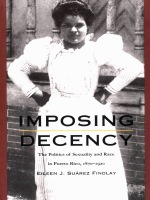
Imposing Decency
The Politics of Sexuality and Race in Puerto Rico, 1870–1920
Eileen J. Suárez Findlay
Duke University Press, 2000
Feminists, socialists, Afro-Puerto Rican activists, and elite politicians join laundresses, prostitutes, and dissatisfied wives in populating the pages of Imposing Decency. Through her analyses of Puerto Rican anti-prostitution campaigns, attempts at reforming marriage, and working-class ideas about free love, Eileen J. Suárez Findlay exposes the race-related double standards of sexual norms and practices in Puerto Rico between 1870 and 1920, the period that witnessed Puerto Rico’s shift from Spanish to U.S. colonialism.
In showing how political projects and alliances in Puerto Rico were affected by racially contingent definitions of “decency” and “disreputability,” Findlay argues that attempts at moral reform and the state’s repression of “sexually dangerous” women were weapons used in batttles between elite and popular, American and Puerto Rican, and black and white. Based on a thorough analysis of popular and elite discourses found in both literature and official archives, Findlay contends that racialized sexual norms and practices were consistently a central component in the construction of social and political orders. The campaigns she analyzes include an attempt at moral reform by elite male liberals and a movement designed to enhance the family and cleanse urban space that ultimately translated into repression against symbollically darkened prostitutes. Findlay also explores how U.S. officials strove to construct a new colonial order by legalizing divorce and how feminist, labor, and Afro-Puerto Rican political demands escalated after World War I, often focusing on the rehabilitation and defense of prostitutes.
Imposing Decency forces us to rethink previous interpretations of political chronologies as well as reigning conceptualizations of both liberalism and the early working-class in Puerto Rico. Her work will appeal to scholars with an interest in Puerto Rican or Latin American studies, sexuality and national identity, women in Latin America, and general women’s studies.
In showing how political projects and alliances in Puerto Rico were affected by racially contingent definitions of “decency” and “disreputability,” Findlay argues that attempts at moral reform and the state’s repression of “sexually dangerous” women were weapons used in batttles between elite and popular, American and Puerto Rican, and black and white. Based on a thorough analysis of popular and elite discourses found in both literature and official archives, Findlay contends that racialized sexual norms and practices were consistently a central component in the construction of social and political orders. The campaigns she analyzes include an attempt at moral reform by elite male liberals and a movement designed to enhance the family and cleanse urban space that ultimately translated into repression against symbollically darkened prostitutes. Findlay also explores how U.S. officials strove to construct a new colonial order by legalizing divorce and how feminist, labor, and Afro-Puerto Rican political demands escalated after World War I, often focusing on the rehabilitation and defense of prostitutes.
Imposing Decency forces us to rethink previous interpretations of political chronologies as well as reigning conceptualizations of both liberalism and the early working-class in Puerto Rico. Her work will appeal to scholars with an interest in Puerto Rican or Latin American studies, sexuality and national identity, women in Latin America, and general women’s studies.
[more]

Inclusion in New Danish Cinema
Sexuality and Transnational Belonging
Meryl Shriver-Rice
Intellect Books, 2015
Often recognized as one of the happiest countries in the world, Denmark, like its Scandinavian neighbors, is known for its progressive culture, which is also reflected in its national cinema. It is not surprising, then, that Danish film boasts as many successful women film directors as men, uses scripts that are often cowritten by the director and the screenwriter, and produces one of the largest numbers of queer films directed by and starring women. Despite all this, Danish film is not widely written about, especially in English. Inclusion in New Danish Cinema brings this vibrant culture to English-language audiences. Meryl Shriver-Rice argues that Denmark has demonstrated that film can reinforce cultural ethics and political values while also navigating the ongoing and mounting forces of digital communication and globalization.
[more]
Intimate Matters
A History of Sexuality in America
John D'Emilio and Estelle B. Freedman
University of Chicago Press, 1997
The first full length study of the history of sexuality in America, Intimate Matters offers trenchant insights into the sexual behavior of Americans, from colonial times to today. D'Emilio and Freedman give us a deeper understanding of how sexuality has dramatically influenced politics and culture throughout our history.
"The book John D'Emilio co-wrote with Estelle B. Freedman, Intimate Matters, was cited by Supreme Court Justice Anthony Kennedy when, writing for a majority of court on July 26, he and his colleagues struck down a Texas law criminalizing sodomy. The decision was widely hailed as a victory for gay rights—and it derived in part, according to Kennedy's written comments, from the information he gleaned from D'Emilio's book, which traces the history of American perspectives on sexual relationships from the nation's founding through the present day. The justice mentioned Intimate Matters specifically in the court's decision."—Julia Keller, Chicago Tribune
"Fascinating. . . . [D'Emilio and Freedman] marshall their material to chart a gradual but decisive shift in the way Americans have understood sex and its meaning in their lives." —Barbara Ehrenreich, New York Times Book Review
"With comprehensiveness and care . . . D'Emilio and Freedman have surveyed the sexual patterns for an entire nation across four centuries." —Martin Bauml Duberman, Nation
"Intimate Matters is comprehensive, meticulous and intelligent." —Jonathan Yardley, Washington Post Book World
"This book is remarkable. . . . [Intimate Matters] is bound to become the definitive survey of American sexual history for years to come." —Roy Porter, Journal of the History of the Behavioral Sciences
"The book John D'Emilio co-wrote with Estelle B. Freedman, Intimate Matters, was cited by Supreme Court Justice Anthony Kennedy when, writing for a majority of court on July 26, he and his colleagues struck down a Texas law criminalizing sodomy. The decision was widely hailed as a victory for gay rights—and it derived in part, according to Kennedy's written comments, from the information he gleaned from D'Emilio's book, which traces the history of American perspectives on sexual relationships from the nation's founding through the present day. The justice mentioned Intimate Matters specifically in the court's decision."—Julia Keller, Chicago Tribune
"Fascinating. . . . [D'Emilio and Freedman] marshall their material to chart a gradual but decisive shift in the way Americans have understood sex and its meaning in their lives." —Barbara Ehrenreich, New York Times Book Review
"With comprehensiveness and care . . . D'Emilio and Freedman have surveyed the sexual patterns for an entire nation across four centuries." —Martin Bauml Duberman, Nation
"Intimate Matters is comprehensive, meticulous and intelligent." —Jonathan Yardley, Washington Post Book World
"This book is remarkable. . . . [Intimate Matters] is bound to become the definitive survey of American sexual history for years to come." —Roy Porter, Journal of the History of the Behavioral Sciences
[more]
Intimate Matters
A History of Sexuality in America, Third Edition
John D'Emilio and Estelle B. Freedman
University of Chicago Press, 2012
As the first full-length study of the history of sexuality in America, Intimate Matters offered trenchant insights into the sexual behavior of Americans from colonial times to the present. Now, twenty-five years after its first publication, this groundbreaking classic is back in a crucial and updated third edition. With new and extended chapters, D’Emilio and Freedman give us an even deeper understanding of how sexuality has dramatically influenced politics and culture throughout our history and into the present.
Hailed by critics for its comprehensive approach and noted by the US Supreme Court in the landmark Lawrence v. Texas ruling, this expanded new edition of Intimate Matters details the changes in sexuality and the ongoing growth of individual freedoms in the United States through meticulous research and lucid prose.
Praise for earlier editions
“The book John D’Emilio co-wrote with Estelle B. Freedman, Intimate Matters, was cited by Supreme Court Justice Anthony Kennedy when, writing for a majority of court on July 26, he and his colleagues struck down a Texas law criminalizing sodomy. The decision was widely hailed as a victory for gay rights—and it derived in part, according to Kennedy's written comments, from the information he gleaned from this book.”—Julia Keller, Chicago Tribune
“Fascinating. . . . D’Emilio and Freedman marshal their material to chart a gradual but decisive shift in the way Americans have understood sex and its meaning in their lives.” —Barbara Ehrenreich, New York Times Book Review
“With comprehensiveness and care . . . D’Emilio and Freedman have surveyed the sexual patterns for an entire nation across four centuries.” —Martin Bauml Duberman, Nation
[more]
Intimate States
Gender, Sexuality, and Governance in Modern US History
Edited by Margot Canaday, Nancy F. Cott, and Robert O. Self
University of Chicago Press, 2021
Fourteen essays examine the unexpected relationships between government power and intimate life in the last 150 years of United States history.
The last few decades have seen a surge of historical scholarship that analyzes state power and expands our understanding of governmental authority and the ways we experience it. At the same time, studies of the history of intimate life—marriage, sexuality, child-rearing, and family—also have blossomed. Yet these two literatures have not been considered together in a sustained way. This book, edited and introduced by three preeminent American historians, aims to close this gap, offering powerful analyses of the relationship between state power and intimate experience in the United States from the Civil War to the present.
The fourteen essays that make up Intimate States argue that “intimate governance”—the binding of private daily experience to the apparatus of the state—should be central to our understanding of modern American history. Our personal experiences have been controlled and arranged by the state in ways we often don’t even see, the authors and editors argue; correspondingly, contemporary government has been profoundly shaped by its approaches and responses to the contours of intimate life, and its power has become so deeply embedded into daily social life that it is largely indistinguishable from society itself. Intimate States makes a persuasive case that the state is always with us, even in our most seemingly private moments.
The last few decades have seen a surge of historical scholarship that analyzes state power and expands our understanding of governmental authority and the ways we experience it. At the same time, studies of the history of intimate life—marriage, sexuality, child-rearing, and family—also have blossomed. Yet these two literatures have not been considered together in a sustained way. This book, edited and introduced by three preeminent American historians, aims to close this gap, offering powerful analyses of the relationship between state power and intimate experience in the United States from the Civil War to the present.
The fourteen essays that make up Intimate States argue that “intimate governance”—the binding of private daily experience to the apparatus of the state—should be central to our understanding of modern American history. Our personal experiences have been controlled and arranged by the state in ways we often don’t even see, the authors and editors argue; correspondingly, contemporary government has been profoundly shaped by its approaches and responses to the contours of intimate life, and its power has become so deeply embedded into daily social life that it is largely indistinguishable from society itself. Intimate States makes a persuasive case that the state is always with us, even in our most seemingly private moments.
[more]
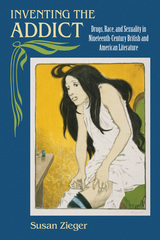
Inventing the Addict
Drugs, Race, and Sexuality in Nineteenth-Century British and American Literature
Susan Zieger
University of Massachusetts Press, 2008
The notion of addiction has always conjured first-person stories, often beginning with an insidious seduction, followed by compulsion and despair, culminating in recovery and tentative hope for the future. We are all familiar with this form of individual life arrative, Susan Zieger observes, but we know far less about its history. "Addict" was not an available identity until the end of the nineteenth century, when a modernizing medical establishment and burgeoning culture of consumption updated the figure of the sinful drunkard popularized by the temperance movement.
In Inventing the Addict, Zieger tells the story of how the addict, a person uniquely torn between disease and desire, emerged from a variety of earlier figures such as drunkards, opium-eating scholars, vicious slave masters, dissipated New Women, and queer doctors. Drawing on a broad range of literary and cultural material, including canonical novels such as Uncle Tom's Cabin, The Strange Case of Dr. Jekyll and Mr. Hyde, and Dracula, she traces the evolution of the concept of addiction through a series of recurrent metaphors: exile, self-enslavement, disease, and vampirism. She shows how addiction took on multiple meanings beyond its common association with intoxication or specific habit-forming substances—it was an abiding desire akin to both sexual attraction and commodity fetishism, a disease that strangely failed to meet the requirements of pathology, and the citizen's ironic refusal to fulfill the promise of freedom.
Nor was addiction an ideologically neutral idea. As Zieger demonstrates, it took form over time through specific, shifting intersections of gender, race, class, and sexuality, reflecting the role of social power in the construction of meaning.
In Inventing the Addict, Zieger tells the story of how the addict, a person uniquely torn between disease and desire, emerged from a variety of earlier figures such as drunkards, opium-eating scholars, vicious slave masters, dissipated New Women, and queer doctors. Drawing on a broad range of literary and cultural material, including canonical novels such as Uncle Tom's Cabin, The Strange Case of Dr. Jekyll and Mr. Hyde, and Dracula, she traces the evolution of the concept of addiction through a series of recurrent metaphors: exile, self-enslavement, disease, and vampirism. She shows how addiction took on multiple meanings beyond its common association with intoxication or specific habit-forming substances—it was an abiding desire akin to both sexual attraction and commodity fetishism, a disease that strangely failed to meet the requirements of pathology, and the citizen's ironic refusal to fulfill the promise of freedom.
Nor was addiction an ideologically neutral idea. As Zieger demonstrates, it took form over time through specific, shifting intersections of gender, race, class, and sexuality, reflecting the role of social power in the construction of meaning.
[more]
READERS
Browse our collection.
PUBLISHERS
See BiblioVault's publisher services.
STUDENT SERVICES
Files for college accessibility offices.
RECENTLY PUBLISHED






UChicago Accessibility Resources
home | accessibility | search | about | contact us
BiblioVault ® 2001 - 2024
The University of Chicago Press