
 A SCHOLARLY BOOK REPOSITORY
8 start with M start with M
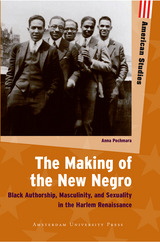
The Making of the New Negro examines black masculinity in the period of the Harlem Renaissance, a cultural movement that spanned the 1920s and 1930s in America and was marked by an outpouring of African American art, music, theater and literature. The Harlem Renaissance, or New Negro Movement, began attracting extensive academic attention in the 1990s as scholars discovered how complex, significant, and fascinating it was.

Oudshoorn emphasizes that the introduction of contraceptives for men depends to a great extent on changing ideas about reproductive responsibility. Initial interest in the male pill, she shows, came from outside the scientific community: from the governments of China and India, which were interested in population control, and from Western feminists, who wanted the responsibilities and health risks associated with contraception shared more equally between the sexes. She documents how in the 1970s, the World Health Organization took the lead in investigating male contraceptives by coordinating an unprecedented, worldwide research network. She chronicles how the search for a male pill required significant reorganization of drug-testing standards and protocols and of the family-planning infrastructure—including founding special clinics for men, creating separate spaces for men within existing clinics, enrolling new professionals, and defining new categories of patients. The Male Pill is ultimately a story as much about the design of masculinities in the last decades of the twentieth century as it is about the development of safe and effective technologies.
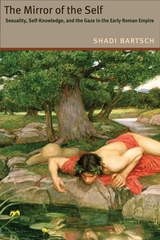
Weaving together literary theory, philosophy, and social history, Bartsch traces this complex notion of self from Plato’s Greece to Seneca’s Rome. She starts by showing how ancient authors envisioned the mirror as both a tool for ethical self-improvement and, paradoxically, a sign of erotic self-indulgence. Her reading of the Phaedrus, for example, demonstrates that the mirroring gaze in Plato, because of its sexual possibilities, could not be adopted by Roman philosophers and their students. Bartsch goes on to examine the Roman treatment of the ethical and sexual gaze, and she traces how self-knowledge, the philosopher’s body, and the performance of virtue all played a role in shaping the Roman understanding of the nature of selfhood. Culminating in a profoundly original reading of Medea, The Mirror of the Self illustrates how Seneca, in his Stoic quest for self-knowledge, embodies the Roman view, marking a new point in human thought about self-perception.
Bartsch leads readers on a journey that unveils divided selves, moral hypocrisy, and lustful Stoics—and offers fresh insights about seminal works. At once sexy and philosophical, The Mirror of the Self will be required reading for classicists, philosophers, and anthropologists alike.
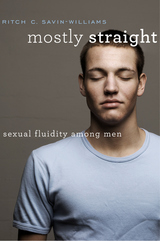
Most of us assume that sexuality is fixed: either you’re straight, gay, or bisexual. Yet an increasing number of young men today say that those categories are too rigid. They are, they insist, “mostly straight.” They’re straight, but they feel a slight but enduring romantic or sexual desire for men. To the uninitiated, this may not make sense. How can a man be “mostly” straight? Ritch Savin-Williams introduces us to this new world by bringing us the stories of young men who consider themselves to be mostly straight or sexually fluid. By hearing about their lives, we discover a radically new way of understanding sexual and romantic development that upends what we thought we knew about men.
Today there are more mostly straight young men than there are gay and bisexual young men combined. Based on cutting-edge research, Savin-Williams explores the personal stories of forty young men to help us understand the biological and psychological factors that led them to become mostly straight and the cultural forces that are loosening the sexual bind that many boys and young men experience. These young men tell us how their lives have been influenced by their “drop of gayness,” from their earliest sexual memories and crushes to their sexual behavior as teenagers and their relationships as young adults. Mostly Straight shows us how these young men are forging a new personal identity that confounds both traditional ideas and conventional scientific opinion.
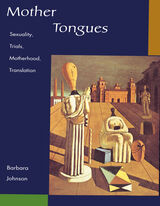
Charles Baudelaire, Walter Benjamin, and Sylvia Plath make up the odd trio on which this book is based. It is in the surprising and revealing links between them--links pertaining to troublesome mothers, elusive foreign languages, and professional disappointments--that Barbara Johnson maps the coordinates of her larger claims about the ideal of oneness in every area of life, and about the damage done by this ideal.
The existence of sexual difference precludes an original or ultimate "one" who would represent all of mankind; the plurality of languages makes it impossible to think that one doesn't live in translation; and the plurality of the sexes means that every human being came from a woman's body, and some will reproduce this feat, while others won't. In her most personal and deeply considered book about difference, Johnson asks: Is the mother the guardian of a oneness we have never had? The relations that link mothers, bodies, words, and laws serve as the guiding puzzles as she searches for an answer.
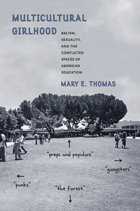
High school turf wars are often a teenage rite of passage, but there are extremes—as when a race riot at a Los Angeles campus in the spring of 2005 resulted in a police lockdown. In her fascinating book,Multicultural Girlhood, Mary Thomas interviewed 26 Latina, Armenian, Filipina, African-American, and Anglo girls at this high school to gauge their responses to the campus violence. They all denounced the outbreak, calling for multicultural understanding and peaceful coexistence.
However, as much as the girls want everyone to just “get along,” they also exhibit strong racist beliefs and validate segregated social spaces on campus and beyond. How can teenagers and “girl power” work together to empower instead of alienate multicultural groups? In her perceptive book, Thomas foregrounds the spaces of teen girlhood and the role that space plays in girls' practices that perpetuate social difference, and she explains the ways we navigate the intellectual terrain between scholarship and school yard.
READERS
Browse our collection.
PUBLISHERS
See BiblioVault's publisher services.
STUDENT SERVICES
Files for college accessibility offices.
RECENTLY PUBLISHED






UChicago Accessibility Resources
home | accessibility | search | about | contact us
BiblioVault ® 2001 - 2024
The University of Chicago Press