
 A SCHOLARLY BOOK REPOSITORY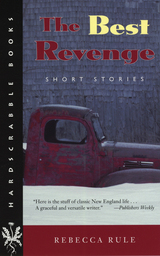
Twice nominated for the Pushcart Prize, Rule captures the essence of small-town New England life as she paints with a sure hand the fallings-out and friendships, the trials and triumphs of the New England microcosm. In Yankee Curse, elderly Miranda knits placidly at a town meeting, pondering an amazing string of unspoken invective against an enemy but stopping short at a curse she would never levy, not even on Mort Wallace: to live too long. In Minna Runs for Selectman, a middle-aged woman's battlefield is the strange, incestuous politics of this eccentric little town but her real opponent is her own insecurity. In Jim's Boat a young couple wages a silent struggle over priorities in their marriage; in Fishing with George a small girl worries that there's a hole in our family that gets bigger every time her parents argue; and in the title story a mother copes with a hated neighbor through a sculpture that makes her laugh the kind of laugh that doesn't end in a sob. Children and grandmothers, trappers and college professors, lifetime Yankees or transplanted Flatlanders: each finds the truth in Rule's observation that revenge takes many forms -- some of which can heal.
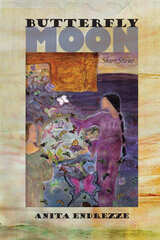
Anita Endrezze has deep memories. Her father was a Yaqui Indian. Her mother traced her heritage to Slovenia, Germany, Romania, and Italy. And her stories seem to bubble up from this ancestral cauldron. Butterfly Moon is a collection of short stories based on folk tales from around the world. But its stories are set in the contemporary, everyday world. Or are they?
Endrezze tells these stories in a distinctive and poetic voice. Fantasy often intrudes into reality. Alternate “realities” and shifting perspectives lead us to question our own perceptions. Endrezze is especially interested in how humans hide feelings or repress thoughts by developing shadow selves. In “Raven’s Moon,” she introduces the shadow concept with a Black Moon, the “unseen reflection of the known.” (Of course the story is about a witch couple who seem very much in love.) The title character in “The Wife Who Lived on Wind” is an ogress who lives in a world somewhat similar to our own, but only somewhat. “The Vampire and the Moth Woman” reveals shape-shifters living among us.
Not surprisingly, Trickster appears in these tales. As in Native American stories, Trickster might be a fox or a coyote or a raven or a human—or something in between. “White Butterflies” and “Where the Bones Are” both deal with devastating diseases that swept through Yaqui country in the 1530s. Underneath their surfaces are old Yaqui folktales that feature the greatest Trickster of all: Death (and his little brother Fate).
Enjoyably disturbing, these stories linger—deep in our memory.

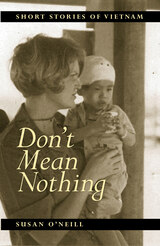
For American nurses in Vietnam, and the men among whom they worked and lived, a common defense against the steady onslaught of dead and dying, wounded and maimed, was a feigned indifference—the irony of the powerless. With the assistance of alcohol, drugs, and casual sex, "Don't mean nothing" became their mantra, a means of coping with the other war—the war against total mental breakdown.
Each or these tales offers new and profound insight into the ways the war in Vietnam forever changed the lives of everyone who served there.
-Lesley Jorbin, Cleveland State Univ. Lib.
Copyright 1991 Reed Business Information, Inc.
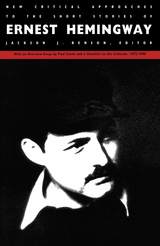
New Critical Approaches to the Short Stories of Ernest Hemingway is an all-new sequel to Benson’s highly acclaimed 1975 book, which provided the first comprehensive anthology of criticism of Ernest Hemingway’s masterful short stories. Since that time the availability of Hemingway’s papers, coupled with new critical and theoretical approaches, has enlivened and enlarged the field of American literary studies. This companion volume reflects current scholarship and draws together essays that were either published during the past decade or written for this collection.
The contributors interpret a variety of individual stories from a number of different critical points of view—from a Lacanian reading of Hemingway’s “After the Storm” to a semiotic analysis of “A Very Short Story” to an historical-biographical analysis of “Old Man at the Bridge.” In identifying the short story as one of Hemingway’s principal thematic and technical tools, this volume reaffirms a focus on the short story as Hemingway’s best work. An overview essay covers Hemingway criticism published since the last volume, and the bibliographical checklist to Hemingway short fiction criticism, which covers 1975 to mid-1989, has doubled in size.
Contributors. Debra A. Moddelmog, Ben Stotzfus, Robert Scholes, Hubert Zapf, Susan F. Beegel, Nina Baym, William Braasch Watson, Kenneth Lynn, Gerry Brenner, Steven K. Hoffman, E. R. Hagemann, Robert W. Lewis, Wayne Kvam, George Monteiro, Scott Donaldson, Bernard Oldsey, Warren Bennett, Kenneth G. Johnston, Richard McCann, Robert P. Weeks, Amberys R. Whittle, Pamela Smiley, Jeffrey Meyers, Robert E. Fleming, David R. Johnson, Howard L. Hannum, Larry Edgerton, William Adair, Alice Hall Petry, Lawrence H. Martin Jr., Paul Smith

The first edition of May’s Short Story Theories (1976) opened with an essay entitled “The Short Story: An Underrated Art.” Almost two decades later, the short story suffers no such slight. Publishers and critics have become increasingly interested in the form, which has enjoyed a renaissance led by such writers as Raymond Carver, Tobias Wolff, Ann Beattie, Bobbie Ann Mason, and Mary Robison. An important part of this revival of interest, Short Story Theories has continued to attract a strong and loyal audience among students and teachers.
The New Short Story Theories includes a few basic pieces from the earlier volume—Poe’s Hawthorne review, Brander Matthew’s extension and formalization of Poe’s theories, and essays by Randall Jarrell, Elizabeth Bowen, and Nadine Gordimer—but most of the essays are new to the collection.
Addressing problems of definition, historical considerations, issues of technique, and cognitive approaches, essays include:
“The Tale as Genre in Short Story Fiction,” by W. S. Penn
“O. Henry and the Theory of the Short Story,” by Suzanne C. Ferguson
“On Writing,” by Raymond Carver
“From Tale to Short Story,” by Robert F. Marler
“A Cognitive Approach to Storyness,” by Susan Lohafer
May’s new collection will continue to highlight the short story, to provoke debate, and to enrich our experience of a demanding and rewarding literary form.

An unhappily married woman is impregnated by her elderly neighbor who lives in a building across the street and with whom she has never had any physical contact. Just as his attention creates life within her, his own life waxes and wanes with her gaze and attention.
A man finds himself trapped in a pub on a sweltering afternoon after refusing to buy a beer with his cigarettes. Guarded by a vigilante bartender and his beer-obsessed patrons, his every attempt at escape is foiled until their life-giving elixir, the beer, runs out.
This collection introduces English-language readers to the work of Dušan Mitana, a cult figure in contemporary Central European literature. In Mitana’s stories, appearing in English for the first time, the rational and the irrational are indistinguishable. His tales infect a banal, quotidian realism with mystical and supernatural distortions. Tinged with Hitchcockian paranoia and full of unexpected turns, the seventeen stories collected here offer a glimpse into Mitana’s trademark absurdist style.
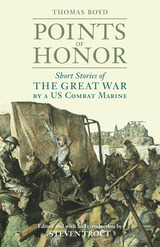
Points of Honor: Short Stories of the Great War by a US Combat Marine is based on author Thomas Alexander Boyd’s personal experiences as an enlisted Marine. First published in 1925 and long out of print, this edition rescues from obscurity a vivid, kaleidoscopic vision of American soldiers, US Marines mostly, serving in a global conflict a century ago. It is a true forgotten masterpiece of World War I literature.
The stories in Points of Honor deal almost entirely with Marines in the midst of battle—or faced with the consequences of military violence. The eleven stories in this collection offer a panoramic view of war experience and its aftermath, what Boyd described as “a mass of more human happenings.” The themes are often antiheroic: dehumanization, pettiness, betrayal by loved ones at home, and the cruelty of military justice. But Boyd’s vision also accommodates courage and loyalty. Like all great works of war literature, this collection underscores the central paradox of armed conflict—its ability to bring out both the best and worst in human beings.
This reissue of Points of Honor is edited, annotated, and introduced by Steven Trout. Trout provides an overview of Thomas Boyd’s war experience and writing career and situates the stories within the broader context of World War I American literature.
Points of Honor received strong reviews at the time of its initial publication and remains an overwhelming reading experience today. While each of the stories is a freestanding work of art, when read together they carry the force of a novel.
A Prescription for Adversity makes the revolutionary case that Ambrose Bierce, far from being a bitter misanthrope, was instead both a compassionate and moral author. Berkove, focusing on Bierce's short fiction, establishes the necessity of recognizing the pattern of his intellectual and literary development over the course of his career. The author shows that Bierce, probably the American author with the most extensive experience of the Civil War, turned to classical Stoicism and English and French Enlightenment literature in his postwar search for meaning. Bierce's fiction arose from his ultimately unsatisfying encounters with the philosophies those sources offered, but the moral commitment as well as the literary techniques of heir authors, particularly Jonathan Swift, inspired him. Dating Bierce's fiction, and introducing uncollected journalism, correspondence, and important new literary history and biographical information, Berkove brings new insights to a number of stories, including "A Son of the Gods" and "A Horseman in the Sky," but especially "An Occurrence at Owl Creek Bridge," and presents compelling readings of the Parenticide Club tales and "Moxon's Master." A Prescription for Adversity substantiates how Bierce at his best is one of the few American authors who rises to the level of Mark Twain, and the only one who touches Jonathan Swift.
A work of both biography and literary criticism, this book rescues Ambrose Bierce and his literature from the neglect to which it has been assigned by "ill-founded, obtuse and unproductive approaches based on skewed notions of his personality and forced or facile readings of individual stories."
One of the most interesting figures to emerge at the turn of the twentieth century was Ambrose Bierce, whose acerbic columns in the San Francisco Examiner spread his fame as America’s most bitter cynic and misanthrope, and whose disappearance into Mexico surrounded his name with an aura of mystery.
Although best known during his lifetime for his journalism and always critical of his own writing—“the magnificent intention mocked by the actual achievement”—Bierce’s fiction endures, especially his short stories about the Civil War. Originally published in the 1890s and rediscovered in the 1920s, the Civil War stories are filled with unsparing descriptions of death and suffering, disillusionment and fatalism. They also show a concern for form and craftsmanship, a controlled irony, and an economy of detail that are distinctly modern.
In this pioneering study of Bierce’s stories, Stuart Woodruff examines the best and worst of Bierce’s fiction with clarity and excellent critical sense, and he traces the causes of Bierce’s success and failure as a writer, analyzing his inability to reconcile the extremes of temperament and belief that marked his life and give his stories their characteristic form.
Among the pieces discussed: “An Occurrence at Owl Creek Bridge,” “The Mocking-bird,” “One of the Missing,” “Chickamauga,” “Haïta the Shepherd,” “What I Saw at Shiloh,” and excerpts from The Devil’s Dictionary and Tales of Soldiers and Civilians.
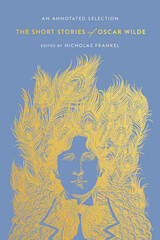
An innovative new edition of nine classic short stories from one of the greatest writers of the Victorian era.
“I cannot think other than in stories,” Oscar Wilde once confessed to his friend André Gide. In this new selection of his short fiction, Wilde’s gifts as a storyteller are on full display, accompanied by informative facing-page annotations from Wilde biographer and scholar Nicholas Frankel. A wide-ranging introduction brings readers into the world from which the author drew inspiration.
Each story in the collection brims with Wilde’s trademark wit, style, and sharp social criticism. Many are reputed to have been written for children, although Wilde insisted this was not true and that his stories would appeal to all “those who have kept the childlike faculties of wonder and joy.” “Lord Arthur Savile’s Crime” stands alongside Wilde’s comic masterpiece The Importance of Being Earnest, while other stories—including “The Happy Prince,” the tale of a young ruler who had never known sorrow, and “The Nightingale and the Rose,” the story of a nightingale who sacrifices herself for true love—embrace the theme of tragic, forbidden love and are driven by an undercurrent of seriousness, even despair, at the repressive social and sexual values of Wilde’s day. Like his later writings, Wilde’s stories are a sweeping indictment of the society that would imprison him for his homosexuality in 1895, five years before his death at the age of forty-six.
Published here in the form in which Victorian readers first encountered them, Wilde’s short stories contain much that appeals to modern readers of vastly different ages and temperaments. They are the perfect distillation of one of the Victorian era’s most remarkable writers.

Southern writer and folklorist Kelly Kazek’s collection of eerie and enigmatic Alabama ghost stories

Ross Chambers shifs the emphasis to precisely the play of authority and mastery by focusing on the narrative situation or the “point” of telling a story in given context. He studies the relation between teller and listener in a set of French, English, and American short stories from the nineteenth and early twentieth centuries and detects in that relationship the key to the power of fiction. In each of these stories, the author identifies the narrative situation by recourse to the metaphor of seduction, a phenomenon Chambers finds characteristic of literary production in the modern period.
“Story and Situation is a powerful work of criticism, the best work in short narrative I know, and will redirect critics’ attention to a form which has always engaged readers but has recently been neglected by literary theorists. . . . It is clear, assured, and intelligently paced.”-Jonathan Culler, Cornell University
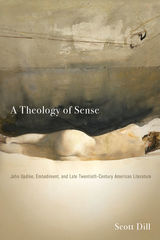
Dill explores Updike’s unique literary legacy in order to argue for a genuinely postsecular theory of aesthetic experience. Each chapter takes up one of the five senses and its relation to broader theoretical concerns: affect, subjectivity, ontology, ethics, and theology. While placing Updike’s work in relation to other late twentieth-century American writers, Dill explains their notions of embodiment and uses them to render a new account of postsecular aesthetics. No other novelist has portrayed mere sense experience as carefully, as extensively, or as theologically—repeatedly turning to the doctrine of creation as his stylistic justification. Across this examination of his many stories, novels, poems, and essays, Dill proves that Updike forces us to reconsider the power of literature to revitalize sense experience as a theological question.

The Wine of Eternity was first published in 1957. Minnesota Archive Editions uses digital technology to make long-unavailable books once again accessible, and are published unaltered from the original University of Minnesota Press editions.
Ever since the small Baltic nation of Latvia became a part of the Soviet Union in 1940, its identity has been blurred to Western eyes. Many of its people have left their country in voluntary or forced exile. But, wherever they are today, the Latvians still cherish and preserve a rich national heritage of folklore and culture. Much of this is revealed in these stories, the work of an established Latvian writer who became a wartime refugee from his country.
This volume makes the work of Knuts Lesins available in English for the first time, although his writing has been published extensively in Europe in the original Latvian. In addition to the stories, the author provides a background sketch of the history and culture of Latvia. While much of the fascinating folklore of the country is interwoven in the stories, they are not primarily folk tales. They are perhaps best described as penetrating glimpses into human lives at moments of crisis or decision which reveal an individual's character and philosophy.
READERS
Browse our collection.
PUBLISHERS
See BiblioVault's publisher services.
STUDENT SERVICES
Files for college accessibility offices.
RECENTLY PUBLISHED


UChicago Accessibility Resources
home | accessibility | search | about | contact us
BiblioVault ® 2001 - 2024
The University of Chicago Press