
 A SCHOLARLY BOOK REPOSITORY
With the election of our first black president, many Americans began to argue that we had finally ended racism, claiming that we now live in a postracial era. Yet near-daily news reports regularly invoke white as a demographic category and recount instances of racialized violence as well as an increased sensitivity to expressions of racial unrest. Clearly, American society isn’t as color-blind as people would like to believe. In Rhetorics of Whiteness: Postracial Hauntings in Popular Culture, Social Media, and Education, contributors reveal how identifications with racialized whiteness continue to manifest themselves in American culture.
The sixteen essays that comprise this collection not only render visible how racialized whiteness infiltrates new twenty-first-century discourses and material spaces but also offer critical tactics for disrupting this normative whiteness. Specifically, contributors examine popular culture (novels, films, TV), social media (YouTube, eHarmony, Facebook), education (state law, the textbook industry, dual credit programs), pedagogy (tactics for teaching via narratives, emotional literacy, and mindfulness) as well as cultural theories (concepts of racialized space, anti-dialogicism, and color blindness). Offering new approaches to understanding racialized whiteness, this volume emphasizes the importance of a rhetorical lens for employing whiteness studies’ theories and methods to identify, analyze, interpret, and interrupt representations of whiteness.
Although whiteness studies has been waning as an active research field for the past decade, the contributors to Rhetorics of Whiteness assert that it hasn’t lost its relevancy because racialized whiteness and issues of systemic racism persist in American society and culture today. Few whiteness studies texts have been published in rhetoric and composition in the past decade, so this collection should quickly become mandatory reading. By focusing on common, yet often overlooked, contemporary examples of how racialized whiteness haunts U.S. society, Rhetorics of Whiteness serves as a valuable text for scholars in the field as well as anyone else interested in the topic.
In Algorithmic Desire, Matthew Flisfeder shows that social media is a metaphor that reveals the dominant form of contemporary ideology: neoliberal capitalism. The preeminent medium of our time, social media’s digital platform and algorithmic logic shape our experience of democracy, enjoyment, and desire. Weaving between critical theory and analyses of popular culture, Flisfeder uses examples from The King’s Speech, Black Mirror, Gone Girl, The Circle, and Arrival to argue that social media highlights the antisocial dimensions of twenty‑first-century capitalism. He counters leading critical theories of social media—such as new materialism and accelerationism—and thinkers such as Gilles Deleuze and Michel Foucault, proposing instead a new structuralist account of the ideology and metaphor of social media. Emphasizing the structural role of crises, gaps, and negativity as central to our experiences of reality, Flisfeder interprets the social media metaphor through a combination of dialectical, Marxist, and Lacanian frameworks to show that algorithms may indeed read our desire, but capitalism, not social media, truly makes us antisocial. Wholly original in its interdisciplinary approach to social media and ideology, Flisfeder’s conception of “algorithmic desire” is timely, intriguing, and sure to inspire debate.
Crowdsourcing is a term that was coined in 2006 to describe how the commercial sector was beginning to outsource problems or tasks to the public through an open call for solutions over the internet or social media. Crowdsourcing works to generate new ideas or develop innovative solutions to problems by drawing on the wisdom of the many rather than the few. US local government experimented with rudimentary crowdsourcing strategies as early as 1989, but in the last few years local, state, and federal government have increasingly turned to crowdsourcing to enhance citizen participation in problem solving, setting priorities, and decision making. While crowdsourcing in the public sector holds much promise and is part of a larger movement toward more citizen participation in democratic government, many challenges, especially legal and ethical issues, need to be addressed to successfully adapt it for use in the public sector.
Daren C. Brabham has been at the forefront of the academic study of crowdsourcing. This book includes extensive interviews with public and private sector managers who have used crowdsourcing. Brabham concludes with a list of the top ten best practices for public managers.

Peck argues that the story of the Slender Man is really a story about the changing nature of belief in the age of the internet. Widely adopted digital technologies, from smartphones to social media, offer vast potential for extending traditional and expressive social behaviors in new ways. As such, understanding the online landscape of contemporary folklore is crucial for grasping the formation and circulation of belief in the digital age. Ultimately, Peck argues that advancing our comprehension of legends online can help us better understand how similar belief genres—like fake news, conspiracy theories, hoaxes, rumors, meme culture, and anti-expert movements—are enabled by digital media.
These new political formations tap into the potential of social media to gain consensus, and use online participatory platforms to include the rank-and-file. Paolo Gerbaudo looks at the restructuring of political parties and campaigns in the time of Facebook, Twitter, Instagram, and big data. Drawing on interviews with key political leaders and digital organizers, he argues that the digital party is very different from the class-based “mass party” of the industrial era, and offers promising new solutions to social polarization and the failures of liberal democracy today.
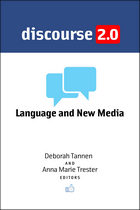
Our everyday lives are increasingly being lived through electronic media, which are changing our interactions and our communications in ways that we are only beginning to understand. In Discourse 2.0: Language and New Media, editors Deborah Tannen and Anna Marie Trester team up with top scholars in the field to shed light on the ways language is being used in, and shaped by, these new media contexts.
Topics explored include: how Web 2.0 can be conceptualized and theorized; the role of English on the worldwide web; how use of social media such as Facebook and texting shape communication with family and friends; electronic discourse and assessment in educational and other settings; multimodality and the "participatory spectacle" in Web 2.0; asynchronicity and turn-taking; ways that we engage with technology including reading on-screen and on paper; and how all of these processes interplay with meaning-making.
Students, professionals, and individuals will discover that Discourse 2.0 offers a rich source of insight into these new forms of discourse that are pervasive in our lives.

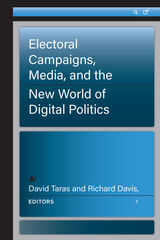
Today, political leaders and candidates for office must campaign in a multimedia world through traditional forums—newspapers, radio, and television—as well as new digital media, particularly social media. Electoral Campaigns, Media, and the New World of Digital Politics chronicles how Twitter, Facebook, Reddit, email, and memes are used successfully and unsuccessfully to influence elections. Each of these platforms have different affordances and reach various audiences in different ways. Campaigns often have to wage different campaigns on each of these mediums. In some instances, they are crucial in altering coverage in the mainstream media. In others, digital media remains underutilized and undeveloped. As has always been the case in politics, outcomes that depend on economic and social conditions often dictate people’s readiness for certain messages. However, the method and content of those messages has changed with great consequences for the health and future of democracy.
This book answers several questions: How do candidates/parties reach audiences that are preoccupied, inattentive, amorphous, and bombarded with so many other messages? How do they cope with the speed of media reporting in a continuous news cycle that demands instantaneous responses? How has media fragmentation altered the campaign styles and content of campaign communication, and general campaign discourse? Finally and most critically, what does this mean for how democracies function?
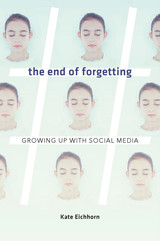
Thanks to Facebook and Instagram, our childhoods have been captured and preserved online, never to go away. But what happens when we can’t leave our most embarrassing moments behind?
Until recently, the awkward moments of growing up could be forgotten. But today we may be on the verge of losing the ability to leave our pasts behind. In The End of Forgetting, Kate Eichhorn explores what happens when images of our younger selves persist, often remaining just a click away.
For today’s teenagers, many of whom spend hours each day posting on social media platforms, efforts to move beyond moments they regret face new and seemingly insurmountable obstacles. Unlike a high school yearbook or a shoebox full of old photos, the information that accumulates on social media is here to stay. What was once fleeting is now documented and tagged, always ready to surface and interrupt our future lives. Moreover, new innovations such as automated facial recognition also mean that the reappearance of our past is increasingly out of our control.
Historically, growing up has been about moving on—achieving a safe distance from painful events that typically mark childhood and adolescence. But what happens when one remains tethered to the past? From the earliest days of the internet, critics have been concerned that it would endanger the innocence of childhood. The greater danger, Eichhorn warns, may ultimately be what happens when young adults find they are unable to distance themselves from their pasts. Rather than a childhood cut short by a premature loss of innocence, the real crisis of the digital age may be the specter of a childhood that can never be forgotten.
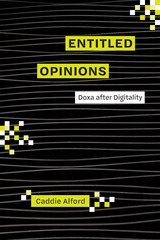
A landmark rhetorical theory of the formation and functioning of opinions in social media contexts
Entitled Opinions: Doxa After Digitality offers a rhetorical theory of opinions, especially as opinions operate within social media.
Many urgent contemporary issues—from demagoguery to white ethno-nationalism—compel us to consider opinions seriously. Yet while clichés like “he tells it like it is” and newer imperatives such as #BlackLivesMatter seem straightforward, haptics, emoji, and “like” buttons belie unexamined collective assumptions about how opinions in the digital realm function.
Caddie Alford illuminates this function by deploying the ancient Greek term for opinions: doxa. Doxa translates to “opinion,” but the term can also signal seemingness and expectations. Doxa’s capacious meanings reveal opinions to be more than static or monolithic: With doxa, opinions become emergent, dynamic, relational, and pluralistic.
Masterfully combining rhetorical frameworks as well as scholarship on opinions and digital media entanglements, Alford puts opinions into conversation with such case studies as algorithms, infrastructure, digital illiteracy, virality, and activism. She shows how “doxa” reveals gradations of opinions, from more reputable to less reputable. She demonstrates that these gradations are multifaceted and susceptible to interventions.
Entitled Opinions sheds much of the baggage associated with opinions while opening up more fertile pathways of inquiry. In a world that says, “don’t read the comments,” this book reads the comments, taking seriously content that could be easily dismissed otherwise and alchemizing judgments into implications.
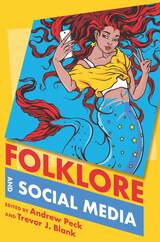
This book features twelve chapters ranging in topics from legend transmission and fake news to case studies of memes, joke cycles, and Twitter hashtag campaigns and offers fresh insights on digital heritage and web archiving. The editors and contributors take both the “digital” and “folklore” elements seriously because social media fundamentally changes folk practices in new, though often invisible, ways. Social media platforms encourage hybrid performances that appear informal and ordinary while also offering significant space to obfuscate backstage behaviors through editing and retakes. The result is that expression online becomes increasingly reminiscent of traditional forms of face-to-face interaction, while also hiding its fundamental differences.
Folklore and Social Media demonstrates various ways to refine methods and analyses in order to develop a better understanding of the informal and traditional dynamics that define an era of folklore and social media. It is an invaluable addition to the literature on digital folklore scholarship that will be of interest to students and scholars alike.
Contributors:
Sheila Bock, Peter M. Broadwell, Bill Ellis, Jeana Jorgensen, Liisi Laineste, John Laudun, Linda J. Lee, Lynne S. McNeill, Ryan M. Milner, Whitney Phillips, Vwani Roychowdhury, Timothy R. Tangherlini, Tok Thompson, Elizabeth Tucker, Kristiana Willsey

While today's presidential tweets may seem a light-year apart from the scratch of quill pens during the era of the American Revolution, the importance of political communication is eternal. This book explores the roles that political narratives, media coverage, and evolving communication technologies have played in precipitating, shaping, and concluding or prolonging wars and revolutions over the course of US history. The case studies begin with the Sons of Liberty in the era of the American Revolution, cover American wars in the nineteenth and twentieth centuries, and conclude with a look at the conflict against ISIS in the Trump era. Special chapters also examine how propagandists shaped American perceptions of two revolutions of international significance: the Russian Revolution and the Chinese Revolution. Each chapter analyzes its subject through the lens of the messengers, messages, and communications-technology-media to reveal the effects on public opinion and the trajectory and conduct of the conflict. The chapters collectively provide an overview of the history of American strategic communications on wars and revolutions that will interest scholars, students, and communications strategists.
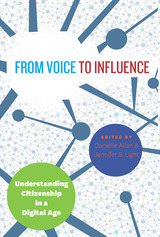
With From Voice to Influence, Danielle Allen and Jennifer S. Light have brought together a stellar group of political and social theorists, social scientists, and media analysts to explore this transformation. Threading through the contributions is the notion of egalitarian participatory democracy, and among the topics discussed are immigration rights activism, the participatory potential of hip hop culture, and the porous boundary between public and private space on social media. The opportunities presented for political efficacy through digital media to people who otherwise might not be easily heard also raise a host of questions about how to define “good participation:” Does the ease with which one can now participate in online petitions or conversations about current events seduce some away from serious civic activities into “slacktivism?”
Drawing on a diverse body of theory, from Hannah Arendt to Anthony Appiah, From Voice to Influence offers a range of distinctive visions for a political ethics to guide citizens in a digitally connected world.
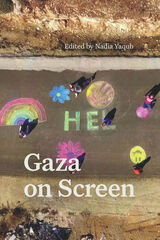
Contributors. Nayrouz Abu Hatoum, Shahd Abusalama, Samirah Alkassim, Basma Alsharif, Hadeel Assali, Azza El-Hassan, Hatim El-Hibri, Mohamed Jabaly, Ahmed Mansour, Arab Nasser, Tarzan Nasser, Kamran Rastegar, Viviane Saglier, Abdelsalam Shehada, Yaron Shemer, Rebecca L. Stein, Helga Tawil-Souri, Shaira Vadasaria, Nadia Yaqub

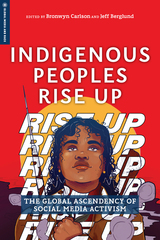
Including a range of international indigenous voices from the US, Canada, Australia, Aotearoa (New Zealand) and Africa, the book takes an interdisciplinary approach, bridging Indigenous studies, media studies, and social justice studies. Including examples like Idle No More in Canada, Australian Recognise!, and social media campaigns to maintain Maori language, Indigenous Peoples Rise Up serves as one of the first studies of Indigenous social media use and activism.

Tekobbe’s methods for analyzing and understanding Indigenous knowledges online center Indigenous storytelling and “thick” (broad, deep, and complex) Indigenous meaning-making. Employing this thickness to interpret Indigenous knowledge ways resists the settler-colonial logics that tend to flatten complex Indigenous concepts into one-note representations of racial stereotypes. Native Americans’ use of social media and digital platforms to support social movements uniquely constructs Indigenous identities as living, producing, and culture-making people, which confronts the commonplace, one-dimensional narrative that Indigenous North Americans either live in isolation or are people of history resigned to the long-forgotten past. Tekobbe’s methods are applicable to additional online research to break through Western paradigms of oppositional critique, the colonial power matrix embedded in hierarchical and taxonomical classification systems, and participant objectification.
Indigenous Voices in Digital Spaces offers new methodological and epistemological opportunities to explore digital communities and technologies, problematizing conventional Western critique. This book is useful to instructors in Indigenous studies, internet studies, digital literacies, cultural studies, and communications, as well as Indigenous and internet studies researchers.
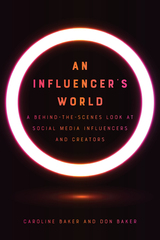
INTERVIEWEES INCLUDE:
Isabella Avila (17.7m on TikTok)
Jacques Bastien (cofounder, SHADE)
Mark Cuban (8.6m on Twitter)
Mary Fitzgerald (1.8m on Instagram)
GloZell Green (4.6m on YouTube)
Tim Karsliyev (1.7m on Instagram)
Kevin Kreider (431k on Instagram)
Max Levine (cofounder, Amp Studios)
Cindy Pham (468k on YouTube)
Michael Schweiger (CEO, Central Entertainment Group)
LaToya Shambo (CEO/founder, Black Girl Digital)
Joshua Suarez (14.4m on TikTok)
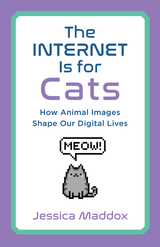
The Internet is for Cats examines how animal images are employed to create a lighter, more playful mood, uniting users within online spaces that can otherwise easily become fractious and toxic. Placing today’s pet videos, photos, and memes within a longer history of mediated animal images, communication scholar Jessica Maddox also considers the factors that make them unique. She explores the roles that animals play within online economies of cuteness and attention, as well as the ways that animal memes and videos respond to common experiences of life under neoliberalism.
Conducting a rich digital ethnography, Maddox combines observations and textual analysis with extensive interviews of the people who create, post and share animal media, including TikTok influencers seeking to make their pets famous, activists tweeting about wildlife conservation, and Redditors upvoting every cute cat photo. The Internet is for Cats will leave you with a new appreciation for the human social practices behind the animal images you encounter online.

This all-new edition gathers a range of contributors to explore real-world uses of library marketing technology, perfect for novices ready to dive in as well as practitioners on the lookout for ways to improve existing efforts. Inside, librarians share insights on how they use their favorite social media tools to promote their library and build community. Applicable to all types of institutions, this guide
- covers popular tools such as Snapchat, Tumblr, Instagram, Facebook, and Twitter;
- shares four easy-to-use tools for creating memes, tips for creating short videos, and ways to integrate blogs into social media;
- demonstrates how to use reaction GIFs and tagging to boost your Tumblr posts;
- shows how to tailor messages to communicate effectively with different generations and audiences; and
- includes screen shots, illustrations, sample social media policies to help you navigate controversies, and free online training resources.
Simultaneously transnational and local, poetry in the twenty-first century is produced across digital networks, shaped through local communities, and evaluated on a global scale. It might start on social media, where a video of a poet circulates and goes viral, gaining international attention without ever going through traditional modes of publication. In Networked Poetics, Susanna L. Sacks introduces readers to the southern African poetry scene in Malawi, Zimbabwe, and South Africa, illustrating how contemporary poetry is shaped, from inception to canonization, by the influence of digital media publication.
Interweaving ethnographic observation and extensive literary analysis, Sacks demonstrates that, as more artists in Africa reach wider audiences through online publication, poetic form has shifted to reflect social media’s aesthetic norms of urgency, immediacy, and populism. These changes have, in turn, challenged elite processes of valuation, forcing literary institutions like prizes, festivals, and curricula to accommodate the digital turn.

Opposing Democracy in the Digital Age is about why ordinary people in a democratizing state oppose democracy and how they leverage both traditional and social media to do so. Aim Sinpeng focuses on the people behind popular, large-scale antidemocratic movements that helped bring down democracy in 2006 and 2014 in Thailand. The yellow shirts (PAD—People’s Alliance for Democracy) that are the focus of the book are antidemocratic movements grown out of democratic periods in Thailand, but became the catalyst for the country’s democratic breakdown. Why, when, and how supporters of these movements mobilize offline and online to bring down democracy are some of the key questions that Sinpeng answers. While the book primarily uses a qualitative methodological approach, it also uses several quantitative tools to analyze social media data in the later chapters. This is one of few studies in the field of regime transition that focuses on antidemocratic mobilization and takes the role of social media seriously.
A scholar and activist tells the story of change makers operating within the Chinese Communist system, whose ideas of social action necessarily differ from those dominant in Western, liberal societies.
The Chinese government has increased digital censorship under Xi Jinping. Why? Because online activism works; it is perceived as a threat in halls of power. In The Other Digital China, Jing Wang, a scholar at MIT and an activist in China, shatters the view that citizens of nonliberal societies are either brainwashed or complicit, either imprisoned for speaking out or paralyzed by fear. Instead, Wang shows the impact of a less confrontational kind of activism. Whereas Westerners tend to equate action with open criticism and street revolutions, Chinese activists are building an invisible and quiet coalition to bring incremental progress to their society.
Many Chinese change makers practice nonconfrontational activism. They prefer to walk around obstacles rather than break through them, tactfully navigating between what is lawful and what is illegitimate. The Other Digital China describes this massive gray zone where NGOs, digital entrepreneurs, university students, IT companies like Tencent and Sina, and tech communities operate. They study the policy winds in Beijing, devising ways to press their case without antagonizing a regime where taboo terms fluctuate at different moments. What emerges is an ever-expanding networked activism on a grand scale. Under extreme ideological constraints, the majority of Chinese activists opt for neither revolution nor inertia. They share a mentality common in China: rules are meant to be bent, if not resisted.

How social media has become a critical tool for advancing the interests of the Canadian oil industry
Petroturfing presents an incisive look into how Canada’s pro-oil movement has leveraged social media to rebrand the extractive economy as a positive force. Adapting its title from the concept of astroturfing, which refers to the practice of disguising political and corporate media campaigns as grassroots movements, the book exposes the consequences of this mutually informed relationship between social media and environmental politics.
Since the early 2010s, an increasingly influential network of pro-oil groups, organizations, and campaigns has harnessed social media strategies originally developed by independent environmental organizations in order to undermine resistance to the fossil fuel industry. Situating these actions within the broader oil culture wars that have developed as an outgrowth of contemporary right-wing media, Petroturfing details how this coalition of groups is working to reform the public view of oil extraction as something socially, economically, and ecologically beneficial.
By uncovering these concerted efforts to influence the “energy consciousness,” Jordan B. Kinder reveals the deep divide between Canada’s environmentally progressive reputation and the economic interests of its layers of government and private companies operating within its borders. Drawing attention to the structures underlying online political expression, Petroturfing highlights the limitations of social media networks in the work of promoting environmental justice and contributing to a more equitable future.

In recent years, anthropologists, historians, and others have been drawn to study the profuse and creative usages of digital media by religious movements. At the same time, scholars of Christian Africa have long been concerned with the history of textual culture, the politics of Bible translation, and the status of the vernacular in Christianity. Students of Islam in Africa have similarly examined politics of knowledge, the transmission of learning in written form, and the influence of new media. Until now, however, these arenas—Christianity and Islam, digital media and “old” media—have been studied separately.
Religion, Media, and Marginality in Modern Africa is one of the first volumes to put new media and old media into significant conversation with one another, and also offers a rare comparison between Christianity and Islam in Africa. The contributors find many previously unacknowledged correspondences among different media and between the two faiths. In the process they challenge the technological determinism—the notion that certain types of media generate particular forms of religious expression—that haunts many studies. In evaluating how media usage and religious commitment intersect in the social, cultural, and political landscapes of modern Africa, this collection will contribute to the development of new paradigms for media and religious studies.
Contributors: Heike Behrend, Andre Chappatte, Maria Frahm-Arp, David Gordon, Liz Gunner, Bruce S. Hall, Sean Hanretta, Jorg Haustein, Katrien Pype, and Asonzeh Ukah.
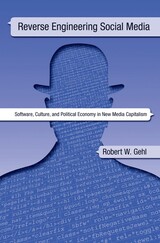
Robert Gehl's timely critique, Reverse Engineering Social Media, rigorously analyzes the ideas of social media and software engineers, using these ideas to find contradictions and fissures beneath the surfaces of glossy sites such as Facebook, Google, and Twitter.
Gehl adeptly uses a mix of software studies, science and technology studies, and political economy to reveal the histories and contexts of these social media sites. Looking backward at divisions of labor and the process of user labor, he provides case studies that illustrate how binary "Like" consumer choices hide surveillance systems that rely on users to build content for site owners who make money selling user data, and that promote a culture of anxiety and immediacy over depth.
Reverse Engineering Social Media also presents ways out of this paradox, illustrating how activists, academics, and users change social media for the better by building alternatives to the dominant social media sites.
Rhetoric, Technology, and the Virtues argues that virtue ethics supports postmodern criticisms of rational autonomy and universalism while also enabling a discussion of the actual ethical behaviors that digital users form through their particular communicative ends and various rhetorical purposes. Authors Jared Colton and Steve Holmes extend Aristotle’s hexis framework through contemporary virtue ethicists and political theorists whose writing works from a tacit virtue ethics framework. They examine these key theorists through a range of case studies of digital habits of human users, including closed captioning, trolling, sampling, remixing, gamifying for environmental causes, and using social media, alongside a consideration of the ethical habits of nonhuman actors.
Tackling a needed topic with clarity and defined organization, Rhetoric, Technology, and the Virtues carefully synthesizes various strands of ethical thinking, convincingly argues that virtue ethics is a viable framework for digital rhetoric, and provides a practical way to assess the changing hexeis encountered across the network of ethical situations in the digital world.
While these countervailing influences are all around us, the essays collected in this volume represent a humanistic ethics of generosity, compassion, and care. Social knowledge creation refreshingly returns to humanist values, emphasizing that people matter more than networks, facts matter more than opinion, and ideas matter more than influence. As a result, the speed and scale of digital culture has challenged humanists from many disciplines to more clearly define the values of education, collaboration, and new knowledge in pursuit of human justice and equality. In short, online culture has presented a new opportunity to define how and why the humanities matter in the age of social media.
Next Generation e-book nonfiction 2023 Indie Book Award Prize.
While social network analyses often demonstrate the usefulness of social media networks to affective publics and otherwise marginalized social justice groups, this book explores the domination and manipulation of social networks by more powerful political groups. Jeffrey Layne Blevins and James Lee look at the ways in which social media conversations about race turn politically charged, and in many cases, ugly. Studies show that social media is an important venue for news and political information, while focusing national attention on racially involved issues. Perhaps less understood, however, is the effective quality of this discourse, and its connection to popular politics, especially when Twitter trolls and social media mobs go on the attack.
Taking on prominent case studies from the past few years, including the Ferguson protests and the Black Lives Matter movement, the 2016 presidential election, and the rise of fake news, this volume presents data visualization sets alongside careful scholarly analysis. The resulting volume provides new insight into social media, legacy news, and social justice.
Social media have been (for quite some time now) part of the fabric of our lives. But as with many new technologies, it often takes a while for us to be able to step back, assess the tool's impact, and consider what's next. This collection offers one of the first sets of scholarly work in our field that responds to social media's influence on both popular and extra-curricular writing as well as on scholarly communication. Too frequently, social media is dismissed as non-academic, unworthy of sustained attention by researchers. The authors featured here present compelling reasons why this oft-neglected form of writing deserves—and demands—continued academic response.
Social Writing/Social Media: Publics, Presentations, and Pedagogies makes this contribution by examining the impact of social media on three writing-related themes: publics and audiences, presentation of self and groups, and pedagogy at various levels of higher education. The contributors to this collection urge readers to pay attention to an undertheorized aspect of writing online—the acts of composing that occur specifically in social-media spaces. Organized in three sections—social media and public audiences; social media and presentation; and social media and pedagogy—it builds on previous explorations of the role of multimodality in composition studies by extending ongoing conversations that have asked readers to expand notions of literacy in the twenty-first century. By addressing the wide range of composing activities that take place in social media and the rich variety of genres, audiences, stylistic choices, and pedagogical possibilities, this collection offers an important contribution to our understanding of pedagogy and practice in social media spaces.

In this probing study, Eric Freedman focuses on what images from photography, mobile communications, and the Internet reveal about looking. Exploring subjectivity by critically examining the look, he elaborates on the nature of the photographic frame and its relation to interpretive practices. Freedman scrutinizes what he calls "technobiography"—a life written through technology, and considers the movement of personal images into public spaces. He also considers authorship that situates the self as inherently engaged with and inscribed by information technology.
All of the chapters in Transient Images explore Freedman's interest in examining how media technologies activate particular notions of self and community. He provides examples that address trauma—pictures of missing children on milk cartons and episodes of the reality series Intervention—as well as the strategies behind creating and distributing personal advertisements on the Internet. Transient Images draws out the tensions that exist in images circulating in the digital era.

Tweets and the Streets analyses the culture of the new protest movements of the 21st century. From the Arab Spring to the 'indignados' protests in Spain and the Occupy movement, Paolo Gerbaudo examines the relationship between the rise of social media and the emergence of new forms of protest.
Gerbaudo argues that activists' use of Twitter and Facebook does not fit with the image of a 'cyberspace' detached from physical reality. Instead, social media is used as part of a project of re-appropriation of public space, which involves the assembling of different groups around 'occupied' places such as Cairo’s Tahrir Square or New York’s Zuccotti Park.
An exciting and invigorating journey through the new politics of dissent, Tweets and the Streets points both to the creative possibilities and to the risks of political evanescence which new media brings to the contemporary protest experience.
Exploring and conceptualizing practices, technologies, and politics of disconnecting
How do we think beyond the dominant images and imaginaries of connectivity? Undoing Networks enables a different connectivity: “digital detox” is a luxury for stressed urbanites wishing to lead a mindful life. Self-help books advocate “digital minimalism” to recover authentic experiences of the offline. Artists envision a world without the internet. Activists mobilize against the expansion of the 5G network.
If connectivity brought us virtual communities, information superhighways, and participatory culture, disconnection comes with privacy tools, Faraday shields, and figures of the shy. This book explores nonusage and the “right to disconnect” from work and from the excessive demands of digital capitalism.

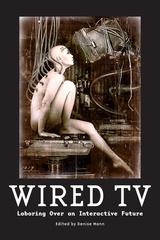
This collection looks at the post–network television industry’s heady experiments with new forms of interactive storytelling—or wired TV—that took place from 2005 to 2010 as the networks responded to the introduction of broadband into the majority of homes and the proliferation of popular, participatory Web 2.0 companies like Facebook, YouTube, and Twitter.
Contributors address a wide range of issues, from the networks’ sporadic efforts to engage fans using transmedia storytelling to the production inefficiencies that continue to dog network television to the impact of multimedia convergence and multinational, corporate conglomeration on entrepreneurial creativity. With essays from such top scholars as Henry Jenkins, John T. Caldwell, and Jonathan Gray and from new and exciting voices emerging in this field, Wired TV elucidates the myriad new digital threats and the equal number of digital opportunities that have become part and parcel of today’s post-network era. Readers will quickly recognize the familiar television franchises on which the contributors focus— including Lost, The Office, Entourage, Battlestar Gallactica, The L Word, and Heroes—in order to reveal their impact on an industry in transition.
While it is not easy for vast bureaucracies to change course, executives from key network divisions engaged in an unprecedented period of innovation and collaboration with four important groups: members of the Hollywood creative community who wanted to expand television’s storytelling worlds and marketing capabilities by incorporating social media; members of the Silicon Valley tech community who were keen to rethink television distribution for the digital era; members of the Madison Avenue advertising community who were eager to rethink ad-supported content; and fans who were enthusiastic and willing to use social media story extensions to proselytize on behalf of a favorite network series.
In the aftermath of the lengthy Writers Guild of America strike of 2007/2008, the networks clamped down on such collaborations and began to reclaim control over their operations, locking themselves back into an aging system of interconnected bureaucracies, entrenched hierarchies, and traditional partners from the past. What’s next for the future of the television industry? Stay tuned—or at least online.
Contributors: Vincent Brook, Will Brooker, John T. Caldwell, M. J. Clarke, Jonathan Gray, Henry Jenkins, Derek Johnson, Robert V. Kozinets, Denise Mann, Katynka Z. Martínez, and Julie Levin Russo

You’re Doing it Wrong! investigates the storied history of mothering advice in the media, from the newspapers, magazines, doctors’ records and personal papers of the nineteenth-century to today’s websites, Facebook groups, and Instagram feeds. Johnson and Quinlan find surprising parallels between today’s mothering experts and their Victorian counterparts, but they also explore how social media has placed unprecedented pressures on new mothers, even while it may function as social support for some. They further examine the contentious construction of prenatal and baby care expertise itself, as individuals such as everyone from medical professionals to experienced moms have competed to have their expertise acknowledged in the public sphere.
Exploring potential health crises from infertility treatments to “better babies” milestones, You’re Doing it Wrong! provides a provocative look at historical and contemporary medical expertise during conception, pregnancy, childbirth, postpartum, and infant care stages.
In an information age of youth social movements, Youth Media Matters examines how young people are using new media technologies to tell stories about themselves and their social worlds. They do so through joint efforts in a range of educational settings and media environments, including high school classrooms, youth media organizations, and social media sites. Korina M. Jocson draws on various theories to show how educators can harness the power of youth media to provide new opportunities for meaningful learning and “do-it-together production.” Describing the impact that youth media can have on the broader culture, Jocson demonstrates how it supports expansive literacy practices and promotes civic engagement, particularly among historically marginalized youth.
In Youth Media Matters, Jocson offers a connective analysis of content area classrooms, career and technical education, literary and media arts organizations, community television stations, and colleges and universities. She provides examples of youth media work—including videos, television broadcasts, websites, and blogs—produced in the San Francisco Bay Area, Los Angeles, New York, and St. Louis. At a time when educators are increasingly attentive to participatory cultures yet constrained by top-down pedagogical requirements, Jocson highlights the knowledge production and transformative potential of youth media with import both in and out of the classroom.
READERS
Browse our collection.
PUBLISHERS
See BiblioVault's publisher services.
STUDENT SERVICES
Files for college accessibility offices.
RECENTLY PUBLISHED





UChicago Accessibility Resources
home | accessibility | search | about | contact us
BiblioVault ® 2001 - 2024
The University of Chicago Press