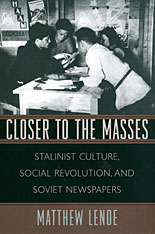
front cover of Closer to the Masses
Closer to the Masses
Stalinist Culture, Social Revolution, and Soviet Newspapers
Matthew Lenoe
Harvard University Press, 2004

In this provocative book, Matthew Lenoe traces the origins of Stalinist mass culture to newspaper journalism in the late 1920s. In examining the transformation of Soviet newspapers during the New Economic Policy and the First Five Year Plan, Lenoe tells a dramatic story of purges, political intrigues, and social upheaval.

Under pressure from the party leadership to mobilize society for the monumental task of industrialization, journalists shaped a master narrative for Soviet history and helped create a Bolshevik identity for millions of new communists. Everyday labor became an epic battle to modernize the USSR, a fight not only against imperialists from outside, but against shirkers and saboteurs within. Soviet newspapermen mobilized party activists by providing them with an identity as warrior heroes battling for socialism. Yet within the framework of propaganda directives, the rank-and-file journalists improvised in ways that ultimately contributed to the creation of a culture. The images and metaphors crafted by Soviet journalists became the core of Stalinist culture in the mid-1930s, and influenced the development of socialist realism.

Deeply researched and lucidly written, this book is a major contribution to the literature on Soviet culture and society.

[more]

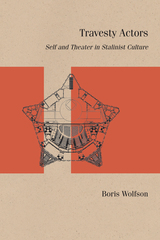
front cover of Travesty Actors
Travesty Actors
Self and Theater in Stalinist Culture
Boris Wolfson, edited by Simon Morrison
Northwestern University Press, 2026
Examining theatrical performance under Stalinist cultural mandates
 
Talk of Joseph Stalin’s “show trials,” the public prosecutions in Moscow’s Hall of Columns in the late 1930s, is so familiar as to obscure the relationship between actual shows—in the Soviet Union’s major theaters—and politics. Travesty Actors: Self and Theater in Stalinist Culture examines theatrical performance within the context of the Soviet cultural establishment’s fashioning of a “genuine Soviet person.” Boris Wolfson focuses on prominent and controversial plays by artists including Aleksandr Afinogenov, Mikhail Bulgakov, Yuri Olesha, and Natalia Sats and the efforts of theater companies, like the Moscow Arts Theater, the Meyerhold Theater, and the Central Children’s Theater, to adhere to this cultural mandate while grappling with repression, censorship, and conflicting interpretations of its aims. Drawing on archival materials, diaries and memoirs and eyewitness accounts, Wolfson greatly illuminates the achievements of Soviet theater during this harsh period and the cultural significance of artistic theories and practices for articulating and enacting ideological programs.

[more]


Send via email Share on Facebook Share on Twitter