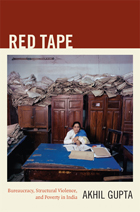
Red Tape presents a major new theory of the state developed by the renowned anthropologist Akhil Gupta. Seeking to understand the chronic and widespread poverty in India, the world's fourth largest economy, Gupta conceives of the relation between the state in India and the poor as one of structural violence. Every year this violence kills between two and three million people, especially women and girls, and lower-caste and indigenous peoples. Yet India's poor are not disenfranchised; they actively participate in the democratic project. Nor is the state indifferent to the plight of the poor; it sponsors many poverty amelioration programs.
Gupta conducted ethnographic research among officials charged with coordinating development programs in rural Uttar Pradesh. Drawing on that research, he offers insightful analyses of corruption; the significance of writing and written records; and governmentality, or the expansion of bureaucracies. Those analyses underlie his argument that care is arbitrary in its consequences, and that arbitrariness is systematically produced by the very mechanisms that are meant to ameliorate social suffering. What must be explained is not only why government programs aimed at providing nutrition, employment, housing, healthcare, and education to poor people do not succeed in their objectives, but also why, when they do succeed, they do so unevenly and erratically.