front cover of Ami and Amile
Ami and Amile
A Medieval Tale of Friendship, Translated from the Old French
Samuel N. Rosenberg and Samuel Danon
University of Michigan Press, 1996
This prose translation of the medieval French verse narrative Ami and Amile recounts the legendary friendship of two valiant knights who are as indistinguishable as twin brothers. Ami and Amile serve Charlemagne together, face together the hatred of an archetypal villain, confront the daunting challenges of women and love, and accept extraordinary sacrifices for each other's sake. Miracles mark the end of their lives, and their shared tomb becomes a pilgrims' shrine.
The compelling translation by Samuel N. Rosenberg and Samuel Danon is accompanied by an introduction on the background, genre, and general sense of the tale. The volume also includes an afterword by David Konstan, which examines the medieval work's concept of friendship within a perspective extending back to classical antiquity.
This translation will reveal Ami and Amile as a major work of the French Middle Ages. In elegant and forceful prose, it weaves together the themes of friendship and love and the status of women, of sin and punishment, the moral problem of doing wrong for the right reason, and the mythic affliction of leprosy. The work will foster lively literary and philosophical discussion.
Ami and Amile is of interest to a wide range of readers, including students of history, comparative literature, and gender studies. Medievalists will find it a welcome addition to their libraries and a captivating experience for their students.
The volume is published in the series Stylus: Studies in Medieval Culture, edited by Eugene Vance, University of Washington. Samuel N. Rosenberg is Professor of French and Italian at Indiana University; Samuel Danon is Professor of French at Reed College.
[more]

front cover of Blessingway
Blessingway
With Three Versions of the Myth Recorded and Translated from the Navajo by Father Berard Haile, O.F.M.
Leland C. Wyman
University of Arizona Press, 1970
An outstanding work crafted from the handwritten pages of translations from the Navajo of the late Father Berard Haile giving three separate versions of the Blessingway rite with each version consisting of a prose text accompanied by the ritual songs and prayers. Valuable insights into the character and use of the Blessingway rite; its ceremonial procedures, its mythology, and its drypaintings.
[more]

front cover of Horace's Odes and Epodes
Horace's Odes and Epodes
Translated with an Introduction and Commentary
David Mulroy
University of Michigan Press, 1994
In his new book David Mulroy presents a translation of the Odes and Epodes of Horace, who was one of the Augustan regime’s best known and most talented poets. Intended for those with little knowledge of these works as well as for those with a more experienced ear, David Mulroy’s translations are accompanied by explanatory notes on the individual poems. Appendices are also provided that offer information on Suetonius’ biography of Horace, on ambiguity in Horace’s personal allusions, and on the theme of sadism in Horace’s writings.Teachers of Latin writers in translation will want to use this book to make Horace accessible to their students; scholars of Latin literature will find much of value in the notes and appendices as well as in the linguistically satisfying translations.
[more]

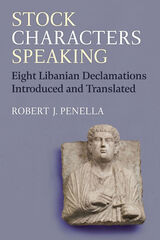
front cover of Stock Characters Speaking
Stock Characters Speaking
Eight Libanian Declamations Introduced and Translated
Robert J. Penella
University of Michigan Press, 2023

Declamations were composed and orally delivered in the Roman Empire by sophists, or teachers of rhetoric, of whom the Greek-speaking Libanius was one of the most distinguished. Stock Characters Speaking may be thought of as emerging from three developments of recent decades: an explosive interest in late antiquity, a newly sympathetic interest in rhetoric (including ancient declamation), and a desire to bring Libanius’s massive corpus into English and other modern languages.

In this book, author Robert J. Penella translates eight of Libanius’s declamations: 29, 30, 34, 35, 37, 45, 46, 47, and, in an appendix, the thirteenth-century Gregory of Cyprus’s response to Declamation 34. Each translation is accompanied by an introduction, in which Penella examines the themes, structure, and the stasis, or key issue, of the declamations. Figures who appear in the translated declamations include a parasite who has lost his patron, a man envious of his rich neighbor, a miser’s son, a poor man willing to die for his city, a rich war-hero accused of aiming at tyranny, and a convict asking for exile. Three of these declamations have appeared in German; otherwise, these translations are the first into a modern language.

[more]


Send via email Share on Facebook Share on Twitter